Georgetown, Guyana Solar Streetlight (Split-Type) Market Analysis: 331-Unit Desert-Climate Configuration Guide
Summary
Georgetown’s coastal road network, 12 m carriageway segments, and high solar resource support a typical 331-unit Solar Streetlight (Split-Type) layout using 7 m poles, 100 W LED heads, 21 m spacing, and 3–5 days of battery backup under IEC 60598 and CJJ 45-2015 design rules.
Key Takeaways
- A typical Georgetown deployment of this scale would use approximately 331 split-type units on 7 m hot-dip galvanized steel poles with 45 m/s wind resistance and 25-year structural life.
- For a 12 m road width and 21 m pole spacing, the specified optical package of 100 W / 15,000 lm can suit collector roads, port access roads, and municipal corridors.
- The proposed top-mounted solar assembly uses 1240 W Mono PERC panels at 21% efficiency, with 0.4%/yr degradation and a 25-year panel warranty.
- Energy storage is configured as 12 V / 250 Ah LiFePO4, delivering 3500 cycles, 90% DoD, 160 Wh/kg, and 3–5 days cloudy-weather autonomy.
- Smart controls combine motion sensing, timer control, and 4G/LoRa remote monitoring, which can reduce wasted burn hours and support fault isolation at the pole level.
- Georgetown’s latitude near 6.8°N and the project climate assumption of 6.5 peak sun hours support dusk-to-dawn operation without grid trenching on suitable corridors.
- Compliance should be checked against CJJ 45-2015, IEC 60598, and IEC 62124, with wiring routed inside the pole and the battery box externally mounted on the pole body.
- SOLAR TODO should position this product in Georgetown as a split-type municipal streetlighting option, not an all-in-one fixture, because the external battery box and larger panel area suit higher-energy lighting duty cycles.
Market Context for Georgetown
Georgetown’s road-lighting demand is shaped by a compact urban coastline, flood-prone terrain, and a growing transport role linked to Guyana’s broader economic expansion, making off-grid lighting attractive where trenching and utility coordination are slow or costly. According to the World Bank (2024), Guyana has been among the world’s fastest-growing economies in recent years, while the Bureau of Statistics Guyana (latest available census publications) places Greater Georgetown as the country’s main urban concentration and administrative center.
According to NASA POWER (2024), the Georgetown area typically receives strong year-round solar resource, and the project climate assumption of 6.5 sun hours is technically favorable for stand-alone lighting with 3–5 days of battery autonomy. This matters because solar streetlighting economics depend less on annual irradiation alone and more on maintaining recharge margin after 2–3 consecutive cloudy days in coastal weather.
Georgetown also faces coastal corrosion and wind exposure. According to the Guyana Civil Aviation and coastal planning data commonly used for engineering baselines, the city sits near sea level on the Atlantic coast, so specifying hot-dip galvanized steel, internal cabling, and an external serviceable battery box is more practical than decorative low-mass poles in salt-laden air. For procurement teams, the 45 m/s wind-resistance requirement is a critical threshold for pole and bracket selection.
Road geometry is another deciding factor. A 12 m road width with 21 m spacing points to a higher-output fixture than the standard 30 W / 60 W panel / 12 V 60 Ah / 6 m walkway class. Based on the supplied corridor geometry, Georgetown’s profile aligns better with a collector-road lighting scheme using a side-arm luminaire and a larger battery reserve, especially where municipal operators want fewer dark spots during rain events.
According to IEA (2023), public lighting remains one of the clearest municipal efficiency opportunities because LED conversion can reduce electricity consumption by 50% to 70% versus legacy systems. In Georgetown, the value proposition is broader: a split-type solar system can also avoid cable theft risk, reduce trenching in waterlogged soil, and simplify phased expansion on roads that are not yet fully served by conventional lighting infrastructure.
As IRENA states, "decentralised renewable energy systems can provide cost-effective energy services where grid extension is expensive or slow" (IRENA, 2022). That statement fits Georgetown’s edge districts, port-adjacent roads, and flood-sensitive corridors where civil works often drive total project cost more than the luminaire itself.
Recommended Technical Configuration
For Georgetown’s 12 m road width, 21 m spacing, and 6.5 peak sun hours, a typical 331-unit deployment would use a high-output split-type configuration with 7 m poles, 100 W LED heads, 1240 W top-mounted solar panels, and 12 V / 250 Ah LiFePO4 battery storage. This is a project-specific recommendation for the supplied corridor profile, not a claim of past installation.
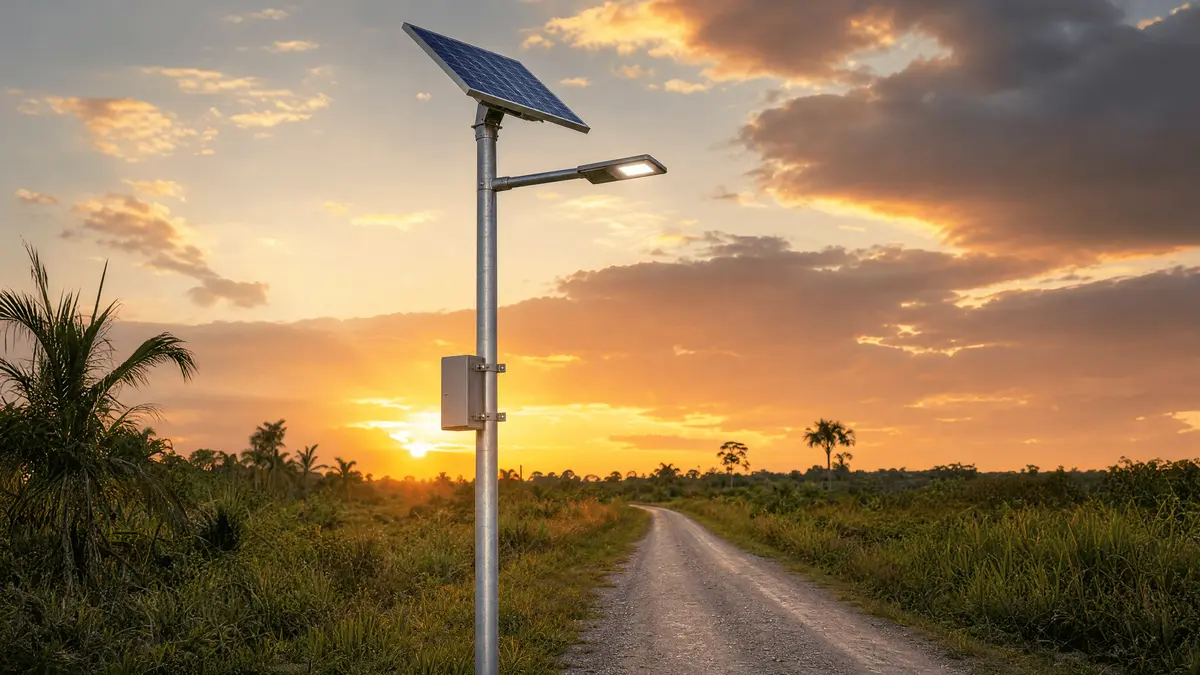
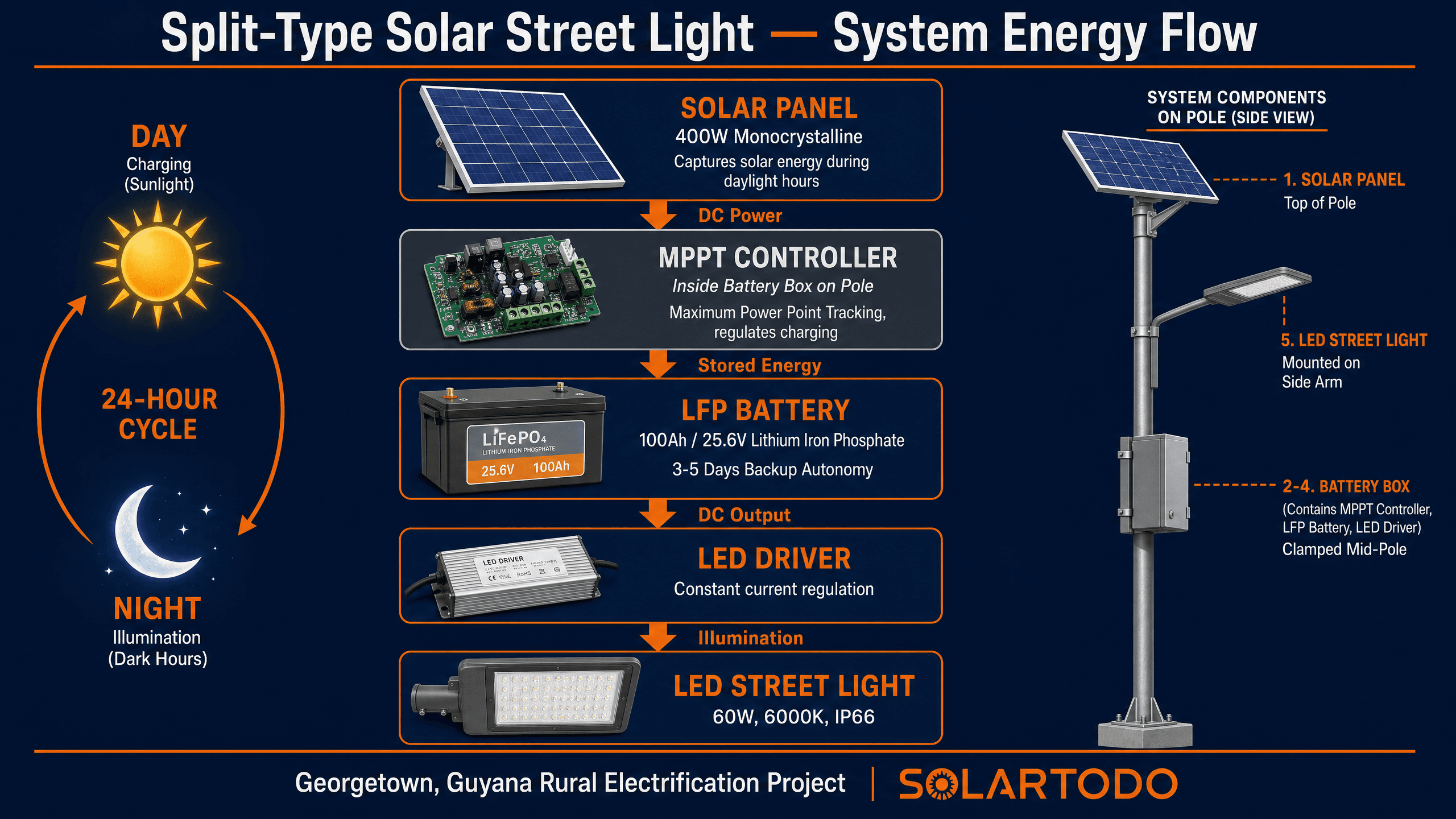
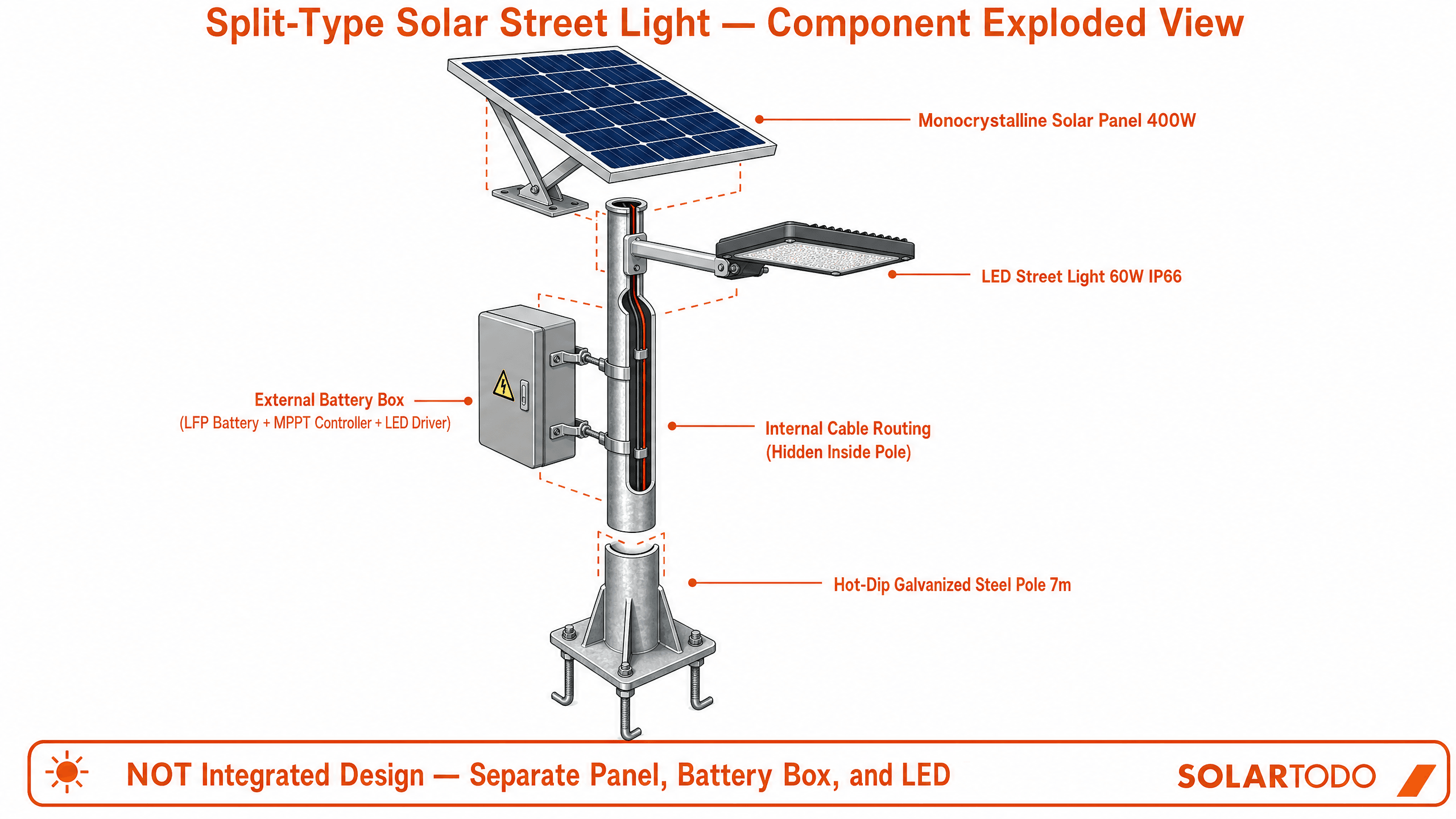
The correct base product family is SOLAR TODO’s Solar Streetlight (Split-Type), not an integrated all-in-one unit. The defining arrangement is fixed: the solar panel sits on a tilted bracket at the very top of the pole, the pole does not pass through the panel center, the LED head is mounted on a side arm below the panel, and the battery box is externally mounted on the pole body. All wiring remains inside the pole, which reduces UV exposure and tampering risk.
For Georgetown, the specified 100 W / 15,000 lm luminaire is suitable where the municipality needs stronger illumination than a community-path system but still wants an off-grid architecture. The generic size-class table in the product family places 50–60 W on 7–8 m poles for community roads and 80 W on 8–10 m poles for secondary roads. However, the user-supplied project configuration is more demanding and should be treated as a corridor-specific engineered package for higher lighting levels on a 12 m road section.
A typical 331-unit deployment in this profile would consist of:
- 331 units of SOLAR TODO Solar Streetlight (Split-Type)
- 7 m hot-dip galvanized steel poles
- 100 W LED luminaires delivering 15,000 lm at 150 lm/W
- 1240 W Mono PERC solar modules at 21% efficiency
- 12 V / 250 Ah LiFePO4 battery boxes mounted externally on the pole body
- MPPT controllers located inside the battery box
- 21 m pole spacing across a 12 m road width
- Motion sensor + timer + 4G/LoRa monitoring for adaptive operation
This configuration is best suited to arterial connectors, port logistics roads, industrial access roads, municipal boulevards, and public corridors where trenchless deployment is preferred. SOLAR TODO should present it as a technically heavier split-type option for buyers who prioritize runtime margin, maintainability, and visible service access to the battery enclosure.
According to NREL (2021), battery-backed stand-alone lighting systems perform best when PV generation, storage autonomy, and nightly load are sized together rather than optimized as separate components. That is why Georgetown buyers should evaluate the lighting duty cycle, rainy-season recharge margin, and maintenance access as one package instead of focusing only on LED wattage.
Technical Specifications
For the supplied Georgetown corridor profile, the recommended specification is a 331-unit, 7 m split-type system with 100 W LED, 1240 W Mono PERC PV, 12 V / 250 Ah LiFePO4, and 21 m spacing under CJJ 45-2015, IEC 60598, and IEC 62124.
- Product type: SOLAR TODO Solar Streetlight (Split-Type), not integrated/all-in-one
- Typical quantity: approximately 331 units for the stated corridor scale
- Pole height: 7 m
- Pole material: hot-dip galvanized steel
- Wind resistance: 45 m/s
- Design life: 25 years
- Solar panel position: mounted at the very top of the pole on a tilted bracket
- Panel penetration rule: pole does not penetrate through panel center
- Solar module rating: 1240 W
- PV technology: Mono PERC
- Module efficiency: 21%
- PV degradation: 0.4% per year
- PV warranty: 25 years
- LED power: 100 W
- Luminous flux: 15,000 lm
- Luminous efficacy: 150 lm/W
- CRI: >70
- LED mounting: side arm below the solar panel
- Battery chemistry: LiFePO4 (LFP)
- Battery specification: 12 V / 250 Ah
- Energy density: 160 Wh/kg
- Cycle life: 3500 cycles
- Depth of discharge: 90% DoD
- Battery warranty: 8 years
- Battery box location: externally mounted on pole body, visible grey box, not inside base
- Controller type: MPPT, installed inside battery box
- Wiring: all wiring inside pole, no visible external cables
- Backup autonomy: 3–5 days in cloudy conditions
- Operating mode: dusk-to-dawn automatic
- Smart features: motion sensor, remote monitoring (4G/LoRa), timer control
- Road geometry basis: 12 m road width, 21 m spacing
- Applicable standards: CJJ 45-2015, IEC 60598, IEC 62124
Implementation Approach
A Georgetown rollout of 331 units would normally be phased across survey, foundation works, pole erection, wiring checks, and commissioning, with each phase tied to 21 m spacing, 7 m pole geometry, and coastal corrosion controls. This is the practical sequence municipal buyers can use for budgeting and tender packaging.
1. Site survey and lighting layout
The first step is corridor mapping by road width, setback, and shadow risk. On a 12 m road, pole positions should be checked against drainage channels, underground utilities, and flood-prone shoulders. At 6.8°N, solar tilt and panel orientation should be optimized for annual energy yield while avoiding shading from trees, utility poles, and low-rise commercial buildings.
2. Foundation and anchor preparation
Foundation dimensions depend on soil bearing capacity, flood exposure, and the pole’s 45 m/s wind design. Georgetown’s coastal alluvial soils can require conservative footing design, especially where water tables are shallow. Buyers should request geotechnical confirmation before finalizing anchor cage details for a 7 m galvanized pole carrying both a 1240 W panel assembly and a side-arm luminaire.
3. Pole, battery box, and luminaire installation
The pole is erected first, followed by the externally mounted 12 V / 250 Ah battery box, internal cable routing, side-arm luminaire, and the top-mounted panel bracket. The visible battery box is a feature, not a defect: it shortens maintenance time, avoids base flooding issues, and keeps the MPPT controller accessible without excavating around the pole foundation.
4. Controls, commissioning, and remote monitoring
After assembly, each unit should be tested for dusk-to-dawn switching, motion-sensor response, timer logic, battery charging, and remote communications over 4G or LoRa. According to IEC 62124 guidance on PV system performance verification, commissioning should include functional checks under realistic operating conditions, not just open-circuit electrical tests.
5. Operations and maintenance planning
A municipal O&M plan should include quarterly visual inspection, semiannual fastener torque checks, and annual battery-health review. Because all wiring is internal, maintenance crews can focus on the luminaire optics, bracket alignment, and battery enclosure seals rather than exposed cable replacement. SOLAR TODO can support this phase with configuration guidance and quotation support via the product page or contact us.
Expected Performance & ROI
For Georgetown’s 6.5 sun hours, 100 W LED load, and 12 V / 250 Ah LFP storage, a split-type system of this scale would typically target dusk-to-dawn operation with 3–5 days of autonomy and lower lifecycle civil cost than trench-dependent grid lighting on difficult corridors. The strongest ROI case appears where cable trenching, feeder extension, or theft risk is high.
According to IEA (2023), LED public lighting can cut electricity use by 50% to 70% relative to older sodium or mercury systems. In an off-grid split-type streetlight, that efficiency gain is compounded by avoided utility connection charges, avoided trenching over long linear corridors, and reduced dependence on unstable feeder availability. For Georgetown, those avoided civil and utility costs may be as important as direct energy savings.
Battery life is a major lifecycle variable. The specified LiFePO4 pack offers 3500 cycles at 90% DoD, which is materially stronger than lower-cost lithium chemistries used in some entry-level streetlights. According to NREL (2021), lithium iron phosphate chemistry is often preferred in stationary and outdoor duty cycles because of thermal stability and long cycle life, especially where daily cycling is expected.
A realistic payback assessment should compare this split-type system against a grid-tied lighting alternative that includes poles, trenching, conduits, cable, utility interconnection, and meter or feeder upgrades. In many municipal road projects, the solar option pays back faster on greenfield or peripheral corridors than in dense central streets where grid power already exists at short distance. Buyers should therefore model ROI by corridor type rather than trying to force one citywide average.
The remote monitoring layer also has operational value. According to the U.S. Department of Energy (2022), connected outdoor lighting systems can improve maintenance response by identifying outages and abnormal performance without waiting for manual night patrols. In a 331-unit estate, that can reduce fault-detection time from days to hours if the communication network is configured correctly.
Results and Impact
For Georgetown, a 331-unit split-type layout would primarily address dark-road coverage, trenching avoidance, and maintenance visibility, with the largest benefits appearing on 12 m corridors where utility extension is costly or flood-prone. The practical impact is better nighttime uniformity, lower dependence on grid availability, and a service model centered on replaceable field components.
From a municipal planning perspective, the system also supports phased rollout. A city can start with 50 to 100 units on priority corridors, then expand toward a 331-unit program as performance data is collected. That staged approach reduces procurement risk and helps verify whether motion sensing, timer dimming logic, and 4G/LoRa monitoring are delivering the expected operations benefit.
As the IEC states, "luminaires for road and street lighting shall comply with relevant safety requirements" (IEC 60598). In procurement terms, that means Georgetown buyers should evaluate not only lumen output and battery size, but also enclosure quality, cable routing, bracket stability, and maintenance access over the full 25-year pole life.
Comparison Table
The table below compares the specified Georgetown configuration with standard split-type size classes used in municipal lighting selection.
| Application class | LED power | Solar panel | Battery | Pole height | Typical use | Fit for Georgetown 12 m road |
|---|---|---|---|---|---|---|
| Walkway / garden path | 30 W | 60 W | 12 V / 60 Ah | 6 m | Parks, paths | Too small for 12 m carriageway |
| Community road / parking | 50–60 W | 100 W | 12 V / 100 Ah | 7–8 m | Local roads, parking | Possible for low-traffic roads, but lower lux margin |
| Secondary road / plaza | 80 W | 150 W | 24 V / 100 Ah | 8–10 m | Secondary roads | Strong fit where taller poles are acceptable |
| Georgetown specified corridor package | 100 W | 1240 W | 12 V / 250 Ah | 7 m | Collector road / municipal corridor | Best match to supplied 21 m spacing and 12 m width |
| Main road / highway class | 120 W | 200 W | 24 V / 150–200 Ah | 10–12 m | Main road, highway | Higher pole and civil cost; use only where standards require |
Pricing & Quotation
SOLAR TODO offers three pricing tiers for this product line: FOB Supply (equipment ex-works China), CIF Delivered (including ocean freight and insurance), and EPC Turnkey (fully installed, commissioned, with 1-year warranty). Volume discounts are available for large-scale deployments. Configure your system online for an instant estimate, or request a custom quotation from our engineering team at [email protected].
Frequently Asked Questions
A Georgetown buyer evaluating 331 split-type units, 7 m poles, and 100 W LED heads should focus on corridor geometry, battery autonomy, maintenance access, and standards compliance before comparing quotations. The answers below address the most common technical and procurement questions.
Q1: Why use a split-type solar streetlight instead of an all-in-one unit in Georgetown?
A split-type design separates the 100 W LED head, 1240 W panel, and 12 V / 250 Ah battery box, which is better for higher nightly energy demand and easier service access. In Georgetown’s coastal environment, the externally mounted battery box also simplifies inspection and replacement without opening the pole base or removing the top assembly.
Q2: Is a 7 m pole high enough for a 12 m road width and 21 m spacing?
Yes, it can be suitable when paired with a 15,000 lm luminaire and proper optics. The supplied configuration is corridor-specific and should still be checked against local illumination targets, pole setback, and mounting angle. If a buyer needs higher uniformity or wider throw, an 8–10 m alternative may be evaluated during lighting simulation.
Q3: How long would a 331-unit project typically take to deliver and install?
A project of 331 units would usually be planned in phases: engineering review, manufacturing, shipping, civil works, erection, and commissioning. Actual duration depends on foundation curing time, customs clearance, and site readiness. For municipal tenders, buyers should allow separate buffers for corrosion-protection inspection and remote-monitoring setup.
Q4: What kind of battery life can be expected from the specified LiFePO4 system?
The specified LiFePO4 12 V / 250 Ah battery is rated at 3500 cycles with 90% depth of discharge and an 8-year warranty. In daily dusk-to-dawn service, usable life depends on temperature, charging consistency, and how often the system reaches deep discharge during extended cloudy periods.
Q5: What maintenance does this configuration require?
Maintenance is usually light but not zero. A municipal operator should schedule quarterly visual checks, semiannual fastener and bracket inspection, annual battery-health review, and cleaning of the solar surface when dust or salt deposits reduce output. Internal wiring reduces exposed-cable failures, but the external battery box still needs seal and clamp inspection.
Q6: How does remote monitoring improve operations on a city-scale rollout?
With 4G/LoRa monitoring, operators can track charging status, battery condition, controller alarms, and lighting faults without waiting for manual night patrols. On a 331-unit network, this shortens fault detection and helps prioritize maintenance crews. It also supports evidence-based expansion decisions if the city adds more corridors later.
Q7: What is the expected ROI or payback period?
There is no single payback number for Georgetown because ROI depends on corridor type. Solar streetlights usually perform best where trenching, utility extension, feeder upgrades, or cable theft risk are expensive. Buyers should compare total installed cost against a grid-lighting baseline that includes civil works, utility connection, and long-term electricity charges.
Q8: Are there EPC and supply-only quotation options?
Yes. SOLAR TODO can quote FOB Supply, CIF Delivered, or EPC Turnkey depending on whether the buyer wants equipment only, delivered goods, or a full installed package. For public procurement, it is useful to request a line-by-line bill of materials covering poles, PV modules, batteries, controllers, brackets, and communication options.
Q9: Which standards matter most for this product in Georgetown?
The key references in this configuration are CJJ 45-2015, IEC 60598, and IEC 62124. Buyers should also verify local civil and electrical requirements for foundations, corrosion protection, and road-lighting performance. Standards review should include not only luminaire safety, but also structural wind loading and commissioning procedures.
Q10: Why is the battery box mounted externally instead of inside the pole base?
An external battery box improves service access and avoids some moisture risks associated with low-mounted enclosed compartments in flood-prone areas. It also leaves the pole base less congested and makes controller replacement easier. For Georgetown’s coastal conditions, visibility and maintainability can be more practical than concealed storage.
References
- World Bank (2024): Guyana country economic updates indicating rapid GDP growth and infrastructure expansion pressure.
- Bureau of Statistics Guyana (latest available): Population and urban concentration data for Georgetown and surrounding regions.
- NASA POWER (2024): Solar resource datasets for Georgetown area supporting strong year-round irradiation near 6.8°N, -58.16°W.
- IEA (2023): Energy efficiency guidance showing LED public lighting can reduce electricity use by 50%–70% versus legacy technologies.
- IRENA (2022): Distributed renewable energy guidance; IRENA states, "decentralised renewable energy systems can provide cost-effective energy services where grid extension is expensive or slow."
- IEC (2020): IEC 60598 requirements for luminaire safety and road-lighting product compliance.
- IEC (2017): IEC 62124 guidance for PV system performance monitoring and verification relevant to commissioning stand-alone solar lighting systems.
- NREL (2021): Battery and stand-alone PV system design guidance supporting integrated sizing of load, storage, and PV generation.
- U.S. Department of Energy (2022): Connected outdoor lighting guidance on maintenance response and control-system benefits.
- Ministry of Public Works, Guyana (latest available plans/reports): Road and urban infrastructure development context relevant to Georgetown corridor lighting upgrades.
Equipment Deployed
- 331 × Solar Streetlight (Split-Type), not integrated/all-in-one
- 7 m hot-dip galvanized steel pole, 45 m/s wind resistance, 25-year life
- 1240 W top-mounted Mono PERC solar panel, 21% efficiency, 0.4%/yr degradation, 25-year warranty
- 100 W LED luminaire, 15,000 lm, 150 lm/W, CRI >70
- Side arm mounting below solar panel
- 12 V / 250 Ah LiFePO4 battery box, 160 Wh/kg, 3500 cycles, 90% DoD, 8-year warranty
- MPPT controller installed inside battery box
- External battery box mounted on pole body, visible grey enclosure
- All internal pole wiring, no visible external cables
- Motion sensor control
- 4G/LoRa remote monitoring module
- Timer control system
- Dusk-to-dawn automatic operation
- 3–5 days cloudy-weather backup