Financiamiento BNDES/CAF para Proyectos de smart pole en…

Cinn Song
Founder & Chief Solutions Architect
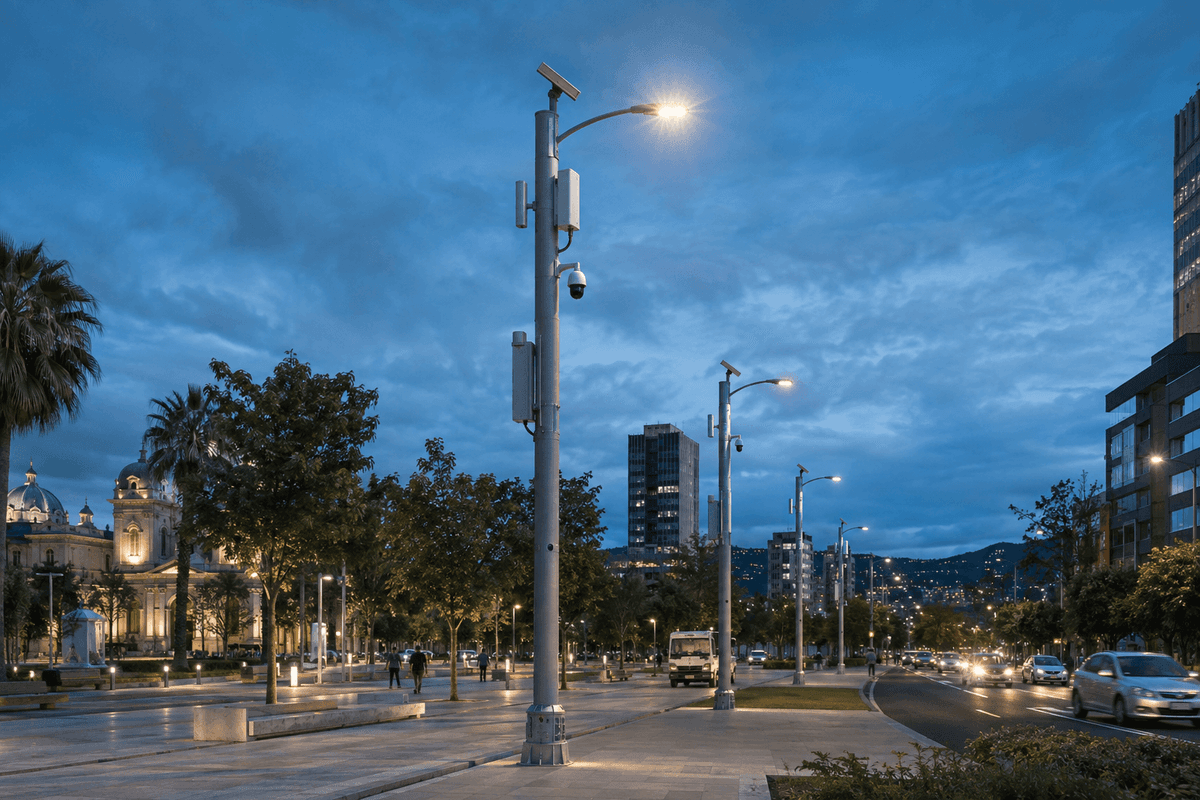
Watch the video
TL;DR
BNDES and CAF financing works best for smart pole projects that are structured as climate-resilient urban infrastructure, not simple equipment purchases. In Brazil, BNDES Fundo Clima scale starts at R$20 million; across Latin America, CAF favors sustainable infrastructure programs. SOLARTODO can support 6 m-10 m poles, 35 m/s wind design, EPC pricing, and 50-70% LED energy-savings models.
BNDES and CAF financing can support Latin American smart pole projects above R$20 million or multi-city CAF programs, combining 6 m-10 m poles, 35 m/s wind design, 50-70% LED energy savings, and EPC delivery.
Summary
BNDES and CAF financing can support Latin American smart pole projects above R$20 million or multi-city CAF programs, combining 6 m-10 m poles, 35 m/s wind design, 50-70% LED energy savings, and EPC delivery.
Key Takeaways
Smart pole financing decisions should link 6 m-10 m technical scope, R$20 million minimum BNDES sizing, and 5-7 year revenue payback assumptions.
- Structure municipal smart pole programs above R$20 million in Brazil to meet BNDES Fundo Clima scale and documentation thresholds.
- Package CAF regional projects with at least 2 climate outcomes, such as LED energy savings and digital infrastructure resilience.
- Specify 6 m poles for 1 antenna and 35 m/s wind speed, or 10 m poles for richer 5G, CCTV, WiFi 6, and sensor payloads.
- Model EPC turnkey budgets at $350-$600 per installed 6 m pole, excluding fiber backhaul and operator radio equipment.
- Apply volume purchasing targets of 50+ poles for 5%, 100+ for 10%, and 250+ for 15% indicative supply discounts.
- Require IEC 60598-1:2024 luminaire safety, IEEE 81-2025 grounding tests, ISO 1461 galvanizing, and TIA-222-H structural checks.
- Compare annual LED energy savings of 50-70% with lease revenue from 4G/5G, CCTV, WiFi, and environmental sensor services.
- Prepare 30% T/T plus 70% against B/L, or 100% L/C at sight, while seeking financing for projects above $1,000K.
Financing Fit for Smart Pole Projects in Latin America
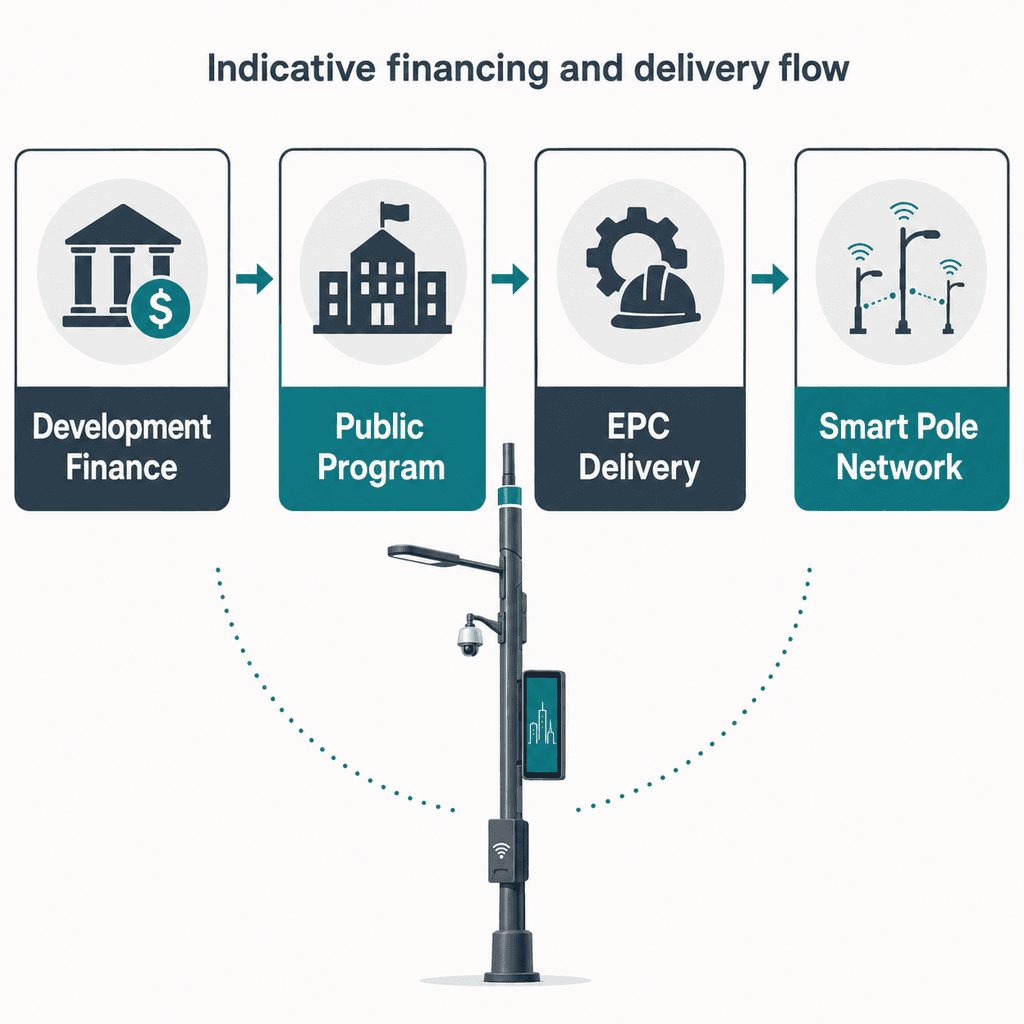
BNDES and CAF financing is most viable when smart pole projects combine 50+ poles, measurable energy savings, digital connectivity, and climate-resilient urban infrastructure.
For Latin American cities, utilities, telecom operators, and EPC contractors, smart pole financing is not only a product-purchase question. Lenders evaluate whether the project improves public lighting efficiency, reduces civil infrastructure duplication, strengthens digital inclusion, and creates a bankable operating model. A 6 m micro cell streetlight combo pole can consolidate 1 LED luminaire and 1 concealed or semi-concealed antenna into a single shared asset, while a 10 m smart pole can add 5G, CCTV, WiFi 6, and environmental monitoring.
BNDES is primarily relevant for Brazil-based public entities, concessionaires, and private companies with operations in Brazil. According to BNDES Fundo Clima urban resilience guidance, eligible borrowers include public-law entities other than the federal government and private legal entities headquartered and managed in Brazil. Its current urban climate line lists efficient public lighting and municipal monitoring systems among eligible themes, with direct financing from R$20 million to R$500 million per economic group every 12 months.
CAF, the Development Bank of Latin America and the Caribbean, is more suitable for regional, sovereign, subnational, and private-sector programs across member countries. According to CAF (2026), its strategy targets 40% of approvals as green or green-agenda operations, while CAF approved USD 3.175 billion in December 2025 for sustainable development operations across the region. This matters because smart pole programs can sit between energy efficiency, urban modernization, telecom densification, and climate resilience.
The bankability case improves when the project owner can show avoided costs and new revenue. Replacing high-pressure sodium lighting with LED typically cuts lighting electricity use by 50-70%, while shared poles can reduce separate foundation locations from 2 to 1. Where telecom operators lease attachment rights, the financial model can include recurring revenue from 4G/5G small cells, public WiFi, CCTV analytics, and sensor data services.
Technical Scope That Lenders Expect to See
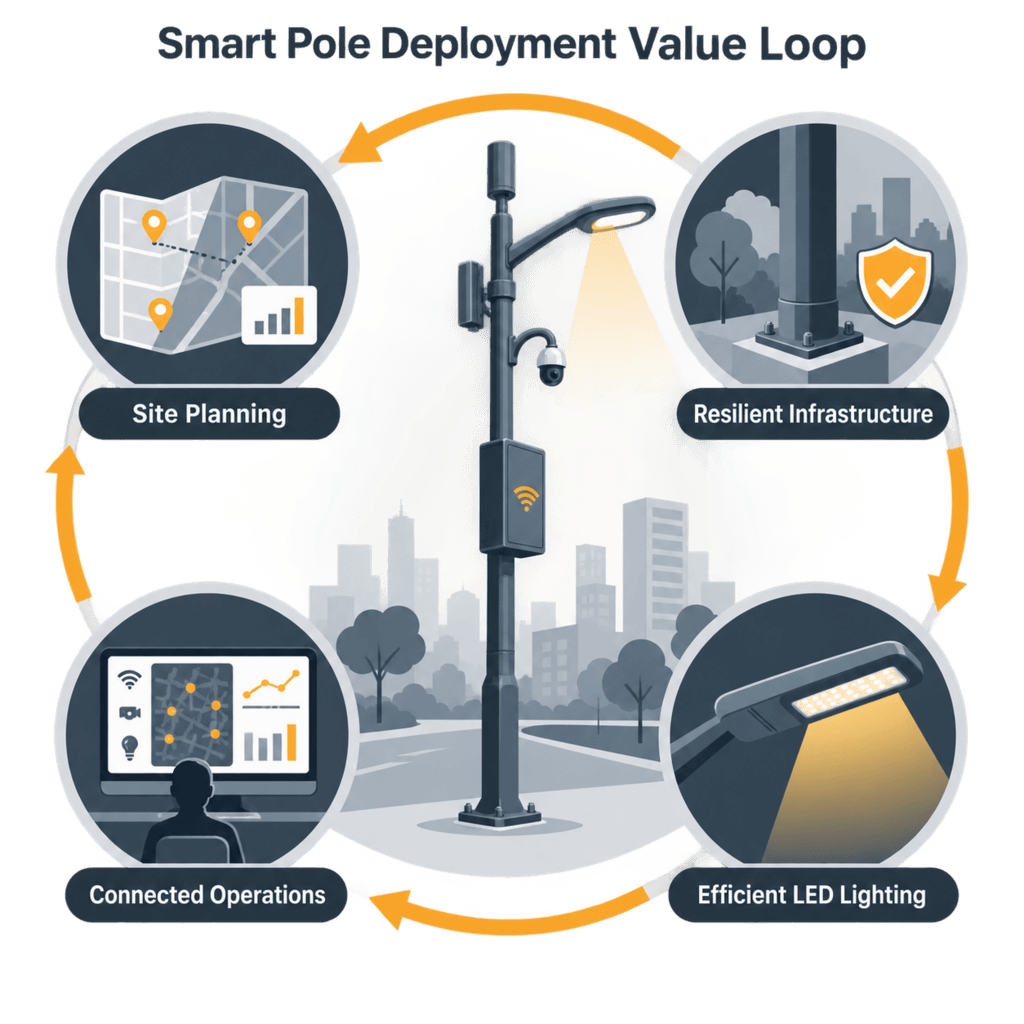
A financeable smart pole package should define height, antenna count, wind speed, LED wattage, grounding target, maintenance cycle, and 25-30 year asset life.
Lenders do not finance generic “smart city” ambition; they finance scoped infrastructure with measurable outputs. For SOLARTODO, the baseline project package can start with the 6m Micro Cell Streetlight Combo Pole: 6 m tower height, steel octagonal shaft, 1 antenna level, 1 antenna capacity, 35 m/s design wind speed, 120 kg nominal pole weight, and hot-dip galvanized or marine-grade coating. This is suitable for sidewalks, ports, campuses, industrial parks, and urban corridors where small-cell inter-site distance may be below 200 m.
For denser urban zones, the 10m 5G Small Cell Integrated Smart Street Light Pole extends the functional scope. It can be specified with Q235 or Q355 steel, hot-dip galvanization, wind load above 150 km/h, 120 W LED lighting, 170 lm/W luminous efficacy, WiFi 6, 4K CCTV, and environmental sensors for PM2.5, PM10, temperature, humidity, and noise. This configuration supports municipalities that want fewer street assets but more digital services per location.
According to IEA (2026), lighting in buildings and outdoor applications represented about 8% of global electricity demand in 2024, equal to roughly 2,200 TWh. IEA states, “Digital technologies can help resolve immediate challenges and reduce investment costs,” which supports the lender logic for LED controls, remote monitoring, and predictive maintenance. According to IEA (2023), smart-grid digital technologies could defer an estimated USD 1.8 trillion of global grid investment to 2050.
Technical documentation should include structural calculations, pole drawings, cable-routing diagrams, foundation loads, grounding and lightning protection notes, luminaire photometrics, and maintenance access plans. IEC 60598-1:2024 applies to general safety requirements for luminaires up to 1,000 V. IEEE 81-2025 covers measurement methods for earth resistivity, ground impedance, surface potentials, touch voltage, and step voltage. For galvanized steel, ISO 1461 should be used as the coating inspection reference.
| Parameter | 6 m Micro Cell Combo Pole | 10 m Integrated Smart Pole | Financing Relevance |
|---|---|---|---|
| Typical height | 6 m | 10 m | Defines coverage, permitting, and foundation cost |
| Antenna capacity | 1 antenna | Multi-service 5G payload | Supports telecom lease revenue |
| Wind design | 35 m/s | Above 150 km/h | Reduces structural risk for lenders |
| LED scope | 1 smart luminaire | 120 W, 170 lm/W option | Drives energy-savings model |
| Typical use | Micro cell, lighting | 5G, CCTV, WiFi, sensors | Defines public-service benefits |
| EPC reference | $350-$600 per installed 6 m pole | $35,000-$48,000 advanced pole | Supports budget class selection |
EPC Investment Analysis and Pricing Structure
EPC smart pole procurement should separate FOB supply, CIF delivery, and turnkey installation so lenders can verify 3 cost layers and cash flow.
Engineering, Procurement, and Construction delivery normally includes site survey, lighting design, pole structural drawings, anchor-bolt and foundation coordination, manufacturing, factory inspection, ocean freight, customs documentation, inland logistics, civil installation, electrical connection, commissioning, and handover files. For telecom-enabled smart poles, the EPC scope should also define whether fiber, radios, SIM routers, CCTV software, and network operation center integration are included or supplied by others.
SOLARTODO is not an online marketplace; it operates through inquiry, offline quotation, project engineering, and export delivery. A practical three-tier pricing structure helps procurement managers compare financeable options without confusing equipment cost with installed asset cost. FOB supply covers the ex-factory export package, CIF delivered adds international freight and insurance to the destination port, and EPC turnkey adds civil works, installation, wiring, commissioning, and project management.
| Pricing Layer | What It Usually Includes | Typical Use in Financing |
|---|---|---|
| FOB Supply | Pole, luminaire bracket, galvanizing, packing, export documents | Equipment procurement and factory inspection |
| CIF Delivered | FOB package plus ocean freight and insurance to port | Import budgeting and landed-cost control |
| EPC Turnkey | Engineering, civil works, installation, wiring, commissioning | Bankable project CAPEX and payback model |
For the 6 m micro cell combo pole, the FOB pole reference is $65 per pole, while the EPC turnkey reference is $350-$600 per installed pole before site-specific fiber, backhaul, radio equipment, and local taxes. Volume pricing guidance should be modeled as 50+ poles for a 5% discount, 100+ poles for a 10% discount, and 250+ poles for a 15% discount, subject to final drawings, steel price, coating class, and shipping route.
For financing, the annual return combines reduced electricity use, avoided duplicate foundations, lower maintenance truck rolls, and optional lease income. A municipal lighting retrofit can often justify the LED component through 50-70% energy savings, while a telecom-integrated program may reach a 5-7 year payback if operators lease small-cell attachment rights. The strongest BNDES or CAF case is a bundle: lighting efficiency, public safety, connectivity, and climate-resilient monitoring.
Payment terms for SOLARTODO export projects are typically 30% T/T advance plus 70% against bill of lading, or 100% irrevocable L/C at sight. Project financing is available for large projects above $1,000K where the buyer can provide the required documentation, bankability package, and repayment basis. For project inquiries and financing coordination, contact [email protected] or +6585559114.
BNDES and CAF Application Strategy
A smart pole financing application should present 5 evidence packs: eligibility, technical design, climate impact, procurement plan, and repayment source.
For BNDES, Brazilian borrowers should first confirm whether the project fits Fundo Clima, BNDES Finem Energia, BNDES Finem Meio Ambiente, or a blended structure. According to BNDES, the Fundo Clima urban resilience line can finance up to 100% of eligible items, with cost based on 6.5% per year financial cost plus BNDES remuneration from 1.2% per year for eligible public-law entities and from 1.3% per year for eligible private entities. Terms may reach 192 months for efficient public lighting and 300 months for certain urban resilience categories, both with grace periods up to 60 months.
For CAF, sponsors should frame the project as sustainable urban infrastructure rather than a hardware-only import. CAF states that its regional infrastructure operations respond to “climate change, the modernization of critical infrastructure,” and quality-of-life needs. According to CAF (2025), it approved USD 1.086 billion for sustainable infrastructure and climate resilience operations in Brazil, Colombia, Uruguay, and Chile, including urban modernization in Brazil and green project credit lines in Chile.
The documentation package should quantify outputs in lender language. For example: 2,000 smart poles, 120 W LED fixtures, 170 lm/W luminaire efficacy, 35 m/s or 150 km/h wind design depending on pole class, 30-year pole design life, 50-70% expected lighting energy reduction, 1-4 digital services per pole, and a 5-7 year payback case where telecom leasing is contracted. Environmental benefits should be tied to measured electricity reduction and system availability rather than broad sustainability claims.
Risk allocation is also important. The municipality or concessionaire should retain rights-of-way and permitting responsibility; SOLARTODO can support technical drawings, manufacturing, quality documentation, and export logistics; the EPC contractor should own installation and commissioning obligations; and telecom or software partners should own service-level commitments for connectivity, CCTV, and data platforms. This division makes the repayment model easier to audit.
Implementation, Procurement, and Risk Controls
Smart pole programs should use pilot batches of 20-50 poles before scaling to 250+ units, reducing permitting, RF, and civil-work risk.
A phased procurement plan is easier to finance than a single oversized purchase. Phase 1 should validate poles, foundations, installation time, luminaire photometrics, telecom clearance, grounding resistance, and data connectivity on 20-50 sites. Phase 2 can expand to 100-250 poles once bills of quantities, trenching assumptions, and service-level indicators are proven. Phase 3 can become a multi-city framework agreement with standardized drawings and pricing formulas.
Procurement managers should request factory quality files before shipment. The package should include material certificates, galvanizing inspection records, welding inspection reports, pole dimensional checks, luminaire datasheets, IP and IK ratings where applicable, packing lists, and installation drawings. For CAF or BNDES-backed projects, procurement should also preserve evidence of competitive sourcing, environmental and social screening, and anti-corruption compliance.
Technical risk is concentrated in foundations, wind loading, radio clearance, grounding, and maintenance access. A 2 kg environmental sensor may be structurally minor, but a 12 kg radio head with offset mounting can materially increase overturning moment. The final design should verify antenna projected area, luminaire wind area, base reactions, anchor bolts, soil assumptions, and local code alignment before mass production.
Commercial risk is concentrated in revenue assumptions. LED savings can be verified through utility tariffs and measured kWh reduction, but telecom lease revenue requires operator demand, lease contracts, or credible letters of intent. Where revenue is uncertain, the base case should be financed on energy efficiency and public-service benefits, with telecom income treated as upside. This is usually more acceptable to public-sector lenders.
FAQ
Smart pole financing FAQs should answer cost, eligibility, installation, technical standards, and maintenance questions in 40-80 words each.
Q: What is BNDES/CAF financing for smart pole projects in Latin America? A: It is development-bank financing for urban infrastructure that combines efficient LED lighting, telecom densification, public safety, and climate-resilient monitoring. BNDES is mainly relevant for Brazil-based borrowers, while CAF can support broader Latin American and Caribbean programs. Projects are stronger when they include 50+ poles, measurable energy savings, and a clear EPC delivery scope.
Q: Can BNDES finance smart pole projects outside Brazil? A: BNDES financing is primarily structured for Brazilian public entities and private legal entities headquartered and managed in Brazil. For projects in other Latin American countries, CAF, local development banks, or blended finance are usually more relevant. Brazilian export participation may still support equipment supply, but project eligibility must be checked case by case.
Q: What minimum project size is practical for BNDES Fundo Clima? A: BNDES lists a R$20 million minimum financing value for the Fundo Clima urban resilience and sustainable development line. That means small pilots may need municipal aggregation, concessionaire bundling, or multi-district procurement to reach scale. A 20-50 pole technical pilot is useful, but the finance application usually needs a larger rollout.
Q: What does EPC turnkey delivery include for a smart pole project? A: EPC turnkey delivery usually includes engineering, pole manufacturing, logistics, civil foundations, installation, electrical works, commissioning, and handover documentation. It may exclude fiber backhaul, telecom radios, CCTV software, and network operations unless these are explicitly included. Procurement teams should separate FOB, CIF, and EPC pricing to avoid budget confusion.
Q: How much does a 6 m smart pole project cost? A: SOLARTODO’s 6 m micro cell streetlight combo pole has a FOB pole reference of $65 per pole and an EPC turnkey reference of $350-$600 per installed pole. Final pricing depends on coating, anchor bolts, luminaire model, sensors, shipping route, local civil works, taxes, and whether telecom backhaul is included.
Q: What payback period should municipalities assume? A: A conservative model should separate LED energy savings from telecom or sensor revenue. LED retrofits often reduce lighting electricity use by 50-70%, while small-cell lease revenue can shorten total payback to about 5-7 years when contracts are secured. Without lease commitments, use energy savings and avoided maintenance as the base case.
Q: Which standards matter most for smart pole financing? A: Key standards include IEC 60598-1:2024 for luminaire safety, IEEE 81-2025 for grounding measurements, ISO 1461 for hot-dip galvanizing, and TIA-222-H or local codes for structural loading. Lenders and EPC reviewers also expect lightning protection, electrical segregation, foundation calculations, and factory inspection records for every pole type.
Q: How should a city choose between 6 m and 10 m smart poles? A: Choose 6 m poles for sidewalks, campuses, and micro-cell locations needing 1 antenna and 1 light point. Choose 10 m poles when the site needs broader lighting, 5G payloads, CCTV, WiFi 6, or environmental sensors. Height selection should follow wind loading, RF coverage, road geometry, and local permitting constraints.
Q: What payment terms does SOLARTODO support for financed projects? A: Standard export payment terms are 30% T/T advance and 70% against bill of lading, or 100% irrevocable L/C at sight. For large projects above $1,000K, project financing may be coordinated when the buyer provides required documents, project scope, repayment assumptions, and bankability evidence.
Q: What documents are needed before approaching BNDES or CAF? A: Prepare borrower eligibility documents, preliminary engineering drawings, CAPEX budget, EPC scope, procurement plan, climate and energy-savings model, implementation schedule, and repayment source. Strong applications also include 25-30 year asset-life assumptions, maintenance plans, environmental and social screening, and evidence of municipal or operator demand.
Q: How long should a smart pole pilot run before full procurement? A: A 20-50 pole pilot should normally run long enough to verify installation productivity, grounding, lighting levels, communications uptime, maintenance access, and user acceptance. For financed rollouts, 3-6 months of operational data can materially improve lender confidence. The pilot should use the same pole family and controls planned for scale.
Q: Who should contact SOLARTODO for smart pole financing support? A: Municipal concessionaires, EPC contractors, utilities, telecom infrastructure companies, and public procurement teams should contact SOLARTODO when planning 50+ pole programs or projects above $1,000K. SOLARTODO can support product selection, export quotation, technical files, and financing coordination through [email protected] or +6585559114.
Conclusion
BNDES/CAF smart pole financing works best when 50+ poles deliver quantified LED savings, 5G-ready infrastructure, and a lender-ready EPC package.
For Latin American buyers, the bottom line is direct: SOLARTODO smart pole projects become more financeable when they combine 6 m-10 m engineered poles, 50-70% lighting energy savings, 25-30 year infrastructure life, and structured FOB/CIF/EPC pricing. Use BNDES for Brazil-eligible climate and urban infrastructure projects, use CAF for broader regional programs, and prepare the technical and repayment evidence before procurement.
References
- IEA LED Lighting Analysis (2026): Reports around 8% of global electricity demand, or about 2,200 TWh in 2024, from buildings and outdoor lighting. https://www.iea.org/commentaries/the-next-wave-of-led-lighting-smarter-circular-and-more-efficient — https://www.iea.org/reports/world-energy-outlook-2024
- IEA Smart Grid Opportunities (2023): Estimates USD 1.8 trillion of grid investment deferral potential by 2050 through digital grid technologies. https://www.iea.org/reports/unlocking-smart-grid-opportunities-in-emerging-markets-and-developing-economies — https://www.iea.org/reports/world-energy-outlook-2024
- IEC 60598-1 (2024): Luminaires Part 1 general safety requirements and tests for electric light sources up to 1,000 V. https://webstore.iec.ch/ — https://webstore.iec.ch/
- IEEE 81 (2025): Guide for measuring earth resistivity, ground impedance, earth surface potentials, touch voltage, and step voltage in grounding systems. https://standards.ieee.org/ieee/81/11218/ — https://standards.ieee.org/ieee/1547/7382/ Authoritative smart pole financing references should combine 5 development-bank, energy, electrical, grounding, and structural sources with current publication years.
- [BNDES Fundo Clima] (2026): Urban resilience and sustainable development financing line with R$20 million minimum, R$500 million maximum, up to 100% eligible item participation, and efficient public lighting eligibility. https://www.bndes.gov.br/
- [CAF Strategy] (2026): Regional strategy targeting 40% green or green-agenda approvals and expanded local, subnational, infrastructure, and private-sector financing. https://www.caf.com/en/who-we-are/caf-strategy/
- [CAF] (2025): USD 3.175 billion approval package for sustainable development in Latin America and the Caribbean across infrastructure, energy, mobility, and resilience. https://www.caf.com/
- [IEA] (2026): LED lighting analysis reporting around 8% of global electricity demand, or about 2,200 TWh in 2024, from buildings and outdoor lighting. https://www.iea.org/commentaries/the-next-wave-of-led-lighting-smarter-circular-and-more-efficient
- [IEA] (2023): Unlocking Smart Grid Opportunities in Emerging Markets and Developing Economies, estimating USD 1.8 trillion of grid investment deferral potential by 2050. https://www.iea.org/reports/unlocking-smart-grid-opportunities-in-emerging-markets-and-developing-economies
- [IEC 60598-1] (2024): Luminaires Part 1 general safety requirements and tests for electric light sources up to 1,000 V. https://webstore.iec.ch/
- [IEEE 81] (2025): Guide for measuring earth resistivity, ground impedance, earth surface potentials, touch voltage, and step voltage in grounding systems. https://standards.ieee.org/ieee/81/11218/
- [ISO 1461] (2022): Hot-dip galvanized coatings on fabricated iron and steel articles, used for pole corrosion-protection inspection and specification control.
About SOLARTODO
SOLARTODO is a global integrated solution provider specializing in solar power generation systems, energy-storage products, smart street-lighting and solar street-lighting, intelligent security & IoT linkage systems, power transmission towers, telecom communication towers, and smart-agriculture solutions for worldwide B2B customers.
About the Author

Cinn Song
Founder & Chief Solutions Architect
Cinn Song founded SOLARTODO LIMITED and leads its smart-city infrastructure engineering — from solar, storage and integrated smart poles to the company's push into physical-AI city edge nodes: pole-mounted edge computing, vertical LLMs for smart cities, drone-based O&M with autonomous battery swapping, robotic maintenance, and high-speed counter-UAS interception. Since 2010, he has directed turnkey EPC + BOT delivery across 50+ countries, including telecom monopole supply for national grid operators, off-grid solar street-lighting for African municipalities, and integrated smart-pole programs for Gulf smart cities.
Cite This Article
Cinn Song. (2026). Financiamiento BNDES/CAF para Proyectos de smart pole en…. SOLARTODO. Retrieved from https://solartodo.com/knowledge/financiamiento-bndescaf-para-proyectos-de-smart-pole-en-latinoamrica
@article{solartodo_financiamiento_bndescaf_para_proyectos_de_smart_pole_en_latinoamrica,
  title = {Financiamiento BNDES/CAF para Proyectos de smart pole en…},
  author = {Cinn Song},
  journal = {SOLARTODO Knowledge Base},
  year = {2026},
  url = {https://solartodo.com/knowledge/financiamiento-bndescaf-para-proyectos-de-smart-pole-en-latinoamrica},
  note = {Accessed: 2026-10-19}
}
Published: September 4, 2026 | Available at: https://solartodo.com/knowledge/financiamiento-bndescaf-para-proyectos-de-smart-pole-en-latinoamrica
Subscribe to Our Newsletter
Get the latest solar energy news and insights delivered to your inbox.
View All Articles