Farm Management Platform Market 2026: SaaS Pricing &…

SOLAR TODO
Solar Energy & Infrastructure Expert Team
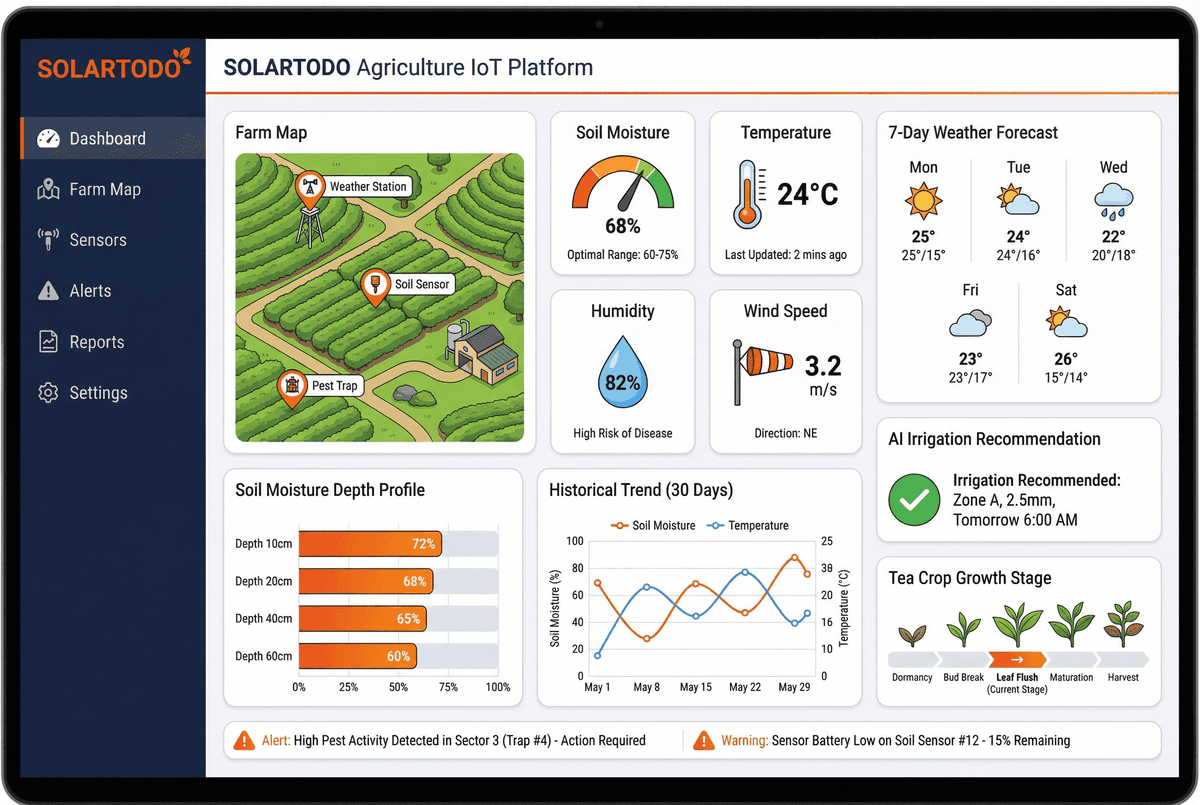
Watch the video
TL;DR
Farm management platform buyers in 2026 should compare total project value, not just software fees. Typical SaaS pricing is $3-15/ha/year, payback is often 2-5 years, and the best results come when weather, soil, alerts, and controls are combined with LoRaWAN or 4G field hardware. For 30-50 ha operations, integrated systems usually outperform software-only tools on ROI and reliability.
Farm management platform spending is moving from pilot budgets to core operating expense: SaaS pricing in 2026 commonly ranges from $3-15/ha/year, precision-ag software is growing at roughly 12-16% CAGR, and integrated platforms can cut irrigation water use by up to 20-50% when paired with field sensors and response protocols.
Summary
Farm management platform spending is moving from pilot budgets to core operating expense: SaaS pricing in 2026 commonly ranges from $3-15/ha/year, precision-ag software is growing at roughly 12-16% CAGR, and integrated platforms can cut irrigation water use by up to 20-50% when paired with field sensors and response protocols.
Key Takeaways
- Prioritize platforms priced at $3-15/ha/year or $500-25,000/year because farm software ROI depends more on acreage, labor savings, and input reduction than on license price alone.
- Compare deployment models across 4 regions because North America and Europe lead software spend, while Latin America and Middle East/Africa show faster adoption in irrigation and remote monitoring.
- Select systems that combine 10-minute field data, weather, and soil monitoring because response speed within 1-3 hours can materially reduce frost, disease, and irrigation losses.
- Verify interoperability with ISO 11783, API export, and LoRaWAN or 4G connectivity because multi-vendor farms often run 2-5 disconnected data systems before standardization.
- Model payback over 2-5 years because farms that reduce water use by 10-30%, labor by 5-15%, or crop loss by 5-20% usually justify subscription upgrades faster.
- Use tiered procurement review for 30 ha, 40 ha, and 50 ha operations because sensor density, cloud analytics, and automation needs differ sharply by crop, terrain, and risk profile.
- Include EPC and delivery terms in budget planning because FOB, CIF, and EPC Turnkey pricing can shift total project cost by 10-25% on international smart agriculture deployments.
- Ask vendors for alert logic, warranty, and data retention terms because 1-year cloud service, 2-year hardware warranty, and 99.5% uptime targets are common commercial baselines.
Farm Management Platform Market Overview 2026
Farm management platform demand in 2026 is being driven by 12-16% software growth, $3-15/ha/year SaaS pricing, and rising pressure to reduce water, labor, and crop-risk losses across 30-50 ha commercial blocks.
Farm management platforms are no longer just digital record books. For B2B buyers, they are operational systems that combine agronomy, irrigation scheduling, weather intelligence, field scouting, and compliance reporting into one software layer. According to MarketsandMarkets (2024), the farm management software market is projected to reach roughly $4.2 billion by 2029 at a CAGR above 12%. According to Grand View Research (2024), precision agriculture markets tied to software and analytics are expanding at double-digit rates through 2030.
The 2026 buying question is not whether software is available; it is whether the software can convert field data into measurable savings. According to IRENA (2024), digital control and monitoring are increasingly important in water-energy-food systems where resource efficiency drives project economics. For orchard, tea, and desert reclamation projects, the financial value often comes from 3 levers: 10-30% lower water use, 5-15% lower labor input, and 5-20% lower crop-loss exposure when alerts trigger action in time.
The International Energy Agency states, "Digitalization has the potential to make energy systems more connected, intelligent, efficient, reliable and sustainable." That statement applies directly to smart agriculture because irrigation pumps, solar power, field nodes, and cloud analytics now operate as one control stack in many commercial projects. For procurement teams, this means software selection must be tied to communications architecture, power supply, and field hardware life, not only user-interface preference.
Market size and regional demand signals
Regional demand in 2026 is strongest in North America and Europe by software spend, while Asia-Pacific, Latin America, and Middle East/Africa are expanding faster in irrigation, remote sensing, and climate-risk monitoring.
According to Fortune Business Insights (2024), North America remains the largest revenue market for farm management software due to higher mechanization and digital adoption. Europe follows with strong compliance and sustainability reporting demand under tighter water and input controls. Asia-Pacific growth is supported by large cultivated area, mobile-first software deployment, and government support for digital agriculture in India, China, and Southeast Asia.
Latin America is important for export crops, orchard management, sugar, soy, and irrigation modernization. Middle East/Africa demand is increasingly linked to water scarcity, solar-powered pumping, and remote operation where grid reliability is weak. For SOLAR TODO target markets, these two regions matter because the software layer often succeeds only when paired with LoRaWAN, 4G LTE, solar power, and field-grade IP67/IP68 sensing hardware.
| Region | 2026 Market Position | Main Demand Driver | Typical Buyer Priority |
|---|---|---|---|
| North America | Largest software spend | Labor efficiency, compliance, analytics | ERP integration, API, machinery data |
| Europe | High-value mature market | Sustainability, traceability, water control | Reporting, interoperability, ESG data |
| Asia-Pacific | Fast growth | Scale, mobile deployment, irrigation | Lower SaaS cost, multilingual apps |
| Latin America | Strong growth in export crops | Irrigation, weather risk, remote farms | Connectivity, rugged hardware |
| Middle East/Africa | Fast growth from lower base | Water scarcity, solar pumping, remote monitoring | Off-grid operation, automation |
SaaS Pricing Benchmarks and Feature Comparison
In 2026, commercial farm management SaaS is commonly sold in 3 tiers—basic at $500-3,000/year, professional at $3,000-12,000/year, and enterprise at $12,000-25,000+/year—with per-hectare pricing often landing at $3-15/ha/year.
Pricing varies more by feature stack than by brand. Entry plans usually include field records, task logs, mobile scouting, and basic weather imports. Mid-tier plans add sensor integration, irrigation scheduling, geofencing, role-based access, and API export. Enterprise plans usually include machine telematics, multi-farm dashboards, custom reporting, ERP integration, and automation logic.
For buyers comparing software only, the annual fee can look modest. The real budget issue is total cost of ownership across 24-60 months, including gateways, weather stations, soil probes, training, cloud retention, and support. A 40 ha orchard may justify a higher software tier if frost alerts reduce one severe event loss, while a 50 ha desert reclamation project may justify enterprise controls because water and energy are managed together.
According to McKinsey & Company (2023), digital agriculture adoption improves when tools are embedded in daily workflows rather than treated as stand-alone analytics products. That is why feature comparison should start with operational outcomes: irrigation timing, disease response, frost mitigation, labor scheduling, and reporting speed.
| SaaS Tier | Typical Annual Price | Typical Price Basis | Core Features | Best Fit |
|---|---|---|---|---|
| Basic | $500-$3,000 | Per farm or up to 20-50 ha | Records, task logs, mobile app, basic reports | Small commercial farms |
| Professional | $3,000-$12,000 | $3-10/ha/year or per site | Weather, soil data, alerts, irrigation scheduling, API export | 30-100 ha operations |
| Enterprise | $12,000-$25,000+ | Custom quote, multi-site | Automation, ERP, machine data, custom dashboards, SLA | Large estates and groups |
Feature comparison for smart agriculture deployments
For 30-50 ha deployments, the highest-value features are usually 10-minute data intervals, multi-point sensing, SMS/email/app alerts, and control outputs for irrigation or frost response.
Below is a B2B comparison based on common market requirements and SOLAR TODO smart agriculture configurations relevant to orchard, tea, and desert reclamation operations.
| Feature Area | Orchard Frost Early Warning 40ha | Tea Garden Precision Monitoring 30ha | Desert Reclamation Solar+Agriculture 50ha |
|---|---|---|---|
| Coverage | 40 ha | 30 ha | 50 ha |
| Sensors/Devices | 10 field sensing points | 15 sensors/devices | 20 sensors |
| Communications | LoRaWAN | LoRaWAN | 4G LTE |
| Data Interval | 10 minutes | 10 minutes | 10 minutes |
| Weather Parameters | 8+ core weather metrics | 10 core parameters | 10 parameters |
| Soil Monitoring | Moisture + temperature | Moisture + temperature | 7-parameter soil analysis |
| Special Function | Wind machine control | AI leaf disease detection | Automated drip irrigation control |
| Power | Solar-powered nodes | Solar-powered outdoor operation | 500 kW solar PV backbone |
| Cloud Service | Professional cloud | 1 professional cloud tier | 1 year professional cloud |
| Warranty | Field-grade practice IP67/IP68 | Field-grade outdoor deployment | 2 years hardware warranty |
These configurations show why feature comparison must include hardware context. A software vendor that offers dashboards but no field communications strategy may fail in orchards with weak cellular coverage or in desert sites with unstable grid power. SOLAR TODO projects are typically specified as complete monitoring systems because the software value depends on data continuity at 10-minute intervals, not just on screen design.
Historical Trends, 2025-2026 Status, and 2030-2040 Outlook
From 2021 to 2026, farm management platforms shifted from record-keeping tools to decision systems, and by 2030-2040 the market will increasingly favor AI-assisted automation, cross-farm benchmarking, and water-energy-agronomy optimization.
Between 2021 and 2023, many farms adopted digital tools for compliance, traceability, and remote oversight, but data often remained fragmented across spreadsheets, machinery portals, and sensor apps. By 2024 and 2025, integration became the priority. According to Deloitte (2024), agricultural operators are increasingly evaluating digital tools by operational ROI rather than by feature count alone. That shift favors platforms that connect software to sensors, pumps, and alerts.
In 2025-2026, current market status shows four visible trends. First, SaaS pricing is stabilizing while implementation services are rising as a share of total project cost. Second, AI features are moving from image recognition into recommendation engines for irrigation and disease risk. Third, buyers are demanding offline-capable mobile apps because many agricultural zones still face weak connectivity. Fourth, data ownership and export terms are becoming procurement issues, especially for growers serving export markets.
| Period | Typical Platform Focus | Common Buyer Concern | Commercial Impact |
|---|---|---|---|
| 2021-2022 | Digital records, basic scouting | User adoption | Limited ROI, siloed data |
| 2023-2024 | Sensor integration, dashboards | Interoperability | Better irrigation and reporting |
| 2025-2026 | Alerts, automation, AI recommendations | Measurable ROI and data ownership | Faster payback, wider deployment |
| 2027-2030 | Cross-system orchestration | Multi-site standardization | Lower labor per hectare |
| 2030-2040 | Semi-autonomous agronomy workflows | Governance and resilience | Higher productivity with fewer field visits |
According to the Food and Agriculture Organization (FAO) (2023), agriculture must improve productivity while reducing pressure on water and land resources. That requirement supports long-term demand for platforms that combine agronomy with irrigation and energy control. According to NREL (2024), digital monitoring also improves renewable-powered agricultural systems by enabling better load matching, fault detection, and performance tracking.
The International Energy Agency also states, "Data and digitalization are becoming central to energy transitions." In agriculture, that means software will increasingly evaluate not only crop conditions but also pump runtime, solar generation, battery state, and water quality. By 2030, many 50 ha projects will likely treat farm software as an operations layer across agronomy and infrastructure. By 2040, the strongest platforms will probably support predictive control, autonomous work orders, and benchmark models trained across thousands of field-days.
Use Cases, ROI, and Procurement Selection Criteria
For most commercial farms, the strongest software business case comes from a 2-5 year payback driven by 10-30% water savings, 5-15% labor reduction, and lower crop-loss risk during extreme weather windows.
Use case economics vary by crop and site. Orchards value frost alerts because blossom damage can occur within 1-3 hours when temperatures approach crop thresholds near 0°C to -2.5°C. Tea operations value disease and moisture visibility because slope, canopy density, and elevation changes from 10 m to 500 m can create uneven pressure across one estate. Desert reclamation projects value integrated water-energy control because evapotranspiration can exceed 5-10 mm/day and pumping costs are material.
For a 30 ha tea garden, a professional monitoring platform can justify itself if it reduces disease-response delay by several hours to several days and improves irrigation timing across multiple slope exposures. For a 40 ha orchard, one prevented frost-loss event can outweigh several years of software subscription cost. For a 50 ha desert project, software ROI often comes from lower water use and better pump scheduling tied to solar generation windows.
| Application | Typical Annual Benefit Driver | Indicative Savings/Benefit | Typical Payback |
|---|---|---|---|
| Orchard frost monitoring 40 ha | Reduced blossom/fruit loss | 5-20% crop-loss avoidance in risk periods | 1-3 seasons |
| Tea garden monitoring 30 ha | Better irrigation and disease timing | 5-15% labor/input efficiency | 2-4 years |
| Desert reclamation 50 ha | Water-energy optimization | Up to 50% water reduction with protocols | 2-5 years |
| Multi-farm reporting | Faster data consolidation | 20-40% admin time reduction | 1-3 years |
EPC Investment Analysis and Pricing Structure
For international smart agriculture projects, EPC budgeting should separate software from delivered system cost because FOB, CIF, and EPC Turnkey structures can change total capital outlay by 10-25%.
EPC means Engineering, Procurement, and Construction under one delivery scope. In smart agriculture, that can include site survey, bill of materials, weather stations, soil probes, gateways, solar power kits, communications setup, cloud onboarding, commissioning, and operator training. For larger deployments, EPC may also include irrigation controls, power distribution, and integration with solar pumping or battery systems.
A practical three-tier budget structure is:
- FOB Supply: factory supply only, suitable for buyers with local installation teams; lowest upfront price but higher coordination burden.
- CIF Delivered: product plus freight and insurance to destination port; useful when import logistics are the main risk.
- EPC Turnkey: supply, installation, commissioning, and training; highest initial price but lower interface risk and faster handover.
Volume pricing guidance for standard packages typically follows:
- 50+ units or nodes: about 5% discount
- 100+ units or nodes: about 10% discount
- 250+ units or nodes: about 15% discount
Payment terms commonly used in export projects are 30% T/T plus 70% against B/L, or 100% L/C at sight. Financing is available for large projects above $1,000K, subject to project review, country risk, and offtake profile. For pricing, EPC scope, and warranty clarification, buyers can contact [email protected].
For B2B buyers evaluating SOLAR TODO, the key procurement point is that software should be quoted together with communications, power, and support scope. A low SaaS fee can become expensive if the project later requires extra gateways, field solar kits, or custom integration. Buyers can review related solutions at View all Smart Agriculture IoT Monitoring System products or Configure your system online.
FAQ
Farm management platform buyers in 2026 should focus on 10 practical questions covering pricing, integration, ROI, installation, and warranty because software value depends on both data quality and field execution.
Q: What is a farm management platform in 2026? A: A farm management platform is software that combines field records, weather, soil data, alerts, and operational workflows in one system. In 2026, commercial platforms often add sensor integration, 10-minute data updates, and mobile task management to support irrigation, disease control, and compliance reporting across 30-50 ha or larger operations.
Q: How much does farm management SaaS usually cost? A: Commercial pricing commonly ranges from $500 to $25,000+ per year depending on acreage, modules, and support level. A practical benchmark is $3-15/ha/year for professional deployments, while enterprise groups often buy custom contracts with API access, SLA terms, and multi-site dashboards.
Q: Which features matter most for a 30-50 ha operation? A: The highest-value features are usually weather integration, soil moisture monitoring, alerts, irrigation scheduling, and data export. For risk-sensitive crops, 10-minute intervals, SMS/email/app notifications, and multi-point sensing often matter more than advanced dashboards because response speed directly affects field outcomes.
Q: How do I compare software-only vendors with hardware-plus-software suppliers? A: Compare them on total cost of ownership over 24-60 months, not on license fee alone. Software-only vendors may look cheaper initially, but farms still need gateways, field power, sensors, and commissioning; integrated suppliers reduce interface risk when connectivity, IP67/IP68 protection, and alert reliability are critical.
Q: What ROI should a commercial farm expect? A: Many projects target payback in 2-5 years, depending on crop value and operational discipline. Water savings of 10-30%, labor savings of 5-15%, or avoided crop loss of 5-20% can justify the subscription and hardware package, especially in orchards, tea estates, and desert irrigation projects.
Q: Why is interoperability important in procurement? A: Interoperability reduces vendor lock-in and lowers future integration cost. Buyers should ask for API access, CSV export, ISO 11783 compatibility where relevant, and support for LoRaWAN or 4G because many farms already operate 2-5 separate data systems before standardizing on one platform.
Q: What communications options are best for remote farms? A: LoRaWAN works well for low-power sensor networks across large fields where long range and low maintenance matter. 4G LTE is useful when higher bandwidth or direct cloud connectivity is needed, but recurring SIM costs and coverage quality should be checked before final selection.
Q: What should be included in an EPC or turnkey quote? A: A proper EPC quote should list engineering scope, sensors, gateways, solar power kits, installation, commissioning, training, and cloud onboarding. It should also define pricing structure as FOB Supply, CIF Delivered, or EPC Turnkey, plus payment terms such as 30% T/T and 70% against B/L or 100% L/C at sight.
Q: What warranty and service terms are typical? A: Commercial smart agriculture packages often include 1 year of professional cloud service and about 2 years of hardware warranty, though terms vary by component. Buyers should also confirm uptime targets, spare-parts policy, alert escalation rules, and whether firmware updates are included in the annual fee.
Q: How long does installation usually take? A: Installation time depends on site size, terrain, and communications setup, but many 30-50 ha projects can be deployed in several days to a few weeks. The critical path is usually mast placement, sensor calibration, gateway commissioning, and cloud rule setup rather than the software subscription itself.
Q: When should a farm upgrade from basic SaaS to professional or enterprise? A: Upgrade when the farm needs multi-user permissions, sensor integration, automation, or consolidated reporting across several blocks. A common trigger is when manual spreadsheet work, delayed alerts, or disconnected data systems start causing measurable losses in labor time, water use, or crop response speed.
References
- IEA (2024): World Energy Outlook and digitalization analysis describing how data systems improve efficiency, reliability, and operational control across energy-linked sectors.
- IRENA (2024): Renewable energy and resource-efficiency publications supporting digital monitoring in water-energy-food systems and cost optimization.
- NREL (2024): Agricultural and distributed energy monitoring methodologies relevant to solar-powered pumping, performance tracking, and remote asset management.
- FAO (2023): Digital agriculture and productivity guidance emphasizing improved resource use, resilience, and data-driven farm operations.
- MarketsandMarkets (2024): Farm management software market forecast estimating multi-billion-dollar market growth through 2029 at double-digit CAGR.
- Fortune Business Insights (2024): Farm management software market regional analysis covering North America, Europe, Asia-Pacific, and emerging regions.
- McKinsey & Company (2023): Digital agriculture adoption analysis showing workflow integration and measurable ROI as key implementation factors.
- ISO 11783 (latest applicable parts): Agricultural electronics and data communication standard used for interoperability across farm equipment and digital systems.
Conclusion
Farm management platforms in 2026 deliver the best value when $3-15/ha/year SaaS is matched with field hardware, 10-minute data, and a 2-5 year ROI model tied to water, labor, and crop-risk reduction.
For commercial farms above 30 ha, SOLAR TODO recommends buying software as part of a complete monitoring architecture because connectivity, power, and sensor reliability determine whether the platform produces measurable savings or just more dashboards.
About SOLARTODO
SOLARTODO is a global integrated solution provider specializing in solar power generation systems, energy-storage products, smart street-lighting and solar street-lighting, intelligent security & IoT linkage systems, power transmission towers, telecom communication towers, and smart-agriculture solutions for worldwide B2B customers.
About the Author

SOLAR TODO
Solar Energy & Infrastructure Expert Team
SOLAR TODO is a professional supplier of solar energy, energy storage, smart lighting, smart agriculture, security systems, communication towers, and power tower equipment.
Our technical team has over 15 years of experience in renewable energy and infrastructure, providing high-quality products and solutions to B2B customers worldwide.
Expertise: PV system design, energy storage optimization, smart lighting integration, smart agriculture monitoring, security system integration, communication and power tower supply.
Cite This Article
SOLAR TODO. (2026). Farm Management Platform Market 2026: SaaS Pricing &…. SOLAR TODO. Retrieved from https://solartodo.com/knowledge/farm-management-platform-market-2026-saas-pricing-feature-comparison-data
@article{solartodo_farm_management_platform_market_2026_saas_pricing_feature_comparison_data,
  title = {Farm Management Platform Market 2026: SaaS Pricing &…},
  author = {SOLAR TODO},
  journal = {SOLAR TODO Knowledge Base},
  year = {2026},
  url = {https://solartodo.com/knowledge/farm-management-platform-market-2026-saas-pricing-feature-comparison-data},
  note = {Accessed: 2026-05-11}
}
Published: May 11, 2026 | Available at: https://solartodo.com/knowledge/farm-management-platform-market-2026-saas-pricing-feature-comparison-data
Subscribe to Our Newsletter
Get the latest solar energy news and insights delivered to your inbox.
View All Articles