EV Charging Smart Poles for Curbside Electrification

Cinn Song
Founder & Chief Solutions Architect
TL;DR
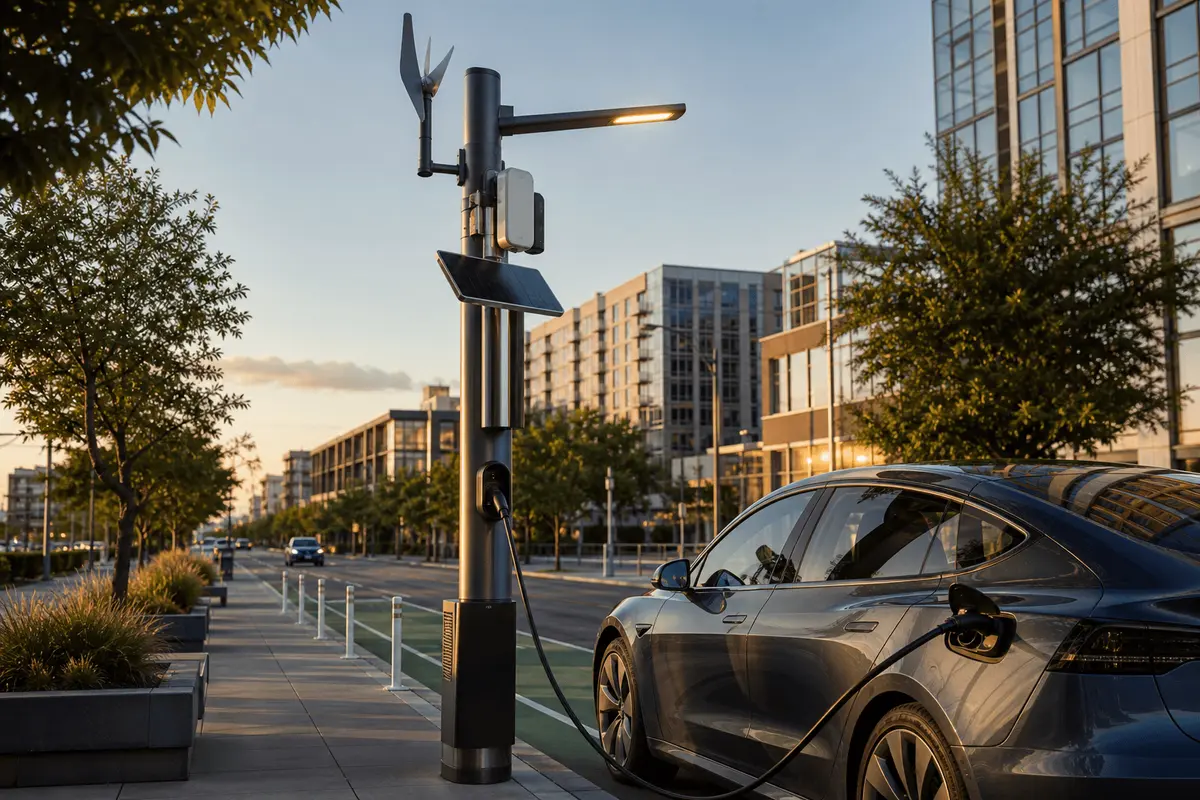
EV charging smart poles are best for curbside locations where vehicles park for 4-10 hours and cities need lighting, charging, monitoring, and communications in one asset. A 7-11kW AC charger, 5-15kWh optional storage, OCPP networking, and 97% uptime target can support practical electrification while reducing footprint by 30-40%.
EV charging smart poles combine 7-11kW AC charging, LED lighting, solar or wind generation, and WiFi/5G controls to expand curbside electrification while cutting pole-plus-bollard footprint by 30-40% for cities, campuses, and logistics lanes.
Summary
EV charging smart poles combine 7-11kW AC charging, LED lighting, solar or wind generation, and WiFi/5G controls to expand curbside electrification while cutting pole-plus-bollard footprint by 30-40% for cities, campuses, and logistics lanes.
Key Takeaways
Use smart poles as 7-11kW curbside charging nodes when streets need EV access, lighting, cameras, sensors, and communications in one asset.
- Deploy 7kW or 11kW Type 2 AC charging for overnight and workday curbside dwell times of 4-10 hours.
- Reduce streetscape footprint by 30-40% by replacing separate EV bollards, lighting poles, cabinets, and cable routes with one welded structure.
- Specify 5-15kWh LFP storage and 400-500W VAWT plus dual 100-200W solar panels where hybrid renewable support is required.
- Plan public charging reliability around the FHWA 97% annual uptime benchmark and remote monitoring at every networked port.
- Prioritize curbside nodes every 30-35m in boulevards, logistics parks, campuses, bus stops, and controlled parking lanes.
- Compare FOB, CIF, and EPC turnkey pricing before procurement because civil works can add 25-45% beyond equipment supply.
- Model payback in 5-8 years using 2-4 daily charging sessions, energy margin, advertising, lighting savings, and maintenance consolidation.
- Require IEC 61851, IEC 62196, ISO 15118, OCPP 1.6J/2.0.1, IP66, and local grid interconnection compliance before installation.
Why EV Charging Belongs in Smart Poles
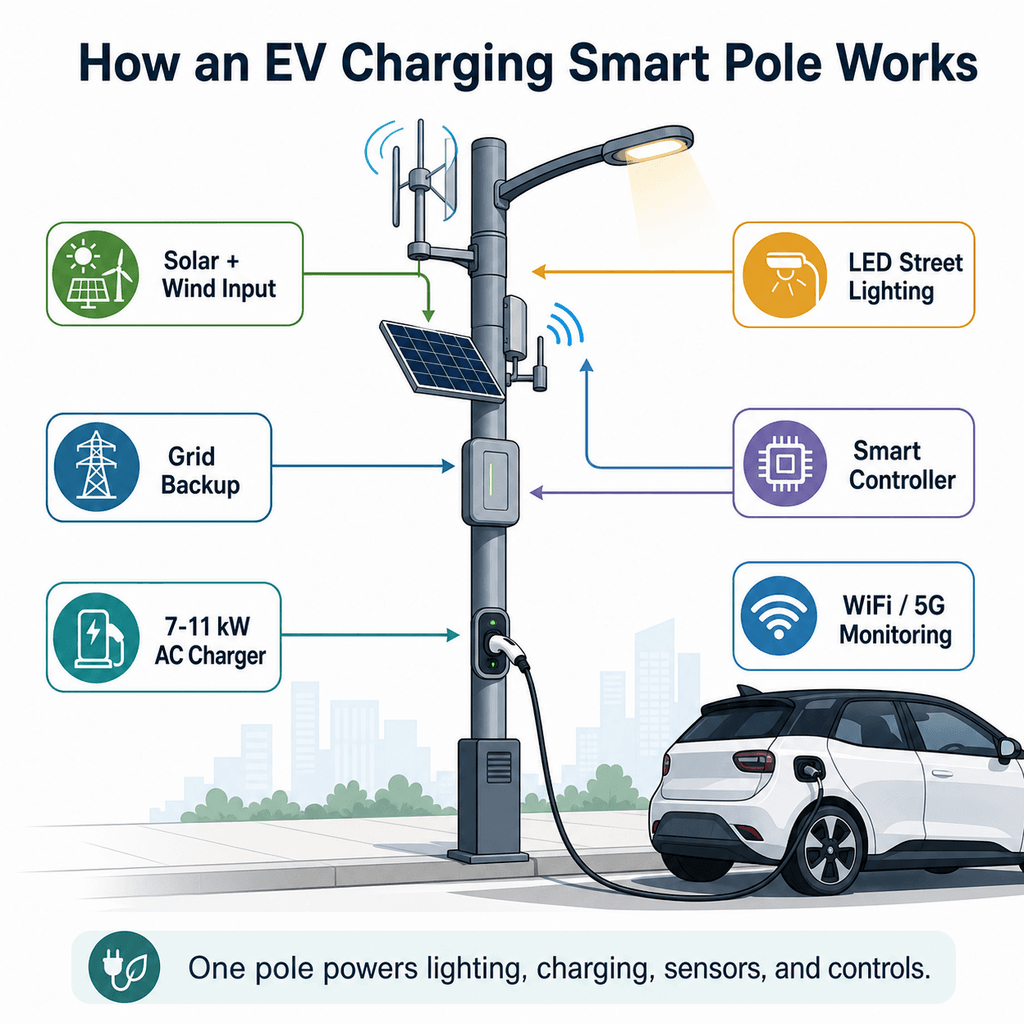
EV charging belongs in smart poles because a single 12m asset can combine 7-11kW AC charging, 160W LED lighting, and 5-15kWh storage without adding a separate curbside pedestal.
Curbside electrification is becoming a practical infrastructure problem, not only a vehicle adoption issue. Dense districts often have limited off-street parking, weak sidewalk space, and high trenching costs. A smart pole with integrated EV charging uses an asset that cities already understand: a lighting pole with power, structure, maintenance access, and a predictable public right-of-way location.
According to IEA (2025), more than 1.3 million public charging points were added globally in 2024, lifting the public stock above 5 million. The same IEA analysis states, 'Access to public charging points is key to supporting mass adoption.' For procurement teams, that means curbside AC charging is not a premium add-on; it is part of the baseline access layer for residents, taxis, municipal fleets, and delivery vehicles.
SOLARTODO positions EV-ready smart poles for B2B projects where the buyer needs lighting, surveillance, communications, environmental monitoring, renewable generation, and charging in one engineered structure. The 12m Wind-Solar Hybrid Smart Pole, for example, integrates a 7kW or 11kW Type 2 AC charger into a welded lower cabinet rather than a separate pedestal, reducing footprint by approximately 30-40% compared with conventional pole-plus-bollard layouts.
The strongest use case is not highway fast charging. It is curbside dwell charging where vehicles remain parked for several hours near offices, boulevards, campuses, apartment blocks, customs facilities, airports, retail parking, and logistics yards. In those environments, a 7-11kW AC charger can deliver meaningful daily range while the pole continues to perform lighting and smart-city functions.
Technical Architecture for EV-Ready Smart Poles
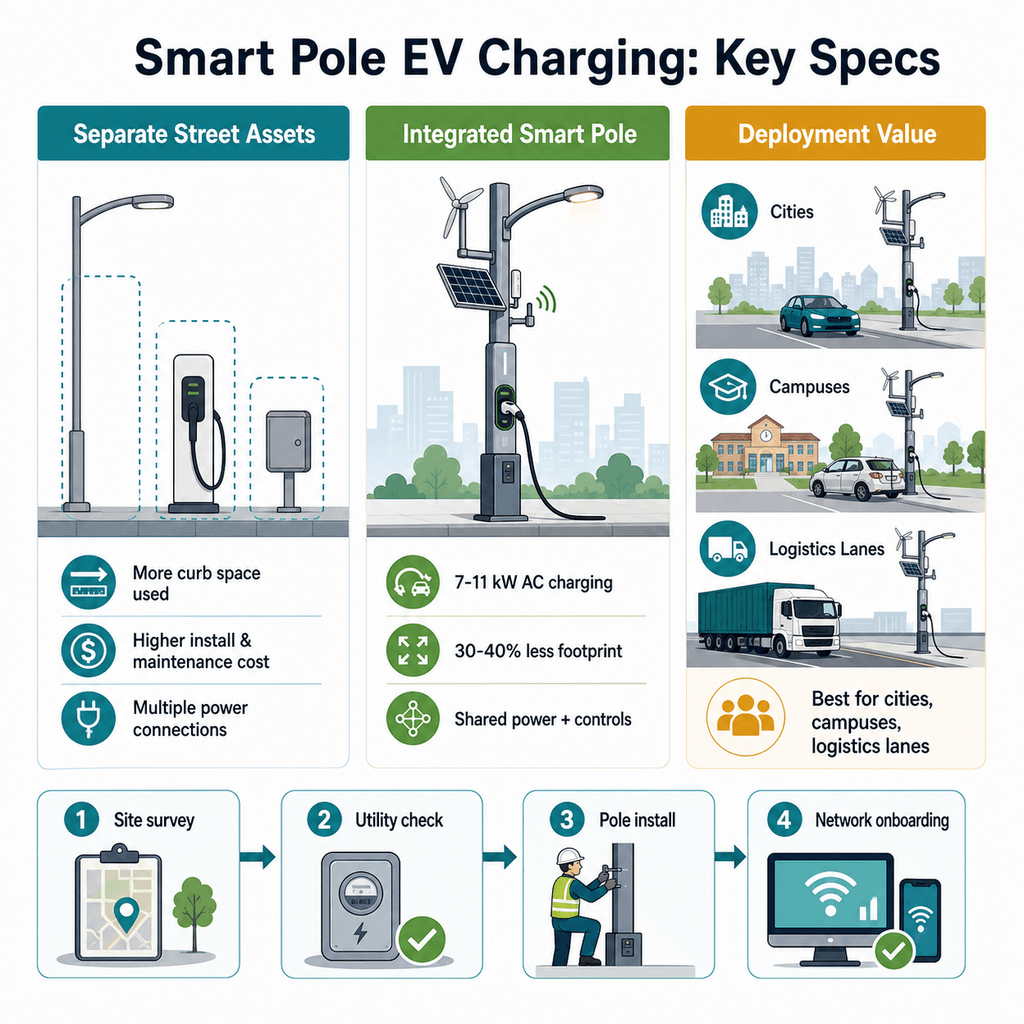
An EV-ready smart pole should integrate 7-11kW AC charging, IP66 outdoor protection, OCPP networking, metering, lighting, and load management inside one maintainable electrical architecture.
The charging subsystem normally includes an AC charger module, Type 2 or regional connector standard, residual-current protection, metering, surge protection, access control, payment interface, and OCPP connection to the charging backend. For U.S. projects, connector and payment requirements may differ, but the engineering principle remains the same: charging must be independently serviceable without compromising lighting, CCTV, WiFi, or sensor operations.
Power architecture is the central design decision. A grid-connected smart pole can use the municipal lighting circuit, a dedicated low-voltage feeder, or a new service connection. A hybrid renewable version adds distributed generation from solar panels, a 400-500W vertical-axis wind turbine, and 5-15kWh LFP storage. The battery is not a substitute for utility power at high utilization, but it can support auxiliary loads, peak shaving, emergency lighting, monitoring continuity, and limited charging resilience.
According to IRENA (2025), global renewable power capacity increased by 585GW in 2024, and solar contributed 452GW of that expansion. This matters for smart poles because solar and wind components are becoming standard distributed assets rather than experimental accessories. In SOLARTODO hybrid boulevard designs, renewable generation is integrated above the roadway equipment zone so EV charging, lighting, and communications can share one managed platform.
Reliability must be designed at port level. FHWA's 2023 NEVI rule requires each federally funded charging port to exceed 97% average annual uptime, and it requires real-time pricing, accessibility, and operational data sharing for public chargers. Even outside the United States, this benchmark is useful for EPC specifications because it converts reliability from a marketing claim into a measurable service requirement.
Core Components
A practical EV smart pole package should include:
- 7kW or 11kW AC EV charger with certified connector and metering
- 160W roadway LED luminaire, or project-specific LED output by lane class
- 5-15kWh LFP battery storage for auxiliary resilience and load smoothing
- 400-500W VAWT plus 2 monocrystalline solar panels where hybrid generation is selected
- PTZ or fixed camera, environmental sensor, emergency call unit, and IP audio column
- WiFi 6, 4G/5G, Ethernet, or fiber backhaul depending on site availability
- IP66 electrical enclosures, surge protection, grounding, and service isolation
- OCPP 1.6J or OCPP 2.0.1 backend integration for remote monitoring and billing
Applications, Site Planning, and Selection Guide
Smart pole EV charging works best in 30-35m pole-spacing corridors where vehicles park for 4-10 hours and civil works must stay compact.
According to NREL (2023), a mid-adoption U.S. scenario for 2030 requires 28 million charging ports, including 1 million public Level 2 ports near homes, workplaces, high-density neighborhoods, offices, and retail outlets. That finding aligns closely with smart pole charging because the infrastructure target is distributed, visible, and close to where vehicles already park.
IEA (2025) reports that more than two-thirds of chargers in Europe and the United States are in urban areas, while over 70% of the European population lives within 1km of a charging point. The United States remains below half of the population within 1km. For project developers in Latin America, the Middle East, Africa, Southeast Asia, and Europe, the implication is direct: curbside coverage can become a city competitiveness metric.
SOLARTODO smart pole projects should be planned around three constraints: electrical capacity, parking behavior, and streetscape acceptance. Electrical capacity defines whether 7kW, 11kW, or managed charging is realistic. Parking behavior defines utilization and ROI. Streetscape acceptance defines whether a welded integrated base, slim cabinet, or full hybrid wind-solar configuration is appropriate.
| Deployment scenario | Recommended configuration | Typical spacing | Commercial logic |
|---|---|---|---|
| Urban boulevard | 12m hybrid smart pole with 7-11kW AC charger | 30-35m | Shared charging, lighting, CCTV, and communications |
| Corporate or university campus | 7-11kW AC charger with WiFi 6 and access control | 25-40m | Employee and visitor dwell charging over 4-8 hours |
| Logistics or customs lane | Smart pole with camera, emergency call, and 7kW AC | 28-35m | Fleet top-up plus security monitoring |
| Retail or airport parking | 11kW AC charger with payment backend and signage | Site-specific | Longer parking sessions and paid charging revenue |
| Residential curbside | 7kW AC smart pole with metering and app access | 30m | Overnight charging for drivers without private parking |
For selection, procurement teams should separate the pole structure from the charging business model. The pole must meet wind load, corrosion protection, service access, grounding, and luminaire requirements. The charging service must meet metering, tariff display, payment, roaming, data, warranty, and uptime requirements. Combining them in one asset should simplify operations, not hide accountability.
EPC Investment Analysis and Pricing Structure
EPC turnkey smart pole delivery bundles engineering, procurement, civil works, grid connection, installation, commissioning, and training into one accountable project package.
A complete EPC scope for EV charging smart poles normally includes site survey, photometric planning, structural foundation design, single-line electrical design, charger selection, pole fabrication, factory acceptance testing, shipping, trenching, cabling, installation, earthing, network setup, commissioning, operator training, and maintenance documentation. For government or campus owners, this reduces coordination risk because lighting, charging, surveillance, and communications are not procured as four unrelated packages.
SOLARTODO is a B2B manufacturer and exporter, not an online marketplace. The business process is inquiry, technical confirmation, offline quotation, and project financing review where applicable. Buyers can contact [email protected] or +6585559114 for engineering drawings, port options, country-specific standards, and commercial terms.
| Pricing tier | What it includes | Best for | Budget effect |
|---|---|---|---|
| FOB Supply | Smart pole, charger, lighting, selected devices, factory testing, export packing | Buyers with own freight and installer | Lowest equipment price basis |
| CIF Delivered | FOB scope plus international freight and insurance to destination port | Importers and EPCs managing local works | Typically FOB plus 8-15% logistics allowance |
| EPC Turnkey | CIF scope plus foundations, cabling, installation, commissioning, training, and handover | Cities, campuses, utilities, logistics parks | Typically CIF plus 25-45% site works allowance |
Volume pricing should be modeled early. For planning, SOLARTODO can structure 50+ units with a 5% equipment discount, 100+ units with a 10% equipment discount, and 250+ units with a 15% equipment discount, subject to final configuration, port standard, steel price, shipping route, and local certification requirements.
ROI depends on utilization. A single 7kW port used for 2 sessions per day at 12kWh per session delivers about 8,760kWh annually. At a net charging margin of USD 0.12/kWh, that produces about USD 1,051 per year before advertising, parking fees, lighting energy savings, or avoided maintenance truck rolls. Adding maintenance consolidation and lighting efficiency can raise annual value by USD 150-400 per pole in many municipal models.
For larger programs above USD 1,000K, financing can be discussed during quotation. Standard payment terms are 30% T/T deposit plus 70% against B/L, or 100% L/C at sight. EPC owners should also request warranty terms for the pole, charger, battery, luminaire, and smart devices separately because each subsystem has a different replacement cycle.
FAQ
These 10 FAQs answer the core procurement, engineering, cost, installation, and maintenance questions for 7-11kW EV charging smart pole projects.
Q: What is an EV charging smart pole? A: An EV charging smart pole is a streetlight structure that integrates a 7kW or 11kW AC charger with lighting, communications, monitoring, and optional renewable generation. Instead of installing a separate charger pedestal beside a lighting pole, the charger is built into the pole base or cabinet, reducing sidewalk clutter and simplifying asset management.
Q: Why use smart poles instead of separate EV charging pedestals? A: Smart poles reduce duplicated foundations, cabinets, cable routes, and maintenance visits by combining several curbside functions in one structure. SOLARTODO's welded EV charging base can cut footprint by about 30-40% versus pole-plus-bollard layouts. This is valuable where sidewalks, parking lanes, and utility corridors are already congested.
Q: What charging speed is realistic from a smart pole? A: Most curbside smart poles are best suited to 7kW or 11kW AC charging, not ultra-fast DC charging. A 7kW charger can add roughly 25-40km of range per hour depending on vehicle efficiency. That is suitable for overnight, workplace, campus, retail, and long-dwell parking use cases.
Q: Can solar and wind power directly charge the EV? A: Solar and wind can support the pole's energy balance, but grid power is normally required for dependable EV charging utilization. A hybrid pole with 400-500W wind, 200-400W solar, and 5-15kWh LFP storage can support lighting, sensors, monitoring, and partial charging resilience. EPC designs should still verify grid capacity.
Q: What standards should buyers require? A: Buyers should require IEC 61851 for conductive charging systems, IEC 62196 for plugs and connectors, ISO 15118 where Plug and Charge is specified, and OCPP 1.6J or 2.0.1 for backend communication. Outdoor systems should also meet IP66 protection, local grounding rules, surge protection requirements, and country-specific grid interconnection regulations.
Q: How much does EPC turnkey delivery include? A: EPC turnkey delivery includes engineering, procurement, construction, installation, testing, commissioning, training, and handover documentation. For EV smart poles, that usually covers foundations, cabling, charger setup, network onboarding, lighting verification, and safety checks. It costs more than FOB supply but reduces coordination risk for public-sector and campus buyers.
Q: What payment terms does SOLARTODO support? A: Standard commercial terms are 30% T/T deposit and 70% against B/L, or 100% L/C at sight for qualified orders. Large projects above USD 1,000K can be reviewed for financing support. Final terms depend on destination country, order volume, configuration, credit review, and project delivery scope.
Q: What maintenance is required after installation? A: Maintenance should include quarterly remote diagnostics, annual electrical inspection, charger connector checks, enclosure seal inspection, grounding verification, firmware updates, and cleaning of solar or sensor surfaces. Batteries and chargers should be monitored separately because their duty cycles differ from LED luminaires. Public networks should target at least 97% annual port uptime.
Q: Where should EV charging smart poles be installed first? A: The best first sites are corridors with long parking dwell time, visible demand, and limited space for separate charging cabinets. Examples include urban boulevards, residential curbside blocks, municipal parking lanes, logistics parks, airports, universities, hospitals, and retail parking. Pilot projects of 10-30 poles can validate utilization before citywide deployment.
Q: How should procurement teams compare suppliers? A: Compare suppliers by structural design life, charger certification, OCPP compatibility, warranty separation, corrosion protection, IP rating, installation references, and spare-parts support. Do not compare only unit price because civil works, grid connection, software fees, and maintenance can materially change lifecycle cost. Request FOB, CIF, and EPC pricing for the same bill of materials.
References
These 8 references cover EV charging demand, renewable capacity, safety standards, interoperability, uptime, and grid integration for smart pole procurement decisions.
- IEA (2025): Global EV Outlook 2025, documenting more than 5 million public charging points globally and over 1.3 million additions in 2024.
- NREL (2023): The 2030 National Charging Network, estimating 28 million U.S. charging ports, including 1 million public Level 2 ports and 182,000 fast ports.
- IRENA (2025): Renewable Capacity Highlights 2025, reporting 585GW of renewable capacity additions in 2024, including 452GW from solar.
- FHWA (2023): National Electric Vehicle Infrastructure Standards and Requirements, 23 CFR Part 680, requiring greater than 97% annual uptime per charging port.
- IEC 61851-1 (2017): Electric vehicle conductive charging system standard covering general requirements for EV conductive charging equipment.
- IEC 62196 (2022): Plugs, socket-outlets, vehicle connectors, and vehicle inlets standard for conductive charging interfaces.
- ISO 15118 (2019-2022): Road vehicles vehicle-to-grid communication interface standard used for Plug and Charge and advanced EV communication.
- IEEE 1547-2018 (2018): Standard for interconnection and interoperability of distributed energy resources with electric power systems.
Conclusion
EV charging smart poles are practical curbside electrification assets when 7-11kW AC charging, 30-40% footprint reduction, and multi-function smart infrastructure are required in one project.
The bottom line: for cities, campuses, logistics parks, and commercial boulevards, SOLARTODO EV charging smart poles can consolidate lighting, charging, surveillance, communications, and renewable support into one EPC-ready platform. Specify 7-11kW AC charging, 5-15kWh storage where needed, 97% uptime monitoring, and FOB/CIF/EPC pricing before awarding a project.
About SOLARTODO
SOLARTODO is a global integrated solution provider specializing in solar power generation systems, energy-storage products, smart street-lighting and solar street-lighting, intelligent security & IoT linkage systems, power transmission towers, telecom communication towers, and smart-agriculture solutions for worldwide B2B customers.
About the Author

Cinn Song
Founder & Chief Solutions Architect
Cinn Song founded SOLARTODO LIMITED and leads its smart-city infrastructure engineering — from solar, storage and integrated smart poles to the company's push into physical-AI city edge nodes: pole-mounted edge computing, vertical LLMs for smart cities, drone-based O&M with autonomous battery swapping, robotic maintenance, and high-speed counter-UAS interception. Since 2010, he has directed turnkey EPC + BOT delivery across 50+ countries, including telecom monopole supply for national grid operators, off-grid solar street-lighting for African municipalities, and integrated smart-pole programs for Gulf smart cities.
Cite This Article
Cinn Song. (2026). EV Charging Smart Poles for Curbside Electrification. SOLARTODO. Retrieved from https://solartodo.com/knowledge/ev-charging-integration-in-smart-poles-powering-curbside-electrification
@article{solartodo_ev_charging_integration_in_smart_poles_powering_curbside_electrification,
  title = {EV Charging Smart Poles for Curbside Electrification},
  author = {Cinn Song},
  journal = {SOLARTODO Knowledge Base},
  year = {2026},
  url = {https://solartodo.com/knowledge/ev-charging-integration-in-smart-poles-powering-curbside-electrification},
  note = {Accessed: 2026-09-19}
}
Published: June 21, 2026 | Available at: https://solartodo.com/knowledge/ev-charging-integration-in-smart-poles-powering-curbside-electrification
Subscribe to Our Newsletter
Get the latest solar energy news and insights delivered to your inbox.
View All Articles