Engineering Solar-Powered Security Systems for solar…

SOLARTODO Editorial Team
Solar Energy & Infrastructure Expert Team
Watch the video
TL;DR
For solar farms, the most cost-effective security design is an off-grid or hybrid system with 8-32 cameras, 16-64 alarm zones, and on-device AI analytics. This setup can reduce nuisance alarms by up to 90% and guard labor by 30-60%, while 48-72 hours of battery autonomy keeps protection active during outages or remote-site disruptions.
Solar-powered security systems for solar farms combine off-grid power, on-device AI, and layered intrusion detection to protect 10-200 hectare sites with 24/7 coverage. A typical design uses 8-32 cameras, cuts nuisance alarms by up to 90%, and can reduce guard labor by 30-60%.
Summary
Solar-powered security systems for solar farms combine off-grid power, on-device AI, and layered intrusion detection to protect 10-200 hectare sites with 24/7 coverage. A typical design uses 8-32 cameras, cuts nuisance alarms by up to 90%, and can reduce guard labor by 30-60%.
Key Takeaways
- Size off-grid security power for 24/7 duty with at least 2 autonomy days, using a measured daily load in Wh and a battery DoD limit of 70-80%.
- Deploy 8-32 IP cameras across 10-200 hectare solar farms, then pair them with 16-64 detector points to improve perimeter and asset-layer coverage.
- Use on-device AI analytics on edge cameras or NVRs to cut nuisance alarms by up to 90% versus motion-only CCTV in wind, dust, and animal activity.
- Reduce guard labor by 30-60% when remote verification, 15-30 second event clips, and alarm zoning replace full-time patrol-only models.
- Segment the site into 16-64 alarm zones so operators can isolate inverter pads, combiner areas, fence lines, gates, and O&M buildings with faster dispatch logic.
- Specify systems against IEC 62676, EN 50131, UL 681, and NFPA 72 principles to improve procurement clarity, installation quality, and insurer acceptance.
- Compare FOB Supply, CIF Delivered, and EPC Turnkey pricing early; volume orders of 50+, 100+, and 250+ units commonly support 5%, 10%, and 15% discounts.
- Plan communications redundancy with 4G plus fiber or Ethernet, because a 1-link design can leave a remote site blind during a single carrier or router failure.
Why Solar Farms Need Solar-Powered Security Systems
Solar farms lose value quickly when theft, cable cutting, or repeated false alarms disrupt 24/7 operations across 10-200 hectares, so security systems must detect, verify, and report incidents within seconds using independent power.
Utility-scale and C&I solar farms have a security problem that is different from warehouses or office compounds. The asset field is wide, fence lines are long, and many critical components sit outdoors with limited nighttime staffing. DC cable theft, inverter tampering, unauthorized entry, and livestock or wildlife movement can all trigger alarms. If the system relies only on floodlights and human patrols, response quality drops as site size moves from 10 hectares to 50 hectares or more.
A solar-powered security architecture solves two linked issues at once. First, it keeps cameras, detectors, radios, and control panels operating when grid supply is absent, unstable, or intentionally isolated from the PV plant. Second, it allows remote sections of the farm such as transformer yards, string inverter rows, and perimeter gates to run as independent security nodes with 24/7 uptime.
According to the International Energy Agency, "Solar PV is set to become the largest renewable power source by 2029." That growth matters for security buyers because more deployed MW means more exposed perimeter length, more copper, and more distributed equipment. According to IRENA (2024), renewable project cost competitiveness continues to improve, but operating risk still depends on protecting physical assets over 20-30 year project lives.
For B2B buyers, the goal is not simply adding more cameras. The goal is reducing the cost per verified event. A system that produces 200 false alerts per week forces unnecessary dispatches and wastes guard time. A system that classifies humans, vehicles, and animals on-device can push only verified alarms to the control room, improving response discipline and reducing labor hours.
SOLAR TODO addresses this requirement with security and surveillance system packages that support off-grid power, hybrid alarm zoning, IP video, and remote communications. For solar farm buyers, the same design logic used in remote infrastructure security applies: layered detection, local power autonomy, and clear EPC scope.
System Architecture and On-Device AI Design
A practical solar farm security design uses 8-32 cameras, 16-64 detector points, edge analytics, and 48-72 hours of power autonomy so the site stays visible during outages, storms, or telecom interruptions.
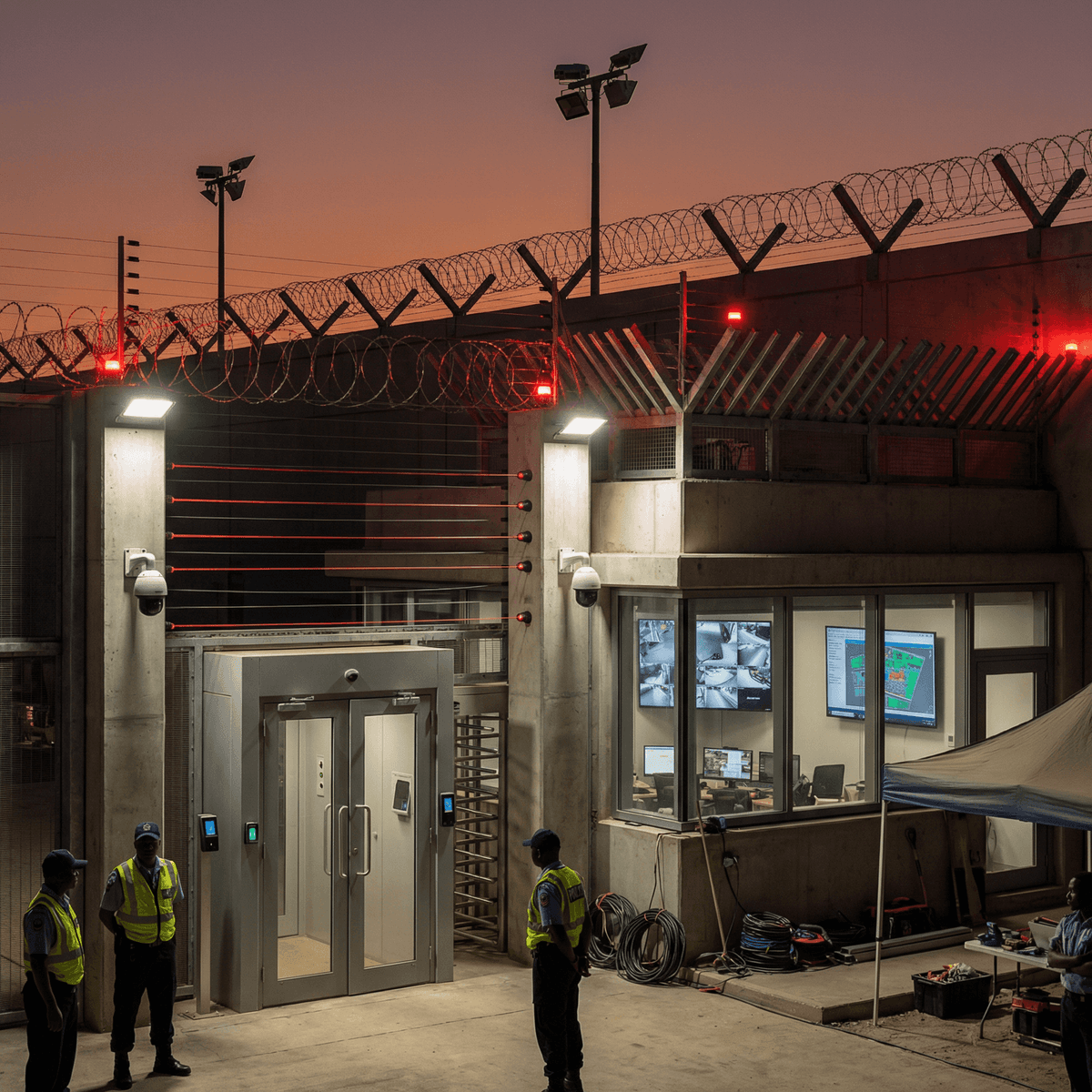
The core architecture usually includes four layers. Layer 1 is perimeter detection using beam sensors, fence-mounted sensors, or dual-technology detectors at gates and vulnerable fence runs. Layer 2 is video verification using fixed IP cameras and PTZ cameras. Layer 3 is local alarm logic in a hybrid control panel or edge controller. Layer 4 is remote monitoring through 4G, Ethernet, or fiber with event escalation.
Off-grid power block sizing
A security node for a solar farm is a small off-grid power system with predictable daily loads. A sample deployment scenario (illustrative): 8 fixed cameras at 8 W each, 2 PTZ cameras at 20 W each, 1 NVR at 35 W, 1 alarm panel at 15 W, 8 beam sets at 3 W each, and communications gear at 20 W creates a continuous load near 198 W. Over 24 hours, that is about 4.75 kWh/day.
If the buyer requires 2 days of autonomy and uses an 80% maximum battery DoD, usable storage should be about 9.5 kWh, with installed nominal capacity closer to 11.9-12.5 kWh after system losses. PV array sizing then depends on local irradiance and seasonal worst month performance. According to NREL (2024), PVWatts remains a standard screening tool for estimating solar yield and system losses before final engineering.
Camera and detector mix
For solar farms, fixed cameras should cover fence lines, gates, inverter pads, and storage containers. PTZ cameras are best reserved for long corridors, central mast positions, or substations where one operator may need to inspect a 200-400 meter line of sight. Detector selection matters because wind-blown vegetation, dust, and thermal variation can make PIR-only designs unstable.
A balanced design often includes:
- 8-24 HD fixed IP cameras for continuous scene coverage
- 2-8 PTZ cameras for long-range verification
- 8-32 perimeter beam sets for fence and gate corridors
- 8-32 PIR or dual-technology detectors for shelters, control rooms, and equipment pads
- 1 hybrid panel with 32-64 zones for alarm partitioning
- 1 NVR sized for 16-32 channels and 15-30 days retention
On-device AI models
On-device AI means the camera, edge box, or NVR runs the detection model locally instead of sending every frame to the cloud. That matters on remote solar farms where uplink bandwidth may be 5-20 Mbps and where 4G latency or data cost makes cloud-only analytics inefficient. Human detection, vehicle classification, line crossing, loitering, and intrusion-in-zone are the most useful first models.
The operational benefit is lower nuisance traffic. Instead of sending every motion event caused by shadows or animals, the system sends clips only when the model confidence and rule logic match a real threat pattern. In current public-sector and industrial deployments, layered AI video analytics can reduce nuisance alarms by up to 90% versus motion-only legacy CCTV. That benchmark aligns with the Government Building 128-Zone Maximum product guidance in the SOLAR TODO security_system range.
According to the International Energy Agency, "Digitalization can improve the monitoring, control and optimization of energy systems." In security terms, the same principle applies: process data at the edge, send exceptions, and keep the operator focused on verified events.
Communications and recording
Remote sites should not rely on a single path. The minimum practical design is 4G plus Ethernet or fiber where available. If one carrier fails, the alarm panel can still push event codes and the NVR can continue local recording. For evidentiary use, 15-30 days retention is common, but critical substations or high-loss regions may justify 30-60 days.
Guard Labor Savings and ROI by Use Case
Solar farm operators can usually cut guard labor by 30-60% when AI-verified alerts, remote talk-down, and zoned response replace patrol-only coverage across gates, fence lines, and inverter blocks.
The labor case is straightforward. A large site may use 2-6 guards across day and night shifts, plus mobile patrol support. If the system can verify alarms remotely and show whether the target is a person, vehicle, or animal within 15-30 seconds, dispatch becomes selective instead of routine. That reduces idle patrol hours and lowers the number of unnecessary vehicle responses.
Sample deployment scenario (illustrative): a 50-hectare site uses 4 guards across rotating shifts. If one night position is removed and replaced by remote monitoring plus event-based dispatch, annual labor savings can be material even after adding telecom and maintenance costs. The exact figure depends on local wages, guard company pricing, and insurer requirements, so buyers should model 3 cases: conservative, base, and high-savings.
The biggest savings usually come from three areas:
- Fewer fixed guard posts at low-traffic perimeter sectors
- Fewer false dispatches caused by non-threat motion events
- Faster evidence retrieval after cable theft, trespass, or vandalism
For O&M contractors, the system also reduces troubleshooting time. If an inverter pad alarm occurs at 02:00, the operator can review a 20-second clip before sending staff. If no intrusion is visible, the event may be environmental or maintenance-related. That prevents unnecessary callouts and improves technician utilization.
SOLAR TODO can support this type of deployment through equipment-only supply, delivered cargo, or turnkey EPC scope depending on project size and buyer preference. For remote energy assets, the procurement discussion should focus on detection coverage per hectare, communications resilience, retention days, and labor displacement assumptions rather than camera count alone.
Comparison and Selection Guide for Solar Farm Security Packages
The right solar farm package depends on site area, alarm zoning, camera count, and whether the buyer needs equipment supply, delivered cargo, or full EPC with commissioning and training.
The table below compares a typical solar farm design logic with relevant SOLAR TODO security_system package benchmarks for buyers evaluating scale, zoning, and delivery scope.
| Configuration | Typical Solar Farm Use | Cameras | Detector / Zone Capacity | Power Mode | Monitoring Style | Indicative Delivery Scope |
|---|---|---|---|---|---|---|
| Small off-grid node | Gate, inverter pad, container area | 8-12 | 16-32 points | Solar + battery | Remote verification | FOB / CIF |
| Medium solar farm package | 10-50 hectare perimeter and core assets | 12-24 | 32-64 zones | Solar + battery hybrid | Remote + local guard | FOB / CIF / EPC |
| Large solar farm package | 50-200 hectare distributed sectors | 24-32+ | 64+ zones | Multi-node solar + backup | Central SOC + dispatch | CIF / EPC |
| Border Checkpoint 32-Zone Off-Grid | Remote perimeter benchmark | 16 | 32 active zones, 64-zone panel | Off-grid | 24/7 full-service monitoring | EPC at USD 7,100-9,200 |
| Government Building 128-Zone Maximum | High-zone benchmark for central facilities | 64 | 128 zones | Grid-powered | 24/7 full-service monitoring | EPC at USD 36,300-46,600 |
Selection should follow site risk, not catalog size. A 12-camera package may be enough for a 10-hectare fenced plant with a single gate and one inverter cluster. The same package will be undersized for a 100-hectare site with multiple access roads, transformer yards, and scattered storage points.
Use these engineering checks during specification:
- Fence line length in meters and number of gates
- Number of critical asset clusters such as inverter pads and transformers
- Required identification distance, not just detection distance
- Minimum autonomy target of 48-72 hours
- Required retention period of 15, 30, or 60 days
- Communications path count: 1, 2, or 3
- Alarm partitions needed for O&M, security, and utility interfaces
According to IEC 62676, video surveillance design should match operational purpose such as detection, observation, recognition, or identification. That distinction is important because a camera that detects movement at 120 meters may not identify a face or license plate at the same distance.
EPC Investment Analysis and Pricing Structure
A solar farm security EPC package should define scope, pricing tier, payment terms, and labor-savings assumptions up front, because a 10-20% scope gap can erase the projected payback.
For B2B procurement, pricing must be separated into three delivery tiers so buyers can compare like-for-like offers.
What EPC turnkey delivery includes
EPC means Engineering, Procurement, and Construction. In security projects, that usually includes site survey, system design, equipment supply, mounting structures, cable schedule, off-grid power block, installation, commissioning, testing, operator training, and handover documentation. It should also define whether civil works, trenching, fence modifications, and telecom subscriptions are included or excluded.
Three-tier pricing model
- FOB Supply: Equipment only, ex-works or free on board. Best for buyers with their own installer and local commissioning team.
- CIF Delivered: Equipment plus freight and insurance to destination port. Best when the buyer manages local installation but wants logistics handled.
- EPC Turnkey: Full delivery including engineering, installation, testing, and training. Best for remote sites or multi-node deployments.
For reference, SOLAR TODO lists the Border Checkpoint 32-Zone Off-Grid at USD 7,100-9,200 in EPC form and the Government Building 128-Zone Maximum at USD 36,300-46,600. A solar farm package will price between those benchmarks depending on camera count, autonomy days, mast height, communications redundancy, and civil scope.
Volume pricing guidance
For portfolio buyers, standard volume guidance can be structured as:
- 50+ units: 5% discount
- 100+ units: 10% discount
- 250+ units: 15% discount
ROI and payback logic
Payback depends on guard labor displacement, theft reduction, and avoided downtime. If a system reduces guard labor by 30-60% and prevents even 1-2 significant cable theft events over 3 years, the project can often pay back in 18-36 months. Buyers should compare annualized system cost against current guard contract cost, incident frequency, and insurance deductibles.
Payment terms and financing
Standard trade terms should be stated clearly:
- 30% T/T deposit + 70% against B/L
- or 100% L/C at sight
For large projects above USD 1,000K, financing support may be available subject to project review. For quotations and EPC scope clarification, buyers can contact [email protected] or reach SOLAR TODO through its project inquiry process.
FAQ
A well-specified solar farm security system uses 8-32 cameras, 16-64 zones, and 48-72 hours of autonomy to improve detection quality while reducing unnecessary guard hours.
Q: What is a solar-powered security system for a solar farm? A: It is an off-grid or hybrid security and surveillance system that powers cameras, detectors, alarm panels, and communications from solar PV and batteries. Typical designs cover 10-200 hectares with 8-32 cameras, 16-64 alarm zones, and 24/7 monitoring even when utility power is unavailable.
Q: Why use solar power for security at a solar farm instead of grid power? A: Solar power keeps the security layer independent from plant outages, maintenance shutdowns, or unstable local supply. That matters on remote sites where fence lines, gates, and inverter blocks may be hundreds of meters from the nearest reliable AC source and still need 48-72 hours of autonomy.
Q: How do on-device AI models reduce false alarms? A: On-device AI runs human, vehicle, line-crossing, or intrusion models inside the camera or edge recorder, so only relevant events are sent upstream. In practice, this can reduce nuisance alarms by up to 90% compared with motion-only CCTV in wind, dust, shadow, or animal-heavy environments.
Q: How much guard labor can a solar farm save with AI security? A: Many sites can reduce guard labor by 30-60% when remote verification replaces some fixed patrol hours. The exact saving depends on site size, local wage rates, insurer rules, and whether the system supports fast event clips, talk-down audio, and clear alarm zoning.
Q: What camera count is typical for a medium-size solar farm? A: A medium site of roughly 10-50 hectares often starts with 12-24 cameras, including 2-6 PTZ units for long-range verification. Final count depends on fence length, gate quantity, inverter pad distribution, required identification distance, and whether substations or storage areas need separate coverage.
Q: What standards should buyers specify in tenders? A: Buyers should reference IEC 62676 for video surveillance, EN 50131 for intrusion systems, UL 681 for installation practice, and NFPA 72 where alarm signaling interfaces matter. For power and communications, the tender should also define retention days, autonomy hours, and redundancy requirements in measurable terms.
Q: How should battery storage be sized for off-grid security loads? A: Start with the measured continuous load in watts, convert it to daily kWh, then multiply by the required autonomy period, usually 2-3 days. Divide by allowable battery DoD, often 70-80%, and add system losses so the installed battery capacity is not undersized during poor weather.
Q: What communications setup is best for remote solar farms? A: A dual-path design is usually best: 4G for primary or backup signaling plus Ethernet or fiber where available. Single-path systems are cheaper at first, but one carrier outage or router failure can leave a site blind, especially if cloud-only analytics are used.
Q: How long should video be stored on a solar farm security system? A: Most operators specify 15-30 days of retention for routine security review and incident evidence. Sites with repeated theft risk, utility interface requirements, or delayed incident reporting may need 30-60 days, which increases storage, bandwidth planning, and power consumption.
Q: What does EPC turnkey include for this type of project? A: EPC turnkey usually includes engineering, equipment supply, mounting structures, installation, commissioning, testing, training, and handover documents. Buyers should confirm whether trenching, mast foundations, telecom subscriptions, and fence modifications are included, because those items can change total project cost by 10-20%.
Q: How are FOB, CIF, and EPC prices different? A: FOB Supply covers equipment only, CIF Delivered adds freight and insurance to the destination port, and EPC Turnkey includes engineering and site execution. For portfolio buyers, these tiers make comparison easier, and volume orders of 50+, 100+, and 250+ units can support 5%, 10%, and 15% discounts.
Q: What are the standard payment terms and financing options? A: Common terms are 30% T/T in advance and 70% against B/L, or 100% L/C at sight for qualified transactions. For larger projects above USD 1,000K, financing support may be available after technical and commercial review with SOLAR TODO.
Conclusion
Solar-powered security systems for solar farms deliver the best value when 8-32 cameras, 16-64 zones, and on-device AI are matched to real perimeter risk and 30-60% guard labor reduction targets.
Bottom line: for remote solar farms, SOLAR TODO recommends an off-grid or hybrid architecture with 48-72 hours autonomy, AI-based event verification, and clear EPC scope, because lower false alarms and faster response usually drive payback within 18-36 months.
References
- NREL (2024): PVWatts Calculator methodology and solar resource modeling used to estimate PV output and off-grid energy balance.
- IEC 62676 (2024): Video surveillance systems for use in security applications, including performance and operational purpose guidance.
- EN 50131 (2023): Intrusion and hold-up alarm systems framework for detector, control, and signaling design.
- UL 681 (2023): Installation and classification guidance for burglary and holdup alarm systems.
- NFPA 72 (2022): National Fire Alarm and Signaling Code, relevant where supervisory and alarm signaling interfaces are required.
- IEA (2024): Renewable and digital energy system outlooks supporting the role of monitoring, automation, and distributed asset management.
- IRENA (2024): Renewable Power Generation Costs report covering project economics and long-term operating competitiveness.
- IEEE 802.3 / IEEE network practice references (2023): Ethernet communication framework commonly applied in IP surveillance backbones.
About SOLARTODO
SOLARTODO is a global integrated solution provider specializing in solar power generation systems, energy-storage products, smart street-lighting and solar street-lighting, intelligent security & IoT linkage systems, power transmission towers, telecom communication towers, and smart-agriculture solutions for worldwide B2B customers.
About the Author

SOLARTODO Editorial Team
Solar Energy & Infrastructure Expert Team
SOLAR TODO is a professional supplier of solar energy, energy storage, smart lighting, smart agriculture, security systems, communication towers, and power tower equipment.
Our technical team has over 15 years of experience in renewable energy and infrastructure, providing high-quality products and solutions to B2B customers worldwide.
Expertise: PV system design, energy storage optimization, smart lighting integration, smart agriculture monitoring, security system integration, communication and power tower supply.
Cite This Article
SOLARTODO Editorial Team. (2026). Engineering Solar-Powered Security Systems for solar…. SOLARTODO. Retrieved from https://solartodo.com/knowledge/engineering-solar-powered-security-systems-for-solar-farms-on-device-ai-models-and-guard-labor-savings
@article{solartodo_engineering_solar_powered_security_systems_for_solar_farms_on_device_ai_models_and_guard_labor_savings,
  title = {Engineering Solar-Powered Security Systems for solar…},
  author = {SOLARTODO Editorial Team},
  journal = {SOLARTODO Knowledge Base},
  year = {2026},
  url = {https://solartodo.com/knowledge/engineering-solar-powered-security-systems-for-solar-farms-on-device-ai-models-and-guard-labor-savings},
  note = {Accessed: 2026-10-19}
}
Published: July 12, 2026 | Available at: https://solartodo.com/knowledge/engineering-solar-powered-security-systems-for-solar-farms-on-device-ai-models-and-guard-labor-savings
Subscribe to Our Newsletter
Get the latest solar energy news and insights delivered to your inbox.
View All Articles