Solar Farm Security Systems: Battery Autonomy & Cost

SOLARTODO Editorial Team
Solar Energy & Infrastructure Expert Team
Watch the video
TL;DR
For remote solar farms, a dedicated off-grid security system is often cheaper than extending utility power. Most projects should target 48-120 hours of battery autonomy, 16-64 cameras, and LiFePO4 storage sized from actual Wh/day load plus 15-20% losses. If grid extension exceeds about 1 km, avoided connection CAPEX can make no-grid security the better financial choice.
Solar-powered security systems for solar farms typically use 2-5 days of battery autonomy, 16-64 cameras, and 24/7 monitoring to avoid grid-extension costs that often exceed USD 15,000-60,000/km. Proper DC load calculation and lithium storage sizing determine uptime, CAPEX, and false-alarm resilience.
Summary
Solar-powered security systems for solar farms typically use 2-5 days of battery autonomy, 16-64 cameras, and 24/7 monitoring to avoid grid-extension costs that often exceed USD 15,000-60,000/km. Proper DC load calculation and lithium storage sizing determine uptime, CAPEX, and false-alarm resilience.
Key Takeaways
- Calculate total daily security load in Wh/day and add a 20-30% design margin before sizing PV and battery capacity for 24/7 operation.
- Size battery autonomy at 48-120 hours for remote solar farms, with LiFePO4 systems commonly limited to 80% depth of discharge for longer cycle life.
- Reduce camera and detector consumption by selecting 4-8 W fixed IP cameras, 15-30 W PTZ cameras, and alarm devices with low standby draw below 2 W.
- Compare no-grid and grid-extension options early because rural utility connection costs often reach USD 15,000-60,000 per km plus transformer and permit charges.
- Use layered detection with 16-64 cameras, PIR detectors, beam sensors, and analytics to cut nuisance alarms by up to 90% versus motion-only legacy CCTV.
- Design for 3-5 peak sun hour worst-month conditions and include 15-20% system losses for wiring, temperature, inverter, and battery conversion.
- Specify compliance with IEC 62676, EN 50131, UL 681, and NFPA 72 when video, intrusion, installation practice, and alarm signaling must align with recognized standards.
- Evaluate EPC pricing in three tiers—FOB, CIF, and turnkey EPC—and apply volume discounts of 5% at 50+, 10% at 100+, and 15% at 250+ units or sites.
Why solar-powered security fits remote solar farms
Solar-powered security systems for solar farms usually deliver lower total project cost when grid connection is unavailable, with battery autonomy of 2-5 days and avoided utility extension costs of USD 15,000-60,000 per km.
A remote PV plant often has a paradox: it generates electricity in the daytime but still lacks a practical low-voltage supply for perimeter security, gate control, and surveillance at night. Utility interconnection for export power does not automatically provide a low-cost, always-available auxiliary supply at every fence line, access road, and equipment cluster. In many projects, trenching, transformer upgrades, and utility approvals add months and substantial CAPEX.
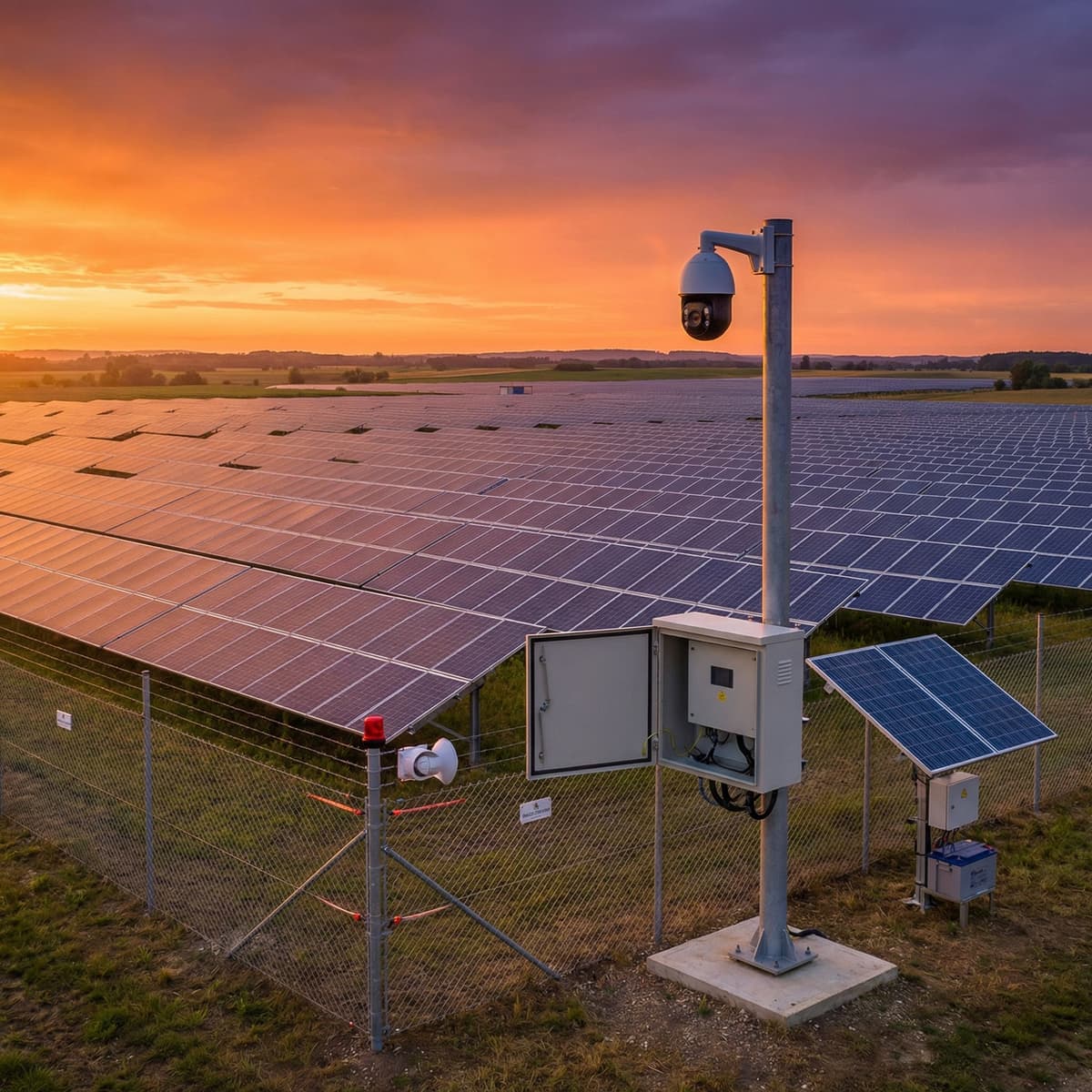
For that reason, developers increasingly separate plant-generation infrastructure from security power architecture. A dedicated off-grid security package uses its own PV array, charge controller, battery bank, DC distribution, and backup logic to support cameras, NVR, wireless links, detectors, warning lights, and communications. This approach is common where the protected perimeter extends 500 m to several kilometers and where theft risk includes cables, modules, inverters, fuel, and tools.
According to the International Energy Agency, "Solar PV is set to become the largest renewable power source by 2029." That growth increases the value of remote solar assets and raises the need for reliable site protection. According to NREL (2024), battery-backed remote power design must start with time-series load and resource analysis rather than nominal module wattage alone, because worst-month irradiance determines real autonomy.
SOLAR TODO addresses this use case with off-grid security and surveillance configurations that combine intrusion detection, video verification, and independent solar power. For medium remote sites, buyers often compare a dedicated off-grid architecture with packages similar in logic to the Border Checkpoint 32-Zone Off-Grid concept: 32 active security zones, 16 cameras, 32 detectors, and 24/7 monitoring support. The same design method can be adapted for solar farms, substations, inverter pads, and O&M compounds.
Battery autonomy design for 24/7 operation
Battery autonomy for solar-farm security is usually set at 48-120 hours because 2-5 days covers night operation, poor-weather periods, and maintenance delays without needing a utility connection.
Battery autonomy is the number of hours or days the system can operate with no usable solar input. For solar-farm security, autonomy is not just a convenience metric; it is the difference between a verified alarm and a dark site after two cloudy days. In practical engineering, autonomy must cover nighttime loads, low-irradiance weather, battery aging, and communications peaks.
The design sequence is straightforward. First, calculate each device load in watts and operating hours per day. Second, total the daily energy demand in Wh/day. Third, apply system losses, usually 15-20%, for battery conversion, cable losses, controller inefficiency, and temperature effects. Fourth, multiply by the required autonomy period, then divide by allowable depth of discharge.
Sample load calculation
A typical medium solar-farm security package may include 12 fixed IP cameras at 6 W each, 4 PTZ cameras at 20 W each, 16 PIR or dual-tech detectors at 1.5 W average, 1 NVR at 40 W, 1 wireless bridge at 18 W, 1 network switch at 20 W, and miscellaneous control loads of 15 W. That totals about 269 W continuous demand.
At 24 hours, the daily energy need is about 6,456 Wh/day. Adding 20% losses gives roughly 7,747 Wh/day. For 3 days of autonomy, the battery must deliver about 23.2 kWh usable energy. With LiFePO4 limited to 80% depth of discharge, nominal battery capacity rises to roughly 29.0 kWh.
| Load Item | Qty | Unit Power | Daily Hours | Daily Energy |
|---|---|---|---|---|
| Fixed IP camera | 12 | 6 W | 24 h | 1,728 Wh |
| PTZ camera | 4 | 20 W | 24 h | 1,920 Wh |
| Detectors | 16 | 1.5 W | 24 h | 576 Wh |
| NVR | 1 | 40 W | 24 h | 960 Wh |
| Wireless bridge | 1 | 18 W | 24 h | 432 Wh |
| PoE/network switch | 1 | 20 W | 24 h | 480 Wh |
| Control and auxiliary loads | 1 | 15 W | 24 h | 360 Wh |
| Total | - | 269 W | - | 6,456 Wh/day |
The battery chemistry matters. Lead-acid can still be used, but LiFePO4 is usually preferred because usable depth of discharge is higher, charge acceptance is better, and cycle life can exceed 4,000-6,000 cycles under controlled conditions. That reduces replacement frequency in sites where truck access is difficult and O&M labor is expensive.
According to IRENA (2024), battery system costs continue to decline, improving the economics of off-grid and hybrid power systems. According to BloombergNEF (2024), lithium-ion battery pack prices fell to record lows in global benchmarking, which supports the business case for dedicated security power instead of long-distance auxiliary grid extension. The International Energy Agency states, "Batteries are becoming a key technology for secure and flexible electricity systems," and that statement applies directly to remote surveillance uptime.
Technical architecture and equipment selection
A solar-farm security architecture should combine 16-64 cameras, 32-128 detector points, and DC-coupled storage sized for worst-month irradiance rather than average annual solar yield.
The technical objective is simple: keep the security layer alive when weather is poor, when the plant is shut down, and when no utility service is available at the perimeter. That requires a power subsystem and a security subsystem designed together, not as separate procurement packages. If the camera count grows from 16 to 32 without revising storage, autonomy collapses quickly.
A practical architecture includes PV modules, MPPT charge controllers, LiFePO4 batteries, DC distribution, surge protection, grounding, communications, NVR or edge recording, and intrusion devices. For larger sites, a distributed design is often better than one central power node. Four smaller solar-security nodes over a 2 km fence can reduce voltage drop, cable theft exposure, and trenching cost.
Recommended subsystem ranges
For medium solar farms, common ranges are:
- PV array: 2.5-8.0 kWp depending on load and worst-month peak sun hours
- Battery bank: 15-60 kWh nominal for 2-5 days autonomy
- Fixed cameras: 8-48 units at 4-8 W each
- PTZ cameras: 2-16 units at 15-30 W each
- Detector points: 16-128 zones using PIR, dual-tech, beam, or fence sensors
- Communications: 4G, point-to-point wireless, fiber spur, or mixed topology
- Recording retention: 15-30 days depending on bitrate, codec, and event rules
For standards alignment, video components should follow IEC 62676 and intrusion logic should align with EN 50131. Installation practice is commonly benchmarked against UL 681, while NFPA 72 becomes relevant where supervisory signaling, fire interface, or monitored alarm transmission is required. Where surge and grounding risk is high, IEC 62305 lightning protection principles should also be considered, especially in open-field PV plants with long cable runs.
SOLAR TODO typically recommends layered detection rather than camera-only protection. A camera can verify an event, but a detector or analytics rule should trigger attention. For example, perimeter beams can protect the fence line, dual-tech detectors can cover inverter stations, and PTZ units can verify alarms at gates or transformer yards. This reduces bandwidth waste and improves operator response time.
According to IEC system guidance and manufacturer field practice, nuisance alarms are a major cost driver because they consume guard labor and reduce trust in the alarm system. In larger public-sector and industrial deployments, AI-assisted video analytics can reduce nuisance alarms by up to 90% versus motion-only legacy CCTV. That benchmark is consistent with current integrator claims across the intelligent surveillance market, though exact results depend on scene calibration, lighting, and vegetation control.
No-grid connection cost versus dedicated off-grid security
Avoiding a grid connection often saves more than the battery system costs when utility extension exceeds 1 km, because trenching, poles, transformer work, and approvals can push auxiliary power CAPEX above USD 15,000-60,000 per km.
The financial comparison should start with a simple question: what is the delivered cost of one reliable watt at the fence line? Many developers underestimate the cost of bringing low-voltage service to remote gates, perimeter towers, and camera poles. Even if the main plant has a substation, the security loads may sit hundreds of meters away across roads, drainage, or rocky terrain.
Grid-extension cost typically includes trenching or poles, armored cable, protection devices, metering, transformer or panel modifications, engineering review, utility fees, civil reinstatement, and schedule delay. In remote markets, the soft costs can be as painful as the hardware. A dedicated off-grid package avoids much of that and turns the problem into a defined equipment scope with predictable installation steps.
EPC Investment Analysis and Pricing Structure
EPC turnkey delivery for off-grid solar security typically includes engineering, procurement, construction, commissioning, and operator handover, while pricing is usually structured as FOB supply, CIF delivered, or full EPC turnkey.
For B2B buyers, the three-tier commercial model should be evaluated early:
| Pricing Tier | What is Included | Typical Use |
|---|---|---|
| FOB Supply | Equipment only, factory dispatch, packing list, basic manuals | Buyers with local installer or EPC partner |
| CIF Delivered | Equipment, export handling, sea freight, insurance to destination port | Importers managing inland works and installation |
| EPC Turnkey | Design, supply, installation, testing, commissioning, training | Developers seeking one accountable contractor |
A medium off-grid security package for a solar farm can vary widely by camera count, autonomy, and communications method. As a guide, systems in the same complexity class as a 32-zone off-grid package with 16 cameras, 32 detectors, and hybrid alarm logic often fall into a turnkey range similar to USD 7,100-9,200 for compact remote security applications, but solar-farm layouts with longer perimeters, larger batteries, elevated poles, and wireless backhaul will usually price higher. Final quotation depends on zone count, retention days, battery kWh, and civil scope.
Volume pricing guidance should be explicit in procurement planning:
- 50+ units or repeated site packages: 5% discount
- 100+ units: 10% discount
- 250+ units: 15% discount
Payment terms commonly used by SOLAR TODO are:
- 30% T/T deposit + 70% against B/L
- 100% L/C at sight
For large projects above USD 1,000K, financing support may be available subject to project review, buyer profile, and country risk. Commercial inquiries can be directed to [email protected] or through SOLAR TODO offline quotation channels.
ROI logic versus grid extension
If a site needs 2 km of auxiliary grid extension at USD 20,000/km, the connection cost alone is about USD 40,000 before local distribution and approvals. If an off-grid security power package costs USD 18,000-28,000 with 3 days autonomy, the avoided connection CAPEX can create immediate savings of USD 12,000-22,000.
The operating side also matters. A dedicated solar-security package avoids monthly utility minimum charges and can keep running during local outages. Payback is often immediate when it replaces new grid extension, or 2-5 years when compared against diesel-supported security posts with fuel, service visits, and generator replacement. According to NREL and IEA guidance on remote power systems, lifecycle cost rather than first-cost should drive design decisions.
Use cases and selection guide for solar farms
The best security design for a solar farm depends on perimeter length, asset concentration, and risk zoning, with 1 primary gate, 2-6 equipment clusters, and 16-64 cameras being common planning ranges.
A utility-scale solar farm rarely needs uniform protection at every meter of fence. It needs risk-based zoning. Gates, inverter stations, combiner boxes, battery containers, spare-parts stores, and O&M buildings usually deserve higher sensor density than low-risk fence stretches. That is why 32-zone and 64-zone architectures are often more efficient than a flat camera count approach.
Sample deployment scenario (illustrative): a site with a 1.8 km perimeter, 1 main gate, 3 inverter blocks, and 1 O&M cabin may use 12 fixed cameras, 4 PTZ cameras, 8 beam sets, 16 dual-tech detectors, and a 30 kWh LiFePO4 battery bank. That package can support 72 hours of autonomy if the total adjusted load stays near 7.5-8.0 kWh/day and the PV array is sized for worst-month irradiance.
| Design Option | Typical Site Profile | Camera Count | Detector Points | Battery Autonomy | Main Advantage |
|---|---|---|---|---|---|
| Compact off-grid | Gate + O&M cabin + short fence | 8-12 | 8-16 | 48-72 h | Lowest CAPEX |
| Medium zoned system | 1-2 km perimeter + inverter blocks | 16-24 | 16-32 | 72-96 h | Balanced coverage |
| Expanded multi-node | 2-5 km perimeter + multiple clusters | 24-64 | 32-128 | 96-120 h | Better resilience and scalability |
Selection should also consider communications. If 4G signal is weak, point-to-point wireless or fiber spur may be necessary. If theft risk includes copper cable, distributed solar nodes reduce long cable runs. If the site has heavy fog, dust, or thermal shimmer, detector mix and analytics rules must be adjusted to maintain detection quality.
SOLAR TODO generally advises buyers to define five inputs before quotation: perimeter length in meters, number of critical assets, required autonomy in hours, video retention days, and available communications path. With those five numbers, an engineer can usually narrow the design to a practical battery size, PV capacity, and zone architecture within one proposal cycle.
FAQ
A well-designed solar-farm security system usually needs 48-120 hours of battery autonomy, 16-64 cameras, and a cost comparison against grid extension before procurement starts.
Q: What is a solar-powered security system for a solar farm? A: It is an off-grid or hybrid surveillance and intrusion system powered by its own PV modules and battery bank rather than a utility feed. A typical package supports 16-64 cameras, 16-128 detector points, communications equipment, and 24/7 recording for remote plant protection.
Q: How many days of battery autonomy should a solar farm security system have? A: Most remote sites should be designed for 2-5 days of autonomy, or 48-120 hours. The right number depends on worst-month irradiance, road access, outage tolerance, and whether the site can accept reduced recording or lower frame rates during extended bad weather.
Q: Why can no-grid security be cheaper than connecting to the utility? A: No-grid security can be cheaper because auxiliary power extension often costs USD 15,000-60,000 per km before local distribution upgrades. If the gate or perimeter is 1-2 km from the nearest practical supply point, batteries and dedicated PV often cost less than trenching, permits, and transformer work.
Q: How do I calculate battery size for cameras and detectors? A: Add all device loads in watts, multiply by 24 hours, add 15-20% system losses, and then multiply by the required autonomy period. Divide that usable energy by allowable depth of discharge, such as 80% for LiFePO4, to get the nominal battery capacity in kWh.
Q: What battery chemistry is best for remote security systems? A: LiFePO4 is usually the preferred option because it supports high cycle life, good charge efficiency, and deeper usable discharge than lead-acid. In many remote applications, 4,000-6,000 cycles and 80% depth of discharge make LiFePO4 more economical over the system life.
Q: How many cameras does a medium solar farm usually need? A: A medium site often uses 16-24 cameras, including fixed units for perimeter views and 2-4 PTZ units for alarm verification. Final quantity depends on perimeter length, gate count, equipment clusters, lighting conditions, and whether analytics or beam sensors are used to reduce blind spots.
Q: What standards should buyers ask for in a security specification? A: Buyers should usually request IEC 62676 for video surveillance, EN 50131 for intrusion systems, UL 681 for installation practice, and NFPA 72 where monitored signaling or fire interface is relevant. For open-field sites, grounding and lightning risk should also be reviewed under IEC 62305 principles.
Q: What does EPC turnkey include for an off-grid security project? A: EPC turnkey normally includes site assessment, electrical and security design, equipment supply, installation, testing, commissioning, and operator training. SOLAR TODO can also support offline quotation, cargo delivery, and financing review for projects above USD 1,000K depending on scope and buyer profile.
Q: What are the usual payment terms and volume discounts? A: Standard payment terms are commonly 30% T/T deposit and 70% against B/L, or 100% L/C at sight. Volume guidance is typically 5% discount for 50+ units, 10% for 100+, and 15% for 250+ units or repeated multi-site procurement.
Q: How long is the ROI period for off-grid solar security? A: ROI can be immediate when the system replaces new grid extension that would cost more than the off-grid package. In comparisons against diesel-backed security posts or rented temporary power, payback is often around 2-5 years depending on fuel, labor, and maintenance costs.
Q: Can the system expand later if the solar farm grows? A: Yes, expansion is common if the control panel, NVR channels, and battery enclosure are selected with spare capacity. A 64-zone hybrid panel, for example, can start with 32 active zones and leave room for added beam sensors, gates, or equipment-yard detectors later.
Q: How should buyers start a technical inquiry with SOLAR TODO? A: Start with five numbers: perimeter length, number of gates, target camera count, required autonomy in hours, and desired video retention days. SOLAR TODO can then prepare an offline quotation covering equipment scope, delivery model, and whether FOB, CIF, or EPC turnkey is the better fit.
References
- NREL (2024): PVWatts and distributed system modeling guidance used to estimate solar energy yield, losses, and off-grid performance assumptions.
- IEA (2024): Renewable market and power-sector outlooks documenting rapid solar PV growth and the increasing value of remote asset protection.
- IRENA (2024): Renewable power generation cost and storage market analysis showing continued improvement in battery economics for off-grid applications.
- IEC 62676 (2025): Video surveillance systems for use in security applications, covering performance and system considerations for CCTV design.
- EN 50131 (2024): Intrusion and hold-up alarm system framework commonly referenced for detector zoning and alarm logic.
- UL 681 (2024): Installation and classification practices for burglary and holdup alarm systems used in professional security projects.
- NFPA 72 (2025): National Fire Alarm and Signaling Code relevant to supervisory signaling, monitored pathways, and integrated alarm communication.
- BloombergNEF (2024): Battery price survey and market benchmarking relevant to lithium storage cost trends in remote power applications.
Conclusion
Solar-powered security for solar farms is usually the lowest-risk option when 48-120 hours of autonomy can avoid grid-extension costs of USD 15,000-60,000 per km and keep 16-64 cameras online during outages.
The bottom line is clear: if a remote solar farm must protect gates, inverter blocks, and perimeter assets without dependable utility supply, a dedicated off-grid security architecture with correctly sized LiFePO4 storage is often the most economical choice. SOLAR TODO can support FOB, CIF, or EPC turnkey delivery with offline quotation based on site perimeter, camera count, battery autonomy, and communications constraints.
About SOLARTODO
SOLARTODO is a global integrated solution provider specializing in solar power generation systems, energy-storage products, smart street-lighting and solar street-lighting, intelligent security & IoT linkage systems, power transmission towers, telecom communication towers, and smart-agriculture solutions for worldwide B2B customers.
About the Author

SOLARTODO Editorial Team
Solar Energy & Infrastructure Expert Team
SOLAR TODO is a professional supplier of solar energy, energy storage, smart lighting, smart agriculture, security systems, communication towers, and power tower equipment.
Our technical team has over 15 years of experience in renewable energy and infrastructure, providing high-quality products and solutions to B2B customers worldwide.
Expertise: PV system design, energy storage optimization, smart lighting integration, smart agriculture monitoring, security system integration, communication and power tower supply.
Cite This Article
SOLARTODO Editorial Team. (2026). Solar Farm Security Systems: Battery Autonomy & Cost. SOLARTODO. Retrieved from https://solartodo.com/knowledge/engineering-solar-powered-security-systems-for-solar-farms-battery-autonomy-and-no-grid-connection-cost
@article{solartodo_engineering_solar_powered_security_systems_for_solar_farms_battery_autonomy_and_no_grid_connection_cost,
  title = {Solar Farm Security Systems: Battery Autonomy & Cost},
  author = {SOLARTODO Editorial Team},
  journal = {SOLARTODO Knowledge Base},
  year = {2026},
  url = {https://solartodo.com/knowledge/engineering-solar-powered-security-systems-for-solar-farms-battery-autonomy-and-no-grid-connection-cost},
  note = {Accessed: 2026-09-19}
}
Published: May 8, 2026 | Available at: https://solartodo.com/knowledge/engineering-solar-powered-security-systems-for-solar-farms-battery-autonomy-and-no-grid-connection-cost
Subscribe to Our Newsletter
Get the latest solar energy news and insights delivered to your inbox.
View All Articles