Edge vs Cloud Processing for Traffic AI in 2026

SOLAR TODO
Solar Energy & Infrastructure Expert Team
Watch the video
TL;DR
Hybrid architecture is now the preferred traffic AI model because it keeps real-time control at the edge and shifts citywide analytics to the cloud. That means sub-100 ms response for signals and enforcement, 70-90% lower bandwidth than cloud-only streaming, and scalable optimization across 50-100+ intersections. For most B2B projects, hybrid delivers the best balance of latency, resilience, and ROI.
Hybrid traffic AI is the 2026 standard because edge delivers sub-100 ms control, while cloud optimizes 50-100+ intersections. The model supports 98% license plate recognition, cuts bandwidth 70-90%, and improves resilience for city and off-grid deployments.
Summary
Hybrid traffic AI architecture is the 2026 standard because edge processing delivers sub-100 ms response for signal control, while cloud analytics scales citywide optimization across 50-100 intersections and supports 98% license plate recognition with lower bandwidth and higher resilience.
Key Takeaways
- Deploy edge AI for safety-critical functions that require sub-100 ms response, including red-light enforcement, emergency priority, and adaptive signal timing at individual intersections.
- Use cloud platforms to aggregate data from 50-100 intersections or more, enabling digital twins, historical trend analysis, and network-wide optimization with lower per-site compute cost.
- Combine edge and cloud to reduce backhaul traffic by 70-90% when only metadata, alerts, and selected video evidence are transmitted instead of continuous raw streams.
- Specify local storage and LFP battery backup for 24/7 operation, especially in off-grid corridors where solar-powered poles can maintain enforcement and sensing during grid outages.
- Prioritize hybrid systems for motorcycle-heavy regions, where AI models covering 45+ object and violation types improve detection of helmet non-compliance, triple riding, and wrong-way movement.
- Compare total cost across FOB Supply, CIF Delivered, and EPC Turnkey models, then apply volume discounts of 5% at 50+ units, 10% at 100+, and 15% at 250+ units.
- Validate interoperability with standards such as IEEE 802.1 TSN, IEEE 1547 where solar integration applies, IEC 62443 cybersecurity guidance, and GDPR-aligned data governance for legal enforcement.
- Plan ROI around measurable KPIs such as 10-30% travel time reduction, 20% emissions reduction, and up to 50% faster emergency response from coordinated smart traffic deployments.
Why Hybrid Architecture Is Becoming the 2026 Standard
Hybrid traffic AI is becoming the 2026 standard because edge nodes handle sub-100 ms decisions locally while cloud platforms optimize 50-100 intersections or entire cities using aggregated data and lower-cost centralized compute.
Pure edge and pure cloud architectures both solve part of the traffic AI problem, but neither solves the full operational requirement of a modern city. Traffic systems must respond instantly to pedestrians, buses, ambulances, motorcycles, and violations at the roadside. They must also support long-horizon planning, cross-corridor optimization, evidence retention, cybersecurity oversight, and model updates across many sites.
According to deployment results cited in the smart traffic sector, Pittsburgh achieved a 25% reduction in travel time and a 20% reduction in emissions using adaptive AI signal control. London reported 10-30% travel time improvement, and coordinated green-wave strategies can reduce stops by 40%. These gains depend on both local control and network-level analytics, which is why hybrid architecture now dominates serious tenders.
For B2B buyers, the question is no longer edge or cloud. The real procurement question is how to split workloads so that latency-sensitive tasks stay local, data-heavy optimization moves to the cloud, and the full system remains resilient during outages, bandwidth constraints, and cyber incidents. SOLAR TODO positions hybrid architecture as the most practical design for municipalities, highways, industrial parks, and off-grid corridors.
The International Energy Agency states, "Digitalization can improve the efficiency, reliability and sustainability of energy systems," and the same logic applies to transport infrastructure when sensing, control, and power systems are integrated. In traffic AI, the winning architecture is the one that balances speed, scale, and survivability.
Edge Processing in Traffic AI: Where Local Decisions Matter
Edge processing is best for real-time traffic actions because local inference can trigger signal changes, emergency priority, and violation capture in under 100 ms without depending on unstable backhaul links.
Edge processing means AI inference runs on devices installed at or near the intersection, such as smart poles, roadside units, industrial gateways, or embedded GPU/ASIC controllers. Cameras, radar, lidar, and loop alternatives send data to the local node, which detects vehicles, pedestrians, incidents, and violations immediately. This architecture is essential when milliseconds matter.
Typical edge workloads include:
- Adaptive signal timing by lane occupancy and queue length
- Red-light and speed violation detection
- Automatic emergency vehicle priority
- Pedestrian crossing protection
- Local license plate recognition at up to 98% accuracy
- Motorcycle and e-bike behavior analysis in mixed traffic
In developing markets, edge AI is especially valuable because two-wheelers often represent 60% or more of traffic. Models must classify helmet use, triple riding, lane intrusion, wrong-way movement, and overloaded motorcycles in real time. SOLAR TODO's smart traffic platform supports 45+ object and violation types, making local inference practical in complex urban conditions where cloud roundtrips would be too slow.
Advantages of edge processing
Edge architecture reduces latency, preserves core operations during connectivity loss, and lowers bandwidth use when only events or metadata are sent upstream. It also supports legal enforcement by storing time-stamped evidence locally before secure transmission. For rural highways and border corridors, edge systems can continue operating even when cellular backhaul is intermittent.
Limits of edge-only design
Edge-only systems become difficult to manage at scale. Every site needs sufficient compute, storage, model lifecycle management, patching, and cybersecurity hardening. If a city expands from 5 intersections to 500, the operational burden rises sharply. Edge-only systems also struggle with citywide optimization because each node sees only its local environment.
Cloud Processing in Traffic AI: Where Scale and Coordination Win
Cloud processing is best for citywide coordination because it can analyze millions of events, train models centrally, and optimize 100+ intersections with digital twins, historical trends, and cross-corridor control logic.
Cloud traffic AI platforms ingest metadata, selected video clips, telemetry, and enforcement records from many sites. They support dashboards, digital twin simulation, policy tuning, fleet integration, and long-term storage. For transportation departments, the cloud provides the management layer required to compare corridors, audit KPIs, retrain models, and coordinate upgrades across a region.
According to the smart traffic deployment data, Singapore achieved a 15% reduction in commute time using digital twin methods, while transit and emergency priority can reduce response time by up to 50%. These are cloud-strength outcomes because they depend on network-wide visibility rather than isolated intersection intelligence.
Cloud workloads usually include:
- Multi-intersection optimization and scenario modeling
- Historical trend analysis and congestion forecasting
- Centralized AI model training and rollout
- Evidence management and retention policies
- SLA monitoring, diagnostics, and firmware governance
- Integration with command centers, ERP, and municipal reporting systems
Advantages of cloud processing
Cloud systems improve scalability and reduce the need for powerful compute at every roadside cabinet. They also simplify reporting for procurement teams and city operators because all KPIs are visible in one place. When paired with digital twins, cloud platforms help justify budgets by simulating the effect of timing plans, lane changes, or enforcement expansion before field deployment.
Limits of cloud-only design
Cloud-only traffic AI is vulnerable to latency, bandwidth cost, and service interruption. Continuous HD video streaming from many intersections is expensive and often unnecessary. More importantly, safety-critical actions cannot wait for a roundtrip to a distant data center. A cloud-only design may be acceptable for reporting, but it is not sufficient for modern adaptive control.
The U.S. National Institute of Standards and Technology states, "Zero trust assumes there is no implicit trust granted to assets or user accounts based solely on their physical or network location." For traffic AI, that means cloud connectivity must be designed securely, but critical roadside decisions should still remain local.
Hybrid Architecture Design: The Practical 2026 Blueprint
Hybrid traffic AI architecture works by keeping 80-90% of time-critical inference at the edge while sending metadata, alerts, and selected evidence to the cloud for optimization, governance, and long-term analytics.
A hybrid design assigns each workload to the layer where it performs best. Edge handles immediate perception and control. Cloud handles coordination, storage policy, fleet management, and model lifecycle. This split reduces backhaul demand, preserves uptime, and enables expansion from pilot to citywide deployment without redesigning the whole system.
A practical hybrid stack includes:
- Edge cameras, radar, or multimodal sensors on smart poles
- Local AI compute for detection, tracking, and event generation
- Local storage for buffered evidence and fail-safe retention
- Secure backhaul via fiber, 4G/5G, microwave, or satellite
- Cloud control plane for dashboards, digital twin, and analytics
- API layer for police, transport authority, and emergency services
Comparison table: edge vs cloud vs hybrid for traffic AI
| Criteria | Edge Processing | Cloud Processing | Hybrid Architecture |
|---|---|---|---|
| Response time | Sub-100 ms | 300 ms to several seconds | Sub-100 ms for control, cloud for planning |
| Bandwidth demand | Low to medium | High if raw video is streamed | Medium, optimized by metadata upload |
| Resilience during outage | High | Low to medium | High |
| Citywide optimization | Limited | Strong | Strong |
| Per-site hardware cost | Higher | Lower | Medium |
| Scalability across 100+ sites | Moderate | High | High |
| Evidence retention | Local first | Centralized | Local plus centralized |
| Best use case | Safety-critical control | Analytics and digital twin | Full smart traffic deployment |
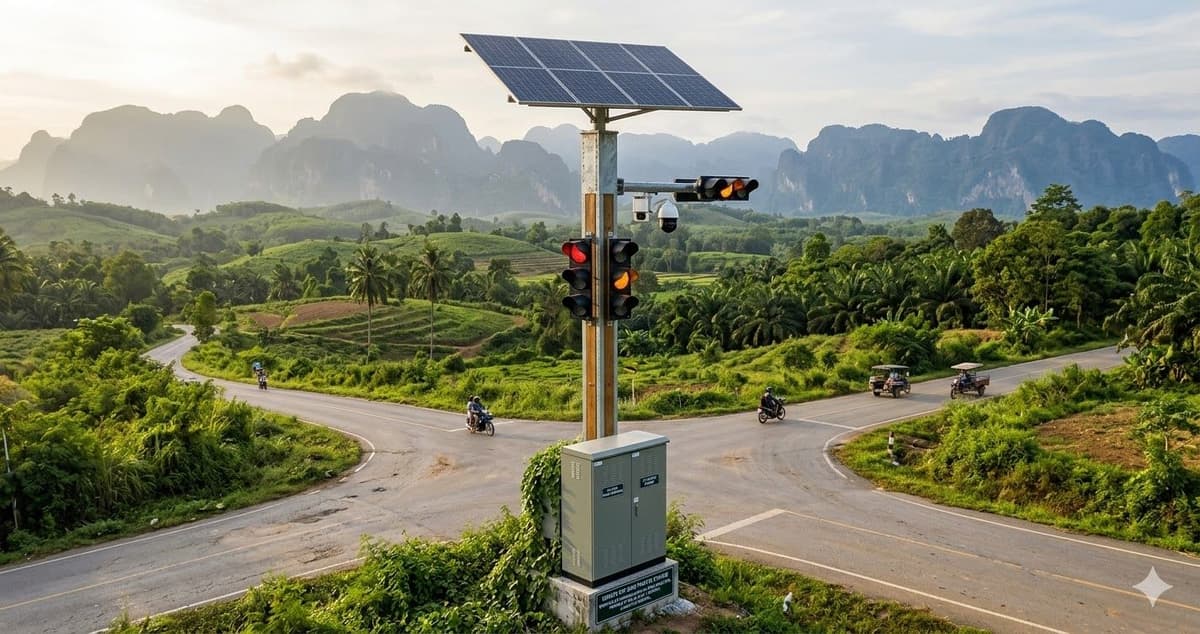
For SOLAR TODO projects, hybrid design becomes even more compelling when infrastructure is solar-powered. Pole-top solar panels and LFP battery storage support 24/7 operation without full dependence on grid electricity. That matters in rural highways, developing regions, and temporary deployments where traffic enforcement and adaptive control must continue during power instability.
According to NREL, distributed energy and resilient edge controls improve continuity for critical infrastructure, especially where outages or weak grids affect service quality. In traffic systems, power resilience is not a secondary feature; it directly affects enforcement continuity, safety, and public trust.
Applications, ROI, and EPC Investment Analysis and Pricing Structure
Hybrid traffic AI delivers the strongest ROI when projects target 10-30% travel time reduction, 20% emissions reduction, and lower operating costs through phased deployment, EPC execution, and solar-backed resilience.
The best commercial case for hybrid architecture appears in three environments: dense urban intersections, regional highway corridors, and off-grid or weak-grid roads. In dense cities, the value comes from reduced congestion, faster emergency response, and better enforcement. On highways, the value comes from incident detection, speed monitoring, and corridor safety. In off-grid regions, the added value comes from avoiding utility extension and keeping systems operational through solar plus storage.
Typical phased deployment model
- Phase 1: 1-3 months, pilot at 3-5 intersections
- Phase 2: 3-9 months, expansion to 50-100 intersections
- Phase 3: 9-18 months, citywide rollout with digital twin and advanced analytics
This phased model reduces procurement risk. Buyers can validate latency, enforcement accuracy, bandwidth consumption, and maintenance workflows before scaling. It also allows KPI-based financing discussions for larger public projects.
EPC Investment Analysis and Pricing Structure
EPC means Engineering, Procurement, and Construction delivered as one turnkey package, covering design, equipment supply, civil works coordination, installation supervision, commissioning, integration, and operator training. For traffic AI, EPC also typically includes network architecture, software configuration, acceptance testing, and documentation for authority approval.
SOLAR TODO commonly structures offers in three tiers:
- FOB Supply: hardware and factory configuration only; buyer manages shipping, local installation, and integration
- CIF Delivered: hardware plus freight and insurance to destination port; buyer manages inland works and commissioning
- EPC Turnkey: end-to-end delivery including design support, installation supervision, integration, testing, and handover
Indicative commercial guidance for B2B tenders should be built around project scale rather than list-price assumptions because camera count, pole design, power architecture, and software scope vary widely. Standard volume discounts are:
- 50+ units: 5% discount
- 100+ units: 10% discount
- 250+ units: 15% discount
Typical payment terms are:
- 30% T/T deposit + 70% against B/L
- 100% L/C at sight
For large projects above $1,000K, financing is available subject to project profile, jurisdiction, and buyer qualification. Commercial inquiries and EPC discussions can be directed to cinn@solartodo.com.
ROI considerations for procurement teams
Compared with conventional fixed-time traffic systems, hybrid AI deployments can reduce unnecessary idling, improve corridor throughput, and lower field maintenance through centralized diagnostics. If a city achieves even a 10% travel time improvement and a 20% emissions reduction, the economic value extends beyond direct traffic revenue to fuel savings, labor productivity, and public safety outcomes.
Where solar integration is used, hybrid traffic poles can also reduce grid connection cost and support carbon-neutral operation. In some cases, distributed solar generation creates an additional value stream where local regulation permits export or offset. SOLAR TODO therefore frames hybrid traffic AI not only as an ITS investment, but as a smart infrastructure platform with transport, energy, and resilience benefits.
FAQ
Hybrid traffic AI answers most buyer concerns by combining sub-100 ms local control, scalable cloud analytics, and phased EPC delivery with 5-15% volume discounts for larger deployments.
Q: What is the difference between edge and cloud processing in traffic AI? A: Edge processing runs AI locally at the roadside, while cloud processing runs analytics in centralized data centers. Edge is better for sub-100 ms actions such as signal changes and violation capture, while cloud is better for citywide reporting, digital twins, and multi-site optimization.
Q: Why is hybrid architecture considered the 2026 standard for traffic AI? A: Hybrid architecture combines the strengths of both models and avoids their main weaknesses. It keeps safety-critical decisions local and sends metadata and selected evidence to the cloud, which improves resilience, reduces bandwidth, and supports expansion from 3-5 pilot intersections to 100+ sites.
Q: When should a city choose edge-heavy architecture? A: A city should choose edge-heavy design when latency, unreliable connectivity, or legal enforcement continuity are top priorities. This is common on rural highways, border roads, and intersections where emergency priority, pedestrian safety, or instant violation capture cannot depend on cloud roundtrips.
Q: When does cloud processing add the most value in traffic projects? A: Cloud processing adds the most value when operators need network-wide visibility, historical analysis, and centralized management. It is especially useful for digital twins, KPI dashboards, AI model updates, and policy comparisons across 50-100 intersections or a full metropolitan network.
Q: How much bandwidth can hybrid traffic AI save compared with cloud-only video streaming? A: Hybrid architecture can often reduce backhaul traffic by 70-90% because the system uploads metadata, alerts, and selected clips instead of continuous raw video. The exact savings depend on camera resolution, retention policy, event frequency, and whether analytics run fully or partially at the edge.
Q: Is hybrid traffic AI suitable for off-grid or weak-grid locations? A: Yes, hybrid traffic AI is well suited to off-grid and weak-grid deployments when paired with solar-powered poles and LFP battery storage. Local edge processing keeps the intersection functional during outages, while the cloud layer synchronizes data whenever connectivity and power conditions are available.
Q: How does hybrid architecture improve cybersecurity and compliance? A: Hybrid design improves cybersecurity by limiting unnecessary raw data transfer and allowing segmented, zero-trust network design. It also supports GDPR-aligned governance by controlling what data is stored locally, what is transmitted centrally, and how legal evidence is encrypted, retained, and audited.
Q: What are the main cost components in a hybrid traffic AI project? A: The main cost components are sensors and cameras, edge compute, poles and power systems, communications, cloud software, integration, and commissioning. Buyers should compare FOB Supply, CIF Delivered, and EPC Turnkey options, then apply discounts of 5% at 50+ units, 10% at 100+, and 15% at 250+.
Q: What does EPC turnkey delivery include for traffic AI systems? A: EPC turnkey delivery includes engineering, procurement, construction coordination, installation supervision, commissioning, integration, testing, and operator training. In practice, it also covers network design, software setup, acceptance documentation, and support for phased deployment from pilot to citywide rollout.
Q: What payment terms and financing options are typical for B2B buyers? A: Typical terms are 30% T/T in advance and 70% against B/L, or 100% L/C at sight. For projects above $1,000K, financing may be available depending on project scale, country risk, and buyer profile; inquiries can be sent to cinn@solartodo.com.
Q: How does hybrid architecture affect maintenance and system uptime? A: Hybrid systems generally improve uptime because intersections continue operating locally even if backhaul fails. Maintenance also becomes more efficient because cloud dashboards centralize alarms, firmware status, and performance data, reducing field visits and helping teams prioritize only the sites that need intervention.
Q: How should procurement teams evaluate vendors for hybrid traffic AI? A: Procurement teams should evaluate latency performance, detection accuracy, cybersecurity design, standards alignment, power resilience, and scalability. They should also verify whether the vendor can support phased deployment, EPC execution, solar integration, and long-term model management across a growing intersection portfolio.
Related Reading
References
Hybrid traffic AI decisions should be grounded in standards and authority guidance from at least 5 organizations, including NREL, IEEE, IEC, NIST, IEA, and IRENA, to balance performance, security, and resilience.
- NREL (2024): Research and guidance on resilient distributed energy systems and infrastructure integration relevant to solar-powered roadside and edge deployments.
- IEEE (2022): IEEE 802.1 Time-Sensitive Networking standards for deterministic communications important to low-latency intelligent transport and control systems.
- IEEE (2018): IEEE 1547-2018, interconnection and interoperability standard relevant where smart traffic poles integrate distributed solar and storage assets.
- IEC (2021): IEC 62443 series for industrial communication networks and cybersecurity, widely used as a reference for secure OT and roadside infrastructure design.
- NIST (2020): SP 800-207 Zero Trust Architecture, foundational guidance for segmented and continuously verified traffic AI networks.
- IEA (2023): Reports on digitalization and system efficiency, supporting the role of data-driven optimization in infrastructure operations.
- IRENA (2024): Renewable power and distributed energy guidance relevant to off-grid and weak-grid solar-powered smart infrastructure.
- UL (2023): UL 9540 and related safety frameworks relevant to energy storage system integration where LFP batteries support 24/7 roadside operation.
Conclusion
Hybrid traffic AI is the best 2026 architecture because it combines sub-100 ms edge response with cloud coordination across 50-100+ intersections, delivering stronger resilience, lower bandwidth demand, and better citywide optimization.
For municipalities, highways, and industrial corridors, the bottom line is clear: choose hybrid architecture when you need real-time control, scalable analytics, and reliable operation under power or network constraints. SOLAR TODO recommends hybrid, solar-ready deployments for buyers seeking measurable ROI, phased EPC delivery, and future-ready smart traffic infrastructure.
About SOLARTODO
SOLARTODO is a global integrated solution provider specializing in solar power generation systems, energy-storage products, smart street-lighting and solar street-lighting, intelligent security & IoT linkage systems, power transmission towers, telecom communication towers, and smart-agriculture solutions for worldwide B2B customers.
About the Author

SOLAR TODO
Solar Energy & Infrastructure Expert Team
SOLAR TODO is a professional supplier of solar energy, energy storage, smart lighting, smart agriculture, security systems, communication towers, and power tower equipment.
Our technical team has over 15 years of experience in renewable energy and infrastructure, providing high-quality products and solutions to B2B customers worldwide.
Expertise: PV system design, energy storage optimization, smart lighting integration, smart agriculture monitoring, security system integration, communication and power tower supply.
Cite This Article
SOLAR TODO. (2026). Edge vs Cloud Processing for Traffic AI in 2026. SOLAR TODO. Retrieved from https://solartodo.com/knowledge/edge-vs-cloud-processing-for-traffic-ai-why-hybrid-architecture-is-the-2026-standard
@article{solartodo_edge_vs_cloud_processing_for_traffic_ai_why_hybrid_architecture_is_the_2026_standard,
  title = {Edge vs Cloud Processing for Traffic AI in 2026},
  author = {SOLAR TODO},
  journal = {SOLAR TODO Knowledge Base},
  year = {2026},
  url = {https://solartodo.com/knowledge/edge-vs-cloud-processing-for-traffic-ai-why-hybrid-architecture-is-the-2026-standard},
  note = {Accessed: 2026-04-18}
}
Published: April 17, 2026 | Available at: https://solartodo.com/knowledge/edge-vs-cloud-processing-for-traffic-ai-why-hybrid-architecture-is-the-2026-standard
Subscribe to Our Newsletter
Get the latest solar energy news and insights delivered to your inbox.
View All Articles