Durban Smart Streetlight Market Analysis: 11m Hybrid Pole Configuration Guide for Coastal Urban Corridors
Summary
Durban’s coastal humidity, mixed urban traffic corridors, and public-space safety demands make an 11m hybrid Smart Streetlight a practical fit. A typical corridor plan would use approximately 170 units at 35m spacing, each with 2×80W LED lighting, 10kWh LFP storage, and integrated 7kW EV charging.
Key Takeaways
- A typical Durban arterial or waterfront deployment of this profile would use approximately 170 units at 35m spacing, covering about 5.95km of roadway or mixed-use corridor.
- Based on Durban’s subtropical coastal climate, the recommended pole class is 11m octagonal tapered steel with backup grid tie, not a smaller 6-8m park pole and not a highway-only mast.
- Each recommended unit combines 2×80W LED luminaires at 150 lm/W and 4000K, delivering about 24,000 lumens total per pole for urban street lighting class applications.
- The hybrid power package uses 1× 500W Darrieus H-type VAWT, 2× 200W monocrystalline panels at 15° tilt, and 10kWh LFP battery storage with MPPT control.
- The lower 2.2m of the pole would function as the integrated EV charging cabinet, housing a 7kW single-gun AC charger with Type 2 connector and OCPP 1.6J support.
- Communications density is suitable for smart-city corridors because each pole can carry WiFi 6 + 5G gateway + LoRaWAN, plus a 4MP IR 50m camera and 8-parameter environmental sensor.
- According to IEA (2023), South Africa remains power-system constrained, so hybrid poles with 10kWh storage and grid backup reduce outage exposure compared with grid-only smart poles.
- For Durban’s salt-laden air and public-facing installations, a recommended finish is antique bronze RAL8011 on galvanized steel, with compliance aligned to IEC 60598, GB/T 37024, and IEC 62196-2.
Market Context for Durban
Durban is a large coastal metro where public-lighting upgrades must balance safety, energy resilience, telecom connectivity, and corrosion control in a humid marine environment. For this reason, an 11m hybrid Smart Streetlight with backup grid tie is a better technical fit than a basic lighting-only pole.
Durban, within the eThekwini Metropolitan Municipality, is one of South Africa’s largest urban economies and a major port city on the Indian Ocean. According to Statistics South Africa (2022), eThekwini has a population of roughly 4.0 million, creating dense demand for lighting, surveillance, public communications, and curbside charging across arterial roads, transport interchanges, and waterfront districts. According to the World Bank (2023), South Africa’s urban population exceeds 67%, which supports continued investment in compact, multi-function street infrastructure rather than single-purpose roadside assets.
The power context matters. According to the IEA (2023), South Africa has faced persistent electricity supply constraints and load-shedding risk, which affects municipal lighting uptime, CCTV continuity, and public charging reliability. For Durban, that condition shifts the preferred Smart Streetlight form factor toward a hybrid self-powered pole with grid backup rather than a purely grid-fed model. A 10kWh LFP battery per pole can support essential loads during outages, while the grid tie stabilizes service in periods of low solar or wind yield.
Climate also shapes the configuration. According to the South African Weather Service and municipal climate planning documents, Durban has a humid subtropical climate with annual rainfall around 1,000mm and strong coastal corrosion exposure. That means steelwork, cabinet seals, cable entry points, and external accessories need careful detailing. IEC 60598 compliance is relevant for luminaires, while charger interfaces should follow IEC 62196-2. For buyers comparing options, the practical point is simple: Durban needs poles designed for urban streets at 25-50m spacing, not decorative park lights and not highway-only high masts.
Telecom and public safety needs also support a multi-function approach. According to ITU (2023), dense urban digital infrastructure increasingly depends on edge-mounted devices such as WiFi access points, cameras, and environmental sensors. In Durban corridors with tourism, transport, and mixed-use retail activity, combining LED lighting, 5G-ready communications, CCTV, SOS, and EV charging on one 11m structure reduces street clutter versus installing separate poles, charger plinths, and camera columns.
As IRENA states, "distributed renewable energy systems can improve resilience and energy access when integrated with local infrastructure" (IRENA, 2023). That statement aligns well with Durban’s municipal-street context, where resilience is not only about energy savings but also about keeping lighting, emergency call points, and cameras available during grid interruptions. The recommended configuration below follows that logic.
Recommended Technical Configuration
For Durban’s coastal urban corridors, a typical 170-unit Smart Streetlight deployment would use 11m hybrid poles with 35m spacing, integrated 7kW EV charging, 10kWh LFP storage, and dual 80W LED luminaires. This size class matches city-street use better than 6-8m park poles or highway-specific traffic masts above 12m.
The recommended product variant is the SOLAR TODO hybrid Smart Streetlight in the project-specific configuration. In Durban, this form is suitable for waterfront boulevards, transit-adjacent streets, mixed commercial corridors, and civic frontage roads where lighting, surveillance, and public connectivity need to sit on one foundation. A typical 170-unit deployment would cover approximately 5.95km at 35m spacing, assuming a linear corridor layout. In divided roads or plazas, the same quantity could be split across shorter segments with denser node concentration.
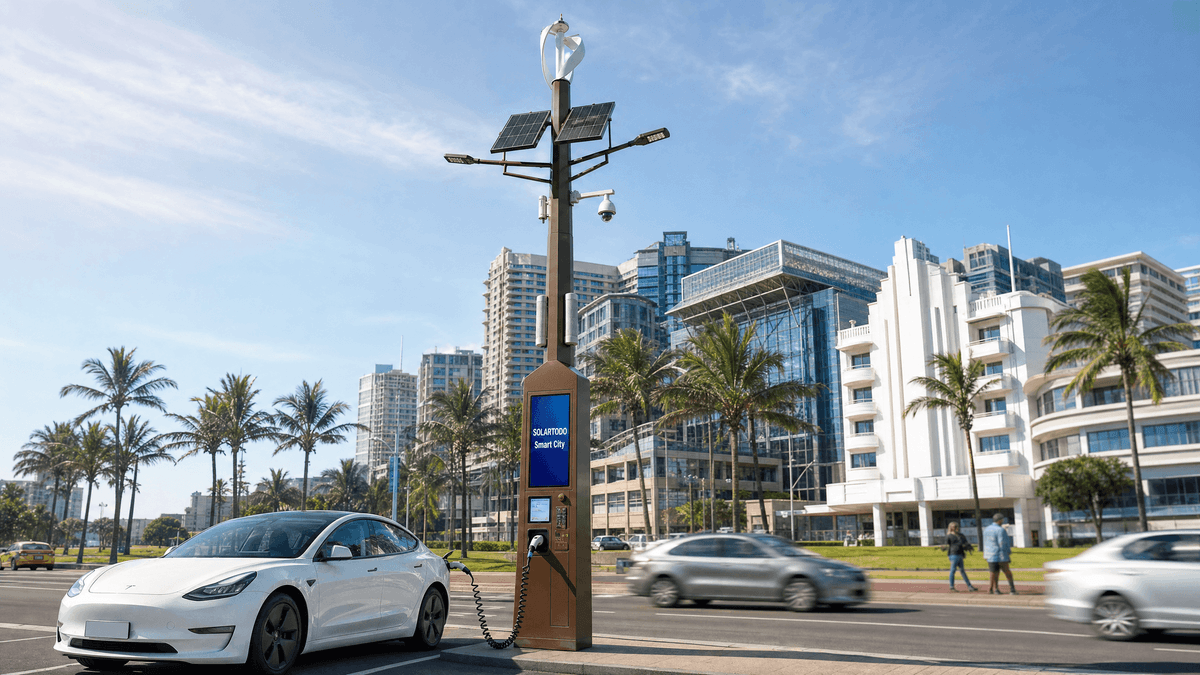
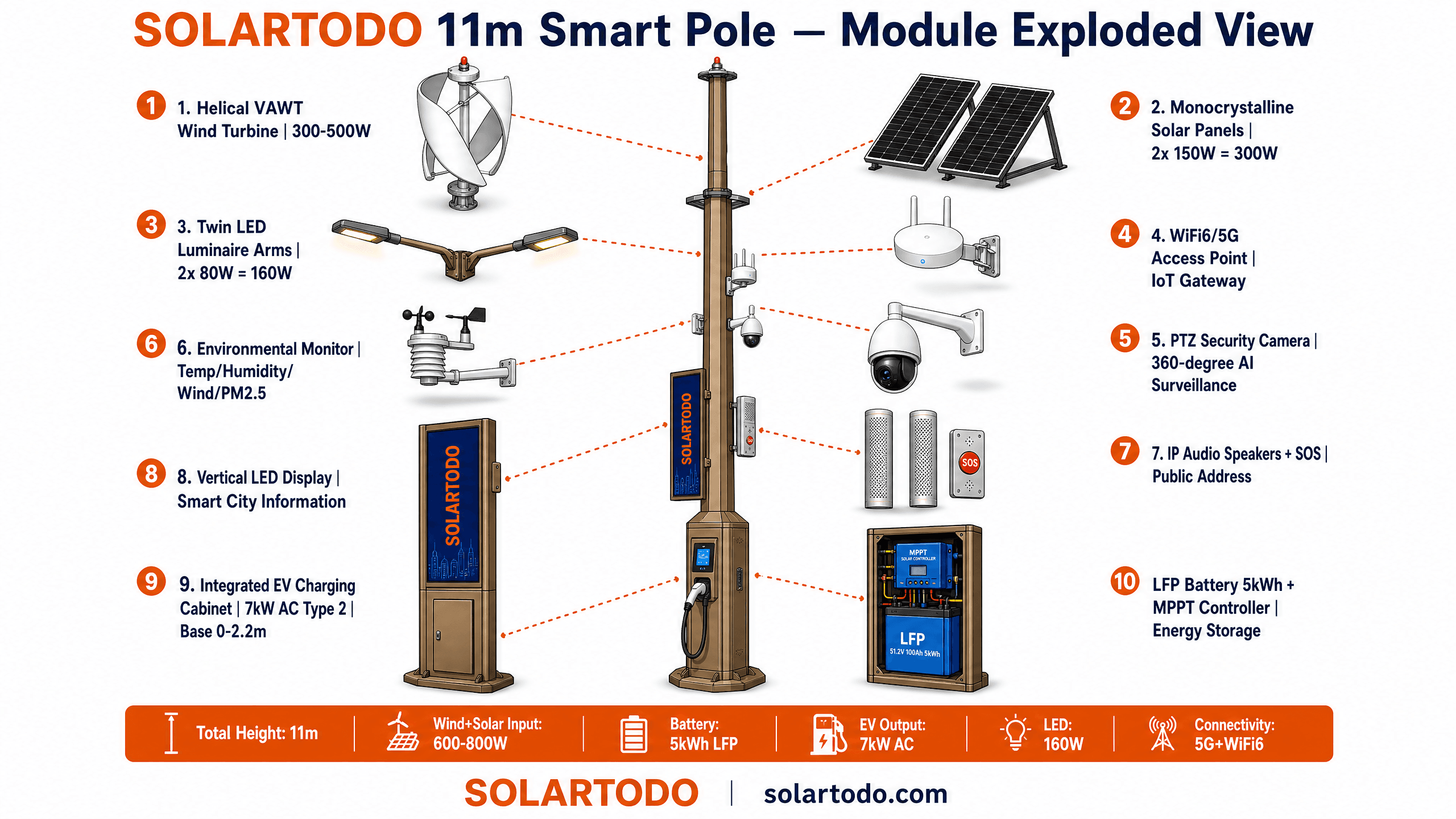
The structural recommendation is an 11m octagonal tapered steel pole with base diameter 45cm tapering to 15cm at the top. This geometry is appropriate for mounting a VAWT, twin LED arms, a 4MP camera, WiFi/5G communications equipment, and a vertical LED display without resorting to separate roadside cabinets. The lower 2.2m of the pole is not an added charger box; it is the EV charging cabinet itself, welded as one continuous steel structure. That integrated layout matters in Durban because it reduces street clutter and lowers the number of exposed enclosure interfaces in a coastal environment.
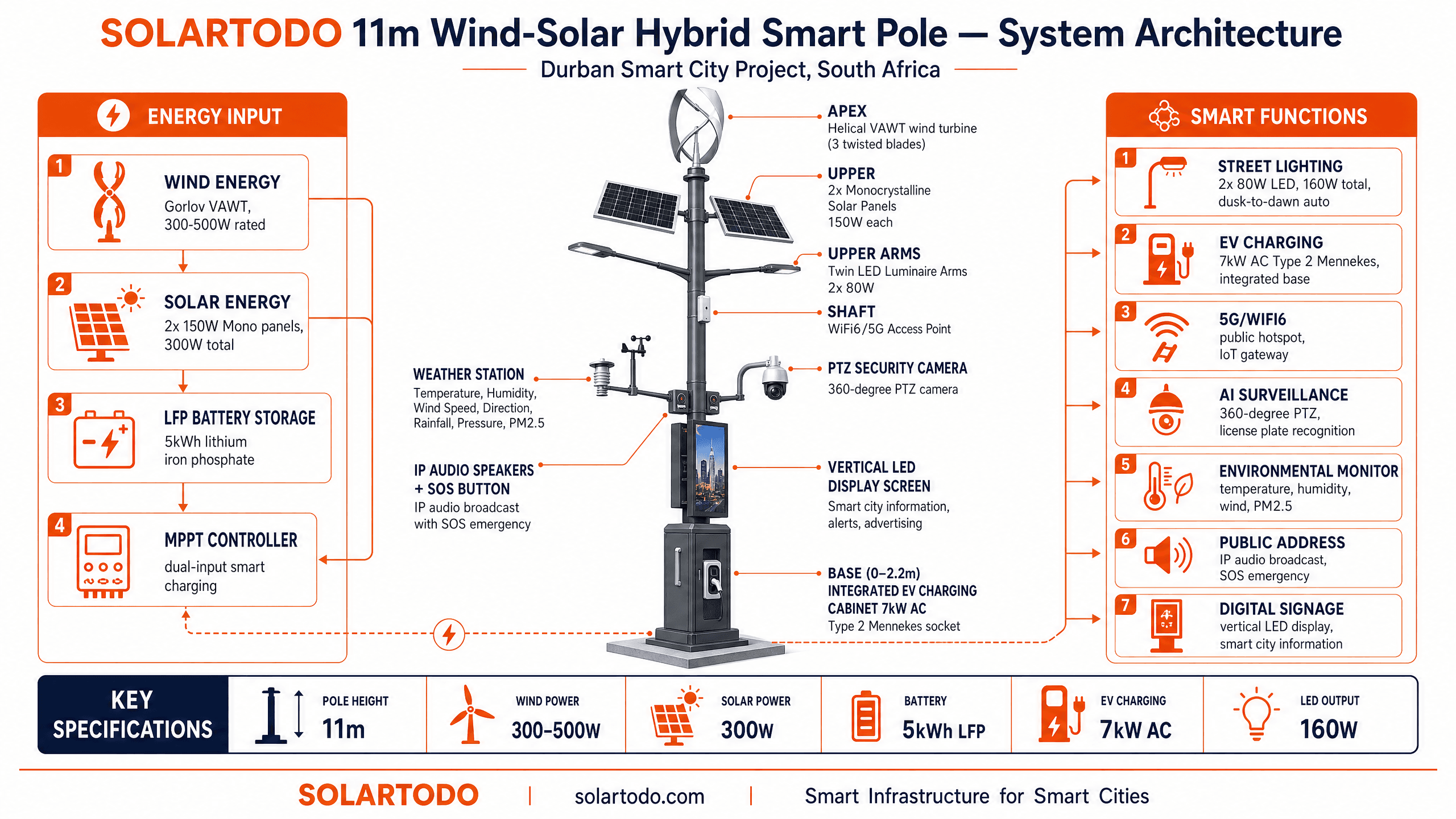
For energy architecture, the recommended hybrid package combines 1× 500W Darrieus H-type VAWT, 2× 200W monocrystalline panels, and a 10kWh LFP battery with MPPT controller. The solar panels are mounted as a symmetric east-west pair on 15° A-frame brackets, while the wind turbine sits at the apex and includes a red aviation LED. This combination does not mean the pole operates fully off-grid at all times; in Durban, the better recommendation is hybrid operation with backup grid tie so lighting, safety devices, and charging remain available during variable weather or extended high-load periods.
SOLAR TODO’s recommended accessory set also fits Durban’s public-space requirements. Each pole would carry a 4MP bullet camera with IR 50m, an 8-parameter environmental sensor, one-press SOS button with camera linkage, 30W IP audio column, WiFi 6 + 5G gateway, LoRaWAN, and USB-C PD 30W + USB-A ports. For municipal buyers, this means one pole can serve lighting, public safety, environmental monitoring, digital access, and curbside charging at a single civil footprint. For specification review or corridor planning, buyers can also review the product category at Smart Streetlight or contact us for a configuration discussion.
Technical Specifications
The recommended Durban configuration is an 11m hybrid Smart Streetlight with 500W wind input, 400W solar input, 10kWh LFP storage, 160W LED lighting, and an integrated 7kW Type 2 EV charger built into the lower 2.2m of the pole.
- Pole structure: 11m octagonal tapered steel smart pole, base Ø45cm to top Ø15cm, antique bronze RAL8011 finish.
- Integrated charger design: lower 2.2m of pole is the EV charging cabinet, welded as one continuous steel structure, not a separate pillar.
- Wind generation: Darrieus H-type VAWT, 3 straight vertical blades, Ø80×110cm, 500W, top-mounted with red aviation LED.
- Solar generation: 2× 200W monocrystalline deep-black panels, mounted mid-pole on 15° A-frame brackets as a symmetric east-west pair.
- Battery system: 10kWh LFP battery inside pole base with MPPT controller.
- Lighting: twin symmetric arms, each 1.5m long with +8° upward tilt; 2× 80W LED, 150 lm/W, 4000K.
- Approximate light output: 24,000 lumens total per pole from 160W LED load.
- Camera: 4MP bullet camera with IR 50m on 30cm short-arm bracket.
- Top sensor: 8-parameter environmental sensor measuring temperature, humidity, wind, pressure, noise, PM2.5, PM10, and illuminance.
- Public address: 1× IP audio column, Ø10×50cm, 30W, 93dB, TCP/IP networked, side-clamp mounted.
- Emergency system: one-press SOS button with camera linkage.
- EV charging: integrated 7kW single-gun AC charger, Type 2, OCPP 1.6J, 5m coiled cable, touchscreen, emergency stop, maintenance door.
- Display: P5 vertical LED screen, 1280×2560mm, portrait format, >5000 cd/m², content specified as “SOLARTODO Smart City” in white sans-serif on deep blue.
- Communications: dual-mode WiFi 6 + 5G gateway with GbE uplink + LoRaWAN, clamped at 8.7m on pole shaft.
- User charging ports: USB-C PD 30W + USB-A.
- Typical spacing: 35m between poles, equal to roughly 28.6 poles/km.
- Applicable standards: IEC 60598, GB/T 37024, IEC 62196-2.
Implementation Approach
A typical Durban rollout would be phased over 4 stages: corridor survey, civil and electrical design, batch installation at 35m intervals, and commissioning of lighting, charger, camera, and network systems. For a 170-unit program, procurement-to-commissioning would commonly be planned over roughly 20-32 weeks depending on permits, utility approvals, and port logistics.
Phase 1 is corridor definition and site survey. For an approximately 170-unit program, the municipality or EPC contractor would usually map pole positions at 35m spacing, verify footpath width, identify underground utilities, and classify each location by lighting need, camera sightline, and EV dwell potential. In Durban, salt exposure and wind loading should be checked early because they affect finish selection, anchor details, and maintenance intervals.
Phase 2 is design coordination. The lighting layout should confirm 2×80W LED coverage against the target road class, while the electrical design should define when the 10kWh battery can carry essential loads and when the grid tie should support charger demand. If the EV charger is expected to operate heavily during business hours, the hybrid package should be treated as resilience support rather than sole charger energy supply. According to IEC 62196-2, connector compatibility and charging interface requirements must be aligned before procurement.
Phase 3 is manufacturing, shipping, and civil works. A buyer may choose CKD or finished-unit delivery depending on local assembly capability. Foundations, conduits, earthing, and anchor-bolt placement should be completed before pole erection because the lower 2.2m charger section is integrated into the structure and should not be treated as a separate charger cabinet install. SOLAR TODO project planning would normally sequence poles in batches so lighting and communications can be activated corridor by corridor rather than waiting for all 170 units.
Phase 4 is commissioning and system integration. Each pole would require tests for luminaire operation, battery management, turbine output, MPPT function, charger communication, camera streaming, SOS triggering, and LED display control. Network acceptance should verify WiFi 6, 5G gateway, and LoRaWAN connectivity. According to IEC, functional verification and safety checks are essential because the unit combines public lighting, communications, and EV charging in one steel enclosure.
Expected Performance & ROI
For Durban, the strongest business case is not only electricity savings but also resilience, asset consolidation, and reduced street clutter; a 170-unit hybrid Smart Streetlight corridor could replace several single-purpose assets per block while supporting 24,000 lumens and 7kW charging per pole. Typical payback would depend on charger utilization, avoided trenching, telecom value, and maintenance strategy rather than solar yield alone.
The direct lighting load per pole is 160W, excluding communications, display, and charger loads. At 150 lm/W, that provides about 24,000 lumens, which is suitable for many urban street and mixed-use frontage applications when spacing is held near 35m. According to the U.S. Department of Energy (2022), LED streetlighting commonly reduces energy use by 50% or more relative to legacy lighting technologies, depending on baseline wattage and controls. In Durban, the additional value comes from integrating the camera, SOS, and communications functions into the same pole rather than maintaining separate powered assets.
Hybrid generation and storage improve uptime during grid instability. According to IEA (2023), South Africa’s grid constraints remain a material planning factor for municipalities and private operators. In this context, a 10kWh LFP battery per pole can keep priority loads such as lighting, camera, SOS, and communications operating during outages, while the 500W wind + 400W solar package contributes recharge energy between grid events. That does not eliminate the need for grid support where EV charging demand is high, but it does reduce dependence on continuous mains availability for core smart-city functions.
Lifecycle economics should be assessed at corridor level. If a city would otherwise install a lighting pole, separate CCTV column, public WiFi node, SOS pedestal, and standalone AC charger, the hybrid Smart Streetlight can reduce the number of foundations, cable routes, and maintenance visits. According to NREL (2023), integrated EV infrastructure planning can reduce site costs when civil works and electrical upgrades are consolidated. For Durban, that means ROI is likely to improve most in dense corridors where several functions are needed within the same 25-50m spacing band.
BloombergNEF states, "lithium-ion battery pack prices have continued their long-term decline, improving the economics of distributed storage applications" (BloombergNEF, 2023). That matters because the 10kWh LFP pack is not only an energy component; it is an uptime component for safety and communications. A practical municipal payback window for a multi-function corridor often falls in the 5-9 year range when avoided civil works, lower energy use, and charger or telecom-related revenue are included, though exact results depend on site-specific utilization and local tariffs.
Results and Impact
For Durban, the likely impact of a 170-unit Smart Streetlight corridor is higher lighting uptime, fewer roadside structures, and better support for public safety and digital services across roughly 5.95km of urban frontage. The main value comes from combining 160W LED lighting, 10kWh storage, CCTV, SOS, WiFi 6, and 7kW charging on one 11m pole.
A corridor configured this way would typically reduce visual clutter because each pole absorbs functions that are often split across 3-5 separate street assets. It would also simplify maintenance routing because technicians can inspect lighting, charger status, communications, and sensor data from one asset registry. For Durban districts with tourism, transport, or mixed retail frontage, that consolidation can be as important as energy performance.
A second impact is resilience. In a city affected by coastal weather and a nationally constrained power system, hybrid poles with 10kWh storage support a more reliable public realm than lighting-only poles tied solely to the grid. For planners evaluating corridor upgrades, the recommendation is to treat SOLAR TODO Smart Streetlight infrastructure as a multi-service urban node rather than only a lamp column.
Comparison Table
The table below compares three practical street-infrastructure approaches for Durban, showing why the 11m hybrid Smart Streetlight is the strongest fit when lighting, safety, connectivity, and EV charging are required together.
| Configuration | Pole Height | Power Architecture | Lighting Load | EV Charging | Smart Devices | Durban Fit |
|---|---|---|---|---|---|---|
| Basic LED streetlight pole | 8-10m | Grid only | 80-150W | No | Limited or none | Suitable for lighting-only streets, weak for resilience |
| Standard modular smart pole | 6-12m | Grid only | 80-150W | Optional 7kW | Camera/sensor/WiFi optional | Suitable where grid reliability is strong |
| SOLAR TODO hybrid Smart Streetlight | 11m | 500W wind + 400W solar + 10kWh LFP + grid backup | 2×80W | Integrated 7kW Type 2 | 4MP camera, 8-param sensor, SOS, IP audio, WiFi 6, 5G, LoRaWAN, LED display | Best fit for Durban corridors needing resilience and multi-function density |
Pricing & Quotation
SOLAR TODO offers three pricing tiers for this product line: FOB Supply (equipment ex-works China), CIF Delivered (including ocean freight and insurance), and EPC Turnkey (fully installed, commissioned, with 1-year warranty). Volume discounts are available for large-scale deployments. Configure your system online for an instant estimate, or request a custom quotation from our engineering team at [email protected].
Frequently Asked Questions
This FAQ answers the main Durban procurement questions on sizing, standards, installation time, ROI, maintenance, and how an 11m hybrid Smart Streetlight compares with a conventional grid-only pole.
Q1: Why is an 11m hybrid Smart Streetlight recommended for Durban instead of a smaller 6-8m pole?
Durban’s target use case is urban streets and mixed-use corridors, not parks. At 35m spacing, an 11m pole with 2×80W LED luminaires gives better road coverage, camera sightlines, and mounting space for WiFi, 5G gateway, and display equipment. Smaller 6-8m poles are usually better suited to pedestrian landscapes and garden-style lighting.
Q2: Can the hybrid system run fully off-grid in Durban?
It can support essential loads from the 500W wind turbine, 400W solar array, and 10kWh LFP battery, but for Durban the recommended configuration includes backup grid tie. That is important because EV charging at 7kW can exceed renewable input during peak use. Hybrid operation gives better uptime for lighting, CCTV, SOS, and communications during grid interruptions.
Q3: Is the EV charger a separate cabinet next to the pole?
No. In this configuration, the lower 2.2m of the pole is the charger cabinet itself, fabricated as one continuous steel structure. That reduces sidewalk clutter and avoids installing a second roadside pedestal. The charger is a 7kW single-gun AC unit with Type 2 connector, 5m coiled cable, touchscreen, emergency stop, and OCPP 1.6J support.
Q4: What deployment timeline is typical for about 170 units in Durban?
A practical program range is about 20-32 weeks from design freeze to commissioning, depending on permits, utility coordination, shipping, and civil readiness. Site survey and approvals may take 4-8 weeks, manufacturing and logistics 8-12 weeks, and installation plus commissioning another 6-12 weeks. Corridor phasing can shorten the time to first energization.
Q5: What maintenance regime should buyers expect?
Most operators would plan quarterly visual inspections and a deeper semiannual service cycle. Key checks include turbine fasteners, panel cleanliness, battery diagnostics, charger cable condition, camera lens cleaning, and corrosion inspection at cable entries and mounting points. In Durban’s coastal air, finish condition and sealing performance should be checked more often than in inland cities.
Q6: How does this compare with a grid-only smart pole on ROI?
A grid-only pole may have lower initial equipment scope, but it offers less resilience during outages. The hybrid version can improve ROI where downtime has a cost, or where separate lighting, CCTV, SOS, WiFi, and EV assets would otherwise be installed. Typical corridor-level payback often falls in the 5-9 year range, depending on charger utilization, avoided civil works, and local tariffs.
Q7: Which standards are most relevant for Durban procurement?
The main listed standards for this configuration are IEC 60598 for luminaires, GB/T 37024 for smart pole reference alignment, and IEC 62196-2 for the EV charging connector interface. Buyers should also align local civil, earthing, and utility connection requirements with South African municipal and national electrical rules during detailed design.
Q8: Is the LED screen intended for third-party advertising?
In the specified configuration, the P5 vertical LED screen sized 1280×2560mm is restricted to the content “SOLARTODO Smart City” in white sans-serif on deep blue, with no other imagery. If a Durban authority wants public information or commercial content, that should be defined separately at specification stage to match local policy and approvals.
Q9: What warranty structure is normally available?
Warranty terms depend on the supply model. The mandatory quotation structure includes FOB Supply, CIF Delivered, and EPC Turnkey, with the EPC option explicitly including a 1-year warranty. Buyers often request longer component warranties for LED drivers, batteries, chargers, and communications hardware, which should be clarified in the final technical schedule.
Q10: What are the main installation requirements on site?
Each pole needs a designed foundation, anchor-bolt set, earthing, conduit routing, and access clearance for the integrated charger door and 5m charging cable. Because the charger is built into the lower 2.2m of the pole, civil works should treat the unit as one structural asset. Utility approval is also needed where the backup grid tie is connected.
References
- Statistics South Africa (2022): Census 2022 municipal population data indicating eThekwini Metropolitan Municipality at roughly 4.0 million residents.
- World Bank (2023): Urban population data for South Africa showing urbanization above 67%, supporting dense municipal infrastructure demand.
- International Energy Agency (IEA) (2023): South Africa energy system reporting on electricity supply constraints and power reliability risks.
- International Renewable Energy Agency (IRENA) (2023): Guidance stating that distributed renewable energy systems can improve resilience when integrated with local infrastructure.
- International Telecommunication Union (ITU) (2023): Smart sustainable city and digital infrastructure guidance relevant to urban WiFi, sensors, and connected public assets.
- IEC (2023): IEC 60598 luminaire safety requirements and IEC 62196-2 conductive charging connector standards.
- U.S. Department of Energy (2022): LED street lighting performance guidance showing energy reductions commonly at 50% or more versus legacy lighting baselines.
- National Renewable Energy Laboratory (NREL) (2023): EV infrastructure planning guidance noting cost benefits when civil works and electrical upgrades are consolidated.
- BloombergNEF (2023): Battery price survey reporting long-term lithium-ion pack cost declines relevant to distributed LFP storage economics.
Equipment Deployed
- 11m octagonal tapered steel Smart Streetlight pole, base Ø45cm to top Ø15cm, antique bronze RAL8011
- Integrated lower 2.2m pole-as-charger cabinet, welded as one continuous steel structure
- Darrieus H-type VAWT, 3 straight vertical blades, Ø80×110cm, 500W, red aviation LED
- 2× 200W monocrystalline deep-black solar panels on 15° A-frame brackets, symmetric east-west pair
- 10kWh LFP battery inside pole base with MPPT controller
- Twin 1.5m symmetric lighting arms with +8° upward tilt
- 2× 80W LED luminaires, 150 lm/W, 4000K
- 4MP bullet camera with IR 50m on 30cm short-arm bracket
- 8-parameter environmental sensor: temperature, humidity, wind, pressure, noise, PM2.5, PM10, illuminance
- IP audio column Ø10×50cm, 30W, 93dB, TCP/IP networked
- One-press SOS button with camera linkage
- Integrated 7kW single-gun AC EV charger, Type 2, OCPP 1.6J, 5m coiled cable, touchscreen, E-stop
- P5 vertical LED display, 1280×2560mm, >5000 cd/m²
- Dual-mode WiFi 6 + 5G gateway with GbE uplink + LoRaWAN, mounted at 8.7m
- USB-C PD 30W + USB-A user charging ports