Smart Agriculture Monitoring System Design Guide

SOLAR TODO
Solar Energy & Infrastructure Expert Team
Watch the video
TL;DR
The best smart agriculture monitoring systems are designed around decisions, not devices. For most 20-50 ha projects, use 4 sensing layers, 10-minute data intervals, and 2-3 alert levels, with LoRaWAN or 4G LTE connectivity and solar-powered field nodes. When integrated correctly, farms can reduce irrigation water use by up to 50%, cut pesticide use by about 30%, and improve yield by 15-25%.
Smart agriculture monitoring systems combine 10-minute data intervals, multi-parameter weather and soil sensing, and automated alerts to cut irrigation water use by up to 50%, reduce pesticide use by about 30%, and improve yield by 15-25% when sensors, connectivity, and response rules are designed as one architecture.
Summary
Smart agriculture monitoring systems combine 10-minute data intervals, multi-parameter weather and soil sensing, and automated alerts to cut irrigation water use by up to 50%, reduce pesticide use by about 30%, and improve yield by 15-25% when sensors, connectivity, and response rules are designed as one architecture.
Key Takeaways
- Define monitoring zones at 5-20 ha per gateway so LoRaWAN or 4G LTE coverage, alert latency, and maintenance routes remain manageable.
- Deploy at least 4 core sensing layers—weather, soil, crop health, and water quality—to improve irrigation timing and reduce disease response delays by hours or days.
- Standardize 10-minute data intervals for most field applications because they balance battery life, agronomic visibility, and cloud data costs.
- Set multi-threshold alerts with 2-3 escalation levels, such as warning, action, and critical, to prevent alarm fatigue and speed field response.
- Use IP67/IP68 field devices and solar-powered nodes sized for year-round autonomy to reduce downtime in remote farms and reclamation sites.
- Integrate data through REST API or ISO 11783-aligned structures so irrigation controllers, farm software, and reporting platforms can share one dataset.
- Model ROI against water savings of up to 50%, pesticide reduction of about 30%, and yield gains of 15-25% rather than sensor cost alone.
- Verify IEC, IEEE, and UL-aligned electrical and communications compliance before procurement to lower commissioning risk and simplify EPC delivery.
System Architecture Fundamentals
A well-designed smart agriculture monitoring system typically combines 4 sensing domains, 10-minute sampling, and 1 cloud platform to deliver actionable alerts across 20-50 ha with lower labor and water waste.
Designing a reliable system starts with the operating decision, not the sensor catalog. B2B buyers often over-specify devices and under-specify workflows, which leads to disconnected data and weak field response. The correct sequence is to define what decisions must be improved first: irrigation timing, disease intervention, frost protection, fertigation control, or compliance reporting.
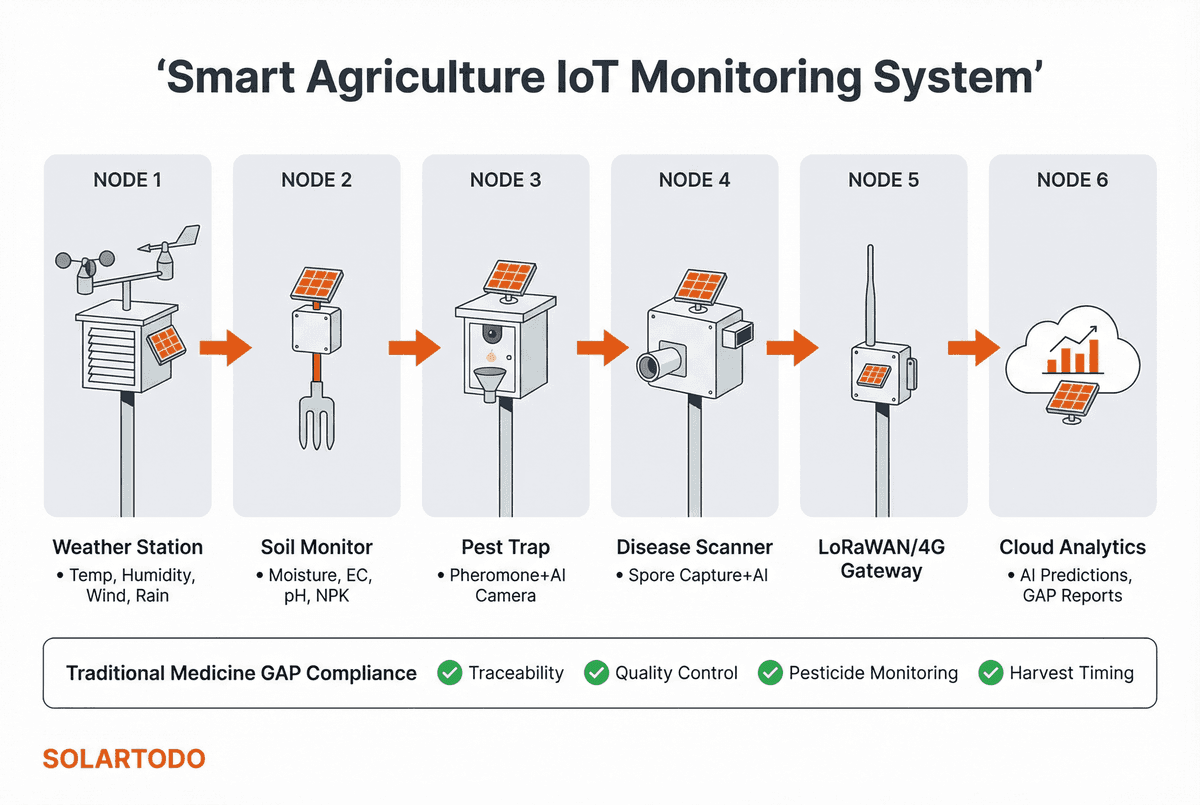
For most commercial farms, the architecture should include four layers: field sensing, communications, cloud analytics, and alert execution. Field sensing captures raw agronomic conditions. Communications moves data from remote zones to a gateway or cellular backhaul. Cloud analytics converts readings into trends, thresholds, and recommendations. Alert execution sends messages to operators or triggers equipment such as pumps and valves.
According to the International Energy Agency, "digitalization can improve energy and operational efficiency across agriculture and infrastructure systems when data is converted into decisions rather than simply collected." That principle is central to smart agriculture design. A system that measures 20 variables but produces no clear action path is less valuable than a system that measures 8 variables and triggers a correct response within 15 minutes.
SOLAR TODO positions these systems as decision infrastructure rather than standalone instrumentation. In practice, that means weather stations, soil probes, disease detection devices, gateways, solar power kits, and cloud dashboards must be specified together. For tea estates, medicinal herb farms, and desert reclamation projects, this integrated approach is usually more bankable than piecemeal procurement.
Core device layers
A practical commercial deployment usually includes the following device groups:
- 1 professional weather station per management block or microclimate zone
- 4-12 soil monitoring points depending on crop variability and irrigation zoning
- 1-4 crop health or disease detection devices where fungal pressure or quality risk is high
- 1-2 gateways for redundancy across 20-50 ha
- 1 cloud environment with dashboards, user roles, and API access
- Solar-powered field enclosures with LFP battery backup for off-grid continuity
Typical monitored parameters
The most useful parameter set for broad deployment includes:
- Air temperature
- Relative humidity
- Rainfall
- Wind speed
- Wind direction
- Solar radiation
- Atmospheric pressure
- Evapotranspiration
- Soil moisture
- Soil temperature
- Soil EC
- Soil pH
- NPK or nutrient trend indicators
- Water quality indicators where irrigation source quality varies
- Pest or disease indicators in high-value crops
IoT Sensors Integration Best Practices
Effective IoT sensor integration requires matching 10-minute data intervals, IP67/IP68 field protection, and interoperable data models so weather, soil, water, and crop signals can be analyzed as one operational dataset.
Sensor integration fails most often because each device is treated as an isolated endpoint. In agriculture, value comes from correlation. A leaf disease alert becomes more accurate when paired with humidity, leaf wetness proxy, rainfall, and temperature trends. Irrigation recommendations improve when soil moisture is combined with evapotranspiration, solar radiation, and pump runtime data.
According to NREL (2024), performance modeling accuracy improves when site-specific environmental inputs are used instead of generalized assumptions. The same logic applies in agriculture: localized, synchronized sensor data improves decision quality. If one probe logs every 5 minutes, another every 30 minutes, and weather data uploads hourly, alert logic becomes inconsistent and false positives increase.
Choose communications by terrain and response need
LoRaWAN is usually the best fit for large farms with low-power sensors and sparse infrastructure. It supports long-range communication and low energy consumption, making it suitable for 20-50 ha deployments with distributed nodes. 4G LTE is preferable when bandwidth demand is higher, camera-based crop diagnostics are required, or existing cellular coverage is strong.
A hybrid architecture is often best. For example, field sensors can connect over LoRaWAN to a gateway, while the gateway uses 4G LTE for cloud backhaul. This reduces device power consumption while preserving remote dashboard access. SOLAR TODO commonly applies this structure in remote agricultural projects where grid reliability is limited.
Standardize timestamps, calibration, and metadata
Every sensor should be commissioned with a common timestamp standard, known location coordinates, installation depth or height, calibration date, and maintenance record. Without metadata discipline, historical trend analysis becomes difficult and auditability weakens. This is especially important for GAP-oriented crops and export supply chains.
Best practice integration checklist:
- Use synchronized timestamps across all devices
- Record GPS coordinates for each node
- Label irrigation zone, crop type, and soil profile for each probe
- Calibrate soil and water sensors before field deployment
- Recheck calibration every 6-12 months depending on sensor type
- Store firmware version and replacement history in the asset register
Build for power continuity
Remote agriculture systems often fail because communications and power design are under-budgeted. Solar-powered nodes should be sized for worst-month irradiance, not annual average irradiance. LFP battery storage is preferred for field reliability, temperature tolerance, and cycle life.
According to IRENA (2024), solar-powered distributed systems remain one of the most economical ways to electrify remote monitoring assets where grid extension is costly. In practical terms, a sensor node with conservative power budgeting and battery autonomy for several low-sun days will outperform a cheaper node that requires frequent site visits.
Alert Logic, Automation, and Response Design
The best agricultural alert systems use 2-3 escalation levels, combine at least 3 sensor inputs, and assign one owner per alert so teams act within minutes instead of discovering problems days later.
An alert is only useful if it produces a response. Many farms receive too many notifications because thresholds are set directly from device defaults rather than agronomic rules. For example, a low soil moisture reading should not always trigger irrigation if rainfall probability is rising, root-zone moisture is still adequate, or the crop is in a stage where mild deficit is acceptable.
The International Electrotechnical Commission emphasizes that monitoring systems should be designed for functional safety, data integrity, and predictable operation. In farm terms, this means alerts must be structured, prioritized, and testable. A useful alert system distinguishes between trend warnings and emergency events.
Recommended alert hierarchy
A three-level model works well for most B2B deployments:
- Warning: parameter drifting out of target range; review within 2-4 hours
- Action: intervention recommended; dispatch or remote control within 30-60 minutes
- Critical: immediate risk to crop, water system, or power continuity; act within 15 minutes
Multi-signal examples
Examples of better alert design include:
- Irrigation alert: soil moisture below threshold + high evapotranspiration + no rainfall forecast window
- Disease alert: high humidity + temperature band favorable to mildew + leaf scanner anomaly
- Pump fault alert: irrigation command sent + no flow increase + power draw abnormality
- Frost alert: falling temperature trend + wind drop + crop-specific risk threshold reached
According to IEA PVPS (2024), digital monitoring creates the most value when alarms are filtered into actionable maintenance and operational categories. The same applies in agriculture. Alarm fatigue is a major hidden cost, especially when one farm manager oversees multiple zones and devices.
Delivery channels and operating discipline
Alerts should be delivered through at least two channels, such as app notification plus SMS or email. Critical events should require acknowledgment, and unresolved alerts should escalate to a second contact. Weekly reporting should summarize alert count, response time, false positives, and unresolved incidents.
SOLAR TODO recommends mapping every alert to a named action owner: irrigation supervisor, agronomist, maintenance technician, or project manager. This small governance step often improves response quality more than adding more sensors.
Use Cases, Comparison, and Selection Guide
The right system design varies by crop and terrain, but 20 ha medicinal herbs, 30 ha tea gardens, and 50 ha desert reclamation sites all benefit when weather, soil, and alert automation are integrated from day one.
Different crops create different monitoring priorities. Tea gardens need microclimate and disease sensitivity across elevation changes. Medicinal herbs need traceable environmental records for GAP compliance. Desert reclamation projects require water, energy, and irrigation automation to be managed together because evapotranspiration, water quality, and power reliability are all operational constraints.
According to precision-agriculture benchmarks cited across IRENA, IEA, and sector datasets, integrated monitoring can reduce irrigation water use by up to 50%, reduce pesticide use by about 30%, and improve yield by 15-25% when paired with disciplined field response. Those gains do not come from sensing alone; they come from sensing plus action.
Comparison of typical smart agriculture configurations
| Application | Typical Area | Communications | Key Devices | Main Objective | Best Alert Focus |
|---|---|---|---|---|---|
| Traditional medicine GAP monitoring | 20 ha | 4G LTE | Weather station, soil probes, AI pest traps, spore detection | Compliance and quality consistency | Disease, pest, moisture deviation |
| Tea garden precision monitoring | 30 ha | LoRaWAN | Weather station, soil sensors, multispectral leaf scanner | Early disease detection and irrigation timing | Fungal risk, leaf stress, slope-zone moisture |
| Desert reclamation solar + agriculture | 50 ha | 4G LTE + field solar | Weather station, 12 soil probes, 4 water-quality points, drip control | Water-energy-agronomy optimization | Irrigation, salinity, pump and flow faults |
Selection criteria for procurement teams
Use the following criteria when comparing suppliers:
- Coverage per gateway and expected signal reliability in real terrain
- Sensor parameter count versus actual agronomic value
- Calibration method and replacement cycle
- IP rating, enclosure quality, and solar power autonomy
- Cloud dashboard usability and API availability
- Local installation support and spare parts planning
- Warranty duration and remote diagnostics capability
- EPC delivery capability for larger projects
EPC Investment Analysis and Pricing Structure
For projects above 20 ha, EPC-style delivery reduces integration risk by bundling engineering, procurement, commissioning, and training into one scope with clearer ROI and accountability.
EPC in smart agriculture means Engineering, Procurement, and Construction or turnkey delivery of the full monitoring and control package. In practice, this includes site survey, sensor layout design, communications planning, solar power sizing, mounting structures, gateway setup, cloud commissioning, alert logic configuration, testing, and operator training. For remote farms, EPC delivery usually lowers total implementation risk because one party is responsible for system performance at handover.
A practical B2B pricing structure usually follows three tiers:
- FOB Supply: equipment only, ex-factory or port basis, suitable for buyers with local installation teams
- CIF Delivered: equipment plus freight and insurance to destination port, suitable when import logistics need simplification
- EPC Turnkey: full design, supply, installation, commissioning, and training, suitable for owners seeking one-point responsibility
Indicative volume guidance for standardized deployments can follow this model:
- 50+ units or equivalent node volume: about 5% discount
- 100+ units or equivalent node volume: about 10% discount
- 250+ units or equivalent node volume: about 15% discount
ROI should be evaluated against avoided losses and operating savings, not hardware cost alone. If a 50 ha project cuts irrigation water use by up to 50%, reduces pesticide use by about 30%, and improves yield by 15-25%, payback can often fall within 2-5 seasons depending on crop value, water cost, and labor intensity. High-value crops usually justify faster payback because disease prevention and quality consistency have direct revenue impact.
Typical payment terms for export projects are:
- 30% T/T deposit and 70% against B/L
- 100% L/C at sight for qualified transactions
Financing may be available for large projects above $1,000K, especially where the package includes solar power, irrigation automation, and long-term infrastructure value. For quotation support, EPC scope review, or financing discussion, buyers can contact cinn@solartodo.com. SOLAR TODO can also support offline configuration for projects that need customized sensor density, gateway redundancy, or cloud integration.
FAQ
A practical smart agriculture FAQ should answer 10 core questions on sensors, alerts, installation, cost, maintenance, and integration so procurement and engineering teams can compare systems quickly.
Q: What is a smart agriculture monitoring system? A: A smart agriculture monitoring system is a field-deployed IoT platform that collects weather, soil, water, and crop data and turns it into alerts or control actions. Most commercial systems sample every 10 minutes and use LoRaWAN or 4G LTE to connect sensors, gateways, and cloud dashboards.
Q: How many sensors are needed for a 20-50 ha farm? A: The correct number depends on crop variability, irrigation zoning, and terrain, but many projects use 15-20 devices across 20-50 ha. A practical baseline includes 1 weather station, 4-12 soil points, 1-4 crop-health devices, and 1-2 gateways for communications resilience.
Q: Why are 10-minute data intervals commonly used? A: Ten-minute intervals are widely used because they provide enough granularity for irrigation, disease, and weather alerts without excessive battery drain or cloud cost. Faster intervals are useful for specialized equipment diagnostics, but for most agronomic decisions 10 minutes is an efficient operating standard.
Q: How do LoRaWAN and 4G LTE compare for agriculture? A: LoRaWAN is usually better for low-power distributed sensors over wide farm areas, while 4G LTE is better for higher-bandwidth data and direct cloud connectivity. Many commercial systems use LoRaWAN in the field and 4G LTE at the gateway to balance power efficiency and remote access.
Q: What alerts should be configured first? A: Start with alerts tied directly to financial or crop risk: low root-zone moisture, disease-favorable microclimate, pump or flow failure, frost risk, and abnormal water quality. A three-level structure—warning, action, and critical—usually works better than a single threshold because it reduces alarm fatigue.
Q: How much water and chemical savings can monitoring deliver? A: Results vary by crop and operating discipline, but integrated monitoring programs can reduce irrigation water use by up to 50% and pesticide use by about 30% when alerts are linked to agronomic action. Yield improvement of 15-25% is also possible in high-variability environments with disciplined response protocols.
Q: What maintenance does the system require? A: Most systems need routine visual inspection, sensor cleaning, battery and solar power checks, and periodic recalibration. Soil and water sensors often need calibration review every 6-12 months, while gateways, enclosures, and mounting hardware should be checked before rainy and high-wind seasons.
Q: How should buyers evaluate cloud software and integration? A: Buyers should check whether the platform supports dashboards, historical trends, user permissions, exportable reports, and REST API integration. Systems aligned with structured agricultural data practices, including ISO 11783-style interoperability, are easier to connect with irrigation, ERP, or farm management software.
Q: What does EPC turnkey delivery include for smart agriculture? A: EPC turnkey delivery typically includes site survey, engineering design, bill of materials, logistics, installation, commissioning, alert setup, training, and handover testing. This model is useful for 20-50 ha or larger projects because it reduces coordination gaps between sensors, communications, power supply, and software.
Q: How are pricing and payment terms usually structured? A: Export projects commonly use three pricing levels: FOB Supply, CIF Delivered, and EPC Turnkey. Standard payment terms are often 30% T/T and 70% against B/L, or 100% L/C at sight, with financing support sometimes available for projects above $1,000K.
Q: What certifications and standards matter most? A: Buyers should review electrical safety, communications interoperability, and environmental protection standards, including relevant IEC, IEEE, and UL references. IP67/IP68 protection, stable power design, and documented commissioning procedures are especially important for remote agricultural deployments exposed to dust, heat, rain, and vibration.
Q: When should a farm choose SOLAR TODO for a project? A: SOLAR TODO is a strong fit when the buyer needs a B2B project package rather than isolated devices, especially for tea estates, medicinal herb farms, and desert reclamation sites. The advantage is integrated supply of sensors, solar-powered field infrastructure, gateways, cloud setup, and offline quotation support for customized scopes.
References
A strong procurement decision should reference at least 7 authoritative sources covering energy, interoperability, electrical safety, and PV-powered field infrastructure.
- NREL (2024): PVWatts Calculator methodology and solar resource modeling used to estimate site-specific energy supply for remote monitoring assets.
- IRENA (2024): Renewable power cost and distributed energy guidance supporting the economics of solar-powered remote systems.
- IEA PVPS (2024): Trends in Photovoltaic Applications, including monitoring, performance, and operational best practices relevant to field-powered IoT deployments.
- IEC 61215-1 (2021): Terrestrial photovoltaic modules design qualification and type approval requirements for reliable solar-powered field systems.
- IEC 61730-1 (2023): Photovoltaic module safety qualification requirements for construction and testing.
- IEEE 1547-2018 (2018): Interconnection and interoperability standard relevant where agricultural monitoring systems interface with distributed power systems.
- ISO 11783 (2023): Agricultural electronics and machinery communication framework supporting interoperability and data exchange.
- UL 61010-1 (2024): Safety requirements for electrical equipment for measurement, control, and laboratory use, relevant to instrumentation safety.
Conclusion
Smart agriculture monitoring systems deliver the best results when 4 sensing layers, 10-minute data intervals, and 2-3 alert levels are engineered as one operational workflow rather than bought as disconnected devices.
For most 20-50 ha projects, SOLAR TODO should be evaluated on total decision performance—water savings up to 50%, pesticide reduction around 30%, and yield gains of 15-25%—with EPC delivery often providing the lowest integration risk and fastest payback.
About SOLARTODO
SOLARTODO is a global integrated solution provider specializing in solar power generation systems, energy-storage products, smart street-lighting and solar street-lighting, intelligent security & IoT linkage systems, power transmission towers, telecom communication towers, and smart-agriculture solutions for worldwide B2B customers.
About the Author

SOLAR TODO
Solar Energy & Infrastructure Expert Team
SOLAR TODO is a professional supplier of solar energy, energy storage, smart lighting, smart agriculture, security systems, communication towers, and power tower equipment.
Our technical team has over 15 years of experience in renewable energy and infrastructure, providing high-quality products and solutions to B2B customers worldwide.
Expertise: PV system design, energy storage optimization, smart lighting integration, smart agriculture monitoring, security system integration, communication and power tower supply.
Cite This Article
SOLAR TODO. (2026). Smart Agriculture Monitoring System Design Guide. SOLAR TODO. Retrieved from https://solartodo.com/knowledge/designing-smart-agriculture-monitoring-systems-iot-sensors-integration-and-alert-systems-best-practices
@article{solartodo_designing_smart_agriculture_monitoring_systems_iot_sensors_integration_and_alert_systems_best_practices,
  title = {Smart Agriculture Monitoring System Design Guide},
  author = {SOLAR TODO},
  journal = {SOLAR TODO Knowledge Base},
  year = {2026},
  url = {https://solartodo.com/knowledge/designing-smart-agriculture-monitoring-systems-iot-sensors-integration-and-alert-systems-best-practices},
  note = {Accessed: 2026-04-19}
}
Published: April 19, 2026 | Available at: https://solartodo.com/knowledge/designing-smart-agriculture-monitoring-systems-iot-sensors-integration-and-alert-systems-best-practices
Subscribe to Our Newsletter
Get the latest solar energy news and insights delivered to your inbox.
View All Articles