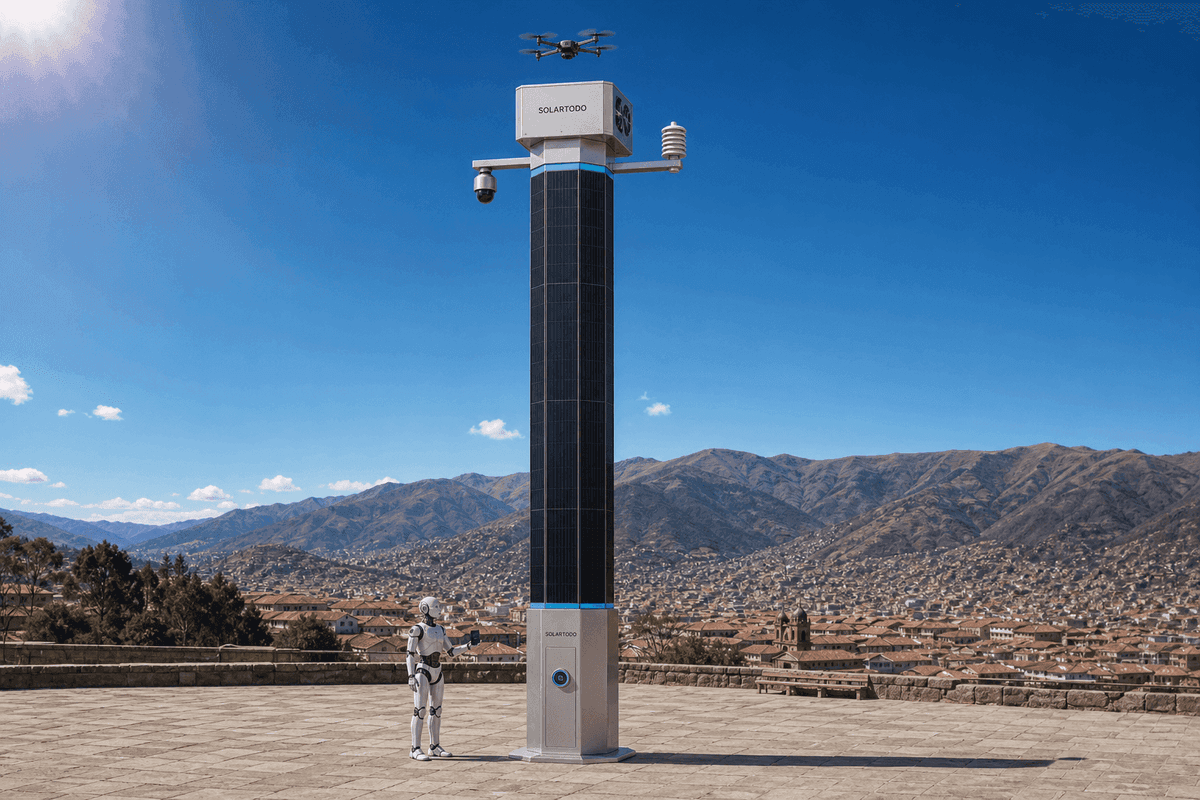
Cusco's High-Altitude Heritage Corridors: SOLARTODO Sentinel City AI Pole 89-Node Configuration Guide
Summary
Cusco's 3,400 m altitude, 145.3 mm January rainfall and 447,588-province population make an 89-node SOLARTODO Sentinel City AI Pole configuration a practical off-grid edge layer for heritage corridors, campuses and municipal perimeters.
Key Takeaways
A typical 89-unit Cusco configuration should prioritize off-grid autonomy, 35 m node spacing, local processing and heritage-sensitive civil works.
- The recommended layout uses approximately 89 SOLARTODO Sentinel City AI Pole nodes at about 35 m spacing, covering roughly 3.1 km of corridor edge coverage before site-specific overlap adjustment.
- Cusco sits at about 3,400 m above sea level, so altitude, UV exposure and temperature cycling matter more than coastal salt-air assumptions.
- According to WMO/SENAMHI climate normals, Cusco's mean monthly rainfall ranges from 1.5 mm in June to 145.3 mm in January, affecting drainage and foundation timing.
- According to INEI (2017), Cusco Province had 447,588 residents, including dense urban districts such as Cusco, San Sebastián, Santiago and Wanchaq.
- Peru's medium-voltage rural design context commonly references 22.9 kV and 22.9/13.2 kV primary networks, although this product remains fully off-grid and does not use site power.
- Each node should be specified with 5-20 kWh-class battery storage, 2.8-3.2 kWp PV nameplate replenishment and realistic clear-sky DC output governed by duty cycle.
- Raw video and sensor data should stay on the pole; only de-identified event and status metadata should leave the node for PDPL-LGPD-oriented workflows.
Market Context for Cusco
Cusco's infrastructure challenge is a 3,400 m inland Andean city with heritage restrictions, rainy-season drainage and fragmented valley corridors.
Cusco is not a coastal smart-city environment; it is an inland Andean urban basin where altitude, old-town geometry and tourism pressure shape every equipment decision. UNESCO states, "City of Cuzco, at 3,400 m above sea level," and identifies a 142.48 ha World Heritage property with a 284.93 ha buffer zone. That status pushes procurement teams toward reversible, low-trenching, low-visual-impact infrastructure, especially near the historic center.
According to INEI (2017), Cusco Province had 447,588 residents, while the broader department had 1,205,527 residents and 60.7% urban population. That matters because the likely Sentinel use case is not citywide pole replacement; it is selected corridor intelligence for transport approaches, municipal assets, tourism zones, campuses, utility perimeters and emergency-response routes. According to PCM territorial information, Cusco department includes 13 provinces, 112 districts and about 72,000 km2, with 39.3% of residents in rural areas, so the same procurement body may need both urban and peri-urban operating modes.
Climate also separates Cusco from generic Latin America templates. According to WMO/SENAMHI (2026), mean daily maximum temperatures in Cusco stay near 18.8-20.9 degrees Celsius, but mean daily minimums fall to about 0.1 degrees Celsius in July. Rainfall is sharply seasonal: January averages 145.3 mm, June only 1.5 mm. For SOLARTODO Sentinel City AI Pole planning, this means civil works should avoid the peak wet season where possible, drainage should be designed around intense summer runoff, and battery scheduling should expect lower solar replenishment during cloudier months.
Peru's public infrastructure context also favors local, auditable operation. According to World Bank data (2023), Peru's electricity access reached 96.2% of population, while according to World Bank data (2024), individuals using the Internet reached 82% of population. World Bank states, "global access to electricity to 92%," which shows Peru is above the global access benchmark, but mountainous regions still face resilience and last-mile service constraints. For a pure smart pole, the point is not replacing the grid; the point is keeping sensing, dispatch metadata and field operations available without drawing grid, city or site power.
Local electrical and regulatory references still matter even for an off-grid product. According to MINEM (2016), Peru's rural primary-line design basis addresses 22.9 kV and 22.9/13.2 kV networks. According to OSINERGMIN (2026), rural voltage-quality monitoring flags poor service when low-voltage variation exceeds +/-7.5% or medium-voltage variation exceeds +/-6% for more than 5% of the measured period. The SOLARTODO configuration should therefore be presented as a self-powered municipal edge layer adjacent to public infrastructure, not as a load added to distribution feeders.
Recommended Technical Configuration
For Cusco, a typical 89-unit Sentinel deployment would use off-grid Sky Hub pole-form nodes spaced around 35 m across prioritized corridors.
A recommended Cusco configuration is approximately 89 SOLARTODO Sentinel City AI Pole units in Sky Hub pole form, subject to engineering confirmation after route survey, wind assessment, geotechnical review and municipal heritage constraints. At 35 m planning spacing, the gross linear planning envelope is about 3,115 m, before subtracting overlaps at plazas, bends, bridge approaches and restricted historic streets. This is best treated as a corridor and perimeter network rather than a general street furniture replacement program.
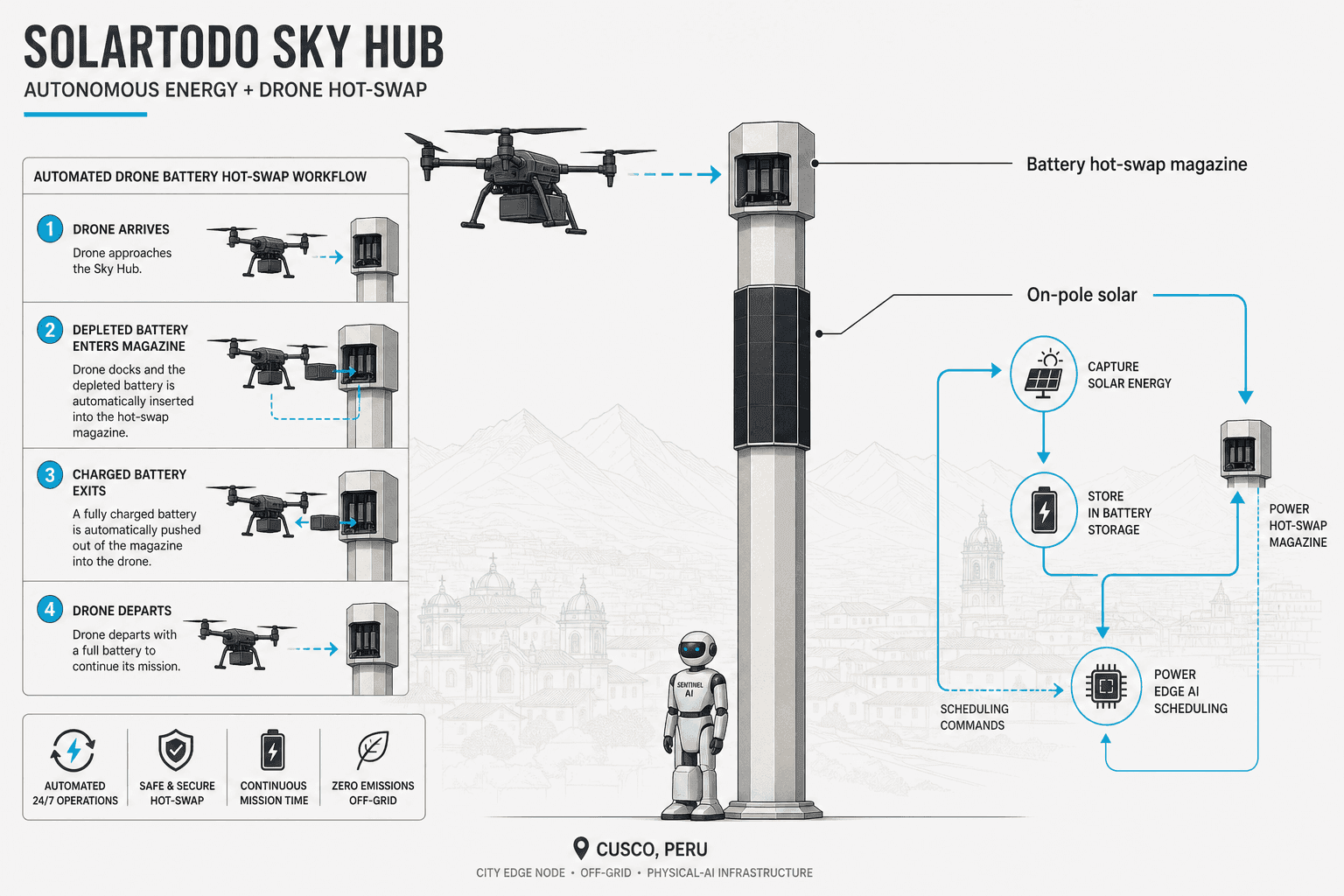
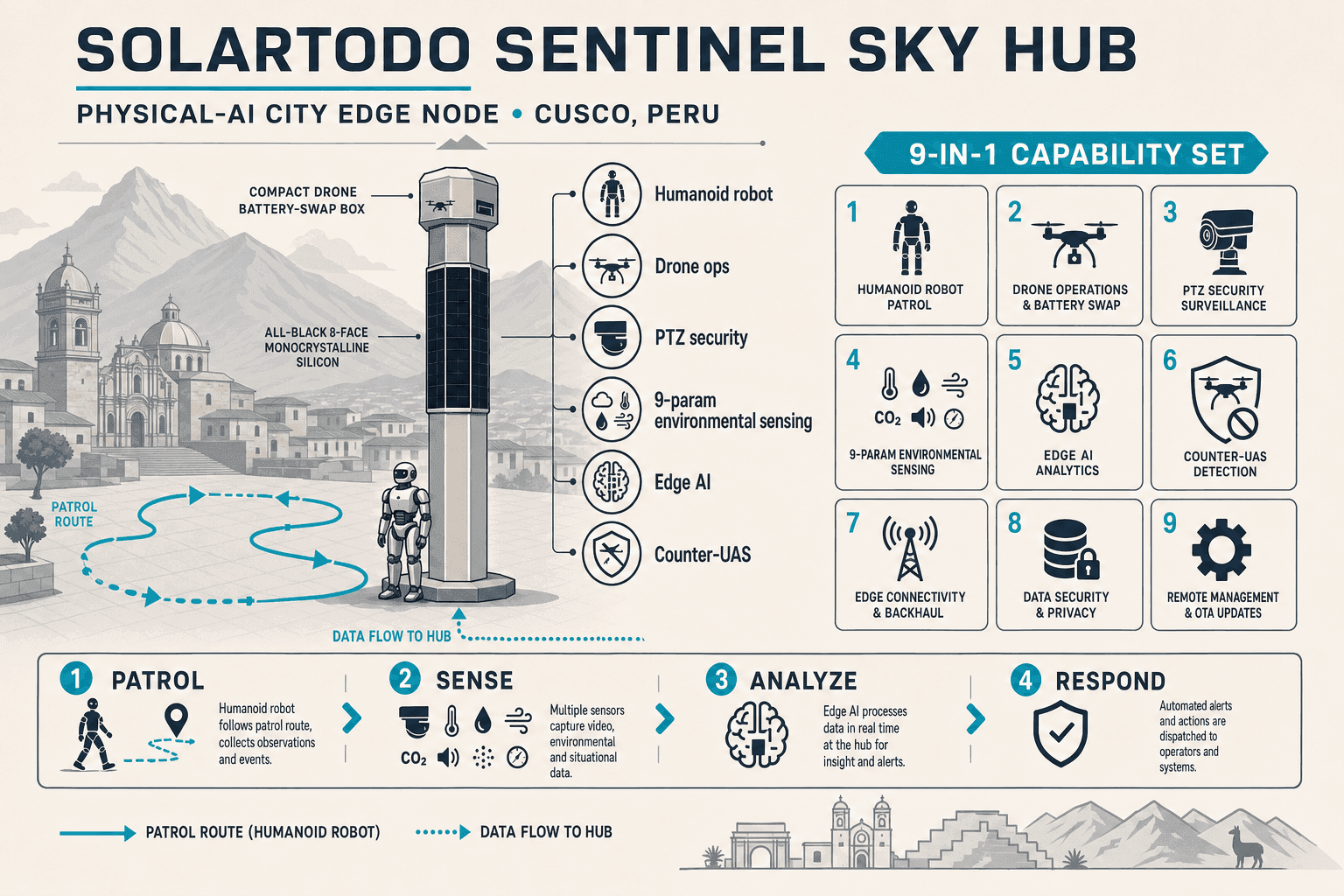
Each node should combine local sensing, edge AI compute, environmental monitoring, drone operations, ground-robot coordination, autonomous battery service workflows and a human-authorized C-UAS coordination layer. The drone workflow can support patrol, inspection, return, battery exchange and redeployment from the node, while mission queueing and fleet health are handled locally. The ground robot workflow supports patrol, inspection, alarm response and return-to-base wireless charging where terrain and sidewalk clearance permit.
For Cusco's dense old-town lanes, the 89-node layout should avoid assuming uniform grid-like placement. Priority segments would include municipal facility perimeters, transport interchange approaches, emergency access routes, tourism concentration zones and open-campus or industrial perimeters outside the most sensitive heritage blocks. In the protected core, foundations, trenching and above-ground service access need municipal and cultural review before procurement quantities are frozen.
Data architecture is a core part of the recommendation. Raw video and raw sensor streams should remain on the pole, processed by Jetson-class edge compute under OTATODO. Only de-identified event metadata, device status, task logs and alerts should leave the node. That approach is designed for local processing and PDPL-LGPD-oriented governance under Peru's Law No. 29733, without claiming certification or automatic compliance.
Technical Specifications
The Cusco configuration should specify 89 off-grid Sky Hub nodes with 5-20 kWh storage, 2.8-3.2 kWp PV nameplate replenishment and local AI processing.
- Product: SOLARTODO Sentinel City AI Pole, Sky Hub pole-form physical-AI city edge node.
- Quantity basis: approximately 89 units, project-based custom configuration, subject to engineering confirmation.
- Spacing basis: about 35 m between nodes, adjusted for terrain, line of sight, municipal restrictions and safe service access.
- Power architecture: fully off-grid operation with on-pole solar replenishment and battery storage; no grid, city or site power dependency.
- Solar replenishment: approximately 2.8-3.2 kWp PV nameplate, with realistic clear-sky peak output around 1.0-1.3 kW DC in high-irradiance conditions.
- Daily replenishment planning: single-digit kWh/day should be used for duty-cycle budgeting; high-power drone and robot tasks are buffered by storage, not assumed to run continuously from solar input.
- Battery storage: 5-20 kWh-class battery capacity, selected by mission tempo, night duty cycle, cloud-season reserve and maintenance access.
- Edge compute: Jetson-class Orin- or Thor-class edge module for local inference, workload scheduling and event summarization.
- Sensing: PTZ-based local perception for anonymous vehicle count, crowd density, intrusion and perimeter awareness; no active face recognition or licence-plate recognition claim.
- Environmental monitoring: wind speed, wind direction, temperature, humidity, atmospheric pressure, noise, PM10, PM2.5 and illuminance.
- Drone operations: launch, patrol, inspection, return, automated battery exchange, task redeployment, mission logs and fleet-health state tracking.
- Ground robot operations: patrol, alarm response, inspection, air-ground coordination and return-to-base wireless charging where route clearance allows.
- C-UAS coordination: detection, tracking, command coordination and human-authorized non-lethal response only; optional radar can be integrated as a partner-sensor input, not as pole hardware.
- Data handling: raw video and sensor data stay on the pole; only de-identified event and status metadata may leave the node.
- Standards context: IEC 60529-style ingress-protection planning, IEC 62443-style control-system cybersecurity practices, and local Peru PDPL-oriented data controls should be evaluated during engineering review.
Implementation Approach
An 89-node Cusco project should be sequenced across 4 practical phases: survey, procurement, civil works and commissioning.
Phase 1 should validate routes, heritage restrictions, soil conditions, service access and wireless backhaul. In Cusco, this survey must specifically check steep grades, narrow streets, seasonal drainage, pedestrian density and any intervention controls near the UNESCO-listed core. The deliverable should be a node-by-node schedule with exclusions, foundation notes, solar exposure assumptions, drone operating envelopes and robot-access constraints.
Phase 2 should convert the selected configuration into procurement lots. For an imported technical system, a practical approach is CKD or modular shipment, staged warehousing and local assembly support through a qualified EPC partner. Customs planning should account for batteries, electronics, spare battery magazines, service tooling and warranty spares rather than treating the system as ordinary pole hardware.
Phase 3 should install foundations, poles, battery systems, compute modules, sensing packages and communication links. Rainy-season work should be planned carefully because January rainfall averages 145.3 mm, while June averages 1.5 mm according to WMO/SENAMHI. Historic-center sites may need smaller crews, restricted delivery windows and non-invasive survey methods before any excavation.
Phase 4 should commission the COP workflow: sensing, authorized assessment and response, edge-compute scheduling, drone or robot dispatch, and maintenance reporting. C-UAS mitigation should be governed by human authorization and local rules of engagement, with clear separation between detection, decision support and actuation. Acceptance testing should confirm battery reserve, event metadata export, local storage behavior, environmental sensor calibration and maintenance procedures.
Expected Performance & ROI
A Cusco 89-node configuration should be evaluated on avoided trenching, resilient field operations and reduced manual patrol hours over a 5-10 year lifecycle.
The main economic benefit is not energy resale or advertising; it is avoided grid extension, faster incident awareness, reduced field inspection frequency and higher operational continuity in corridors where trenching is expensive or disruptive. Because the system is fully off-grid, it can reduce dependence on new feeder connections and site power permits. This matters in protected or congested locations where civil works can dominate total cost and schedule.
Performance should be modeled by duty cycle. Solar replenishment should be treated as a supplemental energy layer, with batteries absorbing high-power drone exchange, robot charging, compute bursts and night operations. In a high-irradiance region, the product architecture supports about 1.0-1.3 kW DC clear-sky peak output and about 7-10 kWh/day replenishment under favorable conditions; Cusco-specific yield must be adjusted for shade, rainy-season cloud and orientation.
ROI should be quoted as a range after site survey, not as a universal promise. For Cusco, practical payback drivers include fewer truck rolls, less manual perimeter inspection, lower trenching scope, faster response triage and more targeted maintenance. A cautious EPC financial model should include battery replacement planning, sensor calibration, drone battery cycle life, connectivity fees, spare parts and periodic software support.
Results and Impact
The expected impact of 89 Cusco nodes is a resilient edge network for roughly 3.1 km of priority corridors, not a claimed completed deployment.
For municipal buyers, the most useful impact metric is operational coverage per node. At 35 m spacing, approximately 89 nodes provide a dense edge-compute mesh for selected approaches, perimeters and high-value public zones, while still allowing exceptions for heritage blocks. The system should be evaluated by incident detection latency, patrol completion rate, node uptime, energy reserve margin and percentage of events resolved without exporting raw video.
For privacy and governance teams, the most important impact is data minimization. Peru's Law No. 29733 protects personal data, and a PDPL-LGPD-oriented architecture should process sensitive streams locally before any external transmission. This is especially relevant in a tourism city where public-space sensing must avoid overcollection, maintain audit trails and use de-identified outputs for routine operations.
For operations teams, the impact is a unified air-ground loop. A node can detect a perimeter event, schedule local compute, request human authorization where required, dispatch a friendly drone or ground robot, and send an event summary to a common-operating-picture view. Non-lethal C-UAS coordination must remain human-authorized and should never be specified as jamming, destructive action or autonomous attack.
Comparison Table
The recommended Cusco option uses 89 off-grid Sentinel nodes, while grid-powered CCTV poles and ordinary IoT poles miss at least 3 autonomy layers.
| Evaluation factor | SOLARTODO Sentinel City AI Pole for Cusco | Conventional grid-powered CCTV pole | Ordinary IoT pole |
|---|---|---|---|
| Typical quantity in this guide | 89 nodes | Project dependent | Project dependent |
| Planning spacing | About 35 m | Often wider, camera-specific | Sensor-specific |
| Power model | Fully off-grid, battery-backed with solar replenishment | Site or grid power | Usually site or grid power |
| Energy buffer | 5-20 kWh-class storage | UPS optional | Small backup optional |
| Local AI processing | Jetson-class edge inference | Often server or VMS dependent | Limited gateway logic |
| Raw data policy | Raw video and sensor data stay on pole | Often streams to VMS | Varies by vendor |
| Drone operations | Launch, return, battery exchange and redeployment | Not native | Not native |
| Ground robot operations | Patrol coordination and return charging | Not native | Not native |
| C-UAS posture | Detection, tracking and human-authorized non-lethal coordination | Not native | Not native |
| Peru data orientation | Designed for local processing and Law No. 29733-aware governance | Requires separate controls | Requires separate controls |
Pricing & Quotation
SOLARTODO provides 3 quotation paths for Cusco buyers: FOB Supply, CIF Delivered and EPC Turnkey, with final scope set after engineering confirmation.
SOLARTODO offers three pricing tiers for this product line: FOB Supply (equipment ex-works China), CIF Delivered (including ocean freight and insurance), and EPC Turnkey (fully installed, commissioned, with 1-year warranty). Volume discounts are available for large-scale deployments. Configure your system online for an instant estimate, or request a custom quotation from our engineering team at [email protected].
For Cusco, quotation inputs should include the 89-node basis, route length, foundation class, rainy-season construction window, drone operating profile, robot route clearance, connectivity plan and battery reserve target. Buyers can review the broader SOLARTODO physical-AI edge portfolio on the solutions page, then use contact us for engineering confirmation.
Frequently Asked Questions
These 10 answers cover specifications, installation, maintenance, pricing and ROI for an 89-node Cusco Sentinel configuration.
Q1: Is the SOLARTODO Sentinel City AI Pole a smart streetlight? No. The SOLARTODO Sentinel City AI Pole is a pure smart pole and includes no lighting system. It is designed for sensing, edge AI processing, environmental monitoring, drone operations, ground robot coordination and human-authorized C-UAS workflows. For Cusco, the 89-node recommendation should be treated as an urban edge infrastructure layer, not a street lighting retrofit.
Q2: Why is Cusco's altitude important for configuration? Cusco's approximately 3,400 m altitude changes the design assumptions for batteries, enclosure protection, UV exposure, maintenance access and worker safety. Temperatures are moderate by day but can fall near 0.1 degrees Celsius in July averages. The design should therefore include altitude-aware commissioning, battery reserve checks and safe service procedures for steep or constrained streets.
Q3: How many units are recommended for Cusco? This guide recommends approximately 89 units at about 35 m spacing, equal to roughly 3.1 km of gross corridor coverage before overlaps and exclusions. The quantity is not a deployment claim. It is a planning configuration that should be confirmed after route survey, heritage review, geotechnical checks, wireless coverage tests and final municipal operating requirements.
Q4: What is the expected deployment timeline? A typical 89-node Cusco project would usually be split into survey, procurement, civil works and commissioning phases. The exact timeline depends on import routing, foundation design, rainy-season limits and approvals near protected heritage areas. Engineering teams should plan longer review time for old-town segments than for campuses, industrial perimeters or transport approaches outside the historic core.
Q5: What maintenance is required? Maintenance should include battery health checks, PV surface inspection, sensor calibration, drone battery magazine inspection, robot charging validation, enclosure sealing checks and software update review. For Cusco, rainy-season drainage and dust accumulation should both be scheduled into maintenance. Event logs and status metadata can support predictive maintenance without exporting raw video from the pole.
Q6: How should ROI be calculated? ROI should be modeled from avoided trenching, fewer inspection truck rolls, reduced manual patrol hours, faster incident triage and improved uptime in priority corridors. The financial model should include 5-20 kWh battery selection, drone battery cycle life, sensor maintenance, connectivity and support. SOLARTODO should not present a fixed payback until site survey and duty-cycle assumptions are confirmed.
Q7: Does the pole connect to Peru's 22.9 kV or 13.2 kV grid? No. Peru's 22.9 kV and 22.9/13.2 kV references are useful local infrastructure context, but the Sentinel City AI Pole is fully off-grid. It uses on-pole solar replenishment plus battery storage and does not require grid, city or site power. This reduces permitting complexity where new electrical connections are difficult or disruptive.
Q8: What data leaves the pole? Raw video and raw sensor data stay on the pole for local processing. Only de-identified event metadata, status messages, task logs and alerts should leave the node. This design is PDPL-LGPD-oriented for Peru's Law No. 29733 environment, but it should not be described as certified compliant unless a separate legal and technical audit confirms that status.
Q9: What is included in EPC pricing? EPC Turnkey pricing typically includes installed equipment, foundations, commissioning and a 1-year warranty, subject to final scope. For Cusco, EPC inputs should define 89-node spacing, civil works, import terms, drone operations scope, robot route feasibility and seasonal installation windows. SOLARTODO also offers FOB Supply and CIF Delivered tiers for buyers using local installers.
Q10: What warranty assumptions should buyers use? The pricing framework specifies a 1-year warranty for EPC Turnkey delivery. Buyers should separately define warranty coverage for batteries, drone battery exchange modules, sensors, edge compute hardware, communications and software support. Cusco projects should also include acceptance tests for energy reserve, local processing, weatherproofing and maintenance access before final handover.
References
These 7 references ground the Cusco analysis in public population, climate, heritage, electricity, telecom and data-protection sources.
- UNESCO (1983/2026): City of Cuzco World Heritage listing; identifies 3,400 m altitude, 142.48 ha property, 284.93 ha buffer zone and heritage-management responsibilities.
- WMO/SENAMHI (2026): World Weather Information Service climate normals for Cuzco; reports monthly temperature bands and rainfall from 1.5 mm in June to 145.3 mm in January.
- INEI (2017): Censos Nacionales 2017; reports Cusco department population of 1,205,527 and Cusco Province population of 447,588.
- PCM Peru (2019): Cusco territorial information; identifies 13 provinces, 112 districts, about 72,000 km2 of territory and 39.3% rural departmental population.
- MINEM Peru (2016): Norma DGE for rural primary lines; defines design basis for 22.9 kV and 22.9/13.2 kV aerial primary networks.
- OSINERGMIN (2026): NTCSER voltage-quality monitoring; references +/-7.5% low-voltage and +/-6% medium-voltage variation thresholds.
- World Bank (2023/2024): Peru data indicators; reports 96.2% electricity access in 2023 and 82% internet use in 2024.
Equipment Deployed
- Approximately 89 SOLARTODO Sentinel City AI Pole Sky Hub nodes
- About 35 m planning spacing, roughly 3.1 km gross corridor coverage
- Fully off-grid battery-backed architecture with on-pole solar replenishment
- 5-20 kWh-class battery storage per node, selected by duty cycle
- 2.8-3.2 kWp PV nameplate replenishment per node
- Realistic clear-sky peak output around 1.0-1.3 kW DC in high-irradiance conditions
- Jetson-class Orin- or Thor-class edge compute for local inference
- PTZ sensing for anonymous vehicle count, crowd density, intrusion and perimeter awareness
- Nine-parameter environmental monitoring: wind speed, wind direction, temperature, humidity, pressure, noise, PM10, PM2.5 and illuminance
- Drone launch, return, automated battery exchange and redeployment workflow
- Ground robot patrol coordination and return-to-base wireless charging workflow
- Human-authorized, non-lethal C-UAS coordination with optional partner-sensor inputs