Chittagong Smart Streetlight Market Analysis: 11m Cylindrical Pole Configuration Guide for Urban Corridors
Summary
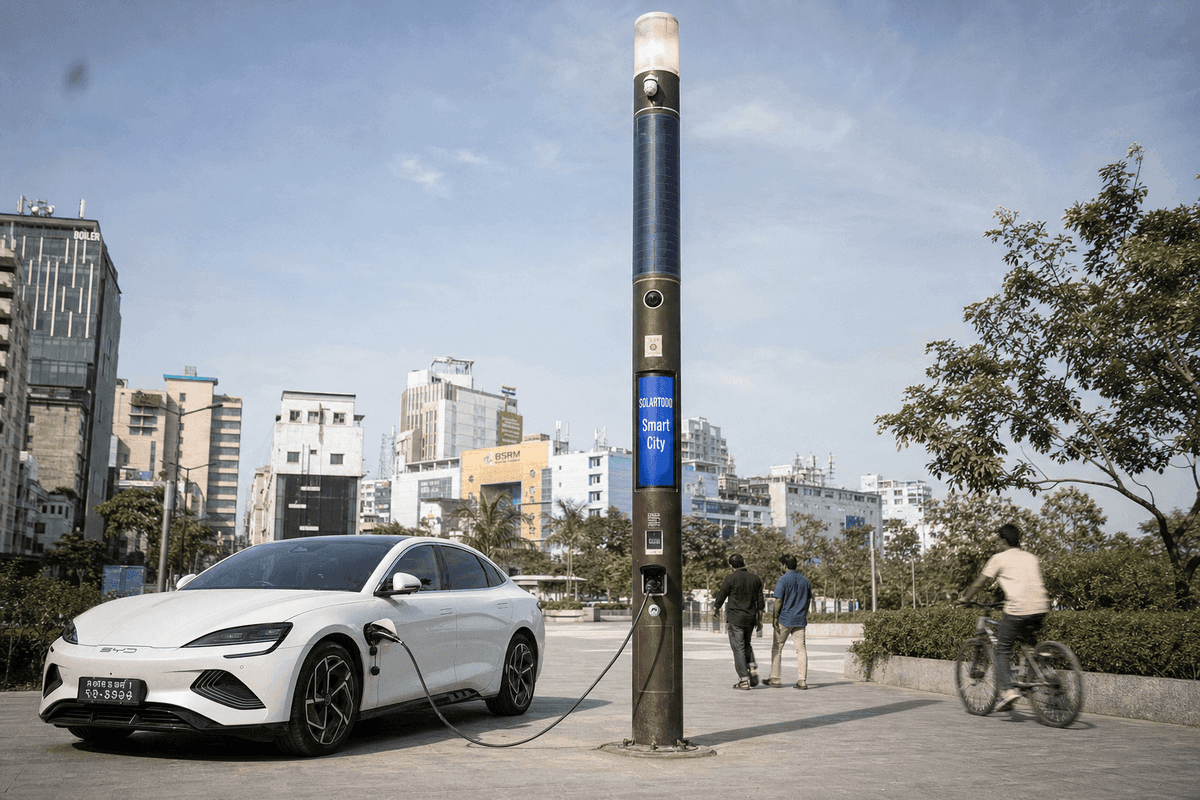
Chittagong’s dense urban corridors, coastal climate, and rising EV and telecom demand make an approximately 109-unit, 11m smart streetlight layout at 22m spacing technically suitable for selected arterial streets. A Ø200mm cylindrical pole with 100W LED, embedded 7kW AC charging, 5G n78, and 3,000Wh LFP backup aligns with IEC 60598 and GB/T 37024.
Key Takeaways
- A typical Chittagong urban-corridor deployment of this profile would use approximately 109 units at 22m spacing, covering about 2.4km of street length.
- The recommended pole class is an 11m seamless cylindrical Ø200mm pole with 5mm wall thickness, hot-dip galvanized steel, and RAL8011 antique bronze finish.
- Each pole would carry a 100W / 15,000lm / 4000K top luminaire with a Ø200mm PMMA diffuser dome, keeping the pole diameter constant with no side arms.
- The self-generation package is limited but useful: ~201W CIGS thin-film solar wrap from 6.5m to 10.3m plus a 3,000Wh LFP battery with MPPT for resilience and limited off-grid support.
- Embedded digital and safety functions include 4MP IR 50m camera, 8-parameter environmental sensor, 5G NR n78, flush SOS + dual-way intercom, and USB-A + Qi charging.
- EV service is sized for curbside opportunity charging, using an embedded 7kW AC Type 2 socket at 1.2m height with a 5m coiled cable and flush touchscreen at 1.5m.
- According to World Bank urban data and Bangladesh planning documents, Chittagong’s high-density transport corridors require multi-function poles that reduce street clutter while supporting lighting, communications, and public safety in a single Ø200mm monolithic structure.
- For procurement, buyers comparing standard octagonal poles versus SOLAR TODO’s cylindrical Smart Streetlight should focus on right-of-way constraints, visual control, corrosion exposure, and module flushness, not only wattage.
Market Context for Chittagong
Chittagong, officially Chattogram, is Bangladesh’s main seaport city and one of the country’s largest urban economies, with metropolitan population estimates in the multi-million range and sustained pressure on transport corridors, port access roads, and mixed-use commercial streets. According to the Bangladesh Bureau of Statistics (2022), Chattogram remains one of the country’s highest-density urban regions, while the World Bank (2023) notes that Bangladesh’s urbanization rate continues to increase demand for transport, municipal lighting, and digital public infrastructure. For smart streetlight planning, that means pole spacing, curb occupation, and maintenance access matter as much as lumen output.
Chittagong’s climate also affects pole selection. According to the Bangladesh Meteorological Department and World Bank Climate Knowledge Portal data, the city experiences high humidity, heavy monsoon rainfall, and cyclone exposure from the Bay of Bengal, with annual precipitation commonly above 2,500mm in the wider region. In practice, this supports a preference for hot-dip galvanized steel, flush-mounted electronics, and reduced external brackets that can trap water, salt, or debris. A monolithic cylindrical form is therefore technically attractive for premium urban corridors near coastal influence.
Grid context also supports a hybrid-but-grid-connected streetlight strategy rather than a fully off-grid streetlight. According to the Bangladesh Power Development Board (BPDB) and Sustainable and Renewable Energy Development Authority (SREDA), Bangladesh’s urban distribution networks are expanding, but municipal infrastructure still benefits from localized backup for resilience during outages and storm events. For Chittagong, this makes a grid-connected Smart Streetlight with 3,000Wh LFP internal storage more practical than trying to run all functions entirely from a ~201W solar wrap.
Telecom readiness is another local driver. The Bangladesh Telecommunication Regulatory Commission (BTRC) reports mobile subscriptions above 190 million nationally in recent years, and 4G densification continues in major cities. According to ITU (2023), urban digital infrastructure increasingly depends on compact edge sites and street-level equipment. That supports a smart pole that can host embedded 5G NR n78 without adding visual clutter or separate cabinets along already-constrained sidewalks.
Two authority statements are relevant here. The IEA states, "Energy efficiency is the first fuel," a point directly applicable to replacing conventional street lighting with 100W, 15,000lm LED systems that provide higher efficacy per circuit load. IEC states that road-lighting equipment must comply with safety and performance requirements under IEC 60598, which is particularly important in humid coastal cities where enclosure integrity and wiring practice affect long-term reliability.
SOLAR TODO’s Smart Streetlight is therefore best positioned in Chittagong as a premium corridor solution for commercial avenues, port-adjacent urban roads, civic streets, and mixed-use redevelopment zones where municipalities want to combine lighting, safety, communications, and limited EV charging in one pole footprint. The fit is strongest where right-of-way is tight and street furniture clutter is already a problem.
Recommended Technical Configuration
For Chittagong’s dense urban streets, a typical deployment of approximately 109 SOLAR TODO Smart Streetlight units would use 11m seamless cylindrical poles at 22m spacing to balance lighting uniformity, curbside functionality, and minimal sidewalk obstruction.
The correct size class for this city profile is the cyl_219 flagship cylindrical smart pole, specifically the project-defined 11m seamless cylindrical Ø200mm configuration. This is the best fit because the site profile is urban street class, not highway and not parkland. The product brief specifies 25-50m typical spacing for urban streets, and the project-specific spacing of 22m indicates a denser corridor treatment suited to commercial streets, transit interfaces, or port-city boulevards where higher function density is justified.
A typical 109-unit deployment in this profile would consist of one continuous corridor of roughly 2,398m if laid in a single line at 22m intervals, or multiple shorter segments if divided across intersections and frontage roads. The recommendation is not based on a claim of past installation. It is a technical planning benchmark for Chittagong streets with high pedestrian interaction, curb activity, and demand for integrated public equipment.
The defining engineering choice is the one-piece monolithic cylinder. The pole remains Ø200mm from top to bottom, with no widened base, no side arms, no external boxes, no speaker columns, and no outriggers. That matters in Chittagong because exposed accessories increase corrosion points, vandalism risk, and maintenance complexity in humid, high-traffic streets.
For lighting, the recommended luminaire is the specified top-mounted Ø200mm PMMA translucent diffuser dome, flush with the pole top and equal to pole diameter. Output is 100W, 15,000 lumens, and 4000K, which suits mixed traffic and pedestrian streets better than warmer decorative temperatures below 3000K or higher-glare cool white above 5000K. A 4000K CCT is commonly used where color recognition, CCTV support, and neutral urban appearance are required.
For energy support, the pole’s 360° wrapped CIGS thin-film solar layer extends from 6.5m to 10.3m and provides approximately 201W total. This should be treated as a resilience feature, not the primary power source for the full smart-pole load. In Chittagong’s monsoon climate, the practical role of the solar wrap is to support low-load functions, reduce net grid draw, and maintain selected services during short outages when paired with the internal 3,000Wh LFP battery and MPPT controller.
For curbside utility, the embedded 7kW AC Type 2 Mennekes charger is appropriate for passenger vehicles parked for 1-3 hours, not for rapid-turnover DC charging. Bangladesh’s EV market is still early compared with Europe or China, but city authorities and private developers increasingly evaluate AC charging in mixed-use zones. Integrating it inside the pole avoids adding a second cabinet or bollard on already narrow sidewalks.
For digital infrastructure, the recommended stack includes the 4MP IR 50m flush camera, 8-parameter environmental sensor, embedded 5G NR n78, flush SOS button, dual-way audio intercom, USB-A, Qi wireless charging, and a 2200mm × ~170mm curved LCD inset into the cylinder. The display content is intentionally restricted to “SOLARTODO Smart City” text only, which keeps the specification simple for municipal review and avoids ad-screen classification issues in many jurisdictions.
Procurement teams evaluating SOLAR TODO Smart Streetlight for Chittagong should therefore treat this configuration as a corridor-grade smart pole for premium urban streets rather than a general low-cost streetlight replacement. For layout validation, corrosion category review, and utility coordination, buyers can contact us during pre-bid design.
Technical Specifications
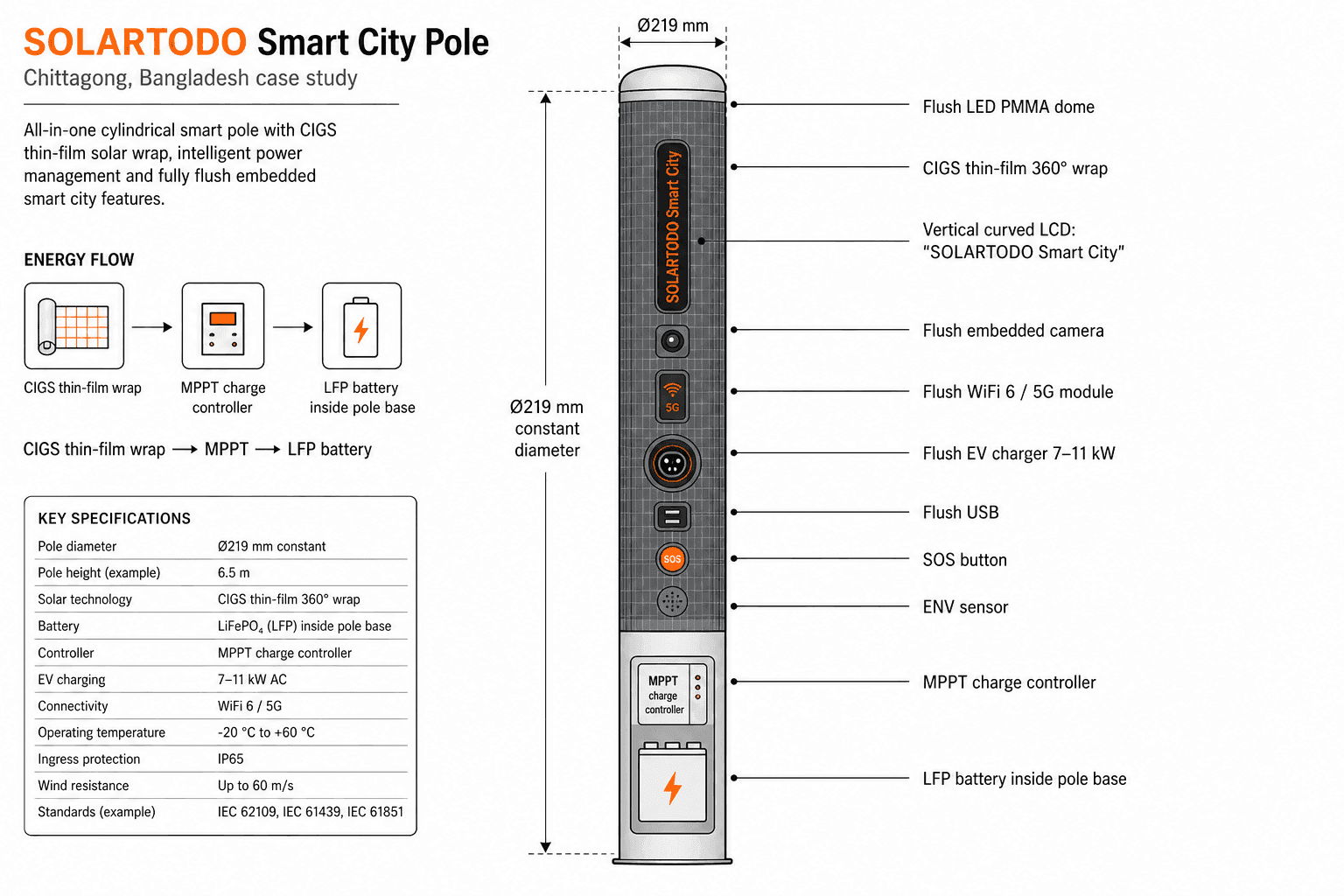
The recommended Chittagong configuration is an 11m, Ø200mm monolithic cylindrical Smart Streetlight with 100W LED, ~201W CIGS wrap, 3,000Wh LFP battery, embedded 7kW AC charging, and fully flush-mounted digital modules.
- Pole form: Seamless cylindrical steel pole, 11m height, Ø200mm constant diameter top-to-bottom, 5mm wall thickness
- Material and finish: Hot-dip galvanized steel, RAL8011 antique bronze
- Structural concept: One monolithic cylinder; no side arms, no luminaire outriggers, no external cabinets, no widened base, no separate charger bollard
- Lighting: Top luminaire with Ø200mm PMMA translucent diffuser dome, flush on pole top, 100W, 15,000lm, 4000K
- Solar collection: 360° CIGS flexible thin-film cells wrapped around pole mid-section from 6.5m to 10.3m, approximately 201W total, dark blue-black semi-transparent laminated film, fully flush to pole skin
- Battery and charging control: 3,000Wh LFP battery inside pole base with MPPT controller
- Camera: Flush bullet camera behind rectangular glass window, 4MP, IR 50m, no protruding body
- Environmental sensing: 8 parameters — temperature, humidity, wind, pressure, noise, PM2.5, PM10, illuminance
- Communications: Embedded 5G NR n78 with internal antenna
- Emergency interface: Flush SOS button and dual-way audio intercom through pinhole speaker grille only; no public-address audio module
- EV charging: Embedded 7kW AC charger, Type 2 Mennekes socket under flush flip-cap at 1.2m, 5m coiled Type 2 cable, flush touchscreen at 1.5m
- Display: Vertical curved LCD, 2200mm tall × ~170mm wide, bent to Ø200mm radius, flush inset, portrait orientation, content restricted to “SOLARTODO Smart City” stacked vertically in white on deep blue
- User utilities: Flush USB-A port and Qi wireless charging pad
- Spacing basis: 22m typical spacing for this corridor scenario
- Applicable standards: IEC 60598, GB/T 37024
Implementation Approach
A corridor-scale rollout in Chittagong would typically be executed in 4 phases over roughly 16-28 weeks, depending on utility approvals, civil permits, and import lead times.
Phase 1 is corridor selection, lighting simulation, and utility coordination. For a 109-unit scope, this usually includes lux modeling, pole setback checks, charger load allocation, and telecom review for n78 backhaul conditions. In Chittagong, this phase should also include drainage review because curbside flooding during monsoon periods can affect base access and cable routing depths.
Phase 2 is detailed engineering and procurement. The buyer would confirm foundation loads, feeder sizing for the 100W LED plus auxiliary equipment, and charger diversity assumptions for the 7kW AC sockets. For imported smart poles, documentation should cover IEC compliance, galvanized coating quality, battery transport classification for LFP, and display/control system integration before shipment.
Phase 3 is civil works and pole installation. A typical sequence is foundation excavation, conduit placement, anchor or embedded base preparation as specified, curing, pole erection, internal wiring checks, and top-level commissioning. Because the pole is a constant Ø200mm monolithic cylinder, installation teams need lifting methods that protect the flush screen, sensor pod, and CIGS wrap during handling.
Phase 4 is systems integration and acceptance testing. This includes lighting verification at 15,000lm, charger functionality at 7kW AC, camera stream validation, SOS call routing, display content confirmation, and battery/MPPT checks. A practical acceptance plan should also test operation after simulated grid interruption to confirm how long critical loads remain available from the 3,000Wh battery.
For Chittagong specifically, corrosion management and maintenance planning should be built into the deployment method. Coastal salt exposure can shorten service life if coating damage is left untreated, so inspection intervals of 6-12 months are more prudent than waiting for visible deterioration. SOLAR TODO buyers should also request spare-part planning for the LCD, charger socket, and camera glass assemblies at tender stage.
Expected Performance & ROI
For Chittagong corridors, a smart streetlight of this class would typically cut lighting energy use by 50-70% versus legacy sodium systems while adding telecom, safety, and EV functions to the same 11m pole footprint.
According to the IEA (2022), LED street lighting commonly reduces electricity demand by 50% or more compared with conventional high-pressure sodium systems. If an existing corridor used 250W HPS fixtures plus ballast losses near 280W, replacing them with 100W LED luminaires can materially reduce feeder load even before considering dimming schedules. Over 4,000-4,200 annual operating hours, that difference can exceed 700 kWh per pole per year in many duty cycles.
The ROI case in Chittagong should not be framed only around electricity savings because this specification includes embedded communications, emergency response, environmental sensing, and EV charging. According to NREL (2023), public EV charging utilization and value depend heavily on dwell time, tariff design, and location type. In this configuration, the 7kW AC charger is best valued as a mixed amenity and future-readiness feature rather than the core payback driver.
Maintenance economics also favor the flush cylindrical design in premium corridors. External brackets, cabinets, and add-on devices often increase cleaning time, corrosion points, and accidental damage risk. A pole that keeps all modules inside a Ø200mm envelope can reduce visual clutter and may lower recurring field interventions, especially where sidewalks are narrow and traffic management for maintenance is costly.
Sample deployment scenario (illustrative): if 109 poles replace legacy 250W HPS points operating 4,100 hours/year, the lighting-only energy reduction could approach 78,000-82,000 kWh annually, excluding controls optimization and solar contribution. Actual payback would depend on local tariff, trenching cost, charger utilization, telecom monetization, and municipal financing structure. In most B2B evaluations, buyers should model a 6-10 year blended payback for premium multifunction poles, while simple LED-only poles may recover faster but deliver fewer municipal functions.
According to IRENA (2023), battery-backed distributed assets improve resilience where grid interruptions affect public services. In Chittagong, that matters because a 3,000Wh LFP reserve can keep selected low-load systems such as communications, sensors, emergency functions, or reduced lighting active during short outages. That resilience value is difficult to express in tariff terms but important for port-city operations and public safety.
Comparison Table
For Chittagong buyers, the main decision is whether a premium cylindrical smart pole delivers enough corridor value versus a simpler octagonal smart pole or a conventional LED streetlight.
| Metric | Recommended SOLAR TODO Cylindrical Smart Streetlight | Standard Octagonal Smart Pole | Conventional LED Streetlight |
|---|---|---|---|
| Pole height | 11m | 6-12m typical | 8-12m typical |
| Pole body | Ø200mm constant cylindrical | Tapered octagonal | Standard lighting pole |
| External arms/boxes | None | Possible depending on accessories | Usually luminaire arm only |
| LED output | 100W / 15,000lm / 4000K | 80-150W typical | 80-150W typical |
| Solar support | ~201W CIGS wrap | Usually none or separate modules | None |
| Battery | 3,000Wh LFP | Optional / project-specific | Usually none |
| EV charging | Embedded 7kW AC Type 2 | Optional modular | Rare |
| Camera | Flush 4MP IR 50m | External or semi-flush | Usually none |
| 5G readiness | Embedded n78 | 5G-ready optional | Usually none |
| Display | 2200mm curved flush LCD | Optional add-on screen | None |
| Street clutter impact | Lowest | Medium | Low to medium |
| Best use case | Premium urban corridors | General smart-city streets | Lighting-only upgrades |
Pricing & Quotation
SOLAR TODO offers three pricing tiers for this product line: FOB Supply (equipment ex-works China), CIF Delivered (including ocean freight and insurance), and EPC Turnkey (fully installed, commissioned, with 1-year warranty). Volume discounts are available for large-scale deployments. Configure your system online for an instant estimate, or request a custom quotation from our engineering team at [email protected].
Frequently Asked Questions
This FAQ answers 10 common buyer questions about Chittagong smart streetlight design, including 11m pole specs, 7kW charging, ROI range, installation time, maintenance, and warranty scope.
Q1: Why is an 11m cylindrical smart pole recommended for Chittagong instead of a shorter 6-8m pole?
An 11m pole fits urban arterial and commercial corridors better than a 6-8m garden-light class pole. It supports wider road coverage, better camera sightlines, and higher placement for the 201W CIGS wrap and 5G n78 antenna. For Chittagong’s mixed traffic streets, this height is more suitable than park-scale poles.
Q2: Can the ~201W solar wrap run the full pole without grid power?
Not continuously. A ~201W CIGS wrap plus 3,000Wh LFP battery is best treated as backup and partial energy support. The 100W LED, display, communications, camera, and 7kW EV charging require grid connection for normal operation. In outages, selected low-load functions can remain active for limited periods.
Q3: What corridor length does 109 poles cover at 22m spacing?
At 22m spacing, 109 units cover roughly 2,398m, or about 2.4km, if arranged in a continuous line. Actual route length varies with intersection offsets, median placement, staggered layouts, and whether both sides of the road are equipped. Designers should verify spacing through photometric simulation before final BOQ approval.
Q4: How long would a project like this typically take to implement?
A 109-unit corridor project would typically take 16-28 weeks from design freeze to commissioning. The range depends on civil permits, utility coordination, import logistics, and foundation curing time. Monsoon scheduling in Chittagong can extend trenching and base work, so procurement teams should avoid assuming dry-season productivity year-round.
Q5: What kind of maintenance does the flush cylindrical design require?
Routine maintenance usually includes 6-12 month inspections for coating damage, charger socket wear, camera window cleaning, battery diagnostics, and display checks. Because the design has no side arms or external cabinets, there are fewer exposed parts to clean or repair. Coastal humidity still makes corrosion inspection important in Chittagong.
Q6: What ROI or payback should buyers expect?
For premium multifunction poles, buyers often model a blended payback of 6-10 years, depending on tariff, civil cost, charger usage, and any telecom or city-service value assigned. Lighting-only energy savings may be significant, but this product’s business case also includes safety, digital infrastructure, and resilience functions beyond kWh reduction.
Q7: How does this compare with a standard octagonal smart pole?
A standard octagonal pole can be lower in first cost and easier to adapt with modular accessories. The cylindrical SOLAR TODO Smart Streetlight offers better visual control, lower street clutter, and fully flush integration inside a constant Ø200mm body. It is usually the stronger choice for premium corridors, waterfront boulevards, and architect-sensitive streetscapes.
Q8: Is the 7kW AC charger appropriate for Bangladesh’s current EV market?
Yes, for selected locations. A 7kW AC Type 2 charger suits dwell-time charging at commercial streets, mixed-use developments, and municipal parking edges. It is not a substitute for DC fast charging, but it provides practical curbside charging where vehicles remain parked for 1-3 hours and where adding a separate charging pedestal is difficult.
Q9: What standards should appear in the technical submittal?
At minimum, buyers should require conformance to IEC 60598 for luminaire safety and the specified GB/T 37024 smart-pole framework. Tender documents should also request material, galvanization, battery, charger, and communications documentation, plus ingress and electrical protection details suitable for humid coastal service conditions.
Q10: What warranty structure is typical for this type of procurement?
Warranty terms vary by scope, but turnkey municipal packages commonly include 1 year for installed systems, with longer component warranties available for LED drivers, batteries, and displays by agreement. Buyers should define response times, spare-parts coverage, and exclusions for vandalism, flooding, or grid-side faults before contract award.
References
- Bangladesh Bureau of Statistics (2022): Population and Housing Census data confirming Chattogram as one of Bangladesh’s largest urban centers.
- World Bank (2023): Bangladesh urban development and climate data indicating rising infrastructure demand and high exposure to coastal climate risks.
- Bangladesh Power Development Board (2023): National power system and urban distribution information relevant to grid-connected municipal infrastructure.
- Bangladesh Telecommunication Regulatory Commission (2023): National mobile and broadband statistics supporting street-level telecom densification needs.
- International Energy Agency (2022): LED lighting efficiency guidance showing street-light electricity savings often exceed 50% versus legacy technologies.
- International Renewable Energy Agency (2023): Distributed energy storage guidance supporting resilience benefits from battery-backed public assets.
- IEC (2023): IEC 60598 luminaire safety requirements applicable to street lighting equipment.
- Standardization Administration of China (latest applicable edition): GB/T 37024 smart multifunction pole framework relevant to integrated smart-pole systems.
Equipment Deployed
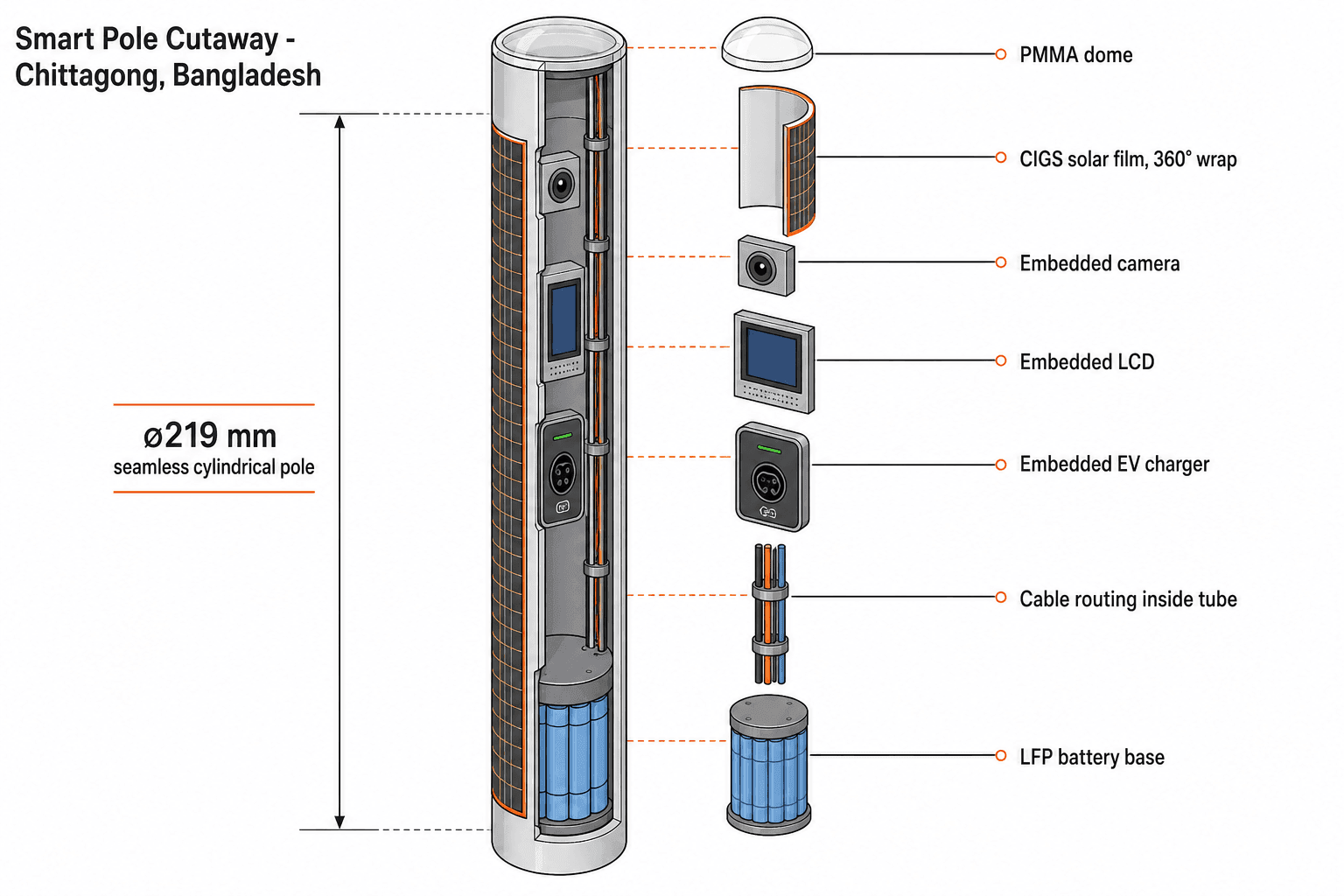
- 11m seamless cylindrical smart pole, Ø200mm constant diameter, 5mm wall, hot-dip galvanized steel, RAL8011 antique bronze
- Top-mounted Ø200mm PMMA diffuser dome luminaire, 100W, 15,000lm, 4000K
- 360° wrapped CIGS flexible thin-film solar cells from 6.5m to 10.3m, approximately 201W total
- LFP battery pack, 3,000Wh, internal base-mounted with MPPT charge controller
- Flush 4MP bullet camera behind rectangular glass window, IR range 50m
- 8-parameter environmental sensor pod: temperature, humidity, wind, pressure, noise, PM2.5, PM10, illuminance
- Embedded 5G NR n78 communications module with internal antenna
- Flush SOS emergency button with dual-way audio intercom via pinhole grille
- Embedded 7kW AC EV charger with Type 2 Mennekes socket at 1.2m and 5m coiled cable
- Flush touchscreen interface at 1.5m height
- Curved vertical LCD display, 2200mm tall × approximately 170mm wide, inset to Ø200mm radius
- Flush USB-A port and Qi wireless charging pad