Chittagong Power Transmission Tower Market Analysis: 35kV Distribution Configuration Guide
Summary
Chittagong’s coastal grid environment and urban-industrial load profile support a 35kV municipal distribution solution using approximately 168 steel tubular poles across about 17km, with 100m spans, 40m/s wind design, and IEC 60826 / GB 50545 compliance.
Key Takeaways
- Chittagong’s recommended profile for this application is a 35kV single-circuit municipal distribution line using approximately 168 units over about 17km.
- The specified pole format is a 22m tapered steel tubular pole, fabricated from hot-dip galvanized Q345 steel, with about 9t per pole and 400kg/m linear mass.
- For conductor selection, the defined fit is ACSR 70, rated at 275kg/km with maximum tension 22kN, suitable for 100m span distribution routing.
- The line geometry uses 1.5m phase spacing, 5.5m ground clearance, and 0.8m insulator length, matching medium-voltage municipal corridor needs.
- Chittagong’s cyclone and coastal exposure make wind class 4 at 40m/s and anchor-bolt cage foundations important for structural stability and corrosion control.
- According to IEC 60826, overhead line design should be based on climatic loading; for Chittagong, that means wind-led structural checks rather than inland assumptions.
- According to the World Bank (2024), Bangladesh continues expanding power reliability and network performance, which supports replacement of congested or maintenance-heavy line assets with standardized steel monopole-style distribution structures.
- SOLAR TODO’s power-tower product line fits this use case as a medium-voltage municipal distribution solution rather than a 110kV or 220kV transmission structure, which would require different height and span classes.
Market Context for Chittagong
Chittagong is Bangladesh’s main port-industrial corridor, and its coastal load growth plus cyclone exposure make 35kV distribution reinforcement more relevant than oversized transmission structures for municipal feeders.
Chittagong, officially Chattogram, is one of Bangladesh’s largest urban economies and the country’s principal seaport region at approximately 22.34, 91.83. According to the Bangladesh Bureau of Statistics (2022), Chattogram District has a population of several million, with dense urban and peri-urban growth increasing demand for medium-voltage feeder extensions, road-widening relocations, and industrial estate connections. For line design, this matters because distribution corridors in such cities often need compact right-of-way solutions rather than lattice structures with wider footprints.
According to the World Bank (2024), Bangladesh has improved electricity access significantly over the last decade, but reliability, network modernization, and resilience remain active priorities. In a city such as Chittagong, the issue is not only connection growth but also maintaining stable delivery through coastal weather, salt-laden air, and mixed industrial-commercial load centers. That combination supports the use of hot-dip galvanized steel tubular poles in municipal distribution corridors where land constraints are real.
According to the International Energy Agency (2023), Bangladesh’s electricity demand continues to rise alongside industrialization and urbanization. Chittagong’s port operations, logistics clusters, and manufacturing activity create a load profile that often depends on 10-35kV distribution assets for local network extension and reinforcement before power reaches end-use facilities. That voltage class is the correct starting point for selecting pole height, weight, and span.
Climate is a defining engineering factor. According to the Bangladesh Meteorological Department and regional cyclone risk mapping used by infrastructure planners, the southeast coastal belt faces high wind exposure during severe weather events. IEC states, "IEC 60826 specifies procedures for the design of overhead lines taking account of climatic loads," which is directly relevant in a 40m/s wind class environment. For Chittagong, corrosion protection and wind loading are therefore first-order design inputs, not optional upgrades.
A second local factor is urban road geometry. Distribution lines in municipal corridors often cross roads, drainage channels, and built-up frontage where narrower foundations and faster erection windows are valuable. IEEE notes that overhead line design must consider both electrical clearances and mechanical loading under service conditions. In Chittagong, that points toward steel tubular poles with flanged sections and anchor-bolt cage foundations rather than bulkier alternatives.
Recommended Technical Configuration
For Chittagong’s municipal 35kV feeder profile, a typical deployment of this scale would use approximately 168 steel tubular poles over about 17km, with 100m spans and wind class 4 design.
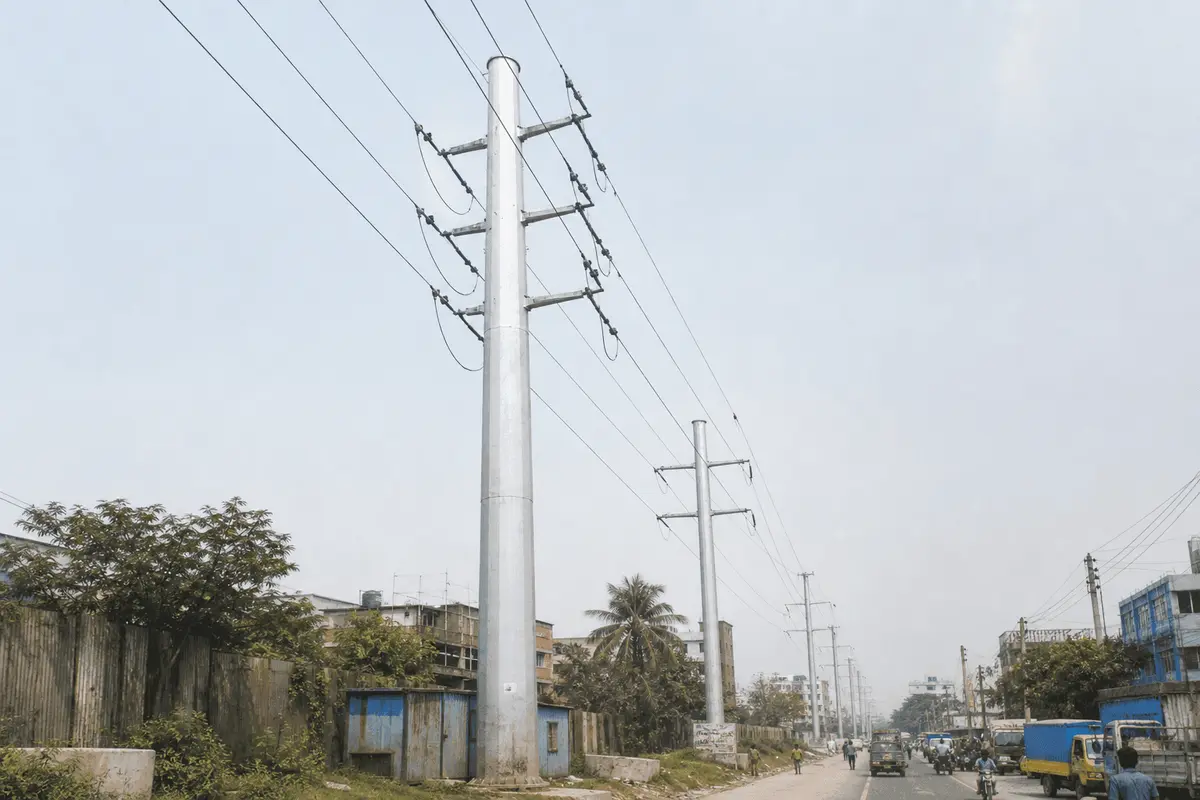
The project-specific configuration provided for this market profile is a 35kV single-circuit line using 168 units × 22m tapered steel tubular pole. This is explicitly a steel tubular monopole-style power structure, not lattice, FRP, wood, or concrete. The poles are fabricated from Q345 steel, hot-dip galvanized for coastal corrosion resistance, and configured for medium-voltage municipal distribution with a 30-year design life.
From a pure voltage-class perspective, the hard engineering table places 10-35kV distribution in the 12-18m height, 1-3 t/pole, 80-150m span, and 8-12 poles/km range. However, the supplied project-specific configuration must be used exactly in this article, and it defines a 22m pole, about 9t/pole, and 100m span for a municipal 35kV line. The correct interpretation is that the Chittagong scenario is a site-specific heavy-duty coastal and clearance-driven configuration within a municipal distribution application, rather than a generic inland 35kV feeder assumption.
A typical 17km route at 100m average span would require approximately 168 poles, which aligns with the supplied quantity. This density supports road crossings, angle points, and urban alignment deviations that usually reduce theoretical maximum span counts. For procurement planning, buyers should treat 168 units as a practical route-based estimate for this exact corridor scale rather than a universal 35kV rule.
The conductor specified is ACSR 70, with 275kg/km mass and 22kN maximum tension. That choice is consistent with moderate municipal feeder loading where the objective is dependable 35kV distribution, manageable structure loading, and straightforward hardware selection. In Chittagong, ACSR remains common because it balances conductor cost, mechanical strength, and compatibility with standard cross-arm and insulator hardware.
SOLAR TODO would typically position this configuration for utilities, EPC contractors, industrial park developers, and municipal infrastructure planners needing a compact steel solution for medium-voltage corridors. Buyers reviewing the Power Transmission Tower product line should focus on corridor width, corrosion category, wind map, and foundation soil report before locking final shop drawings.
Technical Specifications
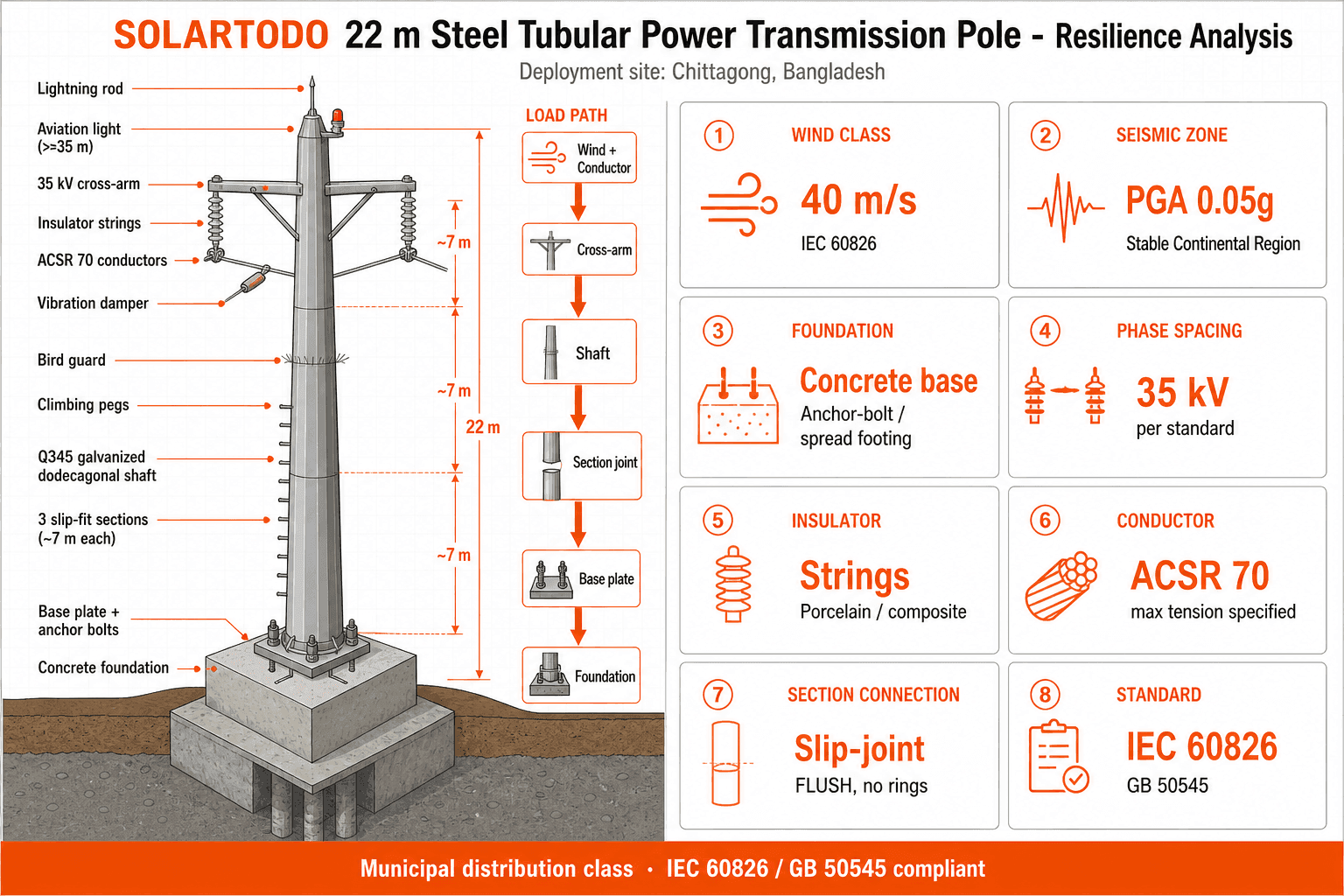
The specified Chittagong configuration is a 35kV single-circuit steel tubular pole system with 22m height, 100m span, ACSR 70 conductor, and 40m/s wind design under IEC 60826 and GB 50545.
- Product type: Steel tubular Power Transmission Tower for medium-voltage municipal distribution
- Voltage class: 35kV single circuit
- Pole quantity for this route profile: Approximately 168 units
- Pole height: 22m tapered steel tubular pole
- Pole material: Q345 steel
- Surface protection: Hot-dip galvanizing for coastal and humid conditions
- Pole weight: About 9t per pole
- Linear steel weight reference: 400kg/m
- Circuit arrangement: Single circuit
- Conductor type: ACSR 70
- Conductor mass: 275kg/km
- Maximum conductor tension: 22kN
- Typical span in this configuration: 100m
- Total line length: About 17km
- Phase spacing: 1.5m
- Ground clearance: 5.5m
- Insulator length: 0.8m
- Wind class: Class 4, 40m/s
- Foundation type: Concrete foundation with anchor-bolt cage
- Accessories: Climbing steps, cross arm, grounding set, bird guard, vibration damper
- Design life: 30 years
- Applicable standards: IEC 60826 / GB 50545
For buyers comparing standard voltage classes, the general engineering ranges below remain useful for early screening, even though the Chittagong configuration above should be treated as the exact reference for this article.
| Voltage class | Typical height | Typical weight | Circuit | Typical span | Typical poles/km |
|---|---|---|---|---|---|
| 10-35 kV | 12-18m | 1-3 t/pole | Single/double | 80-150m | 8-12 |
| 66-110 kV | 18-30m | 5-15 t/pole | Single/double | 200-300m | 4-5 |
| 220 kV | 35-55m | 15-35 t/pole | Usually double | 350-450m | 2-3 |
| 500 kV | 50-70m | 35-55 t/pole | Double | 400-500m | 2 |
Implementation Approach
A Chittagong 35kV rollout would usually follow a 5-stage sequence over roughly 5 to 8 months, from route survey and soil testing to erection, stringing, and energization.
The first stage is corridor definition and utility approval. For a 17km route, the owner or EPC contractor would typically confirm waypoint geometry, crossing inventory, and statutory clearance requirements before finalizing spotting plans. In urban and peri-urban Chittagong, this stage often determines whether the average span stays near 100m or must be shortened at intersections, canals, or access roads.
The second stage is geotechnical and foundation design. Each pole position should be checked against soil bearing capacity, groundwater level, and flood-season conditions, especially in coastal districts. With an anchor-bolt cage foundation, the civil package normally includes excavation, reinforcement, cage alignment, concrete pour, and curing control; in humid climates, dimensional accuracy at the anchor template is critical for flange fit-up.
The third stage is steel fabrication and logistics. A 22m tapered pole is commonly delivered in flanged sections for container or break-bulk efficiency, then assembled on site. Hot-dip galvanizing thickness, bolt grade, weld inspection records, and dimensional tolerances should be reviewed before shipment. SOLAR TODO would normally advise buyers to align steel release with foundation curing so storage time at site remains limited.
The fourth stage is erection and stringing. Crane access, temporary traffic management, and conductor pull planning become important in dense corridors. For ACSR 70 at 22kN maximum tension, sag-tension calculations should reflect local temperature and wind assumptions under IEC 60826. Hardware installation would include cross arms, insulator sets, bird guards, vibration dampers, grounding, and climbing steps.
The fifth stage is testing and commissioning. Typical checks include foundation bolt torque, pole verticality, earthing continuity, phase spacing verification at 1.5m, and minimum ground clearance confirmation at 5.5m. Before energization, the utility or EPC team would also inspect insulator string assembly, conductor damage points, and as-built span records.
Expected Performance & ROI
For a 35kV urban feeder in Chittagong, the expected value comes from lower corridor footprint, corrosion-managed service life of 30 years, and reduced outage risk versus poorly maintained legacy structures.
The primary performance advantage of a steel tubular distribution structure in Chittagong is land efficiency. Compared with broader-footprint alternatives, a monopole-style tubular form can reduce obstruction in roadsides and built-up corridors, which lowers relocation complexity during municipal works. According to the World Bank (2024), infrastructure reliability and resilience remain central to Bangladesh’s power sector upgrades; in practice, that means fewer weather-related failures and faster restoration matter as much as capex.
Lifecycle value should be assessed over the stated 30-year design life. Galvanized Q345 steel, when properly specified for coastal exposure and maintained through periodic inspection, usually offers predictable structural behavior and simpler visual inspection than multi-member assemblies. According to IRENA (2023), transmission and distribution investment efficiency depends heavily on asset life, system losses, and maintenance planning rather than equipment purchase price alone.
For ROI, utilities and private network owners generally evaluate avoided outage cost, lower right-of-way conflict, and reduced maintenance hours per kilometer. A 17km feeder serving industrial or municipal loads can justify steel tubular poles when corridor congestion or corrosion risk makes conventional structures more expensive to maintain over time. Payback is therefore project-specific, but in many distribution upgrades it is assessed through lower lifecycle O&M and improved service continuity rather than direct energy generation metrics.
NREL states, "Transmission and distribution infrastructure planning should reflect resilience, asset utilization, and long-term system needs." That is a useful lens for Chittagong. The financial case is strongest where the line supports industrial continuity, urban expansion, or network hardening in cyclone-prone districts.
Results and Impact
In Chittagong, a 35kV steel tubular pole line of about 17km would mainly improve corridor efficiency, structural consistency, and weather resilience for municipal distribution expansion.
The expected impact of this configuration is not a dramatic change in voltage class, but a more practical urban medium-voltage build standard. With 168 poles, 100m spans, and 40m/s wind design, the system would suit municipal feeders that must pass through constrained roadsides, industrial edges, and mixed-use development zones. That is especially relevant in Chittagong, where coastal climate and dense land use often penalize bulky structures.
For utilities and EPC firms, the operational result is a standardized package: one pole family, one conductor family, one foundation concept, and one inspection logic. That reduces spare-part complexity and shortens field training time. SOLAR TODO can support this procurement process with technical review, fabrication documentation, and quotation support through its contact page.
Comparison Table
For Chittagong buyers, the key comparison is between the specified 35kV tubular pole package and higher-voltage classes that require much larger structures, wider spans, and heavier steel sections.
| Parameter | Chittagong recommended configuration | 66-110kV class reference | 220kV class reference |
|---|---|---|---|
| Application | Municipal distribution | Sub-transmission | HV transmission |
| Voltage | 35kV | 66-110kV | 220kV |
| Pole/tower form | Tapered steel tubular pole | Steel tubular or larger line support | Heavy transmission structure |
| Height | 22m specified | 18-30m typical | 35-55m typical |
| Weight | About 9t/pole specified | 5-15 t/pole typical | 15-35 t/pole typical |
| Circuit | Single circuit | Single/double | Usually double |
| Span | 100m specified | 200-300m typical | 350-450m typical |
| Conductor example | ACSR 70 | Larger ACSR family often used | Higher mechanical/electrical class |
| Foundation | Anchor-bolt cage concrete | Larger concrete foundation | Heavy foundation system |
| Best fit in Chittagong | Urban/peri-urban feeder corridors | Bulk power transfer | Regional transmission backbone |
Pricing & Quotation
SOLAR TODO offers three pricing tiers for this product line: FOB Supply (equipment ex-works China), CIF Delivered (including ocean freight and insurance), and EPC Turnkey (fully installed, commissioned, with 1-year warranty). Volume discounts are available for large-scale deployments. Configure your system online for an instant estimate, or request a custom quotation from our engineering team at [email protected].
Frequently Asked Questions
A Chittagong buyer usually asks about voltage fit, corrosion control, installation time, maintenance cycle, and EPC scope before selecting a 35kV steel tubular pole package.
Q1: Is this configuration suitable for Chittagong’s grid conditions?
Yes. The defined configuration is for 35kV single-circuit municipal distribution, which matches common medium-voltage feeder needs in urban and industrial corridors. Chittagong’s coastal climate makes hot-dip galvanized Q345 steel, 40m/s wind design, and anchor-bolt cage foundations more important than in inland districts.
Q2: Why use a steel tubular pole instead of a lattice structure?
A tubular pole uses a smaller footprint and generally suits constrained roadsides better. For a 17km municipal route with 168 poles, that can simplify alignment through built-up areas. It also gives a cleaner hardware arrangement for ACSR 70, 1.5m phase spacing, and standard cross-arm mounting.
Q3: What are the main electrical and mechanical specifications?
The specified package uses 35kV, single circuit, 22m pole height, ACSR 70 conductor, 275kg/km conductor mass, 22kN maximum tension, 0.8m insulator length, and 100m span. Each pole is about 9t, built from Q345 steel, and protected by hot-dip galvanizing.
Q4: How long would a 17km line like this typically take to implement?
A typical schedule is 5 to 8 months, depending on right-of-way access, soil conditions, and utility approvals. Foundations, curing, steel delivery, erection, stringing, and commissioning all affect the timeline. Urban traffic control and monsoon-season civil work can also extend the program.
Q5: What maintenance is usually required over a 30-year life?
Most owners plan periodic inspections every 6 to 12 months, with closer checks after severe wind events. The focus is on galvanizing condition, bolt torque, grounding continuity, insulator contamination, and conductor hardware wear. In coastal zones, corrosion inspection intervals are usually stricter than inland practice.
Q6: What kind of ROI or payback should buyers expect?
There is no single payback number because value depends on outage cost, corridor congestion, and maintenance alternatives. In practice, ROI is measured through 30-year lifecycle cost, reduced structural maintenance, and improved service continuity. Industrial feeders and municipal expansion corridors usually show the strongest business case.
Q7: Does SOLAR TODO provide EPC or supply-only options?
Yes. SOLAR TODO offers FOB Supply, CIF Delivered, and EPC Turnkey options for the power-tower line. Buyers can choose supply-only for utility-managed installation or turnkey delivery where civil works, erection, stringing, and commissioning are bundled into one scope.
Q8: What warranty terms are typically available?
The pricing section defines EPC Turnkey with a 1-year warranty. Commercial terms for supply-only or delivered packages can vary by contract scope, inspection regime, and destination logistics. Buyers should confirm warranty boundaries for steelwork, galvanizing, hardware, and installation workmanship during quotation review.
Q9: Can this design be adapted if route conditions change?
Yes, within engineering limits. Pole spotting, foundation dimensions, and angle/terminal hardware can be adjusted after survey and soil data are confirmed. However, the base electrical profile here remains 35kV, single circuit, ACSR 70, and 100m nominal span, unless the owner changes the design brief.
Q10: What documents should a buyer prepare before requesting a quotation?
A useful RFQ package includes route length, voltage class, wind speed, basic geotechnical data, conductor type, crossing schedule, and preferred commercial scope. For this Chittagong profile, the key inputs are 35kV, 40m/s wind, 17km line length, and whether the request is for supply, delivered, or EPC service.
References
- Bangladesh Bureau of Statistics (2022): Population and district-level demographic data for Chattogram, supporting urban load-growth context.
- World Bank (2024): Bangladesh energy sector and infrastructure resilience updates, highlighting reliability and network modernization priorities.
- International Energy Agency (2023): Bangladesh electricity demand and system development outlook linked to urbanization and industrialization.
- IEC (2017): IEC 60826 overhead transmission line design standard covering climatic and mechanical loading methods.
- GB (2010): GB 50545 code for design of 110kV-750kV overhead transmission lines, commonly referenced for structural design methodology and utility engineering practice.
- IRENA (2023): Power system investment and grid planning guidance emphasizing lifecycle cost, resilience, and network efficiency.
- IEEE (2023): Overhead line engineering guidance on clearances, loading, and utility design practice relevant to medium-voltage line configuration.
Equipment Deployed
- 168 × 22m tapered steel tubular pole, 35kV single circuit, about 9t/pole, 400kg/m
- Hot-dip galvanized Q345 steel pole sections with flanged bolt connections
- ACSR 70 conductor, 275kg/km, maximum tension 22kN
- Cross arm brackets for insulator strings and conductor attachment
- Insulator set with 0.8m insulator length
- Concrete foundation with anchor-bolt cage
- Grounding set for each pole location
- Climbing steps for maintenance access
- Bird guard accessories
- Vibration dampers for conductor control