Cape Town Solar Streetlight (Split-Type) Market Analysis: 330-Unit Smart Lighting Configuration for 15 m Roads
Summary
Cape Town’s high solar resource, periodic grid constraints, and wide suburban road network make split-type solar lighting technically viable for 15 m corridors. A typical 330-unit layout at 21 m spacing would use 120 W LED heads, 1490 W Mono PERC panels, and 7 m stainless steel 304 poles.
Key Takeaways
- A typical corridor-scale scheme in Cape Town would use approximately 330 units over a 15 m road width with 21 m spacing to maintain consistent roadway illumination.
- The specified configuration uses a 120 W LED / 18,000 lm luminaire on a 7 m stainless steel 304 pole rated for 50 m/s wind resistance and about 40 years service life.
- Each pole would carry a 1490 W Mono PERC solar panel at the very top on a tilted bracket, with 21% module efficiency, 0.4%/yr degradation, and a 25-year warranty.
- Energy storage is based on an externally mounted 12 V / 300 Ah NCM lithium battery box, with 250 Wh/kg, 2000 cycles, 85% DoD, and a 5-year warranty.
- Smart controls would typically combine motion sensing, timer control, and 4G/LoRa remote monitoring, which can reduce unnecessary burn hours and improve fault response time.
- Cape Town receives strong solar resource; according to the World Bank Global Solar Atlas (2024), much of the Western Cape records high PV potential consistent with daily charging assumptions around 5.5 sun-hours in suitable seasons.
- The system is specified for 3-5 days of cloudy-weather backup, dusk-to-dawn automatic operation, and compliance with CJJ 45-2015, IEC 60598, and IEC 62124.
- For buyers comparing options, SOLAR TODO’s Solar Streetlight (Split-Type) format avoids all-in-one thermal constraints by separating the LED head, top-mounted panel, and external battery box for easier maintenance.
Market Context for Cape Town
Cape Town combines strong solar irradiation, coastal wind exposure, and municipal pressure to improve lighting resilience, making split-type solar streetlights suitable for selected roads, parking areas, and peri-urban corridors.
Cape Town is South Africa’s second-largest metropolitan economy and one of its largest municipalities by population and land area. According to Statistics South Africa (2022), the City of Cape Town metro has a population above 4.7 million, creating sustained demand for public lighting across residential roads, transport links, and community facilities. According to the City of Cape Town Integrated Development Plan (2024), infrastructure reliability, public safety, and service continuity remain core municipal priorities, which directly affects lighting procurement decisions.
Cape Town also operates in a power environment shaped by national supply constraints. According to Eskom (2024), South Africa continues to manage generation shortfalls and network stress through load reduction and constrained supply conditions in parts of the system. For municipal buyers, that makes off-grid or grid-independent lighting relevant for roads where trenching, metering, or grid extension adds cost or operational risk. A split-type solar streetlight is not a replacement for all conventional lighting, but it is a practical fit for corridors where autonomy and low operating expenditure matter.
Solar resource is a clear advantage. According to the World Bank Global Solar Atlas (2024), the Western Cape has strong photovoltaic generation potential, while NREL states, "South Africa has some of the world’s best solar resources," supporting high annual yield assumptions for standalone systems. The project-specific climate input of 5.5 peak sun-hours is therefore reasonable for technical sizing analysis in Cape Town, provided seasonal variation and winter cloud cover are included in autonomy calculations.
Wind and corrosion exposure are equally important. Cape Town’s coastal setting requires attention to salt-laden air, gust loading, and long-term material stability. According to IEC 61400 guidance and South African wind design practice used in public infrastructure, coastal installations need conservative structural margins, especially where pole-top equipment adds sail area. That is why the specified stainless steel 304 pole, rated to 50 m/s, is a defensible choice for exposed urban and peri-urban roads.
Public-lighting design in Cape Town must also account for road geometry. A 15 m carriageway or corridor width is wider than a small footpath application and generally pushes system selection toward a higher-output luminaire than the standard 30 W, 60 W, or 80 W classes listed in many catalog tables. In this market context, a 120 W / 18,000 lm side-arm LED head is more aligned with arterial access roads, industrial park edges, logistics yards, and broad collector roads where mounting height and spacing must support usable average illuminance.
SOLAR TODO should therefore position the product in Cape Town as a technical fit for resilience-focused municipal and private-infrastructure buyers rather than as a generic decorative light. The relevant use cases are roads with 15 m width, parking and logistics zones needing 21 m spacing, and sites where battery access, internal wiring protection, and remote diagnostics are more important than compact all-in-one packaging.
Recommended Technical Configuration
For a 15 m road in Cape Town, a typical 330-unit deployment would be specified around a 120 W class split-type streetlight with corrosion-resistant poles, 3-5 days autonomy, and remote fault visibility.
Based on the road width, spacing, and resilience requirement, a typical 330-unit deployment of this scale would consist of the exact project-specific configuration supplied for this analysis rather than a smaller garden-path class system. Although the standard size table lists 120 W LED | 200 W panel | 24 V / 150-200 Ah | 10-12 m pole for a main-road class product, the requested Cape Town configuration is a custom heavy-generation variant intended to support long autonomy, smart controls, and wide road coverage. For procurement clarity, this should be treated as a custom-configured Solar Streetlight (Split-Type) package rather than a stock low-power catalog row.
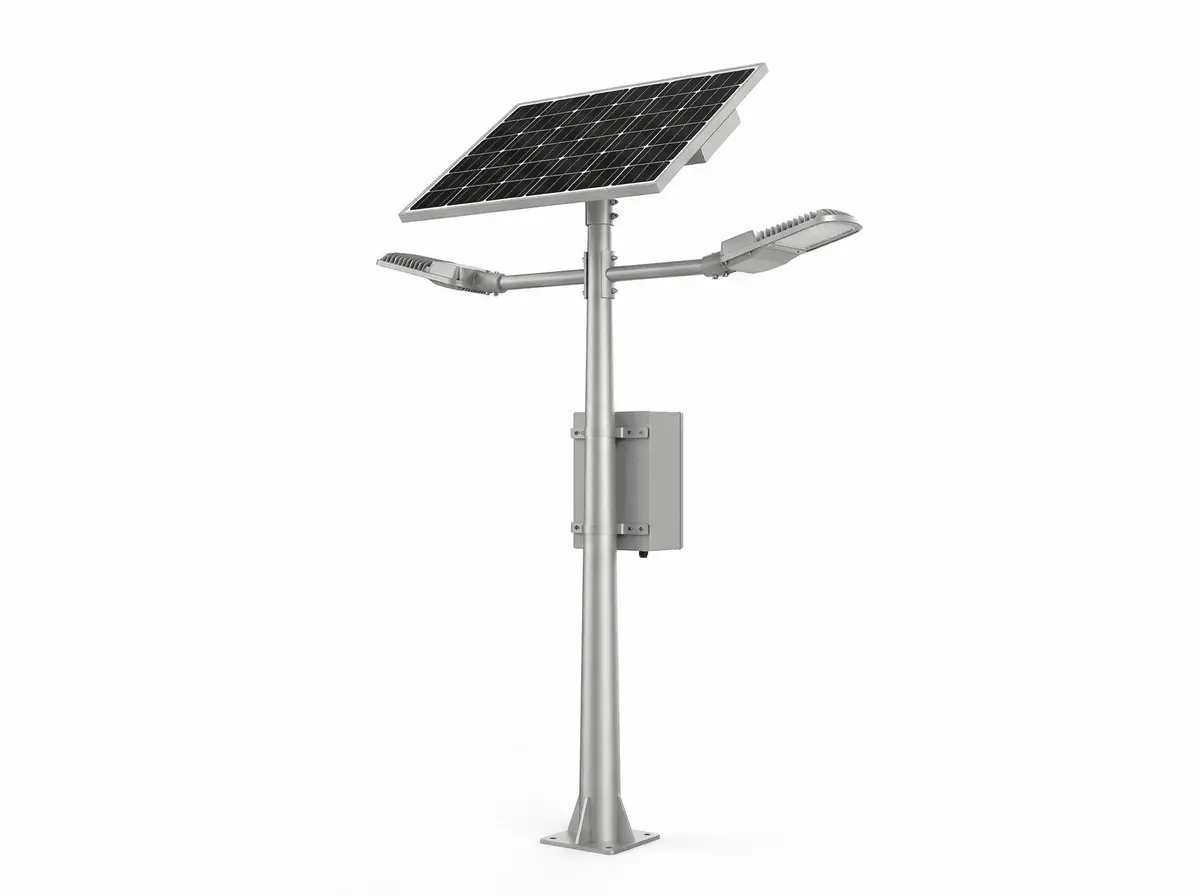
A recommended configuration for Cape Town’s profile would therefore include approximately 330 units of SOLAR TODO Solar Streetlight (Split-Type) using a 7 m stainless steel 304 pole, 120 W LED head, and a very large 1490 W top-mounted Mono PERC panel. The solar panel sits on a tilted bracket at the very top of the pole, and the pole does not penetrate through the center of the panel. The LED head is mounted on a side arm below the panel, which preserves the required split-type geometry and keeps the optical assembly serviceable.
Energy storage would be provided by a visible external battery box clamped to the pole body, not hidden in the base and not integrated into the luminaire housing. The specified battery is 12 V / 300 Ah NCM lithium, with 250 Wh/kg, 2000 cycles, and 85% depth of discharge. The MPPT controller is mounted inside the battery box, while all power and control wiring runs inside the pole, leaving no external cable exposed on the pole surface. That detail matters in Cape Town because UV exposure, vandalism risk, and salt-air corrosion can shorten cable life when wiring is external.
Smart controls should remain part of the base recommendation. Motion sensing can reduce output during low-traffic periods, timer logic can align dimming windows with traffic curves, and 4G/LoRa remote monitoring can flag battery state, charging faults, and luminaire outages. According to IEA (2023), digital control and monitoring improve public-infrastructure asset management by reducing manual inspection frequency and shortening maintenance response cycles.
For buyers evaluating alternatives, SOLAR TODO should avoid presenting this Cape Town configuration as an all-in-one solar light. The city’s wind, corrosion, and maintenance profile favors the split-type arrangement because the battery box is accessible, the LED module is independent, and the solar panel is mounted above the luminaire on a dedicated bracket. That mechanical separation is often preferable on larger roads where each subsystem may require different service intervals over 5 years, 8 years, or 25 years depending on component class.
Technical Specifications
The Cape Town reference configuration is a custom 330-unit split-type specification centered on 120 W lighting output, 1490 W PV generation, 12 V/300 Ah storage, and compliance with IEC and CJJ lighting standards.
- Product type: SOLAR TODO Solar Streetlight (Split-Type), not integrated and not all-in-one
- Typical quantity for this scale: approximately 330 units
- Application profile: 15 m road width with 21 m pole spacing
- Pole material: Stainless steel 304
- Pole height: 7 m
- Wind resistance: 50 m/s
- Expected pole life: approximately 40 years
- Solar panel position: mounted at the very top of pole on a tilted bracket
- Panel geometry: pole does not penetrate through panel center; panel sits on top
- Solar module rating: 1490 W
- PV technology: Mono PERC
- PV efficiency: 21%
- PV degradation: 0.4% per year
- PV warranty: 25 years
- LED luminaire power: 120 W
- Luminous flux: 18,000 lm
- Luminous efficacy: 150 lm/W
- CRI: >70
- LED mounting position: on side arm below the panel
- Battery type: NCM lithium
- Battery capacity: 12 V / 300 Ah
- Specific energy: 250 Wh/kg
- Cycle life: 2000 cycles
- Depth of discharge: 85% DoD
- Battery warranty: 5 years
- Battery box location: externally mounted on pole body, visible grey box, not inside base
- Controller type: MPPT controller inside battery box
- Wiring: all wiring inside pole, no visible external wires
- Autonomy: 3-5 days cloudy-weather backup
- Operation: dusk-to-dawn automatic
- Smart features: motion sensor + remote monitoring (4G/LoRa) + timer control
- Climate basis: tropical-style sizing input with 5.5 h sun
- Standards: CJJ 45-2015 / IEC 60598 / IEC 62124
According to IEC (2020), IEC 60598 sets safety requirements for luminaires, while IEC states, "Luminaires shall be designed and constructed so that in normal use they function safely." According to IEC (2014), IEC 62124 provides performance assessment methods for stand-alone PV systems, which is relevant when validating charging behavior, autonomy, and controller performance for off-grid street lighting.
Implementation Approach
A Cape Town rollout of 330 split-type poles would typically proceed in 5 phases: survey, civil works, pole and battery-box installation, internal wiring and commissioning, then remote-monitoring validation.
Phase 1 is route assessment and lighting design. A municipal or private buyer would first verify road width, pole offsets, shading, underground services, and target lux levels across the 15 m corridor. Coastal wind exposure and salt-air corrosion should be checked by segment because a site 3 km from the shoreline can require different fastening and inspection intervals than an inland industrial road. According to the City of Cape Town planning framework (2024), local approvals and wayleave coordination are often a schedule driver for public-realm works.
Phase 2 is procurement and factory configuration. For split-type systems, the critical factory checks are panel bracket geometry, side-arm alignment, battery-box sealing, and internal cable routing. Buyers should require confirmation that the 1490 W panel sits at the top of the pole, that the LED head remains below the panel, and that the battery box is externally mounted on the pole body exactly as specified. This is also the stage to confirm 4G/LoRa protocol compatibility and controller parameter settings for motion dimming and timer windows.
Phase 3 is civil and structural preparation. Foundations would typically be cast after geotechnical review, with anchor-bolt templates matched to the 7 m stainless steel 304 pole base plate. In windy areas, erection planning should consider gust conditions approaching the specified 50 m/s design envelope, even though installation itself should occur in lower wind windows. Stainless hardware selection and anti-galling procedures matter because 304 fasteners can seize if assembly practice is poor.
Phase 4 is installation and electrical completion. The pole is erected, the top bracket and panel are fixed, the LED side arm is installed below the panel, and the visible battery box is clamped to the pole body. All DC and control wiring is then pulled inside the pole, terminating in the MPPT controller inside the battery box. No external cable should remain visible after commissioning because exposed cable jackets degrade faster under UV, abrasion, and tampering.
Phase 5 is commissioning and monitoring setup. Each pole should be tested for charging current, battery voltage, dusk-to-dawn response, motion-sensor logic, and communication to the 4G/LoRa platform. A practical acceptance plan would include at least 72 hours of monitored operation, fault-alarm verification, and GPS or pole-ID mapping for maintenance records. SOLAR TODO can support this process by providing configuration files, component datasheets, and inspection checklists through the product page or via contact us.
Expected Performance & ROI
In Cape Town, a 120 W split-type solar streetlight with 5.5 sun-hours and 3-5 days autonomy would primarily deliver energy-cost avoidance, outage resilience, and lower trenching requirements rather than only simple kWh payback.
The direct energy benefit is straightforward: an off-grid 120 W luminaire running roughly 12 hours per night avoids about 1.44 kWh/day of grid consumption per pole before dimming adjustments. Across approximately 330 units, that is about 475 kWh/day, or roughly 173,000 kWh/year of avoided grid electricity if runtime remains constant. If motion sensing and timer dimming reduce average load by even 15-30%, the effective stored-energy requirement per night drops further, improving battery cycling depth and reserve margin.
Lifecycle economics depend on trenching, cable theft exposure, utility connection cost, and maintenance regime. According to IRENA (2023), solar-powered public infrastructure can be competitive where grid extension costs are high or reliability is poor. According to the World Bank (2023), distributed energy solutions often show their strongest value where service continuity and avoided outage losses are included in appraisal. In Cape Town, that means ROI should be modeled as a combination of avoided electricity, avoided cabling, reduced outage exposure, and targeted maintenance rather than only tariff savings.
Battery replacement is the main medium-term cost event in this specification because NCM lithium is rated for 2000 cycles and carries a 5-year warranty. By contrast, the Mono PERC panel has a 25-year warranty and 0.4%/yr degradation, while the stainless steel 304 pole is expected to remain in service for around 40 years if inspection and fastening maintenance are performed correctly. For this reason, a realistic financial model should use a 10-15 year horizon with at least one battery replacement event and periodic communication-device servicing.
Operationally, remote monitoring improves maintenance efficiency. IEA notes that digital asset monitoring reduces fault detection delays and improves maintenance planning, and the U.S. Department of Energy has similarly emphasized that connected lighting systems improve visibility into failures and energy performance. For a 330-unit network, that matters because a manual night patrol model is labor-intensive, while LoRa or 4G monitoring can identify low-voltage alarms, lamp faults, or controller communication loss by pole ID.
Cape Town buyers should therefore expect the strongest business case in roads where grid connection is costly, outages are disruptive, or security risk makes copper cabling unattractive. In those conditions, SOLAR TODO’s split-type format supports a lower field-maintenance burden than many compact all-in-one units because the battery box, controller, and luminaire remain individually accessible.
Results and Impact
For Cape Town, the likely impact of a 330-unit split-type scheme is improved lighting continuity across a 15 m corridor, lower dependence on grid availability, and better maintenance visibility through connected controls.
A network at 21 m spacing can support continuous roadway coverage over a substantial corridor length while preserving independent operation at each pole. The practical effect is not only illumination, but also resilience during supply interruptions and reduced exposure to cable theft because there is no continuous energized feeder between poles. According to the World Bank (2023), resilience value is often undercounted in infrastructure appraisal despite being material in service delivery outcomes.
The specified smart-control package also improves operating discipline. Motion sensing, timer control, and 4G/LoRa monitoring give operators a way to tune output by time band, review faults centrally, and prioritize field visits. For municipal and industrial buyers, that can translate into fewer truck rolls, faster fault isolation, and a more auditable maintenance record across 330 assets.
Comparison Table
For Cape Town buyers, the main comparison is between the specified custom 120 W split-type system and lower-power standard classes used on narrower roads or pedestrian zones.
| Configuration Class | Typical Use Case | LED Power | Panel Rating | Battery | Pole Height | Road Fit in Cape Town | Notes |
|---|---|---|---|---|---|---|---|
| Standard walkway class | Garden path / walkway | 30 W | 60 W | 12 V / 60 Ah | 6 m | Poor for 15 m roads | Suitable for paths, not broad collector roads |
| Standard community road class | Community road / parking | 50-60 W | 100 W | 12 V / 100 Ah | 7-8 m | Limited | Better for parking courts and smaller access roads |
| Standard secondary road class | Secondary road / plaza | 80 W | 150 W | 24 V / 100 Ah | 8-10 m | Moderate | May fit narrower collector roads |
| Standard main-road class | Main road / highway | 120 W | 200 W | 24 V / 150-200 Ah | 10-12 m | Strong | Closest standard class for wide roads |
| Cape Town custom reference | 15 m road, 21 m spacing | 120 W / 18,000 lm | 1490 W Mono PERC | 12 V / 300 Ah NCM | 7 m stainless 304 | Strong for resilience-focused deployment | Custom split-type specification supplied for this analysis |
Pricing & Quotation
SOLAR TODO offers three pricing tiers for this product line: FOB Supply (equipment ex-works China), CIF Delivered (including ocean freight and insurance), and EPC Turnkey (fully installed, commissioned, with 1-year warranty). Volume discounts are available for large-scale deployments. Configure your system online for an instant estimate, or request a custom quotation from our engineering team at [email protected].
Frequently Asked Questions
This FAQ answers the most common Cape Town buyer questions on sizing, installation, maintenance, ROI, warranty, and the difference between split-type and all-in-one streetlights.
Q1: Why is a split-type solar streetlight recommended for Cape Town instead of an all-in-one unit?
A split-type system separates the 120 W LED, 1490 W panel, and 12 V/300 Ah battery box, which improves service access and thermal management. In Cape Town’s coastal environment, that layout also helps with maintenance because the battery and controller are easier to inspect or replace than in sealed all-in-one housings.
Q2: Is 330 units a realistic quantity for a Cape Town road-lighting package?
Yes. At 21 m spacing, approximately 330 units would suit a corridor-scale program rather than a single short street. The exact quantity depends on road length, intersection density, and whether poles are single-sided, staggered, or double-sided on a 15 m road reserve.
Q3: How long would a 330-unit project typically take to deploy?
A practical schedule is often 12-20 weeks, depending on approvals, shipping mode, foundation curing, and local civil access. Factory production, transport to South Africa, and commissioning of 4G/LoRa monitoring usually drive the timeline more than pole erection itself.
Q4: What kind of maintenance does this system require?
Routine work is usually limited to panel cleaning, fastener inspection, battery health checks, and communication diagnostics every 6-12 months. Because all wiring runs inside the pole and the battery box is externally accessible, technicians can inspect the MPPT controller and battery without opening the pole base.
Q5: What payback period should buyers expect?
Payback varies by trenching cost, local tariff, outage cost, and theft risk, so there is no single number that fits all Cape Town sites. In practice, buyers should model a 10-15 year lifecycle and include avoided cabling, avoided electricity, and at least one battery replacement event after the 5-year warranty period.
Q6: How does the NCM battery compare with LiFePO4 for this application?
The specified NCM pack offers 250 Wh/kg and 2000 cycles at 85% DoD, which supports compact energy storage. By comparison, LiFePO4 often offers longer cycle life, but NCM can be attractive where energy density and battery-box size are priority factors in a pole-mounted design.
Q7: Is the 7 m pole height sufficient for a 15 m road width?
It can be, provided the optical distribution, bracket outreach, and 21 m spacing are validated in a lighting simulation. For broad roads, luminaire output and beam pattern matter as much as pole height, which is why the specified fixture uses 18,000 lm rather than a lower-output pedestrian-road light.
Q8: What standards should Cape Town buyers ask suppliers to document?
At minimum, buyers should request evidence of compliance with CJJ 45-2015, IEC 60598, and IEC 62124 for the lighting and stand-alone PV system. It is also good practice to request material certificates, battery test reports, and wind-load documentation for the 50 m/s pole rating.
Q9: Can remote monitoring materially reduce operating cost?
Yes. On a 330-unit network, 4G/LoRa monitoring can reduce manual inspections by identifying low battery, controller, or luminaire faults remotely. That does not eliminate field work, but it improves dispatch efficiency and shortens outage duration compared with purely manual patrols.
Q10: What should be included in an EPC quotation?
An EPC quotation should separate equipment scope, shipping terms, civil works, foundations, erection, commissioning, and warranty responsibilities. For this specification, it should also clearly list the 1490 W panel, 120 W LED, 12 V/300 Ah NCM battery, smart controls, stainless steel 304 pole, and monitoring platform scope.
References
- Statistics South Africa (2022): Census 2022 municipal population data showing Cape Town metro population above 4.7 million.
- City of Cape Town (2024): Integrated Development Plan outlining infrastructure reliability, safety, and service delivery priorities.
- Eskom (2024): National power system updates and supply constraints relevant to off-grid public-lighting resilience.
- World Bank Global Solar Atlas (2024): South Africa and Western Cape solar resource maps and PV potential data.
- NREL (2023): South Africa solar resource assessment; NREL states, "South Africa has some of the world’s best solar resources."
- IEC (2020): IEC 60598 luminaire safety requirements; IEC states, "Luminaires shall be designed and constructed so that in normal use they function safely."
- IEC (2014): IEC 62124 performance assessment methods for stand-alone photovoltaic systems relevant to autonomous street lighting.
- IEA (2023): Digitalization and connected infrastructure guidance supporting remote monitoring and maintenance efficiency in public energy assets.
- IRENA (2023): Distributed renewable energy economics and resilience benefits for public infrastructure in weak-grid contexts.
- World Bank (2023): Infrastructure resilience and distributed-energy appraisal guidance for service continuity and outage-risk reduction.
Equipment Deployed
- 330 × SOLAR TODO Solar Streetlight (Split-Type)
- 7 m stainless steel 304 pole, 50 m/s wind resistance, 40-year design life
- 1490 W Mono PERC solar panel, 21% efficiency, 0.4%/yr degradation, 25-year warranty
- 120 W LED luminaire, 18,000 lm, 150 lm/W, CRI >70
- External pole-mounted grey battery box, not inside pole base
- 12 V / 300 Ah NCM lithium battery, 250 Wh/kg, 2000 cycles, 85% DoD, 5-year warranty
- MPPT charge controller installed inside battery box
- Internal pole wiring with no visible external cables
- Motion sensor module
- 4G/LoRa remote monitoring module
- Timer control and dusk-to-dawn automatic switching