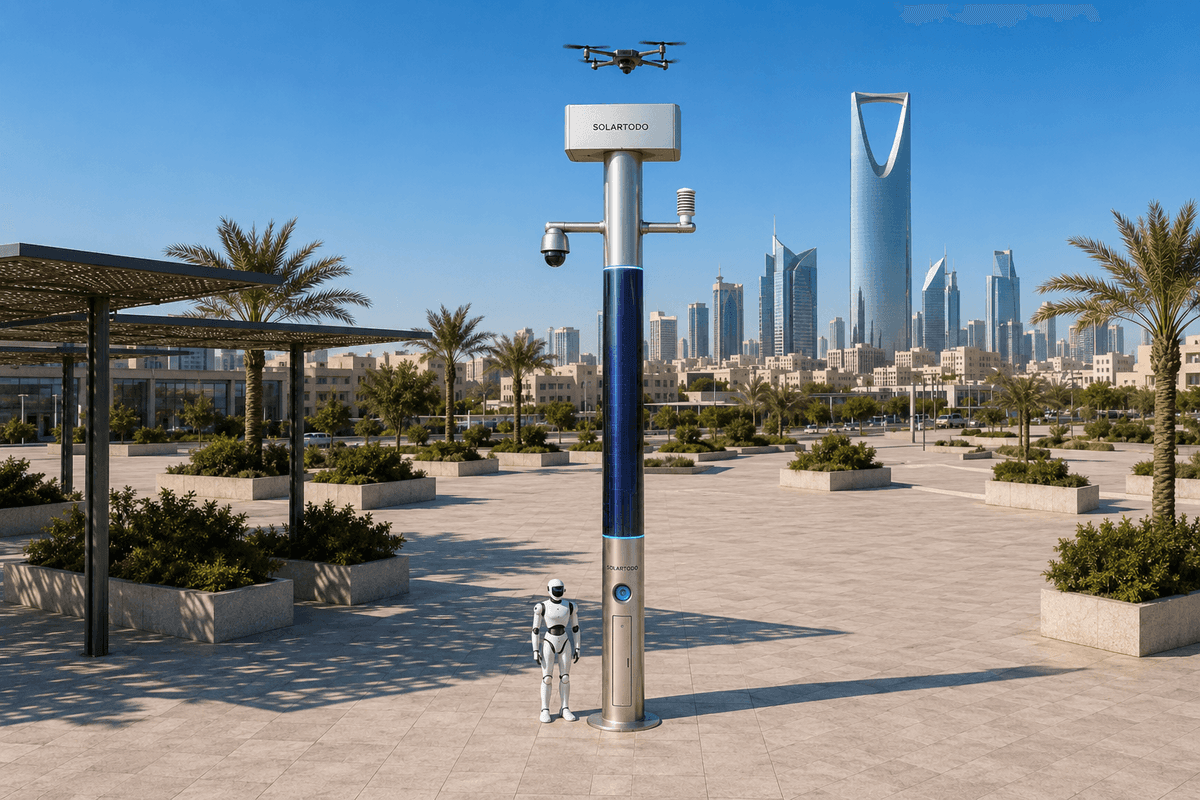
A City AI Pole is a non-lighting physical-AI edge node that combines local sensing, edge compute, off-grid energy, drone operations and robot support in one urban pole. In this Cairo case, SOLARTODO Sentinel Sky Hub is configured for water-authority border-watch, night response and post-disaster infill around port-style utility service zones.
1. City Task And Deployment Logic
For this Cairo deployment scenario, the buyer is a water authority responsible for keeping a port-style utility service perimeter operational after a disruptive event such as flood damage, civil works failure, fire, or localized infrastructure outage. The operating zone is not treated as a street-lighting corridor. It is a controlled water-service edge: gates, quay-like loading areas, pumps, stores, maintenance yards, canal-side access roads and temporary barriers where nighttime visibility, power availability and fast response are difficult to guarantee.
The seasonal trigger is a major sports-event period, when road congestion, public movement and temporary service demand can reduce the reliability of manual patrols. The task is border-watch: detect unauthorized entry, distinguish routine service movement from anomalies, coordinate a human-authorized response and maintain a record for review. The primary topic is robot operations because the night-response gap is often physical: someone must inspect a fence line, verify an alarm, check a pump enclosure, approach a gate or coordinate with an aerial view.
SOLARTODO Sentinel Sky Hub is proposed as a mature, in-service physical-AI node placed where fixed buildings, utility rooms or grid extensions are unavailable or delayed. The mode is post-disaster infill: rapidly adding autonomous sensing, compute, drone readiness, robot charging and local operations control without waiting for trenching or permanent site power. The KPI is framed around false-alarm-rate reduction, not a claimed result. The evaluation target is whether local perception, robot confirmation and operator authorization can reduce unnecessary dispatches while preserving timely escalation for real perimeter events.
2. Off-Grid Power Plan
The module focus for this Cairo plan is power, because post-disaster infill fails if a security node silently becomes another load on damaged infrastructure. Sky Hub is specified as a fully off-grid micro-station: battery storage plus 360-degree wrapped flexible CIGS thin-film solar replenishment on the pole body. It does not use city power, site power or grid dependency as its operating assumption.
The pole carries approximately 15 square meters of wrapped flexible CIGS over a vertical body about 8 meters tall and 0.6 meters wide, producing roughly 2.4 to 2.7 kWp nameplate. In real operation, the full wrap is not illuminated as a flat panel would be. A vertical cylinder collects direct sun mainly on its sun-facing projection, so realistic clear-sky output in high-irradiance conditions is planned around a 0.8 to 1.1 kW DC-class peak, with the peak typically appearing mid-morning or mid-afternoon rather than at noon. Daily replenishment is planned as a single-digit energy contribution, about 6 to 9 kWh/day in strong-sun regions.
That energy is not positioned as unlimited pure-solar self-sufficiency. It is a replenishment layer for a battery-backed off-grid node. The planning envelope uses 5 to 20 kWh-class storage, then schedules drone sorties, robot charging, PTZ patrols, environmental sampling and edge inference by duty cycle. During sports-event nights, the system prioritizes border-watch sensing, robot readiness and selected aerial verification windows. During lower-risk periods, compute jobs, battery recovery and patrol frequency can be adjusted by the OTATODO edge OS scheduler.
3. Night Border-Watch Operations
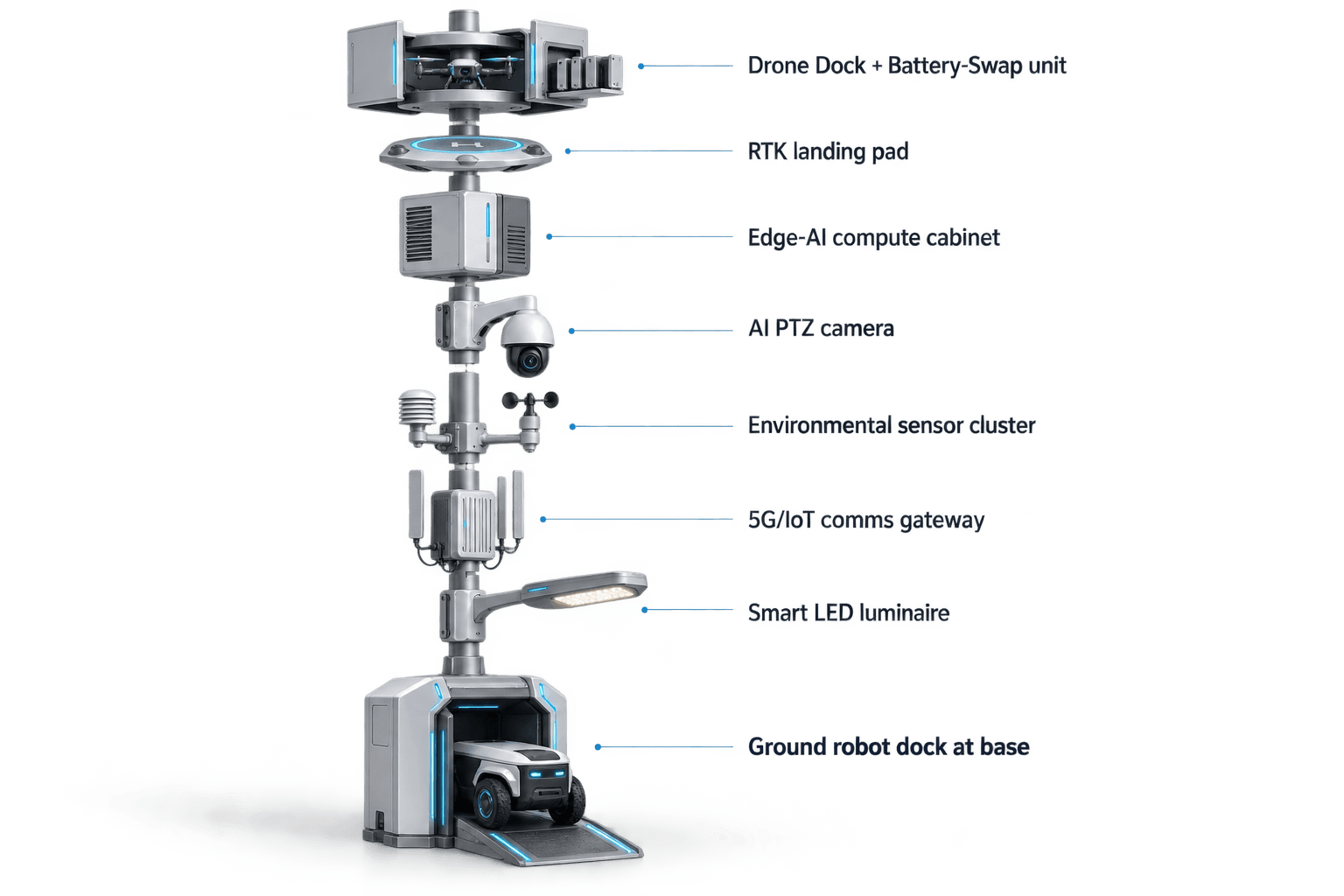
The core operating loop is sensing, authorized assessment and response, edge-compute scheduling, then field operations and maintenance, shown in a single common-operating-picture command view. At night, the pole’s PTZ camera and local perception do not upload raw video for routine analysis. Raw video and sensor data stay on the pole and are processed locally; only de-identified event and status metadata may leave the pole for command review.
A typical event begins with anonymous perimeter awareness: motion near a restricted gate, an unusual vehicle stop, crowding at a service entrance, or a person entering a pump-yard exclusion zone. The edge module classifies and scores the event locally, compares it against allowed maintenance schedules, then presents a concise alert to the operator. If the event remains uncertain, a service robot can leave the pole base, inspect the ground-level scene and return for wireless charging. Where aerial confirmation is more efficient, the node can launch its friendly drone for a short inspection route, then return it for automated battery hot-swap through a rear-service multi-bay battery magazine.
The false-alarm-rate KPI is addressed by layering evidence before dispatch: camera perception, environmental context, schedule comparison, robot confirmation and operator decision. A windy, dusty, high-noise Cairo night may produce movement and sensor noise. The point of the node is not to remove the human from authority; it is to make the human response better informed before a guard team, maintenance crew or emergency liaison is sent.
4. Robot-First Field Response
The ground robot is configured as the primary night-response tool for the water-authority perimeter. It performs autonomous patrol, alarm response, inspection, air-ground coordination and return-to-base wireless charging. It is useful where a human patrol would otherwise cross poorly lit industrial surfaces, debris after a disaster, temporary fencing, mud, water pooling or congested event traffic. The robot does not replace authority; it extends verification reach from the pole.
When the COP flags a border-watch alert, the operator can authorize the robot to inspect a gate, approach a restricted enclosure or coordinate with the drone overhead. The drone provides regional context, while the robot checks ground details such as obstruction, fence damage, standing water, smoke, an open service box or a stopped vehicle. The edge node schedules compute workloads on-pole so the robot mission, PTZ scan and drone status machine do not compete blindly for battery or inference capacity.
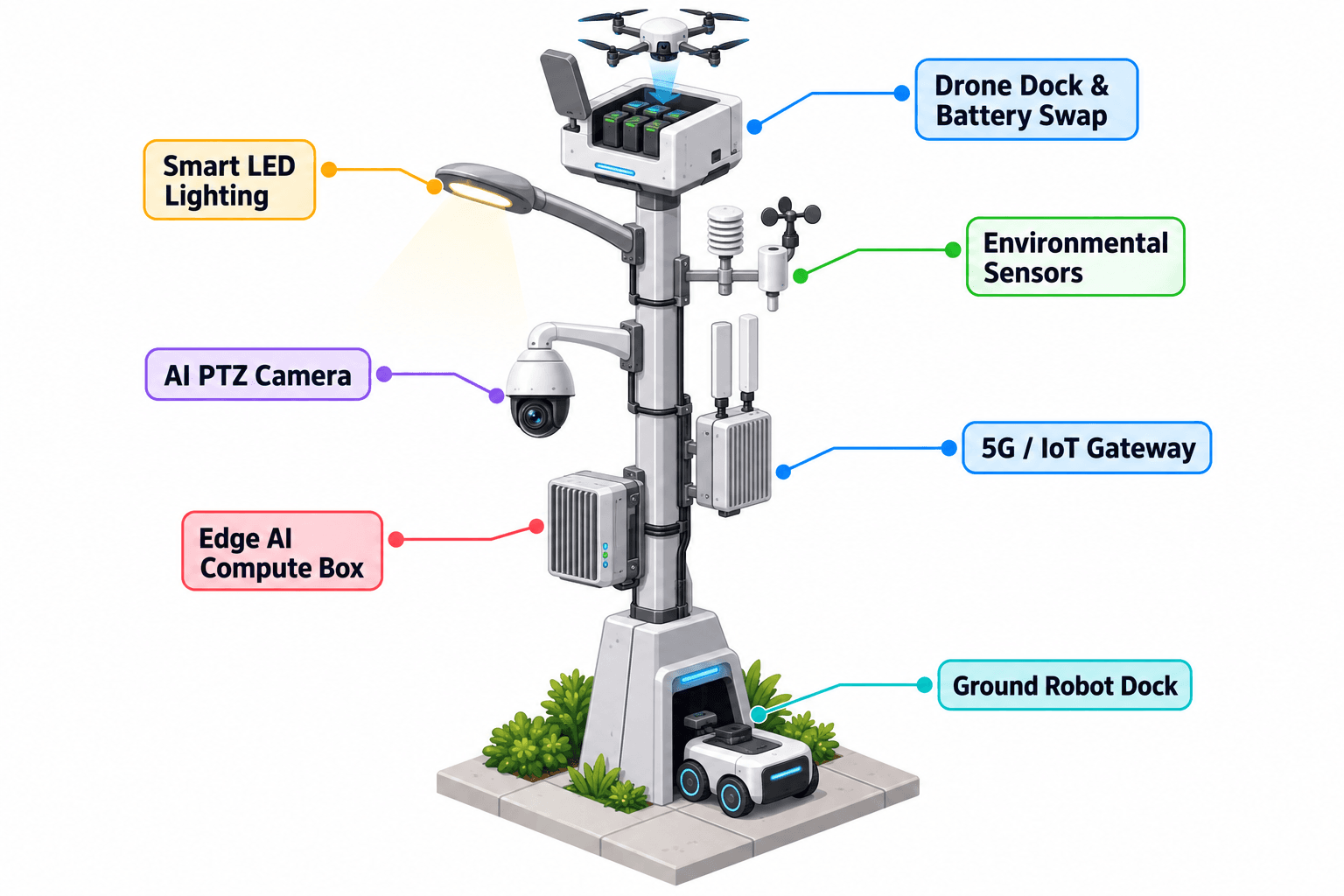
The nine-in-one capability set is used as an operations stack rather than a product checklist. The pure smart pole hosts sensing, compute, energy, drone and robot operations with no lighting system. Drone operations cover launch, patrol, inspection, return and redeployment. The battery hot-swap magazine supports several consecutive sorties based on stored charged packs. Drone operations management covers route planning, charge or swap state, queueing, fleet health and logs. Environmental monitoring adds wind speed, wind direction, temperature, humidity, atmospheric pressure, noise, PM10, PM2.5 and illuminance to explain field conditions that may affect false alarms and mission safety.
5. Governance, C-UAS And Evaluation
For Cairo water-authority use, data governance is designed for local processing and PDPL/LGPD-oriented operating principles. The node is configured so raw video and sensor streams stay on the pole for local inference. The command view receives de-identified event and status metadata: alert type, confidence band, location zone, battery state, robot status, drone state, maintenance condition and operator action. This supports auditability without turning the deployment into a raw-video collection program.
Counter-UAS coordination is included for critical-infrastructure protection, but under strict boundaries. The pole can detect and track an unauthorized drone using its own sensing and, where available, optional partner-sensor inputs. Radar is not built into the pole. With human authorization, the node can command its friendly drone to perform non-lethal mitigation such as soft aerial net-capture or close-approach deterrence. The system is not a shoot-down platform, not a jammer and not an autonomous attack system.
The evaluation plan avoids invented success claims. For the first operating window, the water authority would define target planning inputs: acceptable false-alarm-rate band, night patrol coverage schedule, maximum time-to-human-review target, battery reserve policy, robot return-to-charge threshold and incident record format. During the sports-event period, the deployment is judged by the quality of event triage: fewer avoidable dispatches, better confirmation before escalation, stable off-grid runtime and complete mission logs subject to final engineering confirmation.
System Configuration
| Parameter | Configuration |
|---|---|
| Pole type | SOLARTODO Sentinel Sky Hub pure smart pole; non-lighting physical-AI edge node for sensing, compute, energy, drone and robot operations. |
| Power system | Fully off-grid battery-backed micro-station with ~15 m² 360° wrapped flexible CIGS thin-film replenishment and 5-20 kWh-class storage. |
| Edge AI compute | Jetson-class Orin- or Thor-class edge module in on-pole compute cabinet; local inference and workload scheduling via OTATODO. |
| Camera and sensing | AI PTZ camera for anonymous vehicle count, crowd density, intrusion and perimeter awareness; nine environmental channels including wind, particles, noise and illuminance. |
| Drone operations | Autonomous launch, patrol, inspection, return, task redeployment and automated rear-service multi-bay battery hot-swap. |
| Robot operations | Humanoid or service robot patrol, alarm response, inspection, air-ground coordination and wireless charging at the pole base. |
| Data handling | Raw video and sensor data processed locally on the pole; only de-identified event and status metadata leaves the site. |
How It Works
- On-pole PTZ and environmental sensors flag a night perimeter anomaly at the water-authority service port edge.
- Edge AI classifies the event locally, checks schedule context and assigns a confidence band without exporting raw video.
- The COP presents de-identified event metadata, power state and recommended verification options to a human operator.
- With authorization, the ground robot inspects the alarm zone while the friendly drone performs an overhead confirmation route if needed.
- The operator decides whether to dismiss, monitor, dispatch staff or authorize non-lethal C-UAS coordination for an unauthorized drone.
- The node records event metadata, mission logs, robot charge status, drone swap state and maintenance notes for review.
Planning Assumptions (Indicative)
Illustrative planning inputs a buyer can recompute — target metrics, not achieved results. Subject to final engineering confirmation.
| Metric | Planning assumption | Indicative value |
|---|---|---|
| Inspection labor | Target planning input: robot patrol and drone verification reduce manual night perimeter walks during sports-event surge periods. | ~10-20 manual patrol equivalents/week automated for evaluation. |
| False-alarm-rate | Target planning input: alarms are verified by local perception plus robot or drone confirmation before routine dispatch. | Buyer-defined reduction target; commonly modeled as a 20-40% avoidable-dispatch reduction band. |
| Off-grid resilience | Target planning input: battery reserve supports border-watch operation when nearby grid or site power is unavailable after a disruption. | 5-20 kWh-class storage sized by final duty cycle. |
| Aerial verification capacity | Target planning input: multi-bay battery magazine allows several consecutive short inspection sorties before manual battery service. | ~3-6 short sorties per high-priority night window for planning. |
| Operator workload | Target planning input: COP presents scored events, mission state and energy status instead of raw continuous feeds. | ~1 consolidated command view per node cluster. |
Deployed Equipment
- SOLARTODO Sentinel Sky Hub off-grid pole body with wrapped flexible CIGS layer
- Battery-backed on-pole energy cabinet with power scheduler
- On-pole edge AI compute cabinet running OTATODO
- AI PTZ camera for local perimeter perception
- Nine-channel environmental monitoring package
- Autonomous drone launch and rear-service battery hot-swap magazine
- Ground robot wireless charging interface at pole base
- COP command-view integration for operator authorization and logs
Frequently Asked Questions
Is Sky Hub a smart streetlight for Cairo roads?
No. In this deployment it is specified as a pure smart pole with no lighting system. The role is physical-AI edge infrastructure for a water-authority port-style perimeter: local sensing, off-grid power, edge compute, drone operations, robot charging and command-view coordination. It is not designed or positioned as public street lighting.
How can the node operate after a disaster without site power?
The proposed configuration is fully off-grid. It combines battery storage with 360° wrapped flexible CIGS thin-film solar replenishment on the pole body. The solar layer is treated as supplemental replenishment, not unlimited energy. High-power robot and drone tasks are buffered by 5-20 kWh-class storage and scheduled by duty cycle.
What makes the robot important for night-response operations?
At night, a camera alert alone may not justify sending a crew across a disrupted water-service perimeter. A ground robot can inspect gates, barriers, pump enclosures and ground-level hazards, then return to the pole base for wireless charging. This gives the operator a second source of field evidence before dispatch.
Does the system upload raw video to a remote control room?
The intended data design keeps raw video and sensor data on the pole for local processing. The command view receives de-identified event and status metadata, such as alert type, zone, confidence band, mission state and battery condition. This is PDPL/LGPD-oriented by design, subject to final legal and engineering confirmation.
How is false-alarm-rate evaluated without claiming achieved results?
The buyer defines a target false-alarm-rate reduction and measures it during the operating window. The evaluation compares camera-only alerts with alerts verified by local classification, schedule context, robot inspection or drone confirmation. The case study uses target planning inputs only; it does not claim achieved detection or reduction numbers.
Can Sky Hub respond to unauthorized drones near the water-authority perimeter?
Yes, within non-lethal and human-authorized boundaries. The pole can detect and track an unauthorized drone using onboard sensing and optional partner-sensor inputs. After operator authorization, its friendly drone may perform soft aerial net-capture or close-approach deterrence. It does not perform jamming, shoot-downs or autonomous attacks.
Is radar included in the pole hardware?
Radar is not treated as built-in pole hardware in this configuration. If the water authority requires radar input for a specific perimeter or airspace risk, it can be considered as an optional partner-sensor feed into the common operating picture. Final sensor mix remains subject to engineering confirmation.
Why is this useful during a Cairo sports-event period?
Sports-event periods can increase congestion, temporary access changes and night workload around critical service infrastructure. A post-disaster-infill Sky Hub gives the water authority a local, off-grid node for border-watch verification when manual patrol timing is less predictable. The aim is better triage, cleaner records and fewer avoidable dispatches.
Explore Further
- City AI Pole / smart streetlight product line
- More smart-city deployment cases
- Talk to our engineering team
Planning a similar physical-AI deployment for streets, campuses or public spaces? Request an engineering consultation