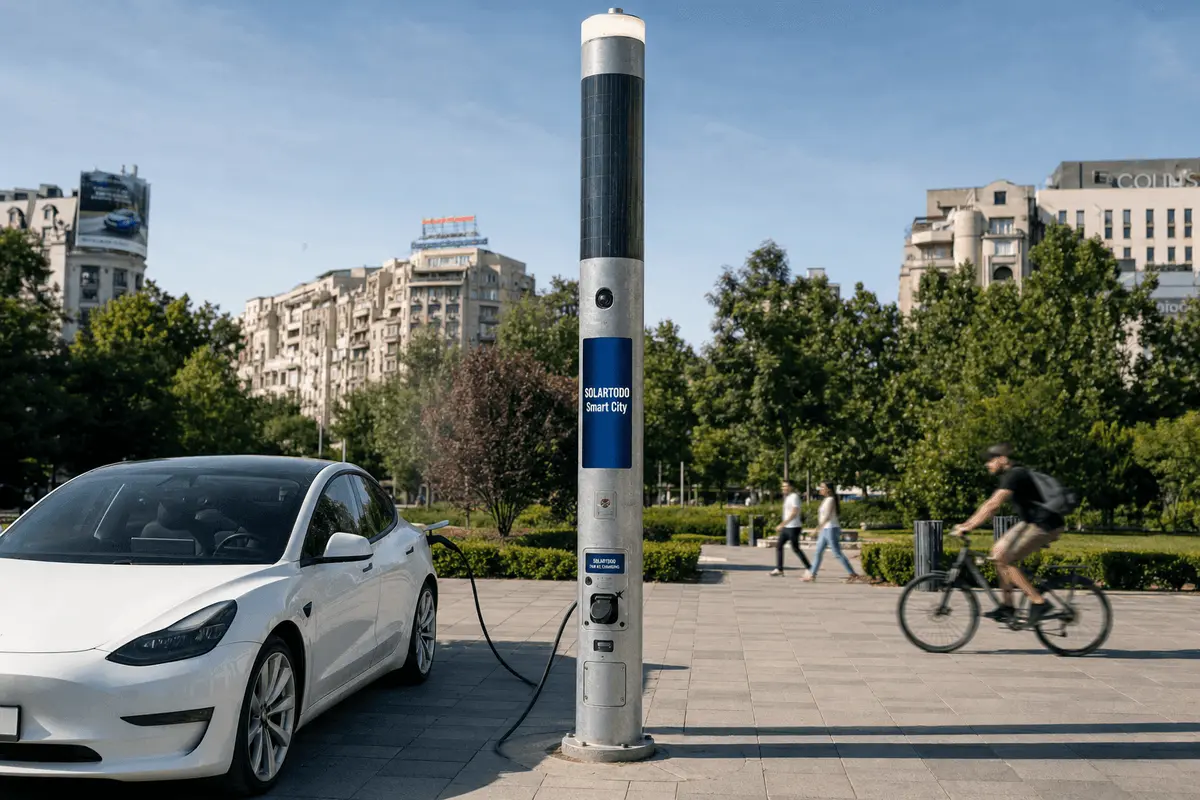
Bucharest Smart Streetlight Market Analysis: 58-Unit Ø200mm Cylindrical Pole Configuration
Summary
Bucharest’s 1.72M residents, 240 km2 urban area, and 22m streetscape spacing make a typical 58-unit SOLARTODO Smart Streetlight configuration a fit for compact civic corridors.
Key Takeaways
Bucharest’s dense 7,000+ residents/km2 profile favors flush Ø200mm smart poles with 6m height, 11kW AC charging, and 22m spacing.
- A typical 58-unit deployment would cover approximately 1.28km at 22m spacing, suitable for dense pedestrian and mixed-use corridors.
- Each pole uses a 6m seamless cylindrical Ø200mm body with 5mm wall thickness and constant diameter from top to bottom.
- Lighting output is 100W and 15,000lm at 4000K, equal to 150 lm/W for urban street-class illumination.
- The CIGS solar wrap covers the 6.5m-5.3m mid-section and contributes approximately 110W per pole through flush 360-degree lamination.
- Each unit integrates a 3000Wh LFP battery with MPPT and an embedded 11kW Type 2 AC EV charger.
- The front display is 2000mm tall and about 170mm wide, curved to Ø200mm radius with only “SOLARTODO Smart City” content.
- Communications include embedded 5G NR n78 internal antenna, LoRaWAN/4G control, and cloud platform integration.
- Standards alignment should reference IEC 60598 for luminaires and GB/T 37024 for smart lighting control requirements.
Market Context for Bucharest
Bucharest’s 1.72M municipal population and 240 km2 footprint create a high-density urban retrofit market where compact multi-function poles reduce sidewalk clutter.
According to Romania’s National Institute of Statistics (2023), Bucharest recorded 1,716,961 residents in the 2021 census, making it the country’s largest municipality. The city’s administrative area is approximately 240 km2, so deployment density matters: street furniture must preserve pedestrian clearance while supporting lighting, sensing, communications, and EV charging. For this reason, a SOLARTODO Smart Streetlight configuration for Bucharest should prioritize a monolithic cylindrical form rather than arm-mounted accessories or separate cabinets.
According to the World Bank and ESMAP (2019), the Global Solar Atlas provides solar resource data at approximately 250m grid resolution, which is adequate for preliminary municipal screening. Romania’s practical solar resource is moderate rather than desert-class; according to IEA PVPS-linked Romania solar data (2024), much of the country falls around 1,000-1,300 kWh/m2/year of annual solar energy flux. That supports auxiliary energy harvesting for sensors, communications, displays, and battery support, but it does not remove the need for grid-aware design in a European capital.
Bucharest’s telecom requirements also matter. According to ANCOM (2022), Romania’s 5G spectrum awards include the 3.4-3.8GHz band, which maps to 5G NR n78 equipment planning. A smart pole with embedded n78-ready internal antennas can support densification without visible side arms, external antenna boxes, or oversized telecom cabinets. ITU states, “A smart sustainable city is an innovative city,” a framing that fits multifunctional infrastructure when public lighting, safety, and connectivity are consolidated into one asset.
Recommended Technical Configuration
A recommended Bucharest configuration is approximately 58 SOLARTODO Smart Streetlight units using 6m Ø200mm cylindrical poles at 22m spacing.
For the requested Bucharest profile, the correct product size class is the premium cylindrical smart pole, not a highway traffic pole or a park garden light. The 6m height fits urban streets, plazas, sidewalks, transit-adjacent public realm, and retail corridors where light distribution, pedestrian safety, and architectural finish are more important than mast height. At 22m spacing, a typical 58-unit deployment would create approximately 1.28km of continuous smart streetscape coverage.
The recommended form is the SOLARTODO Smart Streetlight cylindrical Ø200mm seamless pole. It should remain a constant-diameter monolithic cylinder from top to bottom, with no side arms, no luminaire outriggers, no external boxes, no separate bollard, and no widened charging base. This detail is important in Bucharest because sidewalk obstructions, snow maintenance, curbside parking, and pedestrian circulation make protruding accessories operationally risky.
A typical 58-unit deployment of this scale would combine lighting, sensing, EV charging, emergency intercom, 5G readiness, and civic display functions. The recommendation is conditional: final quantities should be confirmed by photometric simulation, curb geometry, underground utility scans, and local permitting. For technical review, contact SOLARTODO engineering with street width, target illuminance, utility connection points, and wind exposure data.
Technical Specifications
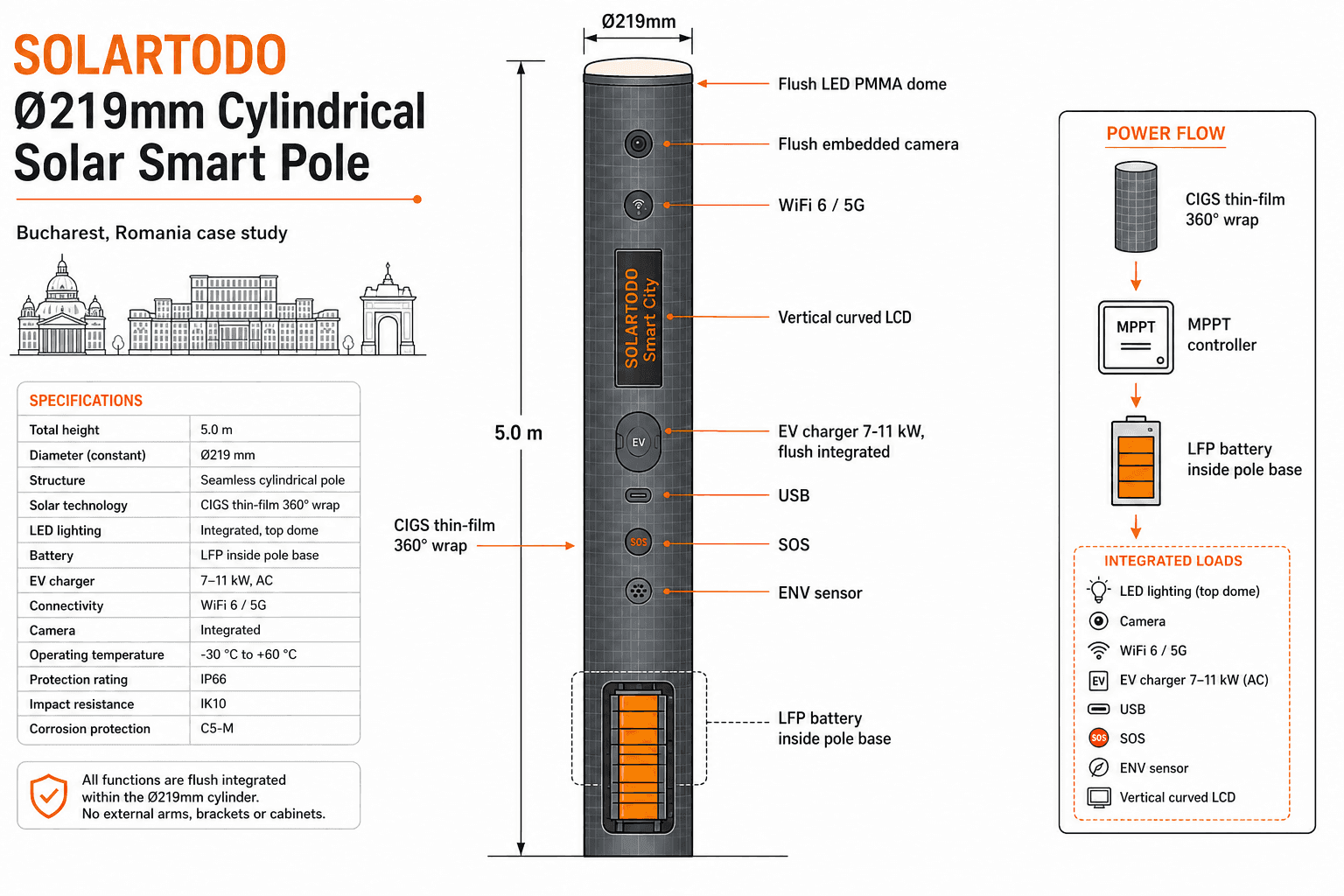
The 58-unit Bucharest technical package uses 6m Ø200mm seamless cylindrical poles, 100W LED lighting, 110W CIGS wrap, and 3000Wh LFP storage.
- Pole body: 6m seamless cylindrical Ø200mm pole, constant diameter top-to-bottom, 5mm wall, hot-dip galvanized, silver-grey finish.
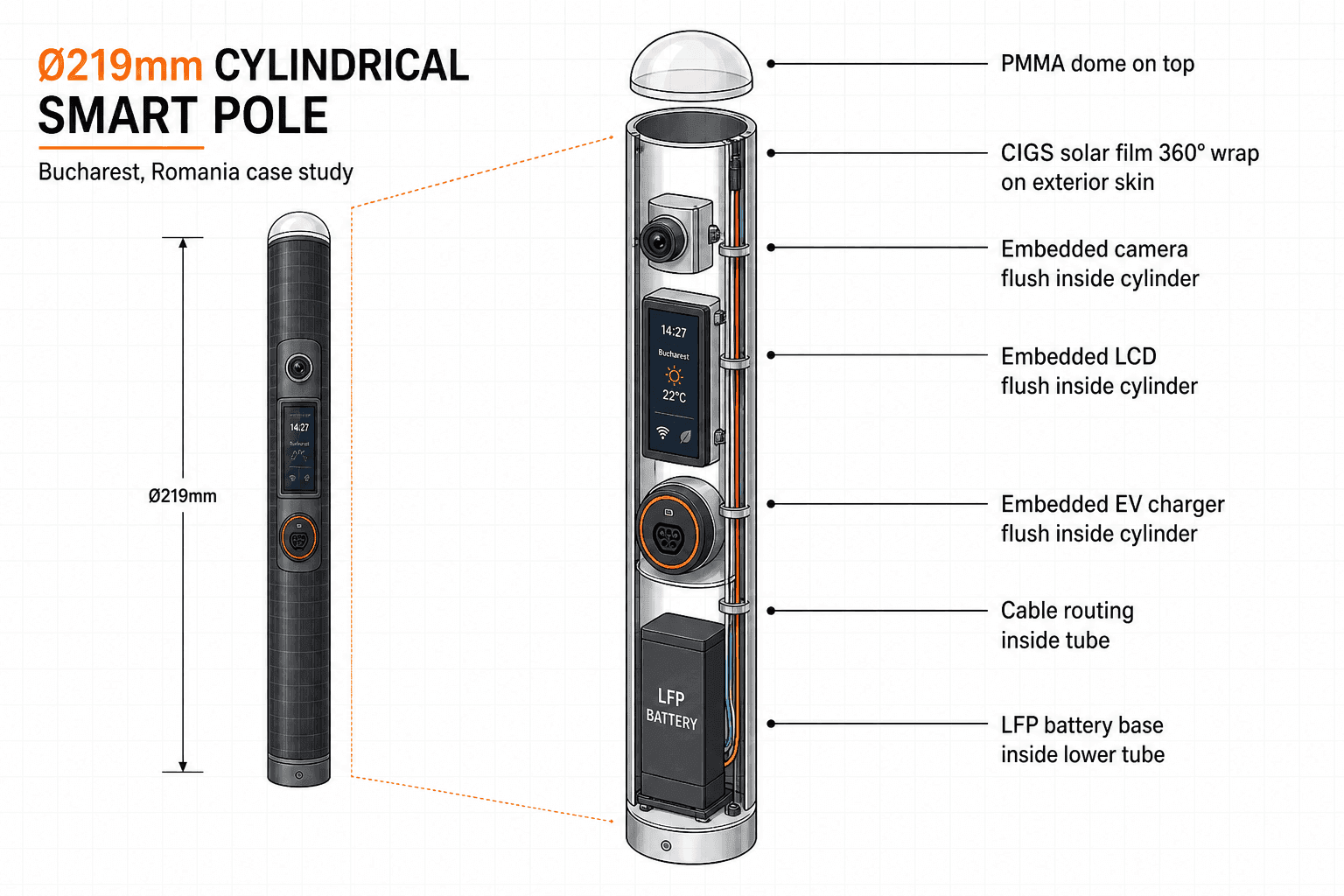
- Mechanical design: one monolithic cylinder with all modules flush-integrated into the cylinder skin; no side arms, no luminaire outriggers, no external boxes.
- Luminaire: Ø200mm multi-ring glow column, 3-5 rings in the top 1.5m, graduated brightness, 100W, 15,000lm, 4000K.
- Solar surface: 360-degree CIGS flexible thin-film wrap on the mid-section from 6.5m to 5.3m, approximately 110W total, flush dark blue-black laminated film.
- Battery and control: 3000Wh LFP battery inside pole base with MPPT, LoRaWAN/4G smart controller, and cloud platform connectivity.
- Camera and sensor: flush 8MP 180-degree fisheye camera behind dome glass plus 4-parameter environment sensing for temperature, humidity, wind speed, and noise.
- Communications: embedded 5G NR n78 with internal antenna, with no exposed antenna brackets.
- Emergency interface: flush SOS button and two-way audio intercom through pinhole speaker grille only.
- EV charging: fully flush embedded 11kW AC charger, Type 2 flip-cap socket, 5m coiled Type 2 cable, and flush touchscreen at 1.5m.
- Display: 2000mm x approximately 170mm vertical curved LCD, bent to Ø200mm radius, front-face portrait orientation, content limited to “SOLARTODO Smart City.”
- Standards: IEC 60598 for luminaire safety and GB/T 37024 for smart lighting application requirements.
According to IEC (2024), IEC 60598 covers general luminaire requirements and tests, making it the correct safety reference for the lighting subsystem. GB/T 37024 should be used for smart lighting control alignment, especially where municipal platforms require device monitoring, dimming logic, and networked management.
Implementation Approach
A typical Bucharest rollout would move through 5 phases: survey, engineering approval, CKD logistics, civil installation, and commissioning.
The first phase should be a corridor survey covering underground utilities, existing lighting circuits, curb geometry, pedestrian clearance, and telecom shadowing. Survey data should feed photometric design, charger load assessment, pole foundation drawings, and a communications coverage model. Because each pole includes 11kW AC charging, electrical design should verify feeder capacity, diversity factors, residual-current protection, metering, and emergency isolation.
The second phase should confirm product configuration and compliance files before procurement. For SOLARTODO Smart Streetlight units, the most important approval points are the Ø200mm constant cylinder, flush charger integration, no side arms, no public-address speaker columns, and no external cabinets. CKD or containerized logistics can then separate pole bodies, electronic modules, batteries, and installation accessories for customs and site staging.
The third phase is foundation, cabling, and erection. A practical sequence is saw-cut or excavation, foundation cage placement, duct routing, earthing, pole anchoring, module inspection, and commissioning. Final acceptance should include luminaire test, camera view test, EV charger test, battery/MPPT test, display content verification, SOS intercom test, 5G antenna scan, and cloud-platform registration.
Expected Performance & ROI
A 58-unit Bucharest configuration would provide 870,000lm of installed LED output and up to 638kW of distributed AC charging capacity.
Expected performance should be modeled as a municipal infrastructure bundle rather than as a stand-alone solar project. The total nominal lighting output would be 58 x 15,000lm, or 870,000lm, while total lighting load would be 5.8kW before dimming schedules. If dimming and presence-aware control are applied, energy use can fall materially compared with legacy discharge lighting; according to the IEA (2023), LEDs remain central to efficient lighting transitions because they provide high efficacy and controllability.
The EV charging layer is the largest electrical load. A typical 58-unit deployment would include 58 embedded 11kW AC chargers, equal to 638kW of connected charging capacity before simultaneity assumptions. Municipal ROI depends on utilization, tariff structure, maintenance contract, advertising restrictions, parking policy, and grid connection cost. Because this configuration limits display content to “SOLARTODO Smart City,” the ROI model should not assume third-party advertising income.
Maintenance value comes from reduced clutter and fewer exposed components. Flush integration protects wiring, camera, antenna, charger socket, display, and SOS controls from accidental impact and tampering. World Bank/ESMAP states, “Global Solar Atlas is a free, online, map-based application,” which makes it useful for screening solar contribution, but actual ROI should be based on Bucharest tariff data and measured corridor usage.
Comparison Table
The Ø200mm cylindrical configuration is the strongest Bucharest fit among 4 SOLARTODO form variants because it minimizes street clutter while retaining 11kW charging.
| SOLARTODO form variant | Best-fit context | Bucharest fit | Key technical difference |
|---|---|---|---|
| Cylindrical Ø200mm Smart Streetlight | Premium urban corridors | High | 6m seamless cylinder, flush modules, 110W CIGS wrap, 11kW charger |
| Standard 6-12m octagonal smart pole | General municipal roads | Medium | Modular accessories can be added, but external modules may increase clutter |
| Hybrid 12m wind-solar pole | Wider roads in Americas/APAC | Low-medium | 12m height, VAWT/HAWT, A-frame panels, larger visual profile |
| Grid 12m integrated EV pole | MENA grid-powered corridors | Low-medium | 12m octagonal pole with integrated lower charger cabinet |
Pricing & Quotation
SOLARTODO provides 3 quotation tiers for Bucharest buyers: FOB Supply, CIF Delivered, and EPC Turnkey with 1-year warranty.
SOLARTODO offers three pricing tiers for this product line: FOB Supply (equipment ex-works China), CIF Delivered (including ocean freight and insurance), and EPC Turnkey (fully installed, commissioned, with 1-year warranty). Volume discounts are available for large-scale deployments. Configure your system online for an instant estimate, or request a custom quotation from our engineering team at [email protected].
Frequently Asked Questions
These 10 FAQs cover Bucharest technical fit, timeline, ROI, maintenance, pricing structure, warranty, installation, and comparison points for a 58-unit design.
Q1: Why is the Ø200mm cylindrical Smart Streetlight recommended for Bucharest? The Ø200mm cylindrical form is recommended because Bucharest’s dense sidewalks and mixed-use corridors benefit from a constant-diameter 6m pole with no side arms, cabinets, or separate charging bollards. A typical 58-unit configuration at 22m spacing can cover about 1.28km while integrating lighting, sensing, 5G readiness, emergency intercom, display, and 11kW AC charging.
Q2: How long would a Bucharest deployment typically take? A typical schedule would require 2-4 weeks for survey and engineering, 4-8 weeks for production and logistics planning, and 3-6 weeks for civil works and commissioning, depending on permits and utility access. The 58-unit quantity is manageable for phased installation, but EV feeder upgrades or traffic-management restrictions can extend the program.
Q3: What ROI factors matter most for this Smart Streetlight configuration? The main ROI variables are LED energy savings, charger utilization, maintenance reduction, telecom value, and avoided clutter from separate poles or cabinets. For this Bucharest configuration, display advertising should not be included because the specified LCD content is restricted to “SOLARTODO Smart City.” Payback should be calculated from local tariffs, operating hours, and actual charging demand.
Q4: Does the 110W CIGS solar wrap power the whole pole? No. The approximately 110W CIGS wrap supports auxiliary generation and battery charging, but it should not be treated as the only power source for lighting, display, camera, communications, and 11kW EV charging. In Bucharest, the practical design should use the grid for major loads, with the 3000Wh LFP battery and MPPT supporting resilience and control electronics.
Q5: What maintenance is expected for the flush cylindrical design? Maintenance should focus on annual electrical inspection, charger socket testing, touchscreen cleaning, camera lens inspection, battery health checks, firmware updates, and protective coating review. The flush design reduces exposed brackets and accessory boxes, which can lower accidental damage risk. Battery replacement planning should follow LFP lifecycle data, ambient temperature records, and actual cycling depth.
Q6: How does this compare with a standard octagonal smart pole? A standard 6-12m octagonal pole is practical for many roads, but it often uses modular accessories that can protrude from the shaft. The Bucharest recommendation uses a seamless Ø200mm cylinder where camera, SOS, charger, display, solar film, and antenna are flush-integrated. That makes it better for premium corridors where visual quality and pedestrian clearance matter.
Q7: Can SOLARTODO provide EPC pricing for Romania? SOLARTODO can quote FOB Supply, CIF Delivered, or EPC Turnkey structures, but the correct option depends on buyer scope, local contractor participation, permitting, and utility interconnection responsibility. EPC pricing should include foundation works, cabling, installation, commissioning, and 1-year warranty. The article intentionally excludes prices because site conditions and grid works can materially change the total.
Q8: What warranty structure is appropriate for Bucharest procurement? A typical EPC Turnkey structure includes a 1-year warranty, while component warranties may vary by LED, battery, charger, display, controller, and pole finish. Procurement documents should separate workmanship warranty from product warranty and define response times for charger faults, communication outages, display failures, and battery alarms. Warranty scope should also specify vandalism and force-majeure exclusions.
Q9: What installation checks are critical before commissioning? Commissioning should verify foundation torque, earthing continuity, insulation resistance, luminaire output, 4000K color consistency, EV charger safety, Type 2 socket operation, 5m cable handling, camera field of view, SOS audio quality, LCD content, MPPT operation, battery state reporting, and cloud connectivity. A 58-unit deployment should use serialized asset records for municipal handover.
Q10: Is this product suitable for highways or parks in Bucharest? This 6m cylindrical Smart Streetlight is intended for city and urban street classes, not highways or garden-lighting applications. Highways normally require 12m or taller traffic-pole classes with different wind, outreach, and road-lighting calculations. Parks often use 6-8m garden lighting with softer distribution and fewer integrated EV or telecom functions.
References
These 7 references support Bucharest demographics, solar screening, telecom planning, lighting safety, smart-city framing, and smart-lighting technical compliance.
- National Institute of Statistics Romania (2023): Definitive 2021 census results reporting Bucharest’s resident population at 1,716,961.
- Municipality of Bucharest / official city data (2024): Bucharest administrative area of approximately 240 km2 and six-sector municipal structure.
- World Bank and ESMAP (2019): Global Solar Atlas 2.0, solar resource and PV potential mapping at approximately 250m grid resolution. https://globalsolaratlas.info
- IEA PVPS / Romania solar data (2024): Romania solar resource commonly cited around 1,000-1,300 kWh/m2/year annual solar energy flux.
- ANCOM Romania (2022): 5G spectrum auction including 3.4-3.8GHz bands relevant to 5G NR n78 planning.
- IEC (2024): IEC 60598 series for luminaire safety requirements and tests.
- Standardization Administration of China (2018): GB/T 37024 smart lighting application requirements for networked lighting control systems.
Equipment Deployed
- 58 units x 6m seamless cylindrical Ø200mm pole, constant diameter top-to-bottom, 5mm wall, hot-dip galvanized silver-grey finish
- Ø200mm multi-ring glow column luminaire, 3-5 rings in top 1.5m, 100W, 15,000lm, 4000K
- 360-degree CIGS flexible thin-film solar wrap, approximately 110W, laminated flush to mid-section
- 3000Wh LFP battery inside pole base with MPPT
- Embedded 11kW AC EV charger with Type 2 flush flip-cap socket, 5m coiled Type 2 cable, and 1.5m touchscreen
- Flush 8MP 180-degree fisheye panoramic camera behind dome glass
- Flush 4-parameter environment sensor for temperature, humidity, wind speed, and noise
- Embedded 5G NR n78 internal antenna with LoRaWAN/4G smart controller and cloud platform
- Flush SOS button and two-way intercom through pinhole speaker grille
- Vertical curved LCD display, 2000mm x approximately 170mm, showing only SOLARTODO Smart City