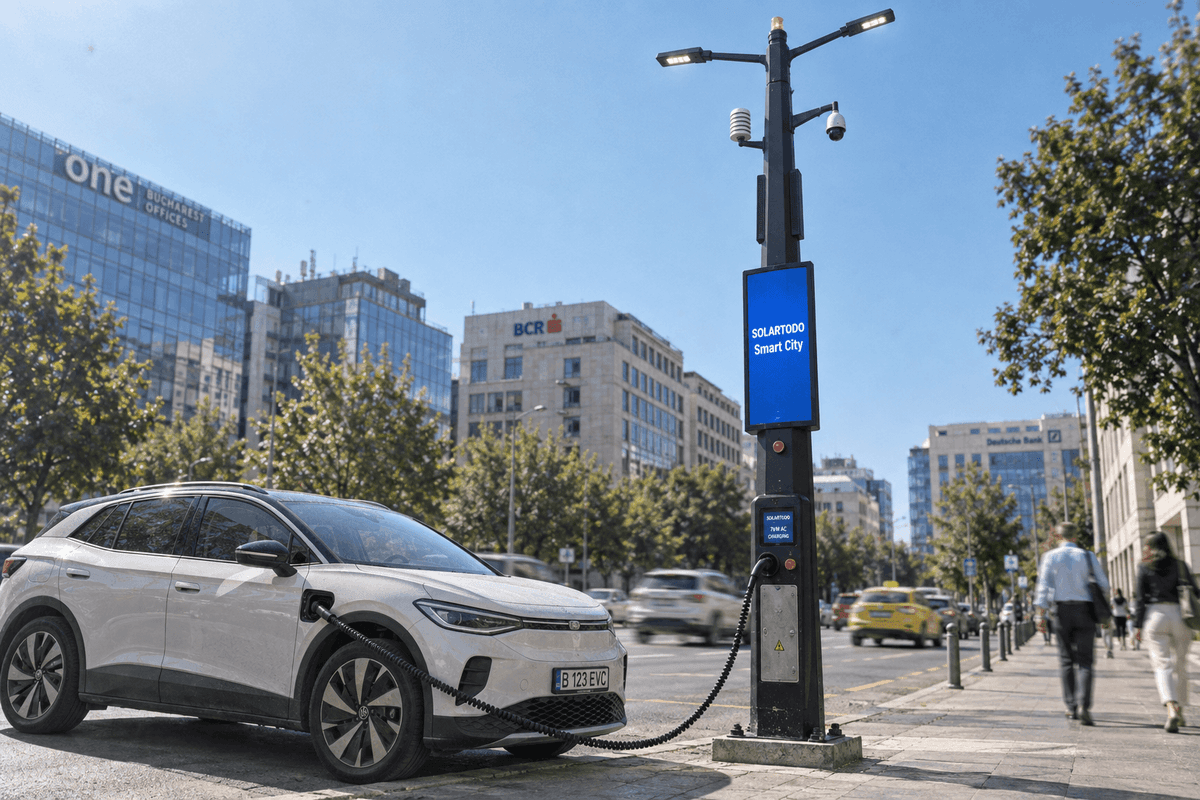
Bucharest Curbside EV Charging and Old-Street Integration: Smart Streetlight Technical Fit for a 52-Unit 10m Configuration
Summary
Bucharest’s 1.72 million residents, 1,820.8 km street network, and Romania’s 230/400V low-voltage grid make a 52-unit, 10m SOLARTODO Smart Streetlight layout practical for curbside lighting, monitoring, WiFi 6, SOS, and 11kW Type 2 AC charging.
Key Takeaways
A 52-unit Bucharest Smart Streetlight deployment would use 10m poles at 28m spacing, covering approximately 1.46 km of urban corridor.
- The recommended pole is a 10m octagonal tapered steel structure, base Ø45cm to top Ø15cm, black RAL9005 powder coat.
- Each pole provides 2×80W LED luminaires, 4000K color temperature, and 150 lm/W efficacy for municipal street-class lighting.
- Integrated EV charging uses an 11kW single-gun AC Type 2 charger with OCPP 1.6J and IEC 62196-2 compatibility.
- The lower 2.2m of the pole is the charger cabinet itself, welded into one continuous structure rather than placed as a separate pillar.
- At 28m spacing, 52 poles equal approximately 35.7 poles/km, within the 30-50 poles/km density used for urban streets.
- Communications include WiFi 6 at 8.7m, 4G/LoRaWAN smart control, 256-device AP capacity, and 1.8Gbps peak AP rating.
- Safety modules include a 20x zoom mini PTZ camera, IR 100m, one-press SOS, and 2×30W TCP/IP audio columns.
- Romania’s public low-voltage supply is 230V single-phase and 400/230V three-phase, aligning with the 220/380V AC configuration.
Market Context for Bucharest
Bucharest’s smart-pole priority is not highway lighting; it is dense curbside utility consolidation across 5,340 streets and 1,820.8 km of urban road network. According to Romania’s National Institute of Statistics (2021), Bucharest had 1,716,961 resident inhabitants at the 2021 census, which makes sidewalk space, curb access, and public-service integration more important than standalone decorative lighting. According to Bucharest municipal documentation (2018), the city road network included 5,340 streets totaling 1,820.8 km, with management split between the General Municipality and the six sector administrations.
The city is inland on the Romanian Plain, around 60-90m above sea level, and is crossed by the Dâmbovița urban corridor. That means Bucharest does not need coastal salt-air pole treatments like Constanța, but it does need corrosion protection against freeze-thaw cycles, winter de-icing splash, summer heat, road dust, and periodic stormwater ponding around curbs. A hot-summer continental climate also creates electronics stress: cabinets should be sealed, ventilated, and easy to service without exposing power terminals on narrow sidewalks.
According to Romania’s technical low-voltage regulation published through Portal Legislativ (2011), the public distribution network uses 230V single-phase and 400/230V three-phase supply in the TN-C system. That is directly relevant for a grid-powered SOLARTODO Smart Streetlight using AC 220/380V service, 11kW Type 2 charging, LED lighting, and communications loads. ANRE also lists electricity distribution performance standards through Order 46/2021 and Order 64/2022, so grid-connection work should be coordinated with licensed distribution operators and local permitting bodies.
Bucharest procurement is also institutionally specific. According to the Bucharest Streets Administration, it is a public service under Bucharest City Hall responsible for administration, maintenance, rehabilitation, bridges, underpasses, traffic lights, signs, markings, and public parking areas. For smart poles, that points toward multi-party approvals: street administration, sector administrations, electricity distributor, telecom provider, traffic-management authority, and public-procurement procedures.
Recommended Technical Configuration
A Bucharest-ready Smart Streetlight should prioritize grid-powered integrated charging, 10m street lighting, and unibody curbside design rather than solar autonomy. The recommended SOLARTODO configuration is a typical 52-unit deployment of 10m octagonal tapered steel smart poles at 28m spacing. This is a city-street class solution, not a highway mast, park bollard, or standalone EV charging column.
The best-fit form factor is the grid-powered smart pole variant, adapted to the supplied project-specific configuration rather than the default 12m flagship. Bucharest’s 230/400V distribution context, dense sidewalks, and old-town street geometry favor an integrated charger in the lower 2.2m of the pole. A separate charger cabinet would increase sidewalk clutter and conflict with pedestrian routes, utility covers, parking edges, and tram/bus stop furniture.
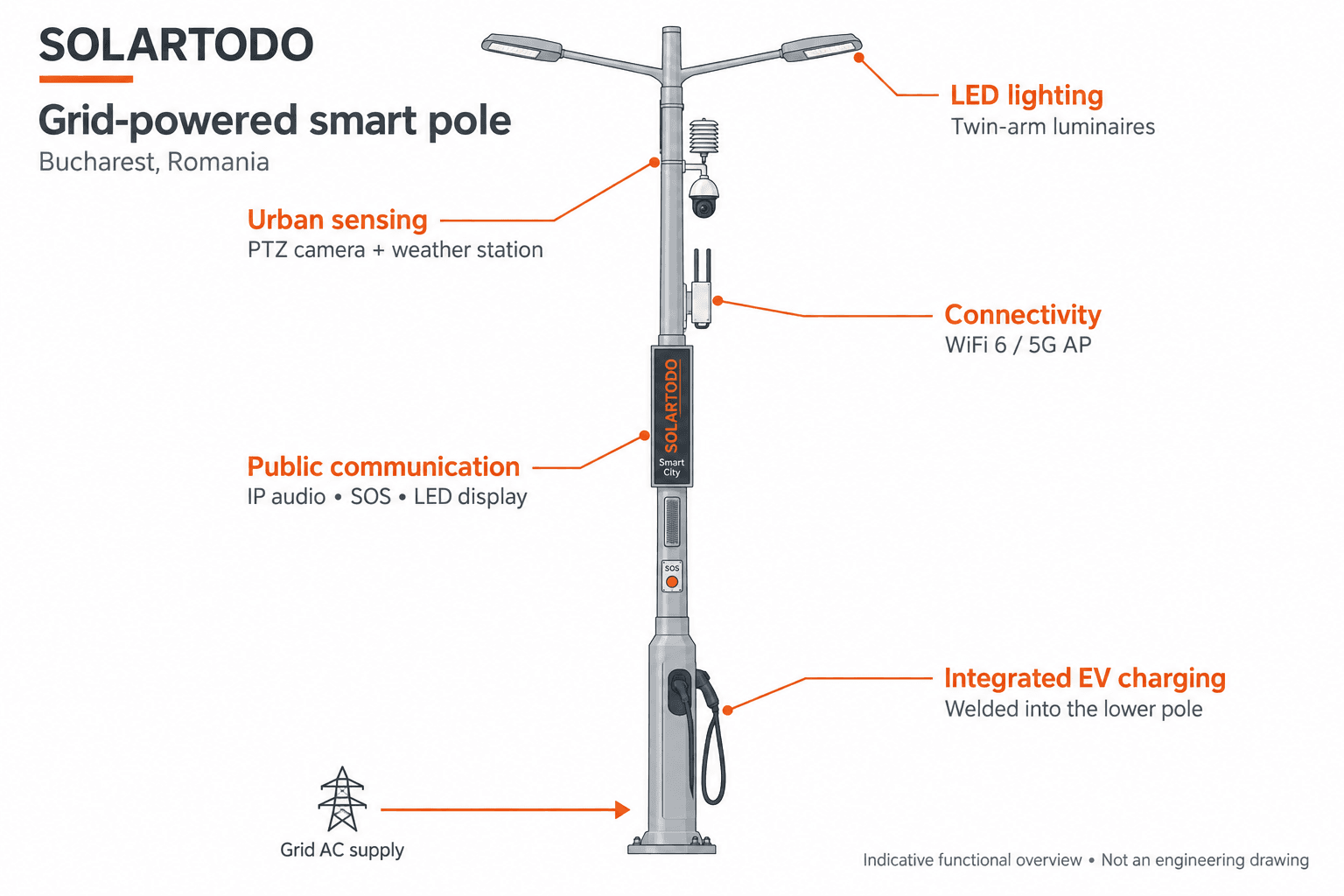
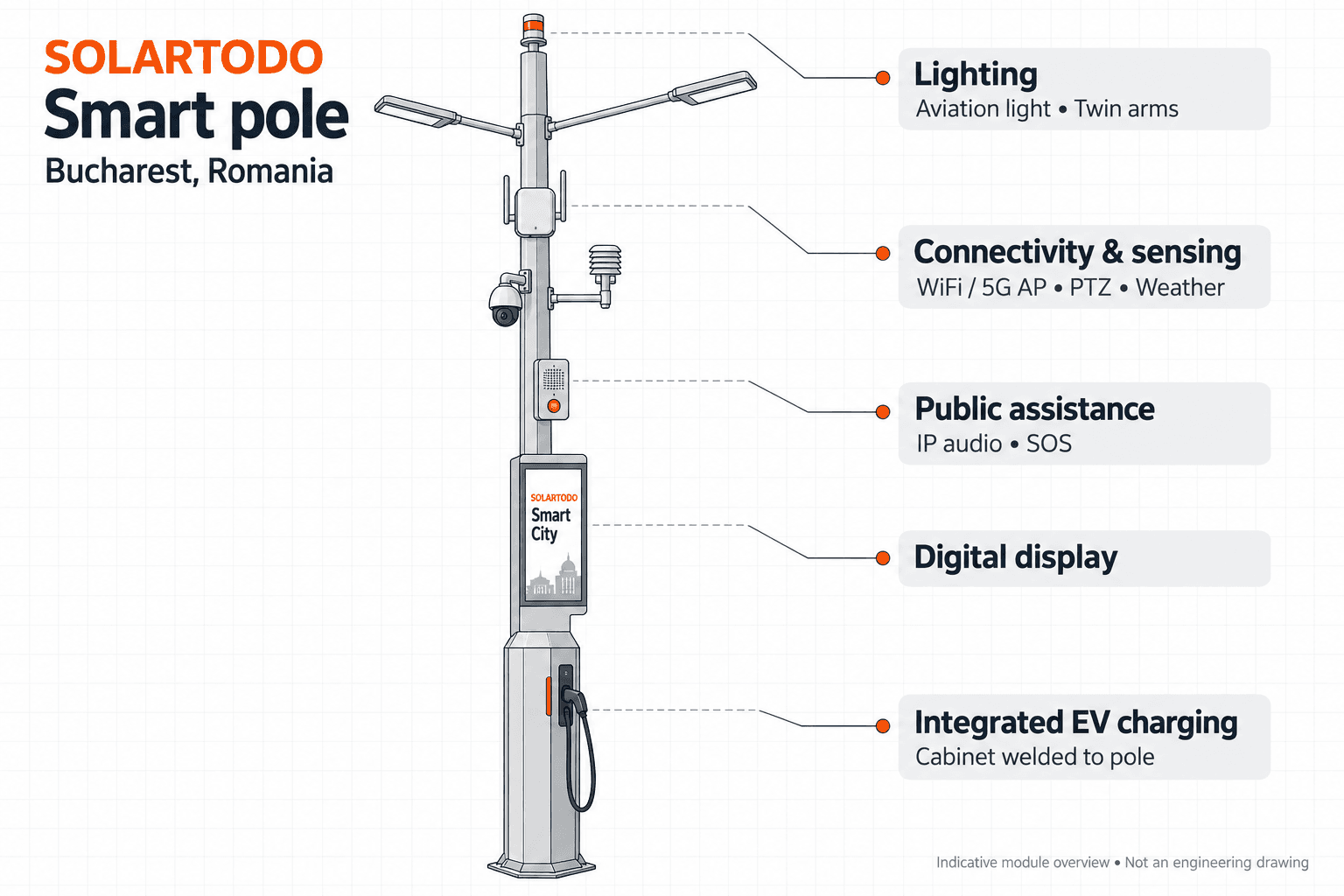
A typical 52-unit deployment in this profile would consist of black RAL9005 powder-coated 10m octagonal poles, each with twin 1.5m symmetric arms tilted +8 degrees. The lighting package uses 2×80W SOLARTODO LED heads at 150 lm/W and 4000K, which is suitable for urban streets requiring neutral visibility without excessive blue-white glare. The pole also consolidates CCTV, environmental sensing, SOS, audio notification, WiFi 6, USB charging, LED display, and EV charging in a single steel structure.
According to EUR-Lex Regulation (EU) 2023/1804, public AC recharging points installed or renovated from 8 January 2026 must use at least Type 2 connectors for interoperability. The regulation states, “AC recharging points shall be equipped with Type 2 connectors,” which supports the Type 2 charging selection in this SOLARTODO design. IEC states, “IEC 62196-2:2016 applies to plugs, socket-outlets, vehicle connectors and vehicle inlets,” which makes IEC 62196-2 a relevant connector reference for procurement specifications.
Technical Specifications
The 52-unit technical package uses a 10m grid-powered pole, 2×80W lighting, 11kW AC charging, and integrated sensing per pole.
- Product: SOLARTODO Smart Streetlight for urban street class, product page Smart Streetlight.
- Quantity basis: approximately 52 units for a 1.46 km corridor at 28m spacing.
- Pole: 10m octagonal tapered steel pole, base Ø45cm to top Ø15cm.
- Finish: black RAL9005 powder coat over protected steel structure.
- Power input: grid-powered AC 220/380V, aligned with Romania’s 230/400V public low-voltage class.
- Integrated EV charger: lower 2.2m of pole is the welded charger cabinet, not a separate standalone pillar.
- Charging output: 11kW single-gun AC charger, Type 2, OCPP 1.6J, 5m coiled Type 2 cable.
- Charger interface: 8-inch touchscreen at 1.5m, red mushroom E-stop, stainless maintenance door.
- Lighting: twin symmetric 1.5m arms with +8 degree upward tilt, 2×80W SOLARTODO LED, 150 lm/W, 4000K.
- Camera: 15cm mini white PTZ dome, 360 degrees, 20x zoom, IR 100m, mounted on 40cm L-bracket.
- Environmental sensor: top 4-parameter module for temperature, humidity, wind speed, and noise.
- Public address: 2×30W/93dB TCP/IP networked audio columns, Ø10×50cm, flush against opposite pole faces.
- Emergency: one-press SOS button with camera linkage.
- LED display: P3 vertical screen, 1000×2000mm portrait, >6000 cd/m², content limited to “SOLARTODO Smart City”.
- Connectivity: WiFi 6 AP, 802.11ax, 256 devices, 1.8Gbps, flush integrated at 8.7m.
- Device integration: housing color-matched to the pole with continuous paint across device and pole boundary.
- Extras: USB-C PD 30W and USB-A public charging.
- Control: LoRaWAN/4G smart controller with cloud platform readiness.
- Standards: IEC 60598 for luminaires, GB/T 37024 for smart streetlight system reference, IEC 62196-2 for EV charging interface.
Implementation Approach
A 52-unit Bucharest rollout would typically proceed through survey, utility coordination, foundations, CKD delivery, erection, and commissioning. The first phase is a corridor audit: sidewalk width, utility chambers, tram traction interfaces, tree canopies, existing lantern spacing, camera privacy constraints, and parking turnover. Because Bucharest streets are administered through both city and sector bodies, permit sequencing should identify who controls the road, sidewalk, traffic works, and public lighting asset handover.
The second phase is electrical and civil design. Each pole location should be checked for 220/380V AC availability, protective earthing, residual-current protection, EV charger load diversity, and cable route feasibility. In historic or narrow streets, foundations may need compact reinforced designs and careful excavation to avoid telecom ducts, water lines, gas networks, and tree roots.
The third phase is logistics and installation. CKD shipment can reduce transport volume, while local assembly should preserve factory alignment of the charger cabinet, maintenance door, screen aperture, speaker mounting, and WiFi housing. After erection, commissioning should test LED photometrics, OCPP 1.6J charger communication, emergency stop, SOS camera linkage, WiFi access, PTZ video, audio broadcast, LED display brightness, and controller telemetry.
Expected Performance & ROI
A 52-unit corridor would combine 8.32kW of LED lighting load and up to 572kW of distributed AC charging nameplate capacity. Expected ROI should be modeled as a multi-benefit municipal asset rather than a lighting-only retrofit. The lighting load is 160W per pole, while the integrated EV charger adds 11kW when occupied; therefore the financial model should separate predictable night lighting energy from variable EV charging revenue or cost recovery.
According to the IEA (2024), global electric car sales approached 14 million in 2023, indicating continuing pressure for public charging access in urban areas. For Bucharest, the relevant takeaway is not that every pole needs high-power DC charging; it is that curbside AC charging can serve dwell-time parking without placing large cabinets on sidewalks. EU AFIR rules reinforce this by standardizing public AC connector expectations around Type 2.
A typical payback model should include avoided trenching duplication, lighting energy savings against legacy lamps, OCPP-managed charging utilization, advertising-screen operating policy, telecom/WiFi service value, security response value, and maintenance consolidation. Payback could vary widely depending on EV utilization and electricity tariffs, so SOLARTODO should be evaluated through lifecycle cost and service revenue scenarios rather than fixed savings claims. For engineering discussion, contact us with corridor length, utility connection assumptions, and expected charger utilization.
Comparison Table
The integrated 10m Smart Streetlight has the best Bucharest fit when sidewalk clutter and 230/400V grid access matter most.
| Option | Bucharest fit | Height | Charging | Street impact | Best use |
|---|---|---|---|---|---|
| SOLARTODO 10m grid integrated pole | High | 10m | 11kW Type 2 AC integrated in lower 2.2m | One foundation, no separate charger pillar | Dense streets, curbside parking, monitored corridors |
| Standard modular smart pole | Medium | 6-12m | Optional module | More flexible but less unified | General lighting upgrades without strong EV priority |
| Standalone EV charger plus existing pole | Medium-low | Existing | 7-22kW typical AC | Adds sidewalk object and separate civil works | Car parks or wide sidewalks |
| Solar-hybrid smart pole | Low-medium | 12m | Integrated EV possible | More visible hardware, battery base space needed | Areas with weak grid or resilience requirement |
| Cylindrical wrapped solar pole | Premium niche | Diameter-led | Flush EV option | Very clean appearance but different visual language | Landmark boulevards or premium districts |
Pricing & Quotation
SOLARTODO offers 3 quotation paths for Bucharest projects: FOB Supply, CIF Delivered, and EPC Turnkey with 1-year warranty.
SOLARTODO offers three pricing tiers for this product line: FOB Supply (equipment ex-works China), CIF Delivered (including ocean freight and insurance), and EPC Turnkey (fully installed, commissioned, with 1-year warranty). Volume discounts are available for large-scale deployments. Configure your system online for an instant estimate, or request a custom quotation from our engineering team at [email protected].
Frequently Asked Questions
A Bucharest Smart Streetlight specification should answer 10 practical questions about grid power, EV charging, installation, maintenance, ROI, and warranty.
Q1: Why is a 10m Smart Streetlight recommended for Bucharest instead of a 12m pole? A 10m pole fits urban streets where lighting, CCTV, WiFi, SOS, and curbside EV charging must share constrained sidewalk space. Bucharest has many dense corridors and older street geometries, so a 12m pole can be excessive outside major boulevards. The 10m configuration still supports 2×80W LED heads, PTZ camera coverage, audio columns, display, WiFi 6, and integrated 11kW charging.
Q2: How many poles are needed for a typical Bucharest corridor? For the supplied configuration, approximately 52 units at 28m spacing cover about 1.46 km. That equals roughly 35.7 poles per km, which sits inside the normal 30-50 poles/km urban street density. Final quantities depend on junctions, bus stops, tree canopy, building setbacks, existing lighting points, utility conflicts, and required illumination class.
Q3: Does the EV charger stand beside the pole? No. In this SOLARTODO configuration, the lower 2.2m of the pole is the EV charging cabinet itself. It is welded into one continuous steel structure with the upper pole, not installed as a separate pedestal. This matters in Bucharest because sidewalk width, parking edges, underground utilities, and pedestrian flow often make extra roadside cabinets difficult.
Q4: Is the 11kW Type 2 charger suitable for Romania? Yes, for normal AC public charging use. Romania’s public low-voltage system uses 230V single-phase and 400/230V three-phase supply, and EU rules point public AC charging toward Type 2 interoperability. The charger specified here is 11kW AC, Type 2, OCPP 1.6J, with a 5m coiled cable and IEC 62196-2 interface reference.
Q5: What is the expected installation timeline? A practical schedule for 52 units would normally include 2-4 weeks for survey and approvals, 3-6 weeks for production and logistics planning, and staged civil/electrical installation by corridor segment. Commissioning can be done pole-by-pole, covering LED output, charger communication, SOS linkage, PTZ video, WiFi, audio, and controller telemetry before public opening.
Q6: What ROI should Bucharest buyers expect? ROI should be modeled, not promised as a fixed number. Savings and revenue depend on legacy lamp wattage, night operating hours, electricity tariffs, EV charger utilization, OCPP billing policy, maintenance labor, and whether the LED display is used for approved municipal messaging. The strongest business case usually comes from combining lighting modernization, EV charging access, security, communications, and reduced sidewalk hardware.
Q7: How is maintenance handled on an integrated pole-as-charger design? Maintenance access is through the stainless door in the integrated lower cabinet, while lighting, camera, WiFi, sensor, speaker, and display modules are serviced through defined access points. A recommended plan includes quarterly visual checks, annual electrical inspection, cleaning of display and camera surfaces, firmware updates for OCPP/controller devices, and post-winter inspection for corrosion or de-icing splash damage.
Q8: How does this compare with separate EV chargers and existing streetlights? Separate chargers can be easier to source but add another object, another foundation, another cabinet, and additional sidewalk coordination. The integrated SOLARTODO pole consolidates lighting, 11kW charging, camera, WiFi, SOS, audio, sensor, USB charging, and display into one structure. For Bucharest’s dense corridors, that consolidation can reduce clutter and simplify asset mapping.
Q9: Can EPC pricing be quoted from this article alone? No. EPC pricing requires a corridor survey, foundation assumptions, grid-connection distance, trenching length, distribution-board upgrades, traffic-management requirements, and local civil works scope. SOLARTODO can quote FOB Supply, CIF Delivered, or EPC Turnkey, but Bucharest installation cost depends heavily on underground utilities, approvals, night-work restrictions, and whether existing foundations can be reused.
Q10: What warranty basis is appropriate for procurement? For EPC Turnkey, the required SOLARTODO quotation paragraph specifies a 1-year warranty. Procurement documents should separately define warranty coverage for steel structure, LED drivers, charger electronics, touchscreen, display modules, camera, WiFi AP, controller, and corrosion protection. Buyers should also require spare-parts availability, response times, software-update policy, and OCPP platform responsibilities.
References
- Institutul Național de Statistică (2021): Romania census results listing Bucharest resident population at 1,716,961 inhabitants.
- Primăria Municipiului București (2018): Municipal street network data listing 5,340 streets and 1,820.8 km total road length.
- Bucharest Streets Administration (2026): Public institution under Bucharest City Hall responsible for roads, bridges, underpasses, traffic lights, signs, markings, and public parking.
- Portal Legislativ Romania (2011): Low-voltage public distribution supply in Romania is 230V single-phase and 400/230V three-phase, harmonized with SR HD 472S1.
- ANRE (2021-2022): Electricity distribution performance standards under ANRE Order 46/2021 and amendments through Order 64/2022.
- EUR-Lex / European Union (2023): Regulation (EU) 2023/1804 on alternative fuels infrastructure, including Type 2 connector requirements for public AC recharging points.
- IEC (2016): IEC 62196-2:2016 for dimensional compatibility and interchangeability requirements for AC EV plugs, socket-outlets, connectors, and inlets.
- IEA (2024): Global EV Outlook reporting nearly 14 million electric car sales worldwide in 2023, supporting urban public-charging demand analysis.
Equipment Deployed
- 52 units × 10m octagonal tapered steel smart pole, base Ø45cm to top Ø15cm, black RAL9005 powder coat
- Grid-powered AC 220/380V input for Romania 230/400V low-voltage context
- Integrated lower 2.2m pole-as-charger cabinet, welded as one continuous steel structure
- 11kW single-gun AC EV charger, Type 2, OCPP 1.6J, 5m coiled cable
- Twin symmetric 1.5m arms with +8° tilt and 2×80W SOLARTODO LED, 150 lm/W, 4000K
- 15cm mini white PTZ dome camera, 360°, 20x zoom, IR 100m, 40cm L-bracket
- Top 4-parameter environmental sensor: temperature, humidity, wind speed, noise
- 2×30W/93dB TCP/IP IP audio columns, Ø10×50cm, flush-mounted and color-matched
- One-press SOS button with camera linkage
- P3 portrait LED display 1000×2000mm, >6000 cd/m², SOLARTODO Smart City text only
- WiFi 6 AP, 802.11ax, 256 devices, 1.8Gbps, flush-mounted at 8.7m
- USB-C PD 30W plus USB-A public charging