Bogota SOLARTODO Sentinel City AI Pole Market Analysis: 56-Node Off-Grid Edge Configuration Guide
Summary
Bogota's 7.9M-resident, 1,587 km2 capital district would suit a typical 56-node SOLARTODO Sentinel layout at 40 m spacing, covering about 2.2 km with local AI processing and 5-20 kWh storage per pole.
Key Takeaways
- A typical 56-unit SOLARTODO Sentinel City AI Pole deployment at 40 m spacing would create approximately 2.2 km of edge-node coverage for district, campus or perimeter corridors.
- Bogota sits at about 2,640 m elevation and covers roughly 1,587 km2, so equipment selection should account for cool temperatures, cloud cover and high-altitude maintenance access.
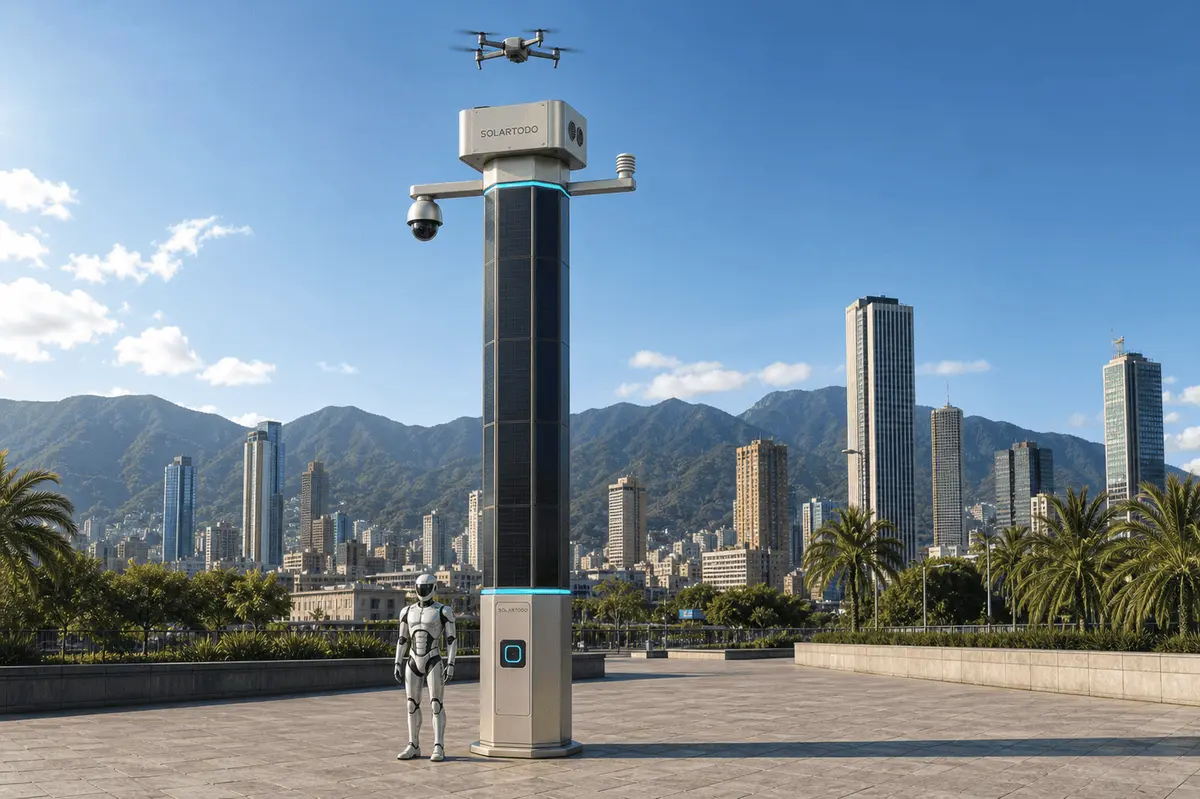
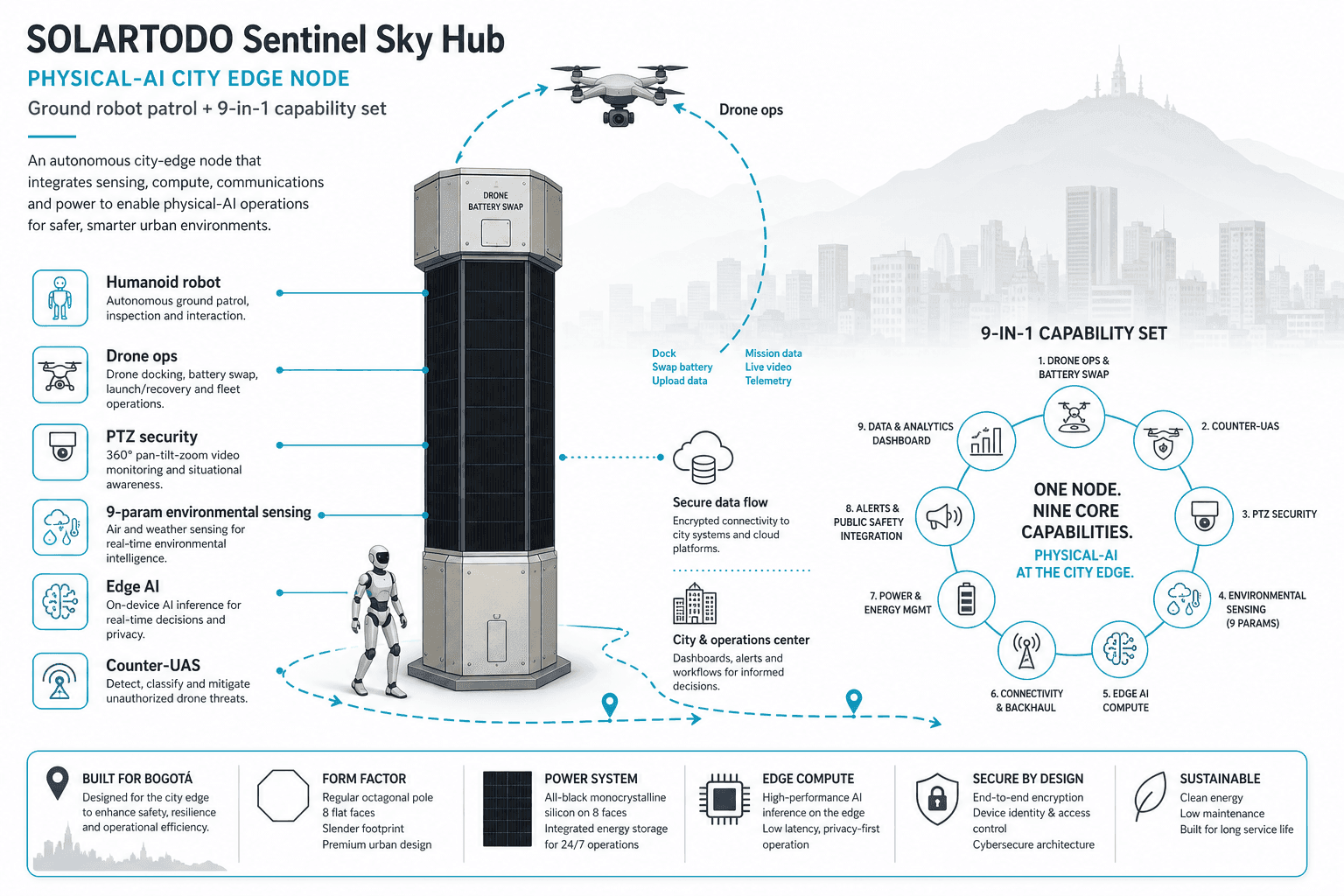
- Each Sentinel pole is a pure smart pole with no lighting system, combining edge AI, environmental sensing, drone operations and ground-robot charging in one off-grid node.
- On-pole PV replenishment is in the 2.8-3.2 kWp nameplate class, with realistic clear-sky output of about 1.0-1.3 kW DC peak and 7-10 kWh/day in high-irradiance regions.
- The recommended energy buffer is 5-20 kWh-class storage per node, with drone and robot missions scheduled by duty cycle rather than unlimited solar autonomy.
- Local sensing should prioritize anonymous vehicle count, crowd density, intrusion and perimeter awareness; raw video and sensor data remain on the pole.
- Counter-UAS workflows should be non-lethal and human-authorized, using detection, tracking, coordination and soft capture or close-approach deterrence only.
- The configuration should be treated as project-based custom engineering, with foundation, wind, telecom backhaul and Colombian data-protection review confirmed before procurement.
Market Context for Bogota
Bogota's scale, altitude and security workload make a 56-node off-grid edge network more relevant for controlled corridors than for generalized citywide surveillance. According to Bogota public demographic reporting and DANE-based city profiles, the capital district has roughly 7.9 million residents across about 1,587 km2, divided into 20 localities. That density creates practical demand for localized event detection, transport-adjacent monitoring, campus security and critical-infrastructure perimeter awareness without sending raw data to remote cloud systems.
According to public city profiles, Bogota's average elevation is about 2,640 m, with a cool highland climate near 14.5 C average temperature. For a SOLARTODO Sentinel City AI Pole design, this matters because batteries, drone sortie planning and maintenance cycles should be specified for cool, cloudy and rainy-season operating windows. According to the World Bank and ESMAP Global Solar Atlas (2019), solar resource mapping supports pre-feasibility planning at approximately 250 m solar-resource resolution and 1 km PV-output resolution, which is suitable for first-pass site screening but not a substitute for on-site shading surveys.
Bogota's digital-infrastructure requirement is not simply more cameras; it is a need for edge processing, privacy-oriented event filtering and resilient field operations. ITU states, "A smart sustainable city is an innovative city that uses ICTs," and that framing fits Bogota only if ICT systems are governed, maintained and limited to defined public purposes. Colombia's Law 1581 of 2012 also requires personal-data governance, so the recommended SOLARTODO architecture is designed for local processing and PDPL-LGPD-oriented data minimization rather than raw-video export.
Recommended Technical Configuration
A typical 56-unit SOLARTODO Sentinel City AI Pole configuration in Bogota would use off-grid edge nodes at approximately 40 m spacing for a 2.2 km managed corridor. This size class is appropriate for smart districts, industrial parks, mobility interchanges, university campuses, logistics zones and public-facility perimeters where operators need repeatable coverage and local response workflows. The correct product line is the city-ai-pole / physical-AI edge node line, not a power tower, telecom monopole, solar streetlight or lighting pole.
The recommended configuration consists of approximately 56 SOLARTODO Sentinel Sky Hub pole-form nodes, each operating as a battery-backed micro-station with on-pole PV replenishment, edge compute, sensing, drone operations and ground-robot service support. At 40 m spacing, the design assumes overlapping awareness zones for perimeter events and inspection tasks, while allowing the engineering team to adjust exact spacing for line-of-sight, public right-of-way, tree canopy, backhaul availability and foundation constraints. SOLARTODO should be specified as the outward product brand, with third-party drone, camera and compute components treated as technical subsystems rather than public-facing brands.
For system architecture, the strongest fit is a common-operating-picture workflow: sensing, authorized assessment, edge-compute scheduling, field response and maintenance reporting. Raw video and sensor data stay on the pole for local inference; only de-identified event metadata, health status and task logs leave the node. The configuration can include non-lethal counter-UAS coordination, but mitigation must remain human-authorized and must exclude jamming, hard-kill action, autonomous attack or weapons.
Technical Specifications
The technical baseline is a 56-node, fully off-grid SOLARTODO Sentinel configuration with 5-20 kWh-class battery storage per pole and local AI processing. The SOLARTODO Sentinel City AI Pole is specified as a pure smart pole with no lighting system. Its role is to host sensing, compute, energy storage, drone operations, ground-robot charging and event coordination, not to provide street illumination.
- Quantity: approximately 56 SOLARTODO Sentinel City AI Pole nodes, subject to engineering confirmation.
- Spacing: approximately 40 m between nodes, equal to about 2.2 km of corridor coverage at this scale.
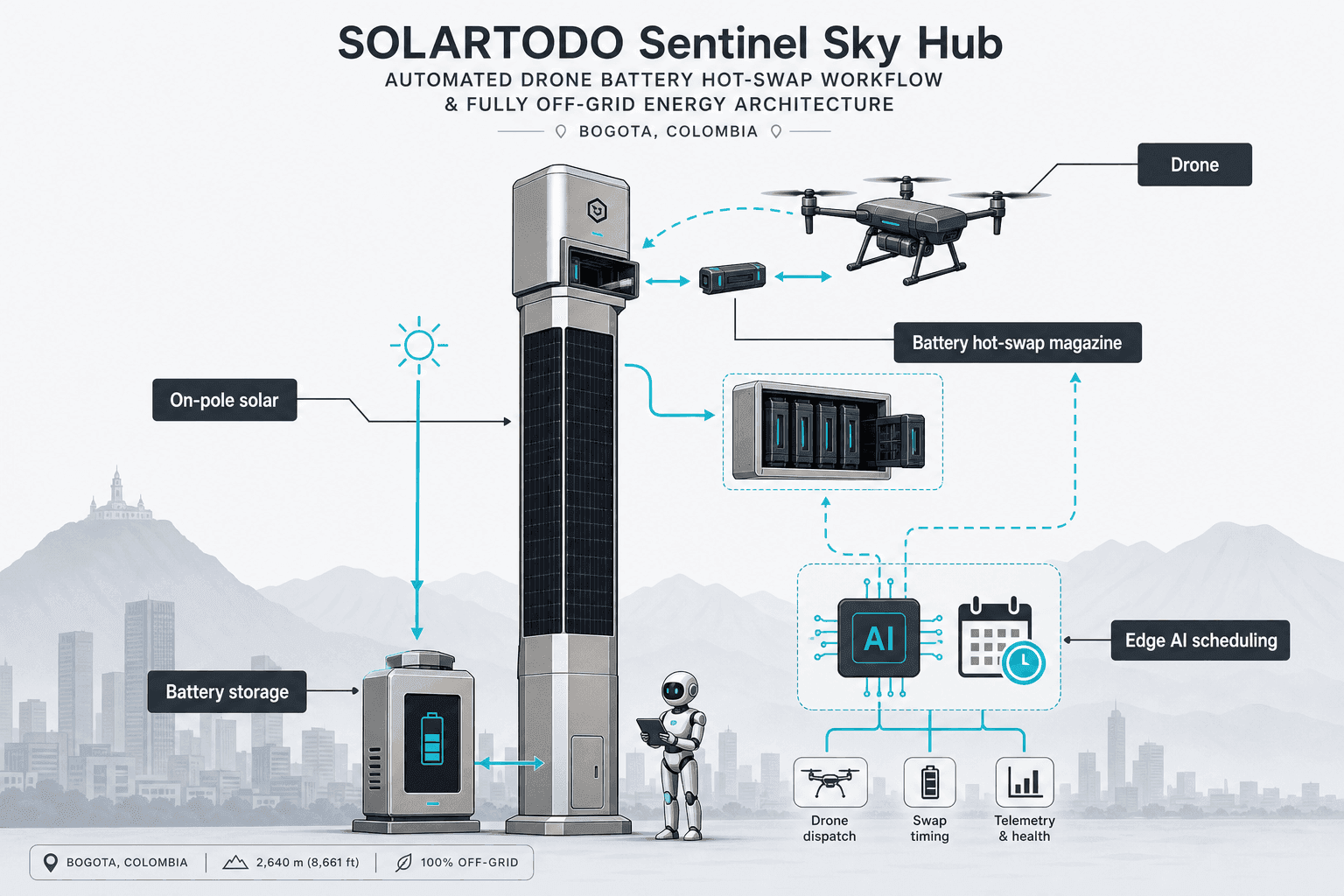
- Power architecture: fully off-grid, using on-pole solar replenishment plus battery storage; no city, grid or site power dependency is assumed.
- PV replenishment layer: 2.8-3.2 kWp nameplate class integrated into the pole body, with about 1.0-1.3 kW DC realistic clear-sky peak in high-irradiance regions.
- Daily solar contribution: approximately 7-10 kWh/day in high-irradiance conditions; Bogota-specific output requires shading and irradiation modeling.
- Battery buffer: 5-20 kWh-class storage per node, sized against drone sortie frequency, robot charging duty cycle, sensor load and communications uptime.
- Edge compute: Jetson-class local AI module for inference, workload scheduling and event filtering.
- Environmental sensing: wind speed, wind direction, temperature, humidity, atmospheric pressure, noise, PM10, PM2.5 and illuminance.
- Security sensing: PTZ visual sensing with local perception for anonymous vehicle counts, crowd density, intrusion detection and perimeter awareness.
- Drone operations: autonomous launch, route patrol, inspection, return, battery hot-swap and task redeployment without an on-site operator.
- Ground robot operations: patrol, inspection, alarm response, air-ground coordination and return-to-base wireless charging.
- Counter-UAS coordination: detection, tracking and human-authorized soft response using friendly-drone coordination; radar is optional partner-sensor input, not pole hardware.
- Data handling: raw video and sensor feeds stay on-pole; only de-identified event, status and maintenance metadata may be transmitted.
According to IEC 62443 (2018-2024 series), industrial automation cybersecurity should address secure development, system requirements, integration practices and operational security. IEC describes the 62443 series as covering "industrial automation and control systems security," which is the right reference model for field edge nodes connected to operations centers. For Bogota, this means secure boot, role-based access, signed updates, segmented networks, audit logs and incident-response procedures should be part of the procurement specification.
Implementation Approach
A 56-node Bogota deployment would typically be implemented in 6 phases over roughly 12-24 weeks after site access, permits and engineering release. Phase 1 is route survey and risk mapping: the project team would verify the 40 m spacing plan, soil conditions, pedestrian clearance, wind exposure, wireless backhaul and priority event zones. This should include a privacy-impact review because Colombia's Law 1581 of 2012 governs personal data processing.
Phase 2 is detailed engineering and bill-of-material confirmation. The engineering pack should define foundations, pole anchoring, battery sizing, drone duty cycles, environmental-sensor calibration, network topology, cybersecurity controls and command-center interfaces. For a SOLARTODO project-based custom configuration, this stage is where the 5 kWh, 10 kWh or 20 kWh storage class should be selected by workload rather than by generic catalogue assumptions.
Phase 3 is procurement and logistics. A typical international supply model can use CKD or modular shipping, followed by local assembly, electrical safety checks and acceptance testing. Phase 4 is civil works and pole erection; each site should be prepared with foundation curing, drainage review, anti-tamper access control and safe maintenance clearance.
Phase 5 is commissioning. Each node should be tested for PV replenishment, battery state reporting, local inference, sensor calibration, drone battery exchange, robot charging, mission logs and event metadata export. Phase 6 is operational handover, including operator training, maintenance intervals, data-retention rules and incident escalation procedures for human-authorized response.
Expected Performance & ROI
Expected performance should be measured by uptime, inspection coverage, dispatch reduction and avoided manual patrol hours, not by claimed citywide crime reduction. A typical 56-node SOLARTODO Sentinel configuration can support approximately 2.2 km of managed corridor coverage, with each node processing video and environmental data locally. The strongest ROI cases are usually high-cost perimeter operations, industrial campuses, ports, depots and public corridors where manual patrols, truck rolls and repeated inspections are expensive.
According to IEA (2023), digital technologies can improve energy-system operations by using data, automation and connected devices; the same operational logic applies to city edge infrastructure when it is carefully governed. According to the World Bank and ESMAP Global Solar Atlas (2019), map-based solar data is appropriate for initial zoning and pre-feasibility, but final PV yield requires local validation. For Bogota, conservative ROI modeling should include cloudier highland conditions, service-access time, spare battery packs, drone replacement parts, communications fees and operator staffing.
A practical payback model should compare the Sentinel network against a conventional stack of fixed poles, separate surveillance equipment, separate drone docking infrastructure, robot charging stations, environmental stations and manual patrol contracts. Where one node replaces several independently powered systems, lifecycle value improves through fewer foundations, fewer service visits and unified command workflows. ROI should be quoted only after site survey; a 3-6 year range may be reasonable for high-security private or public-infrastructure corridors, but low-risk sites may justify the system primarily through resilience and response quality.
Results and Impact
The expected impact of a 56-node Bogota configuration is a privacy-oriented edge network covering about 2.2 km, with local inference and human-authorized response. For operators, the practical result is faster event triage, fewer unnecessary patrol dispatches and better maintenance visibility across drones, batteries, sensors and robot charging points. For public-sector buyers, the main benefit is not raw surveillance volume but selective, de-identified event reporting aligned with Colombian data-protection expectations.
Operationally, the system should improve inspection frequency in areas where manual patrols are irregular or costly. Environmental monitoring adds local PM2.5, PM10, noise, wind and weather context that can support facility operations and event review. Counter-UAS coordination adds a bounded response layer for unauthorized drones, but the permitted response remains non-lethal, human-authorized and limited to soft capture or close-approach deterrence.
Comparison Table
A 56-node SOLARTODO Sentinel network consolidates 6 major field functions that are usually procured as separate powered assets. The table below compares the recommended Sentinel configuration with a conventional multi-system approach for a Bogota corridor or campus perimeter.
| Metric | SOLARTODO Sentinel City AI Pole | Conventional Separate Systems |
|---|---|---|
| Typical node count for this guide | 56 integrated poles | 56+ poles plus separate stations |
| Approximate spacing | 40 m | 30-60 m depending on device type |
| Linear coverage | About 2.2 km | About 2.2 km, but with more asset types |
| Power model | Fully off-grid battery-backed node with PV replenishment | Usually grid-fed or mixed power points |
| Storage class | 5-20 kWh per node | Separate UPS or cabinets per subsystem |
| Local AI processing | On-pole edge inference | Often split between camera, server and cloud |
| Raw data handling | Raw video and sensor data stay on pole | Often backhauled to VMS or cloud systems |
| Drone operations | Launch, return, hot-swap and task queue | Separate drone dock or manual drone team |
| Robot support | Wireless charging at pole base | Separate robot dock |
| Environmental sensing | 9 parameters per node | Separate weather and air-quality station |
| Counter-UAS | Human-authorized, non-lethal coordination | Often separate detector and response workflow |
| Best-fit buyer | Smart district, campus, port, industrial park, perimeter | Buyer with existing grid, VMS and separate O&M teams |
Pricing & Quotation
SOLARTODO offers 3 commercial quotation paths for the Sentinel product line, with final pricing dependent on storage, sensors and EPC scope. SOLARTODO offers three pricing tiers for this product line: FOB Supply (equipment ex-works China), CIF Delivered (including ocean freight and insurance), and EPC Turnkey (fully installed, commissioned, with 1-year warranty). Volume discounts are available for large-scale deployments. Configure your system online for an instant estimate, or request a custom quotation from our engineering team at [email protected].
For technical scoping, buyers should provide route length, node spacing, target operating hours, drone sortie frequency, robot duty cycle, local wind criteria, data-retention rules and backhaul preference. The SOLARTODO solutions team can then size storage, sensor packages and commissioning scope around the real workload rather than a generic pole count.
Frequently Asked Questions
A Bogota Sentinel specification should answer at least 10 procurement questions covering power, data, installation, maintenance, warranty and ROI.
Q1: Is the SOLARTODO Sentinel City AI Pole a smart streetlight? No. The SOLARTODO Sentinel City AI Pole is a pure smart pole with no lighting system. It is designed for edge AI, sensing, drone operations, ground-robot support and off-grid energy buffering. Buyers should not specify LED luminaires, lamp heads or street-lighting photometrics for this product line.
Q2: How many units are recommended for the Bogota configuration? This guide uses approximately 56 units at about 40 m spacing, which represents roughly 2.2 km of corridor coverage. The number should be treated as a typical deployment scale, not a past installation claim. Final quantities depend on route geometry, line-of-sight, foundations, backhaul and priority event zones.
Q3: Does the system depend on Bogota's power grid? No grid dependency is assumed. Each Sentinel node is fully off-grid, with battery storage and on-pole solar replenishment. The solar layer is supplemental, not unlimited self-sufficiency. High-load drone and robot tasks should be scheduled against the 5-20 kWh storage class and confirmed with local irradiance modeling.
Q4: What data leaves the pole? Raw video and raw sensor data stay on the pole for local processing. Only de-identified event metadata, system status, mission logs and maintenance alerts should leave the node. This architecture supports privacy-oriented design under Colombian data-protection expectations, but it should still be reviewed by local legal counsel.
Q5: What is the expected deployment timeline? After permits, site access and engineering release, a 56-node project would typically require about 12-24 weeks for survey, engineering, procurement, civil works, erection, commissioning and training. Complex foundations, restricted public corridors, telecom backhaul delays or added counter-UAS partner sensors can extend the schedule.
Q6: What maintenance is required? Maintenance should include PV surface inspection, battery health checks, drone battery-magazine inspection, robot charging verification, sensor calibration, enclosure inspection, firmware updates and audit-log review. A practical plan would use quarterly field inspection plus remote health monitoring, with faster response for drone, battery or communications alarms.
Q7: What ROI or payback should buyers expect? ROI depends on avoided patrol labor, fewer truck rolls, inspection frequency, security risk and the value of uninterrupted operations. For high-security campuses, depots or industrial perimeters, a 3-6 year payback may be possible. SOLARTODO should quote ROI only after route survey, workload definition and local operating-cost review.
Q8: How does Sentinel compare with separate cameras and drone docks? Separate systems can work when grid power, cabinets, backhaul and maintenance crews are already available. Sentinel is stronger where buyers need an integrated off-grid node combining sensing, edge compute, drone service, robot charging and environmental monitoring. The tradeoff is higher engineering complexity per pole and stricter commissioning discipline.
Q9: Does the product include counter-UAS capability? Yes, but only as non-lethal, human-authorized coordination. The pole can support detection, tracking, command coordination and friendly-drone soft response such as aerial net capture or close-approach deterrence. It must not be specified for shoot-down, hard-kill action, jamming, GNSS denial, weapons or autonomous attack.
Q10: What warranty and EPC scope are typical? For EPC Turnkey scope, SOLARTODO states a 1-year warranty in the quotation structure. Final warranty terms should identify battery coverage, drone-service components, sensors, commissioning acceptance tests, spare parts and response times. Buyers should separate equipment warranty from civil works, local installation and operations support obligations.
References
The analysis uses 7 public standards and data sources to ground Bogota context, edge architecture and compliance assumptions.
- DANE / Bogota public demographic profiles (2024): Bogota population and district-scale demographic context for a capital city of roughly 7.9 million residents.
- Alcaldia Mayor de Bogota (2024): District development and public-management context for 2024-2027 planning, including digital, safety and infrastructure priorities.
- World Bank / ESMAP Global Solar Atlas (2019): Solar-resource and PV-output mapping methodology, including approximately 250 m solar-resource and 1 km PV-output data resolution.
- IDEAM climate normals (1991-2020): Bogota highland climate context, including cool average temperatures and rainy-season operating constraints.
- IEC (2018-2024): IEC 62443 industrial automation and control system cybersecurity standards for secure product development, integration and operations.
- ITU-T (2016): Smart sustainable city guidance, including ICT-based city infrastructure definitions and indicators relevant to connected urban systems.
- Republic of Colombia (2012): Law 1581 of 2012 personal-data protection framework for data processing, authorization, security and restricted circulation principles.
Equipment Deployed
- Approximately 56 SOLARTODO Sentinel City AI Pole nodes at ~40 m spacing
- Fully off-grid pole architecture with on-pole PV replenishment and 5-20 kWh-class battery storage
- 2.8-3.2 kWp nameplate PV replenishment layer per pole, modeled locally for Bogota conditions
- Jetson-class edge AI compute module for local inference and workload scheduling
- PTZ sensing package for anonymous vehicle count, crowd density, intrusion and perimeter awareness
- Nine-parameter environmental monitoring: wind speed, wind direction, temperature, humidity, pressure, noise, PM10, PM2.5 and illuminance
- Autonomous drone operations package with launch, return, hot-swap battery service and task queueing
- Ground-robot operations support with patrol workflows and wireless charging at pole base
- Human-authorized non-lethal counter-UAS coordination; optional partner radar input only
- Common-operating-picture software workflow for event metadata, status reporting and maintenance logs