Summary
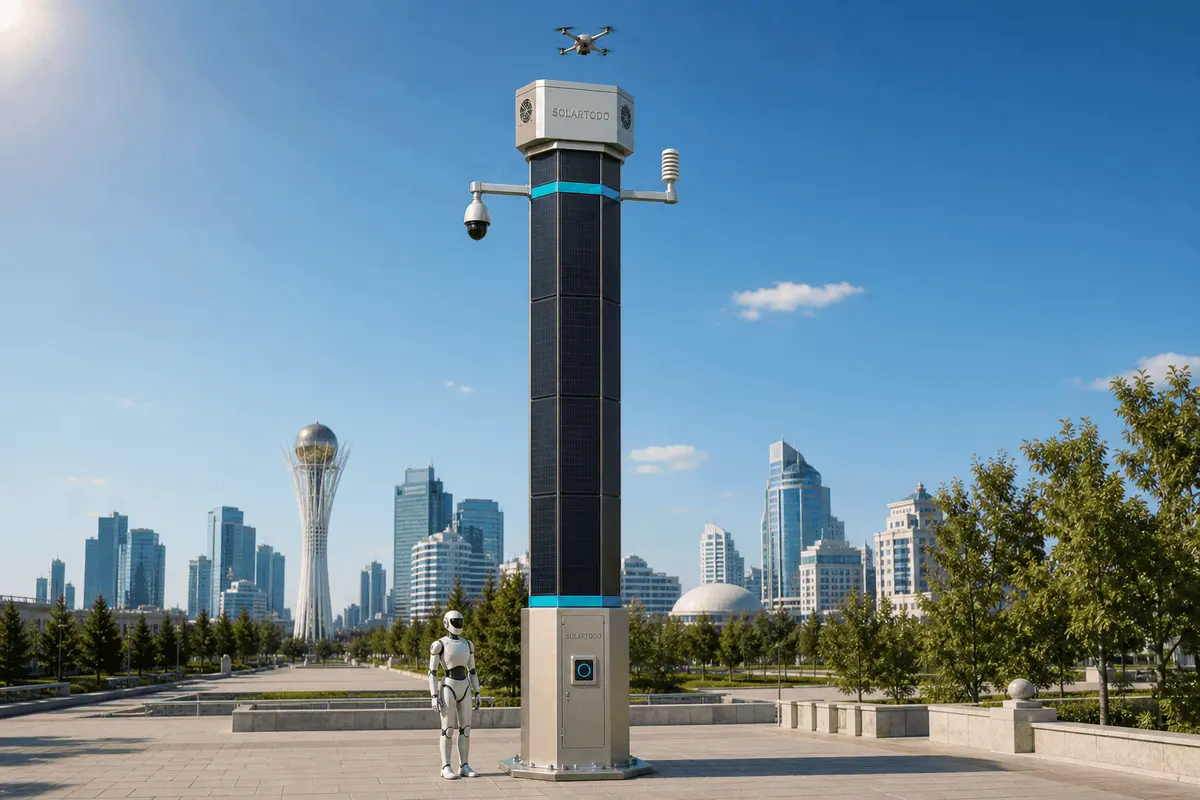
Astana’s 1.5M+ population, -14°C January profile, and 73-node corridor model make SOLARTODO Sentinel a strong off-grid edge-AI pole fit for 2.5 km smart-city coverage.
Key Takeaways
Answer Capsule: A 73-node SOLARTODO Sentinel layout at 35 m spacing can monitor about 2.5 km of Astana corridor without claiming a past deployment.
- 73 nodes: A straight-line design creates 72 intervals, or about 2,520 m of distributed sensing coverage.
- 35 m spacing: The spacing supports overlapping visual perception, environmental sensing, drone service zones, and maintenance access.
- 1.5M+ residents: According to Kazakhstan’s Bureau of National Statistics (2025), Astana exceeded 1.5 million residents, supporting district-scale edge infrastructure.
- -14°C winter baseline: January averages near -14°C require battery thermal control, sealed enclosures, wind-load checks, and winter maintenance planning.
- 2.8-3.2 kWp PV nameplate: The pole should be modeled as solar-replenished, not solar-unlimited, with winter derating applied.
- 5-20 kWh battery class: Storage should be sized by drone sorties, robot charging, edge compute, sensor load, and cold-weather reserve.
- 9 environmental variables: Wind speed, wind direction, temperature, humidity, pressure, noise, PM10, PM2.5, and illuminance should be measured locally.
- Metadata-first governance: Raw video should remain on the pole; only de-identified events, alarms, health data, and mission metadata should leave the node.
Astana Market Fit
Answer Capsule: Astana’s 1.5M+ population, 810 km² area, and severe winter climate make distributed edge-AI poles more practical than central CCTV backhaul alone.
Astana should be treated as a city-edge physical-AI market, not a conventional streetlight upgrade market. According to Kazakhstan’s Bureau of National Statistics (2025), Astana had more than 1.5 million residents, creating demand for scalable monitoring across government districts, transport approaches, campuses, industrial zones, and public perimeters.
Climate is a decisive engineering constraint. Public climate records place Astana near -14°C in January, with recurring severe cold, snow, wind exposure, and freeze-thaw cycles. That means each SOLARTODO Sentinel City AI Pole should be specified for enclosure sealing, low-temperature batteries, conservative foundations, and maintainable winter access.
According to the IEA (2023), global grids must add or refurbish about 80 million km of lines by 2040. That grid-pressure context supports off-grid, battery-backed monitoring nodes where trenching, utility interconnection, or heavy centralized backhaul would slow deployment.
Recommended SOLARTODO Configuration
Answer Capsule: The recommended Astana design uses 73 SOLARTODO Sentinel City AI Pole nodes at 35 m spacing for about 2.5 km of monitored frontage.
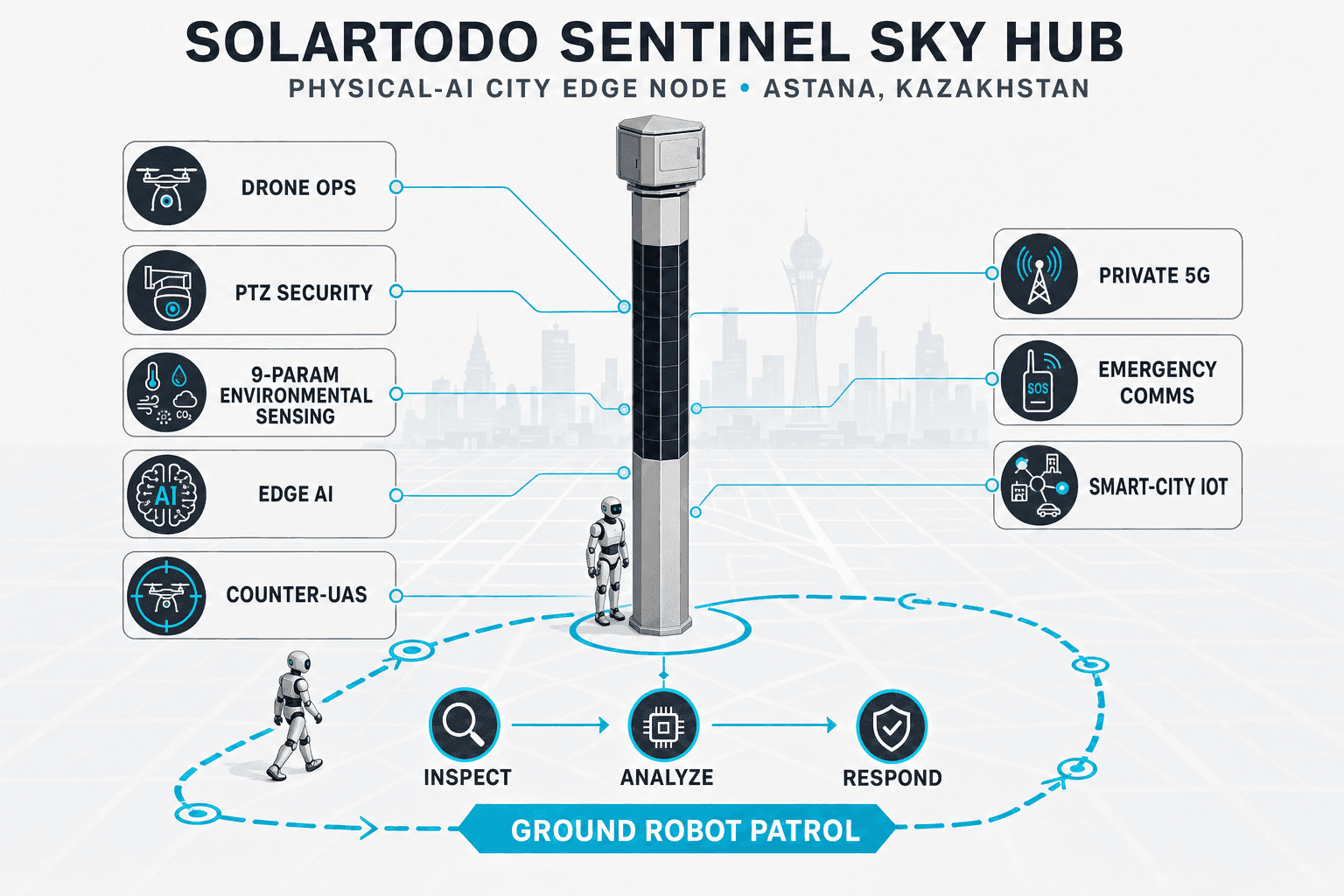
The recommended configuration is a pure smart pole platform with no lighting system. It should host sensing, Jetson-class edge inference, drone service workflows, ground-robot coordination, environmental monitoring, communications, and human-authorized incident response.
A 73-node straight corridor has about 72 spacing intervals. At 35 m per interval, the monitored frontage is approximately 2,520 m before route curves, access breaks, radio constraints, and civil engineering adjustments are applied.
According to IEEE (2019), IEEE 2413 provides an architectural framework for IoT systems, which is relevant because Sentinel nodes combine sensing, compute, communications, energy storage, and operations logic. The practical design goal is local autonomy first, with command visibility second.
Technical Specifications
Answer Capsule: Each Sentinel node should combine 2.8-3.2 kWp PV nameplate, 5-20 kWh storage, 9 environmental channels, and local AI inference.
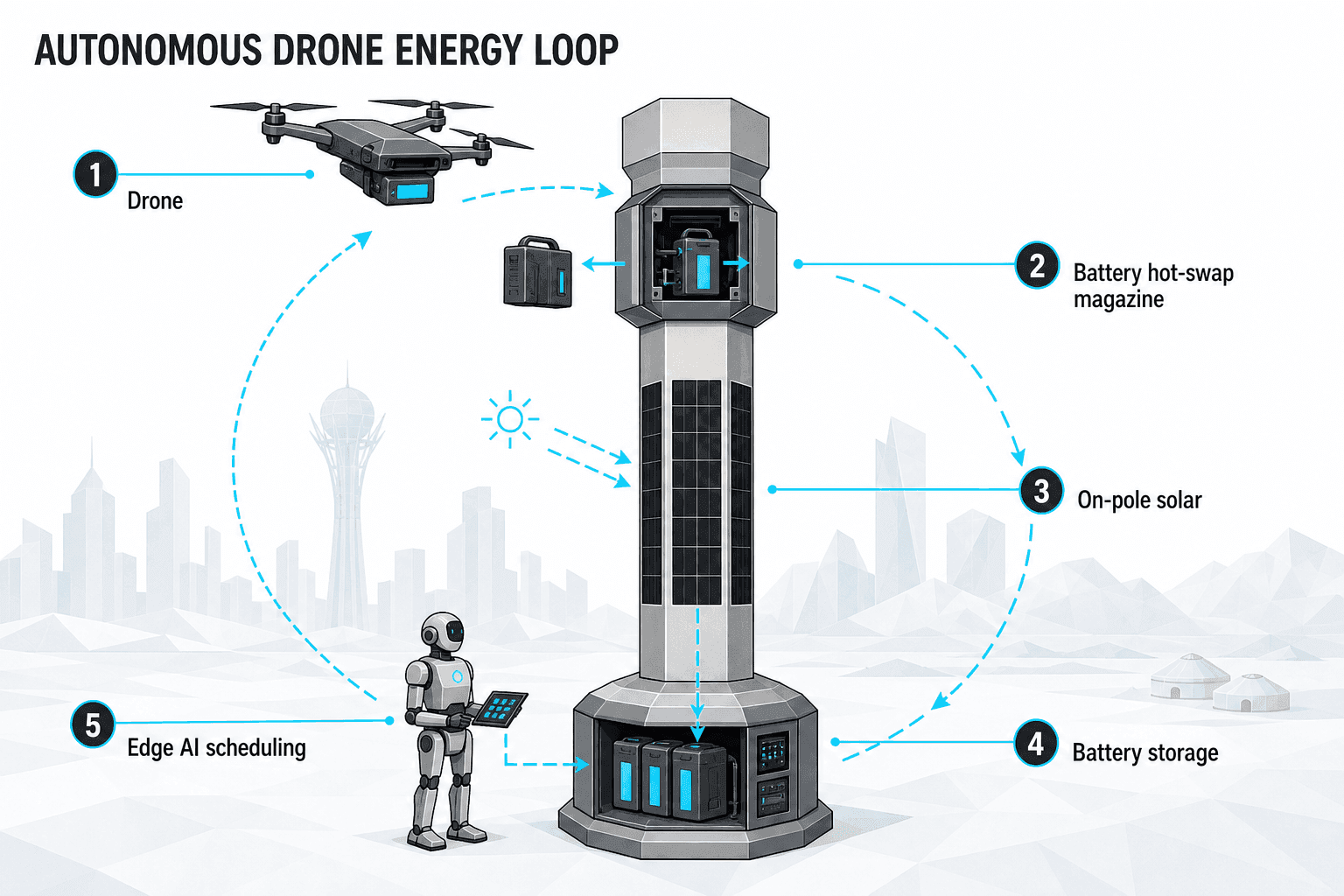
Energy architecture should be fully off-grid, using on-pole photovoltaic replenishment plus battery-backed operation. The 2.8-3.2 kWp PV layer should be modeled conservatively, with realistic high-irradiance output around 1.0-1.3 kW DC peak and about 7-10 kWh/day under favorable conditions.
According to NREL (2024), PV performance depends on irradiance, temperature, system losses, soiling, shading, and array geometry. For Astana, that means snow cover, winter sun angle, battery derating, and service access must be included before procurement.
The sensing package should support anonymous vehicle count, crowd-density estimation, intrusion detection, and perimeter awareness. It should not be positioned as active face recognition or licence-plate recognition unless a separate legal, privacy, and procurement process approves those functions.
According to IEC (2019), IEC 62443-4-2 defines technical security requirements for industrial automation and control system components. Sentinel procurement should therefore include identity management, least privilege, secure update handling, logging, segmentation, and vulnerability response expectations.
Comparison Table
Answer Capsule: Compared with CCTV poles, telecom poles, and solar lights, a 73-node Sentinel network adds robotics, edge AI, storage, and local metadata control.
| Option | Typical Purpose | Off-Grid Operation | Edge AI | Drone/Robot Support | Environmental Sensors | Best Fit |
|---|---|---|---|---|---|---|
| Existing CCTV pole | Video mounting | Usually no | Limited | No | Rare | Low-cost camera extension |
| Solar streetlight | Illumination | Sometimes | No | No | Rare | Lighting corridors |
| Telecom monopole | Communications | Usually grid-tied | No | No | No | Carrier coverage |
| Utility pole | Power distribution | No | No | No | No | Electrical networks |
| SOLARTODO Sentinel City AI Pole | Physical-AI edge node | Yes | Yes | Yes | 9 channels | Smart-city, campus, perimeter, industrial monitoring |
The main distinction is operational scope. SOLARTODO Sentinel is not a lamp pole, telecom tower, or power structure; it is an edge-compute micro-station for sensing, autonomy support, and command coordination.
Implementation Plan
Answer Capsule: A 73-node Astana rollout should be planned over 10-16 weeks after survey, foundation design, logistics confirmation, and acceptance-test approval.
Implementation should start with a route survey, GNSS control, 35 m spacing validation, sightline checks, snow-clearance review, radio-backhaul planning, and soil/foundation confirmation. Civil design should account for frost depth, wind load, service-vehicle access, and pole erection sequencing.
A practical deployment can move in lots of 10-15 poles per crew cycle. Each lot should complete anchor templates, battery commissioning, pole erection, communications activation, local inference tests, drone service workflow tests, robot charging checks, and environmental sensor verification.
According to IEC (2021), IEC 61724-1 defines photovoltaic system performance monitoring classes. Acceptance should therefore include PV output telemetry, state-of-charge behavior, inverter/controller logs, operating temperature records, and winter-maintenance assumptions.
Privacy, Cybersecurity, and C-UAS Limits
Answer Capsule: Sentinel should process raw data locally across 73 nodes, exporting only de-identified metadata and keeping C-UAS response human-authorized.
Raw video and sensor streams should remain on the pole for local inference. The upstream command layer should receive only de-identified events, alarms, health status, mission logs, and control metadata, reducing bandwidth needs and privacy exposure.
According to IEC (2022), IEC 60529 classifies enclosure ingress protection against dust and water. Astana specifications should therefore require tested IP ratings rather than generic “weatherproof” language.
Counter-UAS capability should be limited to detection, tracking, coordination, and human-authorized non-lethal response. Acceptable modes include friendly-drone soft net capture or close-approach deterrence; autonomous attack, RF/GNSS jamming, hard-kill effects, and destructive measures should be excluded.
Pricing and Procurement Model
Answer Capsule: Buyers should price 73 nodes through FOB Supply, CIF Delivered, or EPC Turnkey tiers, with battery size and robotics modules driving cost.
SOLARTODO should quote the Astana configuration in three tiers: FOB Supply for equipment ex-works China, CIF Delivered for freight and insurance, and EPC Turnkey for installed and commissioned delivery with warranty. A 73-node project should also separate civil works, customs, winter foundation requirements, batteries, drone modules, robot docks, and software integration.
According to IRENA (2023), renewable capacity added in 2022 reduced power-sector fuel costs by at least USD 520 billion globally. That supports the economic logic of distributed solar-replenished infrastructure, but Sentinel ROI should still be modeled mainly against patrol reduction, faster incident response, avoided trenching, and avoided grid connection.
Frequently Asked Questions
1. How much does a 73-node SOLARTODO Sentinel project cost?
Pricing depends on the selected tier, battery size, drone service module, robot charging option, communications package, foundation design, and installation scope. SOLARTODO should quote FOB Supply, CIF Delivered, and EPC Turnkey separately. For Astana, buyers should also budget for winter civil works, customs handling, radio survey, commissioning, operator training, and maintenance spares.
2. What are the core technical specifications?
A typical node uses a non-lighting smart pole form with 2.8-3.2 kWp PV nameplate, 5-20 kWh battery storage, Jetson-class edge compute, PTZ visual sensing, 9 environmental channels, communications, and robotics support. The 73-node layout uses about 35 m spacing, creating roughly 2.5 km of monitored frontage before site-specific route adjustment.
3. Does the pole need city power or trenching?
No city power is required in the target configuration. The system is designed as an off-grid micro-station with battery storage and on-pole solar replenishment. Trenching may still be needed for special fiber, grounding, foundations, or site-specific civil constraints, but the standard energy model avoids routine grid interconnection at every node.
4. How long would installation take in Astana?
A 73-node rollout should typically be planned over 10-16 weeks after engineering approval. The schedule includes survey, spacing validation, foundation design, logistics, customs planning, pole erection, battery commissioning, radio testing, sensor calibration, drone workflow checks, robot charging tests, and operator handover. Winter works may extend the schedule.
5. What logistics model should buyers choose?
FOB Supply fits buyers with their own freight, import, and installation teams. CIF Delivered fits buyers who want equipment delivered with ocean freight and insurance included. EPC Turnkey is best when the buyer wants SOLARTODO or its project partner to manage installation, commissioning, acceptance testing, and warranty handover under one delivery scope.
6. What warranty is realistic?
The EPC Turnkey tier should include a 1-year standard warranty unless the quotation specifies longer terms. Battery packs, drone mechanisms, robot charging contacts, sensors, and moving parts may require separate service conditions. Buyers should define spare-part stock, response time, firmware support, winter inspection intervals, and acceptance-test records before signing.
7. How is it different from cameras on existing poles?
Existing poles normally provide a mounting point, not a managed edge-AI micro-station. SOLARTODO Sentinel adds off-grid power, battery buffering, local inference, environmental sensing, drone service workflows, robot charging, health telemetry, and metadata-first command integration. That makes it suitable for monitored corridors where utility access and patrol coverage are limited.
8. Can it support counter-UAS missions?
Yes, but only within non-lethal and human-authorized limits. The pole can support detection, tracking, event classification, command coordination, and friendly-drone response workflows such as soft net capture or close-approach deterrence. It should not be specified for autonomous attack, destructive effects, RF jamming, GNSS jamming, or unapproved spectrum activity.
9. Does radar come built into the pole?
No. Radar should be treated as an optional partner-sensor input, not native pole hardware. If radar is required, the project must confirm spectrum rules, physical mounting, data interface, power load, environmental rating, and command integration. The Sentinel pole can consume radar events, but the base configuration remains visual, environmental, compute, robotics, and communications focused.
10. What maintenance interval should Astana use?
A quarterly inspection cycle is a practical baseline for batteries, seals, fasteners, sensors, PV surfaces, drone magazines, robot charging alignment, firmware logs, and environmental calibration drift. Winter conditions may require additional checks after heavy snow, freezing rain, severe wind, or repeated freeze-thaw events. Maintenance planning should include safe access routes.
11. What ROI should buyers model?
ROI should be modeled against avoided trenching, reduced manual patrol hours, faster event triage, lower response latency, fewer blind spots, and better environmental awareness. It should not be modeled as electricity export revenue. The strongest business case is operational resilience across a 2.5 km monitored corridor, campus, industrial perimeter, or critical-infrastructure zone.
12. What standards should procurement reference?
Procurement should reference IEC 62443 for industrial cybersecurity, IEC 60529 for enclosure ingress protection, IEC 61724-1 for PV performance monitoring, IEC 61215/61730 for PV module performance and safety, and IEEE 2413 for IoT architecture. Local Kazakhstan permitting, privacy law, spectrum rules, and civil engineering requirements remain mandatory.
References
- Kazakhstan Bureau of National Statistics (2025): Astana population reported above 1.5 million residents.
- IEA (2023): Electricity Grids and Secure Energy Transitions reports about 80 million km of grid additions or refurbishment needed by 2040. https://www.iea.org/reports/electricity-grids-and-secure-energy-transitions
- NREL (2024): PVWatts guidance models PV output using irradiance, temperature, losses, soiling, shading, and array geometry. https://pvwatts.nrel.gov/
- IEC (2019): IEC 62443-4-2 defines technical security requirements for industrial automation and control system components. https://webstore.iec.ch/
- IEC (2021): IEC 61724-1 defines photovoltaic system performance monitoring classes. https://webstore.iec.ch/
- IEC (2022): IEC 60529 defines ingress-protection classification for enclosures. https://webstore.iec.ch/
- IEEE (2019): IEEE 2413 provides an architectural framework for Internet of Things systems. https://standards.ieee.org/
- IRENA (2023): Renewable capacity added in 2022 reduced global power-sector fuel costs by at least USD 520 billion. https://www.irena.org/
Equipment Deployed
- Approximately 73 SOLARTODO Sentinel City AI Pole edge-node poles in Sky Hub pole form
- Typical spacing of about 35 m between nodes, subject to site survey and engineering confirmation
- Fully off-grid on-pole solar replenishment with battery-backed storage for scheduled duty cycles
- Integrated environmental monitoring for wind speed, wind direction, temperature, humidity, atmospheric pressure, noise, PM10, PM2.5, and illuminance
- Jetson-class on-pole edge AI compute for local inference, workload scheduling, and event metadata generation
- PTZ-based security sensing for anonymous vehicle count, crowd density, intrusion, and perimeter awareness
- Autonomous drone operations workflow including launch, patrol, inspection, return, battery hot-swap, and task redeployment
- Ground robot support for patrol, inspection, alarm response, air-ground coordination, and return-to-base wireless charging
- Human-authorized non-lethal C-UAS coordination using detection, tracking, soft net-capture, or close-approach deterrence
- Common-operating-picture workflow for sensing, assessment, edge scheduling, field operation, and maintenance coordination