Almaty Winter-Foothill Smart Streetlight Fit: 9m Hybrid Pole Configuration for 30m Urban Spacing
Summary
Almaty's 2.36 million residents, 851m elevation, and 2026 plan for 12,000 new luminaires make a 148-unit, 9m hybrid Smart Streetlight fit for 30m urban corridors needing backup grid tie.
Key Takeaways
Almaty Smart Streetlight planning should prioritize 9m hybrid poles, 30m spacing, winter battery reserve, and procurement compatibility with Kazakhstan lighting standards.
- A typical 148-unit deployment would cover about 4.4km at 30m spacing, using 9m octagonal tapered steel poles.
- Each pole should carry 2 × 80W LED heads at 4000K and 150 lm/W, giving 24,000 lm per pole.
- Hybrid autonomy should use 2 × 100W monocrystalline panels, a 300W Savonius VAWT, and 10kWh LFP storage.
- The lower 2.2m should be the integrated 7kW Type 2 AC EV charging cabinet, not a separate roadside pillar.
- Almaty city reported 12,000 new luminaires planned for 2026, plus 2,000 poles and 126km of lighting lines.
- Kazakhstan's grid context includes KEGOC assets from 0.4kV to 1150kV and substations from 35kV to 1150kV.
- At 43.24 latitude and 851m elevation, Almaty needs winter-rated batteries, sealed electronics, and snow-accessible maintenance doors.
Market Context for Almaty
Almaty is a dense inland foothill city of 2.36 million people where lighting upgrades must address winter lows, old corridors, and municipal automation.
According to Kazakhstan's Bureau of National Statistics (2026), Almaty city had 2,362,463 residents as of May 1, 2026, making it the country's largest urban market by population. According to Kazhydromet (2026), the Almaty weather station is at 43.23 latitude, 76.93 longitude, and 851m above sea level, which matters for wind exposure, freeze-thaw foundation design, and maintenance access. The city is inland, not coastal, so the main enclosure risk is not salt spray; the harder issues are winter icing, dust from dry periods, foothill runoff, and dense streets with mature trees.
According to the Almaty Akimat (2026), the city plans to install about 12,000 new luminaires, 2,000 poles, and 126km of lighting lines in 2026, after reporting more than 12,000 luminaires installed in 2025. A separate Almaty Akimat update (2025) said outdoor lighting work included 45,000 replaced luminaires, 3,000 new poles, and roughly 500km of cable from early 2024. These figures show a municipal program that is not simply buying lamps; it is rebuilding control cabinets, lines, and coverage on previously dark streets.
Grid and agency context is also specific. According to KEGOC (2026), Kazakhstan's national grid assets span 0.4-1150kV lines, while substations include the 35-1150kV range; streetlight feeders normally interface downstream through low-voltage distribution and control cabinets, not directly on transmission corridors. Almaty's centralized outdoor lighting operator is GKP on REM Almaty Kala Zharyk under the city akimat, so technical submissions should align with municipal procurement, district akimat coordination, and future Smart Lighting interfaces.
Kazakhstan standards are relevant to market access. ST RK 3056-2017 covers LED luminaires for indoor and outdoor applications including streets, roads, squares, tunnels, interchanges, residential, and recreational spaces. EAEU TR CU 004/2011 applies to low-voltage equipment safety across the Eurasian Economic Union, while IEC 60598-1:2024 covers luminaires up to 1,000V. IEC states, "general safety requirements for luminaires," which is the right compliance baseline for the LED and electrical assembly.
Recommended Technical Configuration
A typical 148-unit Almaty Smart Streetlight deployment should use 9m hybrid poles at 30m spacing for urban streets, transit stops, and civic corridors.
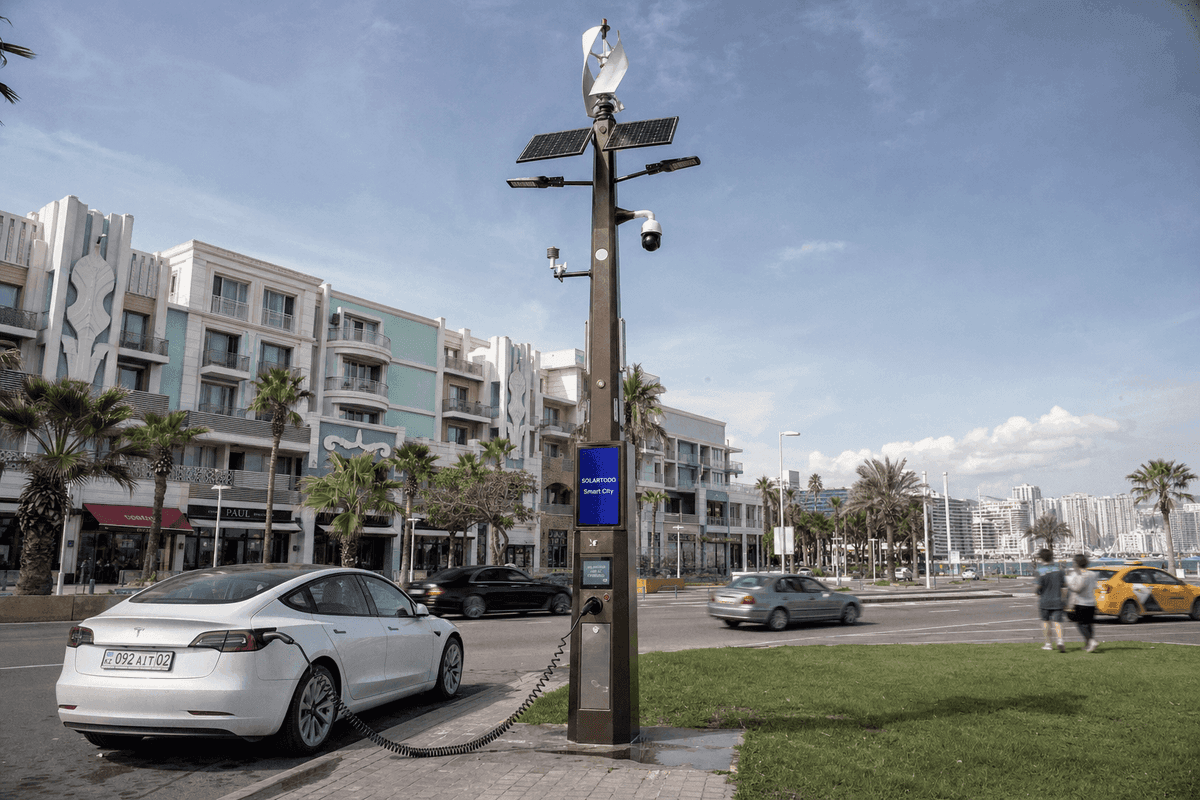
For Almaty's profile, the correct size class is a city-street Smart Streetlight, not a highway pole and not a park bollard. The recommended SOLARTODO configuration is Smart Streetlight variant hybrid12 adapted to 9m: approximately 148 units of octagonal tapered steel poles, each base Ø45cm to top Ø15cm, finished in antique bronze RAL8011. This height supports twin road luminaires, camera sightlines, environmental sensing, WiFi 6/5G gateway equipment, and an integrated 7kW AC charger without creating the visual bulk of a transmission or highway structure.
The Almaty-specific rationale is practical. In dense streets such as older central corridors and tree-lined sidewalks, the twin 1.5m arms with +8 degrees upward tilt help push light past canopy edges while keeping the pole body in the pedestrian zone. In foothill-adjacent districts, the hybrid wind-solar system reduces dependence on newly trenched supply where cable routes are constrained by slopes, drainage, and utility congestion. Grid backup remains necessary because winter production can be lower and EV charging loads should not rely on renewable generation alone.
A typical 148-unit deployment would cover about 4.4km at 30m spacing, subject to photometric design, junction geometry, driveway spacing, and utility-clearance review. For procurement packages, SOLARTODO should position the lower 2.2m pole-as-charger as a single welded steel structure, because separate EV pillars increase sidewalk clutter and complicate snow-clearing. The integrated design is particularly relevant in Almaty, where municipal lighting, pedestrian safety, and streetscape modernization are being handled together.
Technical Specifications
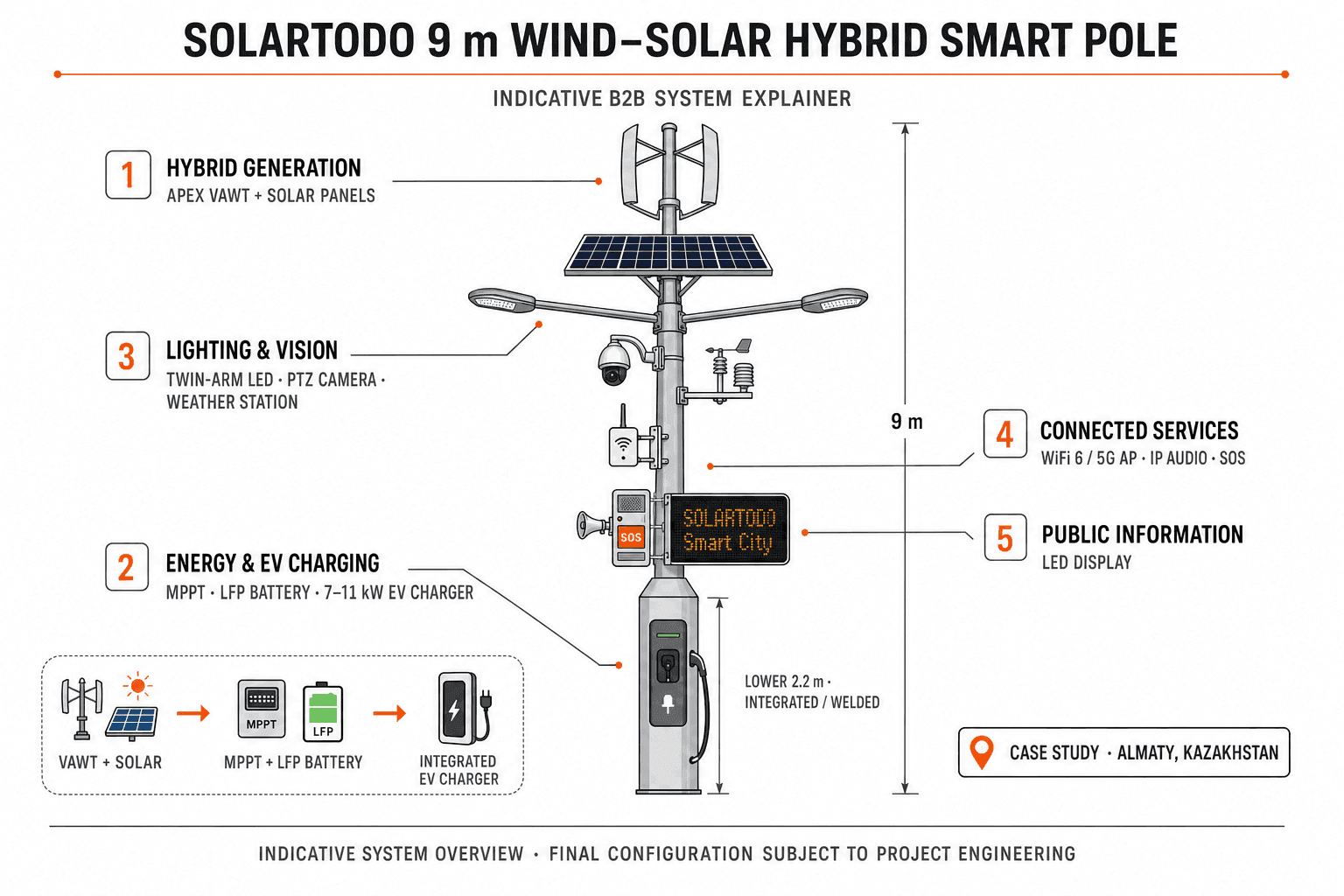
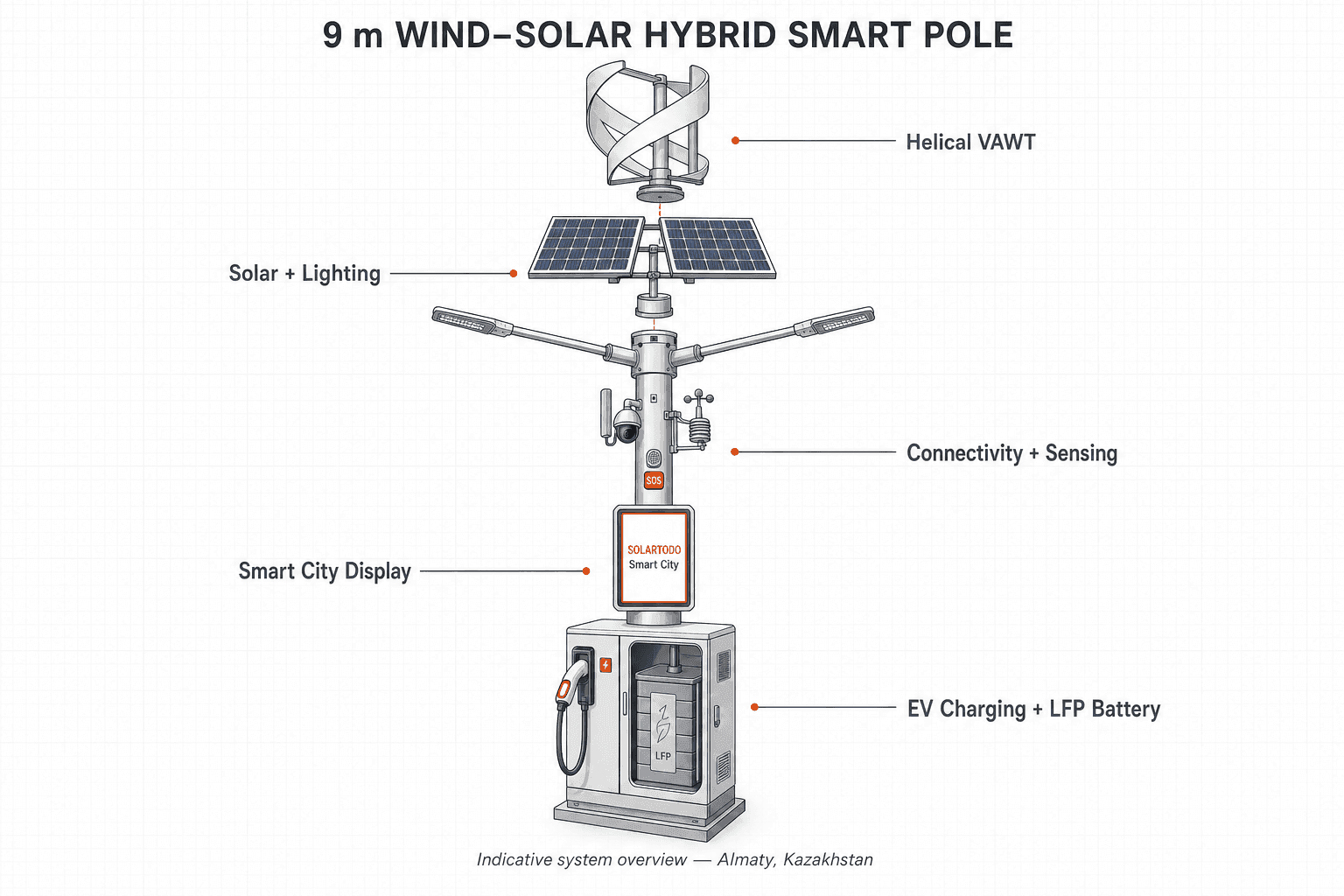
The Almaty configuration uses 148 hybrid 9m poles, each combining 160W LED lighting, 200W solar, 300W VAWT, 10kWh LFP, and 7kW AC charging.
- Pole structure: 9m octagonal tapered steel smart pole, base Ø45cm to top Ø15cm, antique bronze RAL8011.
- Integrated charger body: lower 2.2m of the pole is the EV charging cabinet, welded as one continuous steel structure.
- Wind generation: Savonius bucket VAWT with 2 curved scoops, Ø60 × 90cm, 300W, with red aviation LED.
- Solar generation: 2 × 100W monocrystalline deep-black panels on 15-degree A-frame brackets, symmetric east-west pair.
- Battery and controller: 10kWh LFP battery inside pole base, MPPT controller, and backup grid tie.
- LED lighting: twin symmetric 1.5m arms with +8-degree upward tilt, 2 × 80W LED, 4000K, 150 lm/W.
- Camera: 22cm white PTZ dome, 360-degree rotation, 25x zoom, IR 150m, mounted on a 50cm L-bracket outrigger.
- Sensor: top 4-parameter environmental sensor for temperature, humidity, wind speed, and noise.
- Public address: 1 × 30W/93dB TCP/IP IP audio column, Ø10 × 50cm, flush against flat pole face and color-matched.
- Emergency interface: SOS, panic alarm, camera linkage, and emergency broadcast trigger.
- EV charging: 7kW single-gun AC charger, Type 2 connector, OCPP 1.6J, 5m coiled cable, touchscreen, E-stop, and maintenance door.
- Display: P5 vertical LED screen, 1280 × 2560mm portrait, above 5000 cd/m2, content limited to "SOLARTODO Smart City" in white sans-serif on deep blue.
- Communications: flush WiFi 6 plus 5G gateway at 8.7m, GbE uplink, LoRaWAN, color-matched housing with continuous paint boundary.
- User power: USB-C PD 30W and USB-A charging.
- Standards basis: IEC 60598, GB/T 37024, IEC 62196-2, plus Kazakhstan low-voltage and outdoor lighting compliance review.
According to IEC (2024), IEC 60598-1 applies to luminaires operating from supply voltages up to 1,000V. According to the official Kazakhstan standards catalogue (2017), ST RK 3056-2017 applies to LED luminaires for streets, roads, squares, tunnels, interchanges, open industrial areas, residential areas, and recreational facilities. These standards do not replace local design approvals, but they define the technical evidence a buyer should expect in a SOLARTODO submittal.
Implementation Approach
A 148-unit Almaty rollout should be phased over 4-6 work packages covering survey, approvals, CKD delivery, foundations, erection, and commissioning.
The first phase is corridor survey. Engineers would map 30m pole positions against driveways, bus stops, trees, overhead utilities, district heating routes, drainage paths, and snow-clearing equipment paths. Almaty's foothill topography means foundations should be reviewed for frost depth, slope runoff, and localized landslide or seismic conditions; the World Bank's Natural Disaster Hotspots work identifies earthquake and landslide as high regional risks for Almaty.
The second phase is technical approval and procurement packaging. Documents should separate structural calculations, luminaire photometrics, low-voltage electrical drawings, EV charger compliance, communications topology, and OCPP platform integration. According to Almaty Akimat (2025), the city's automation work included replacement of 320 lighting control cabinets and a target to update 70% of 1,100 cabinets by year-end, so smart poles should be designed to communicate with both legacy cabinets and future centralized controls.
The third phase is logistics and installation. CKD shipping is practical for 9m tapered steel poles because pole shafts, arms, panels, VAWT assemblies, displays, and electronics can be packed separately and assembled near the corridor. The installation sequence would normally be foundations and conduits first, then pole erection, grid tie, device fit-out, charger testing, luminaire aiming, camera commissioning, WiFi/5G gateway activation, LoRaWAN controller registration, and cloud platform acceptance.
Expected Performance & ROI
The recommended 148-unit system can deliver 23.68kW of LED load, 1.48MWh of battery storage, and about 4.4km of smart corridor coverage.
Energy performance should be modeled rather than claimed as a past result. The connected lighting load is 148 × 160W, or 23.68kW before dimming. If operated for an average 11 hours per night, the undimmed annual lighting energy would be about 95MWh; adaptive dimming and occupancy schedules can reduce that, while cameras, gateways, display, and charger standby add separate loads.
The ROI case in Almaty is strongest when multiple budgets are consolidated. One pole supports lighting, surveillance, public address, emergency SOS, WiFi 6, 5G-ready backhaul, environmental monitoring, USB charging, digital civic display, and Type 2 EV charging. According to the IEA (2022), Kazakhstan generates more than 70% of its electricity from coal, so every kWh avoided through efficient 150 lm/W LED optics and dimming has both operating-cost and emissions relevance. IEA states, "more than 70% of its electricity from coal," which supports efficiency-first procurement.
For payback, buyers should use scenario analysis instead of a single headline number. In a municipal corridor, payback typically depends on avoided trenching, avoided separate camera and EV pedestals, reduced maintenance truck rolls, advertising or civic-display value, and energy savings versus sodium or metal-halide lighting. For Almaty's tender environment, the integrated cabinet and modular electronics may matter as much as energy savings because serviceability and contractor accountability have been visible municipal issues.
Results and Impact
A typical 148-unit Almaty project would be evaluated by coverage, uptime, safety functions, cabinet integration, and maintenance response metrics over 12 months.
Expected impact should be framed as forecast performance, not as a completed SOLARTODO deployment. At 30m spacing, 148 poles can support approximately 4.4km of corridor coverage, subject to intersections and setbacks. The 150 lm/W LED package supports lower lighting energy per lumen than legacy sodium luminaires, while the 10kWh battery and grid backup reduce blackout exposure for communications, SOS, and camera functions.
Operationally, the highest value comes from replacing fragmented roadside hardware. A single SOLARTODO pole can remove the need for separate lighting columns, charger pedestals, public-address boxes, camera poles, and WiFi mounts. For Almaty, where public updates emphasize dark-section elimination, lighting control cabinet modernization, and district-level maintenance, that consolidation can reduce interface disputes between electrical, telecom, security, and streetscape contractors.
Comparison Table
The 9m hybrid Smart Streetlight is best suited to Almaty's urban corridors, while 12m grid and cylindrical forms fit different procurement priorities.
| Configuration option | Best Almaty use case | Height / form | Power architecture | Key advantage | Main trade-off |
|---|---|---|---|---|---|
| Recommended hybrid 9m | Dense urban streets and transit corridors | 9m octagonal tapered steel | 200W solar + 300W VAWT + 10kWh LFP + grid backup | Works where trenching and outages are concerns | More components to maintain |
| Grid 12m | Broad arterials with stable feeders | 12m octagonal tapered steel | Grid-powered AC | Strong for high-load EV and displays | Less resilient during feeder outages |
| Cylindrical CIGS | Premium CBD streetscape | Ø180/200/315/400mm seamless cylinder | Wrapped CIGS plus grid/controls | Flush premium visual design | Higher fabrication complexity |
| Standard 6-12m | Basic LED modernization | 6-12m galvanized modular pole | Grid or simple hybrid | Lower integration complexity | Less differentiated smart-city value |
Pricing & Quotation
SOLARTODO provides 3 quotation models for Almaty buyers: FOB Supply, CIF Delivered, and EPC Turnkey with commissioning and a 1-year warranty.
SOLARTODO offers three pricing tiers for this product line: FOB Supply (equipment ex-works China), CIF Delivered (including ocean freight and insurance), and EPC Turnkey (fully installed, commissioned, with 1-year warranty). Volume discounts are available for large-scale deployments. Configure your system online for an instant estimate, or request a custom quotation from our engineering team at [email protected].
For Almaty, quotation inputs should include corridor length, pole spacing, foundation class, grid availability, winter temperature design basis, EV charger certification needs, cloud hosting requirements, and whether the LED display is civic-only or revenue-enabled. SOLARTODO can prepare a technical bill of materials for contact us review without representing the analysis as a completed local project.
Frequently Asked Questions
These 10 Almaty Smart Streetlight answers cover 148-unit sizing, 9m pole selection, 30m spacing, EV charging, maintenance, payback, warranty, and installation.
Q1: Why is a 9m Smart Streetlight recommended for Almaty instead of a 12m pole? A 9m pole fits dense urban streets, sidewalks, transit approaches, and tree-lined corridors better than a 12m arterial pole. The recommended unit still supports twin 80W luminaires, a PTZ camera, WiFi 6/5G gateway, 10kWh battery, and integrated 7kW EV charging. For highways or wide arterials, 12m-plus traffic poles should be evaluated separately.
Q2: How many poles would a typical Almaty corridor require? At the specified 30m spacing, approximately 148 units cover about 4.4km before allowances for intersections, medians, driveways, and restricted foundations. Final quantities require a photometric layout and utility survey. SOLARTODO should present the 148-unit figure as a typical deployment scale, not as a completed or contracted installation in Almaty.
Q3: What makes the EV charger design different from a separate roadside charger? The lower 2.2m of the steel pole is the 7kW Type 2 AC charging cabinet, welded into one continuous structure. This reduces sidewalk clutter, avoids a separate charger pedestal, and simplifies streetscape coordination. The unit includes OCPP 1.6J, touchscreen, E-stop, maintenance door, 5m coiled cable, USB-C PD 30W, and USB-A.
Q4: Can the hybrid power system work through Almaty winters? The hybrid system is designed to support resilience, not full winter independence under every load. Each pole includes 2 × 100W solar panels, a 300W Savonius VAWT, 10kWh LFP storage, MPPT control, and backup grid tie. Winter commissioning should set priority loads so lighting, SOS, camera, and communications stay available before discretionary loads.
Q5: What maintenance plan is realistic for this configuration? A practical plan uses quarterly visual inspection, semiannual electrical and communications checks, annual battery health reporting, and event-based service after storms or outage alarms. The PTZ camera, IP audio column, LED display, charger, and gateway should be monitored remotely. Snow access to the lower maintenance door must be preserved in the civil layout.
Q6: How should Almaty buyers compare ROI against ordinary LED poles? Ordinary LED poles mainly reduce lighting energy. The SOLARTODO Smart Streetlight adds EV charging, camera coverage, SOS, public address, WiFi 6, 5G-ready communications, environmental sensing, and civic display functions. ROI should compare total corridor infrastructure cost, not only lamp wattage, because separate camera poles, charger pedestals, and communication cabinets can duplicate foundations and maintenance.
Q7: What is the expected deployment timeline for 148 units? A typical 148-unit project can be planned in 4-6 work packages: survey, technical approvals, manufacturing, CKD shipping, foundations, erection, commissioning, and acceptance testing. Actual duration depends on Almaty permits, winter construction windows, cable trenching, grid tie availability, and whether traffic management is required for each corridor segment.
Q8: Which standards should be requested in the technical submittal? The submittal should include IEC 60598 for luminaires, GB/T 37024 for smart pole functionality, IEC 62196-2 for Type 2 EV charging interfaces, and applicable Kazakhstan or EAEU low-voltage conformity documents. For Kazakhstan, ST RK 3056-2017 is relevant for LED lighting products used in streets, roads, squares, tunnels, interchanges, residential areas, and recreational facilities.
Q9: Does SOLARTODO provide EPC pricing for Almaty? SOLARTODO can quote FOB Supply, CIF Delivered, or EPC Turnkey. EPC scope normally includes installation, commissioning, and a 1-year warranty, but the exact commercial value depends on foundations, trenching, grid connection, customs route, local contractor scope, and acceptance testing. Buyers should request a priced bill of materials through the configurator or contact page.
Q10: What warranty and spare-parts assumptions should be used? For planning, use a 1-year turnkey warranty as stated in the SOLARTODO quotation model, with spare parts defined for LED drivers, charge controllers, communication modules, charger components, fans or thermal interfaces, and display modules. Battery warranties should be confirmed separately because LFP life depends on depth of discharge, temperature profile, and charge-control settings.
References
These 7 references support Almaty's population, climate, lighting program, grid context, standards, and Kazakhstan energy assumptions used in this guide.
- Bureau of National Statistics of Kazakhstan (2026): Regional statistics list Almaty city population at 2,362,463 persons as of May 1, 2026. https://stat.gov.kz/en/region/?param=POPULATION
- Kazhydromet (2026): Almaty climate page gives weather-station coordinates 43.23, 76.93 and elevation of 851m, with 1991-2020 climate normals. https://www.kazhydromet.kz/ru/klimat/almaty
- Almaty Akimat (2026): Municipal lighting plan includes about 12,000 new luminaires, 2,000 poles, and 126km of lighting lines in 2026. https://www.gov.kz/memleket/entities/almaty/press/news/details/1198446?lang=ru
- Almaty Akimat (2025): Outdoor lighting modernization report cites 45,000 replaced luminaires, 3,000 new poles, 500km of cable, and cabinet automation work. https://www.gov.kz/memleket/entities/almaty/press/news/details/992807?lang=ru
- KEGOC (2026): Kazakhstan grid assets include overhead lines in the 0.4-1150kV range and substations in the 35-1150kV range. https://www.kegoc.kz/ru/electric-power/deyatelnost-kompanii/
- IEC (2024): IEC 60598-1:2024 specifies general safety requirements for luminaires operating from supply voltages up to 1,000V. https://webstore.iec.ch/en/publication/66620
- IEA (2022): Kazakhstan generates more than 70% of its electricity from coal and needs efficiency and flexibility in its power system. https://www.iea.org/news/kazakhstan-has-set-out-ambitious-and-welcome-clean-energy-transition-plans-but-must-overcome-historical-reliance-on-fossil-fuels-iea-review-says
Equipment Deployed
- 148 units × 9m octagonal tapered steel smart pole, base Ø45cm to top Ø15cm, antique bronze RAL8011
- Lower 2.2m integrated 7kW Type 2 AC EV charging cabinet, OCPP 1.6J, 5m coiled cable, touchscreen, E-stop
- Savonius bucket VAWT, 2 curved scoops, Ø60 × 90cm, 300W, red aviation LED
- 2 × 100W monocrystalline deep-black solar panels on 15-degree A-frame brackets
- 10kWh LFP battery inside pole base with MPPT controller and backup grid tie
- Twin 1.5m symmetric arms with +8-degree tilt and 2 × 80W LED luminaires, 4000K, 150 lm/W
- 22cm white PTZ dome camera, 360-degree rotation, 25x zoom, IR 150m, 50cm L-bracket
- 4-parameter top environmental sensor for temperature, humidity, wind speed, and noise
- 30W/93dB TCP/IP IP audio column, Ø10 × 50cm, flush color-matched mounting
- P5 vertical LED screen, 1280 × 2560mm portrait, above 5000 cd/m2, SOLARTODO Smart City content only
- Dual-mode WiFi 6 + 5G gateway with GbE uplink and LoRaWAN at 8.7m
- USB-C PD 30W plus USB-A charging interface