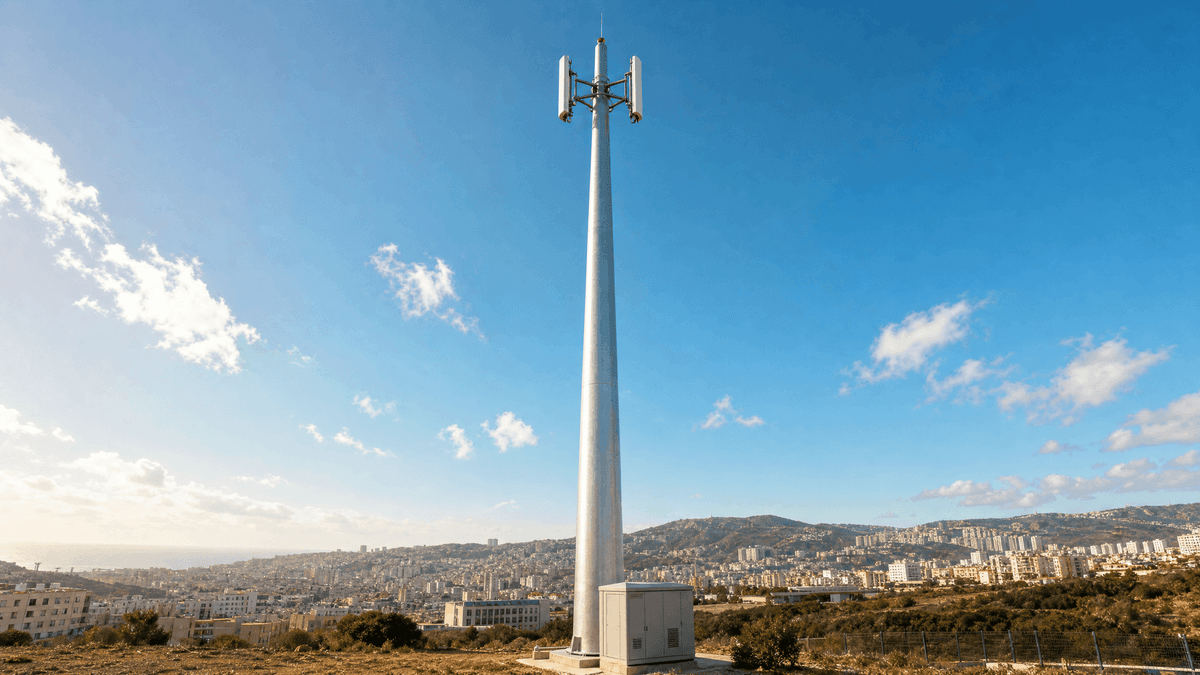
Algiers Telecom Tower Market Analysis: 20m Urban Macro Configuration Guide for 73-Site Rollout Planning
Summary
Algiers combines high urban density, coastal wind exposure, and rising mobile data demand, making a 20m steel Telecom Tower a practical urban macro option. For a typical 73-site rollout profile, recommended specifications include Q345 hot-dip galvanized steel, Wind Class 2 at 50 m/s, and drilled pier foundations.
Key Takeaways
A 20m steel Telecom Tower configuration aligns with dense urban macro coverage in Algiers, where approximately 3.9 million residents live in the province and land availability is constrained in built-up districts.
- A typical 73-unit deployment profile in Algiers would use 20m tapered steel monopoles, matching the 15-25m urban infill class and supporting macro coverage where rooftop rights or plot size are limited.
- The specified tower mass of about 7t per tower equals 350 kg/m, which is technically consistent for a 20m telecom monopole and below the heavier 500 kg/m rule-of-thumb upper range for taller macro poles.
- For Algiers coastal exposure, Wind Class 2 at 50 m/s with factor 1.15 is a practical baseline under TIA-222-H, especially for open corridors and elevated districts.
- The recommended antenna set of 3 panel antennas + 1 microwave dish + RRU + small cell fits a mixed urban macro/backhaul role without moving into the heavier 25-35m suburban class.
- A concrete pier foundation is suitable for many constrained city plots because drilled pier construction reduces excavation footprint compared with large pad foundations.
- CKD shipping cuts transport volume by 60-70%, which matters for port handling through Algiers logistics chains and for moving sections into dense streets with crane access limits.
- A standard manufacturing window of 30-45 days supports phased procurement, while a 30-year design life and hot-dip galvanizing reduce long-term corrosion maintenance in low-corrosion urban zones.
- SOLAR TODO should be evaluated against local permitting, rooftop alternatives, and municipal aviation-lighting requirements before finalizing a 73-site bill of quantities.
Market Context for Algiers
Algiers is Algeria's largest metropolitan concentration, and its telecom tower requirement is shaped by population density, coastal topography, and high mobile usage rather than by wide rural spacing. According to the World Bank (2023), Algeria's urban population exceeds 74% of total population, and the Office National des Statistiques, Algeria, reports that Algiers Province has roughly 3.9 million residents, creating sustained demand for urban macro and infill telecom infrastructure.
According to the International Telecommunication Union (ITU) (2023), mobile broadband growth across MENA continues to increase pressure on urban networks, especially in capital regions where smartphone penetration and data use are highest. In Algiers, this means operators often need compact macro structures in the 15-25m range rather than very tall greenfield towers above 35m, because zoning, visual impact, and limited plots constrain site geometry.
Climate also matters. Algiers has a Mediterranean coastal climate with winter storms, salt-laden air near the shoreline, and dense construction inland. According to Meteo Algerie climate summaries and World Bank Climate Knowledge Portal data, coastal Algeria faces seasonal gusting and humidity patterns that make galvanizing and grounding quality more important than in dry interior provinces. For that reason, a low-corrosion classification can still justify hot-dip galvanizing on Q345 steel and a full grounding plus lightning package.
The city context supports monopoles over lattice towers in many districts. A tapered steel monopole uses a smaller footprint, presents a simpler permit profile, and can be lifted in sections where lane closures are short. For Algiers, that is relevant around mixed residential and commercial corridors where a 20m urban macro pole can fill coverage gaps without the land take associated with a 35-45m highway/peri-urban structure.
Local standards and international telecom practice also support this direction. According to TIA-222-H, antenna-supporting structures should be checked for wind, ice where relevant, serviceability, and appurtenance loading. GB/T 50233 further guides transmission and tower construction quality in fabrication and erection control, making it a useful companion standard for export supply and installation QA.
The market implication is straightforward: in Algiers, a typical urban macro program would favor moderate-height monopoles with mixed radio and microwave loading, fast logistics, and drilled foundations. This is the profile where SOLAR TODO's Telecom Tower line fits best, provided final geotechnical and municipal checks confirm the assumed soil and setback conditions.
Recommended Technical Configuration
A typical 73-unit Algiers deployment profile would use 20m hot-dip galvanized steel monopoles with 7t tower weight, 50 m/s wind design, and drilled pier foundations for compact urban macro coverage.
The correct engineering class for this configuration is the 15-25m size class, which the product matrix assigns to rooftop/urban infill applications with 1 platform and 3-6 panel antennas at 8-15t per tower. The project-specific requirement is 20m and about 7t per tower, which is slightly lighter than the generic class band but still credible because the actual loading is moderate and the pole is specified as a tapered monopole in Q345 steel, not a heavy multi-sector rural tower.
A typical 73-unit deployment of this scale in Algiers would consist of the following baseline arrangement:
- 20m tapered steel monopole tower
- Hot-dip galvanized Q345 steel
- Wind Class 2: 50 m/s, factor 1.15
- Low-corrosion zone design assumption
- 3 panel antennas + 1 microwave dish + RRU + small cell
- Concrete pier (drilled pier) foundation
- 3 antenna platforms
- Climbing ladder, cable tray, aircraft warning light, grounding system, lightning rod, safety cage
- 30-year design life
- CKD shipment with 60-70% volume reduction
- Production lead time of 30-45 days
- Compliance target: TIA-222-H / GB/T 50233
This specification fits Algiers for three reasons. First, 20m is tall enough for urban macro propagation over mid-rise obstacles in many districts without moving into the permit and crane burden of 30-40m poles. Second, the antenna package combines sector coverage, microwave backhaul, and small-cell support, which is practical where fiber access is uneven across neighborhoods. Third, drilled pier foundations reduce the site footprint, which matters on constrained roadside parcels and fenced utility plots.
The microwave dish is particularly relevant in Algiers because backhaul availability can vary by district. According to GSMA (2023), urban network quality increasingly depends on backhaul resilience as 4G and 5G traffic rises. A 3-sector + 1 dish + RRU + small cell arrangement gives operators flexibility to support macro coverage and local capacity at the same site rather than splitting the requirement into two structures.
SOLAR TODO should therefore be assessed as a compact urban macro option rather than a rural high-rise tower option in Algiers. If the target area shifts toward expressways, ports, or peri-urban expansion zones, the specification would likely move upward into the 25-35m or 35-45m class with heavier steel mass and different foundation geometry.
Technical Specifications
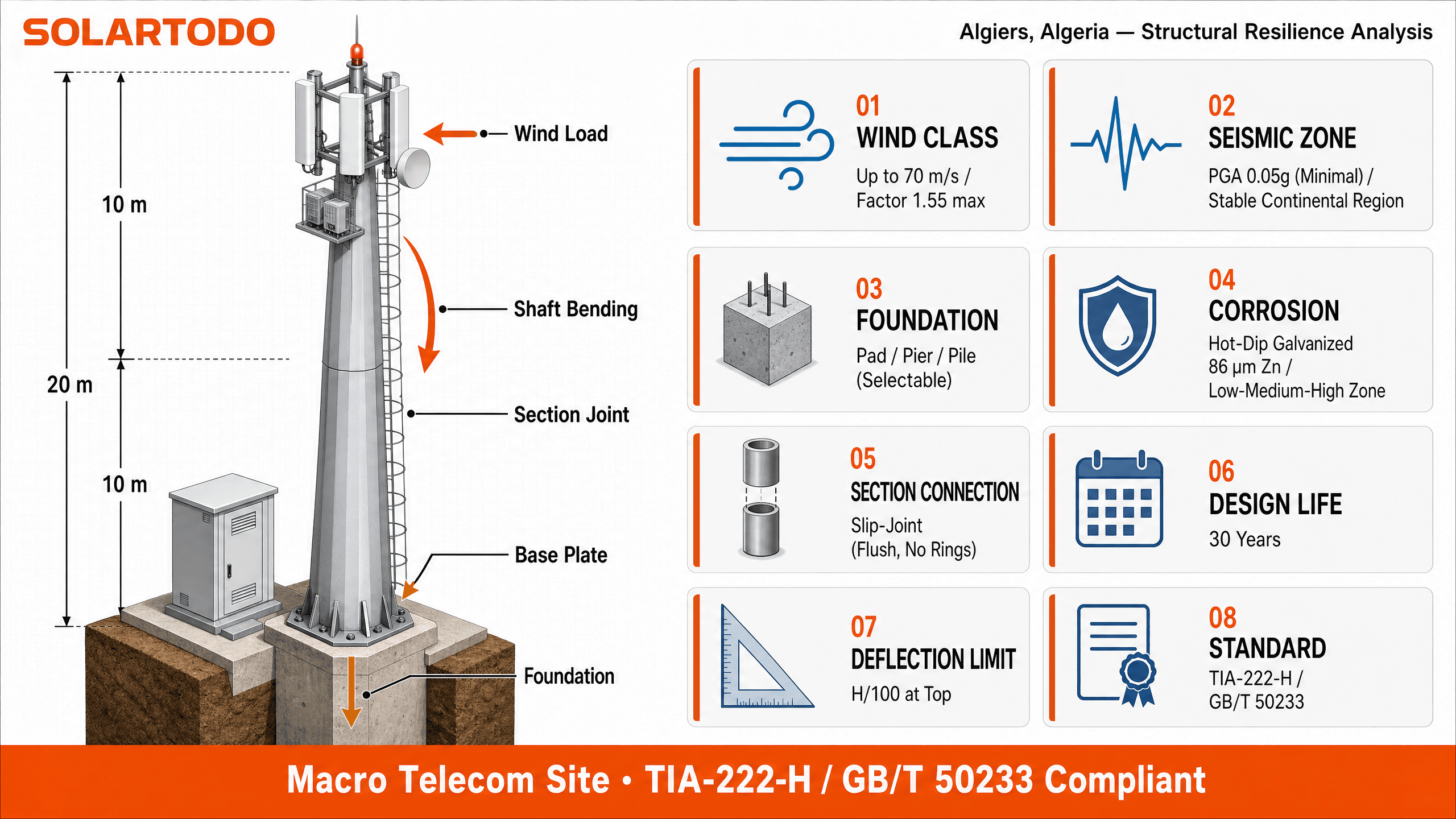
The specified Algiers configuration centers on a 20m Q345 steel monopole with 7t unit weight, 50 m/s wind resistance, drilled pier foundation, and 30-year design life under TIA-222-H and GB/T 50233.
- Product type: Steel monopole Telecom Tower
- Form: Tapered steel monopole, sectional bolt-on construction
- Height: 20m
- Application class: Urban macro site
- Material: Q345 hot-dip galvanized steel
- Tower weight: Approximately 7t per tower
- Weight ratio: 350 kg/m, acceptable for a 20m telecom monopole
- Wind class: Class 2
- Basic wind speed: 50 m/s
- Wind factor: 1.15
- Corrosion zone: Low
- Antenna load: 3× panel antennas + 1× microwave dish + RRU + small cell
- Platforms: 3 antenna platforms
- Foundation type: Concrete pier (drilled pier)
- Accessories: Climbing ladder, cable tray, aircraft warning light, grounding system, lightning rod, safety cage
- Design life: 30 years
- Shipping mode: CKD, with 60-70% volume reduction versus fully assembled shipment
- Production lead time: 30-45 days
- Standards: TIA-222-H / GB/T 50233
From a size-class perspective, the 20m height sits inside the 15-25m urban infill band, which is the correct class for dense city deployment. The standard table for this band indicates 3-6 panel antennas and 8-15t per tower as a common envelope. The Algiers profile uses 3 panels plus one microwave dish, so the loading remains within a practical urban monopole range even with the added RRU and small-cell hardware.
According to TIA-222-H, appurtenance loading and wind exposure category must be checked together, not as isolated values. That matters because a 50 m/s wind requirement on a coastal city monopole is driven not only by pole height but also by dish area, panel drag, mounting offsets, and local terrain. GB/T 50233 adds erection and construction quality controls that are useful for bolt torque, verticality, and galvanized surface inspection.
The Telecommunications Industry Association states, "This Standard provides minimum requirements for the structural design and analysis of antenna supporting structures and antennas." That is the correct design basis for this Algiers configuration. The ITU also states, "Broadband infrastructure is a foundational enabler of the digital economy," which supports the market case for urban macro densification in capital cities.
Implementation Approach
A 73-site Algiers rollout would typically move through 5 phases over 4-8 months, from survey and geotechnical checks to CKD delivery, drilled pier construction, erection, and RF commissioning.
Phase 1 is site screening and permitting. For 73 candidate sites, the operator or EPC contractor would normally review zoning setbacks, rooftop alternatives, utility conflicts, and aviation-light requirements. In Algiers, this stage should also screen for road-closure constraints because a 20m monopole section delivery is easier than a 35m class pole but still requires crane positioning and traffic management.
Phase 2 is geotechnical investigation and structural verification. Even with a standard concrete pier foundation, borehole and soil bearing data remain necessary because urban fill conditions can vary significantly within 1-3 km. Foundation diameter, embedment depth, anchor cage design, and rebar schedule should be finalized only after geotechnical review, especially where underground utilities or retaining walls are nearby.
Phase 3 is fabrication and logistics. The specified production window is 30-45 days, which supports a phased batch schedule such as 20 + 20 + 33 units. CKD shipment reduces transport volume by 60-70%, which helps both ocean freight efficiency and inland movement through tight urban approaches. For SOLAR TODO, CKD also simplifies staged unloading and reduces the need for oversized transport permits compared with one-piece poles.
Phase 4 is civil works and erection. Drilled pier construction is typically sequenced first, followed by anchor cage setting, concrete curing, and flange alignment checks. After curing, monopole sections, platforms, cable trays, ladder systems, and lightning rods are installed. For a 20m tower, erection windows are shorter than those for 30m+ structures, but urban safety controls remain strict because of adjacent pedestrians, traffic, and overhead services.
Phase 5 is integration and acceptance. This includes grounding resistance measurement, plumbness verification, galvanizing inspection, bolt torque checks, antenna mounting, feeder or hybrid cable routing, and warning-light testing. RF commissioning then confirms sector alignment, microwave path clearance, and handover performance. A practical acceptance package should reference TIA-222-H, local municipal approvals, and operator-specific telecom standards.
Expected Performance & ROI
A 20m urban macro Telecom Tower in Algiers would typically improve coverage continuity and backhaul flexibility while targeting a 15-30 year asset life and lower logistics cost through 60-70% CKD volume reduction.
For network performance, the main value is structural support for a mixed radio package rather than tower height alone. A 3-sector + 1 microwave dish + RRU + small cell arrangement can support macro coverage, local capacity, and non-fiber backhaul on one pole. According to GSMA (2023), mobile data traffic in MENA continues to rise sharply, so operators increasingly value sites that can host both coverage and capacity layers without duplicating civil works.
From a cost-of-ownership perspective, monopoles often reduce land take, fencing area, and visual impact relative to lattice alternatives in cities. According to NREL (2022), lifecycle cost analysis for infrastructure should include logistics, installation time, maintenance access, and asset life rather than capex alone. In Algiers, CKD shipping with 60-70% volume reduction can lower freight inefficiency, while a 30-year design life spreads structural cost over multiple radio upgrade cycles.
Maintenance intervals are also relevant to ROI. A hot-dip galvanized Q345 monopole in a low-corrosion zone should generally require routine visual inspection rather than major steel treatment in early years, assuming coating thickness, drainage, and grounding are correct. Typical inspection programs include annual visual checks and more detailed structural review every 3-5 years, with bolt re-torque and corrosion spot checks after severe wind events.
Payback is operator-specific, so a fixed number would be misleading without tenancy, lease model, and ARPU data. A practical procurement view is that ROI improves when one 20m monopole replaces multiple fragmented assets such as a separate microwave pole, a rooftop frame, and a street-level small-cell mast. In dense districts, this consolidation can reduce permitting complexity, shorten maintenance routes, and improve uptime if the tower is designed with proper cable management and grounding.
Results and Impact
For Algiers, the likely impact of a 73-site 20m monopole program is better urban coverage continuity, faster site delivery through 30-45 day production cycles, and lower transport friction from CKD shipment.
The strongest practical result is network densification without moving into oversized tower classes. A 20m urban macro pole can fit districts where 30-45m structures would face stronger visual, zoning, or crane-access resistance. This makes the configuration suitable for capital-city infill and corridor strengthening rather than rural blanket coverage.
A second impact is deployment efficiency. Drilled pier foundations and sectional flanged construction support repeatable installation methods across a multi-site program. For procurement teams, that means more predictable steel, concrete, and erection scopes across approximately 73 units. For operations teams, the standard accessory package simplifies maintenance planning over a 30-year design life.
A third impact is upgrade flexibility. The specified load set already includes RRU and small cell support, so the tower can host a mixed access strategy rather than a single legacy radio layer. That matters in Algiers, where capacity pressure is likely to remain concentrated in dense mixed-use districts over the next 5-10 years.
Comparison Table
The table below compares the recommended 20m Algiers monopole profile with alternative tower classes that may be considered during site planning.
| Configuration | Height | Typical Use in Algiers | Antenna Load | Approx. Tower Weight | Foundation | Wind Basis | Fit Assessment |
|---|---|---|---|---|---|---|---|
| Recommended urban macro monopole | 20m | Dense urban macro / infill | 3 panels + 1 microwave + RRU + small cell | ~7t | Concrete pier | 50 m/s, Class 2 | Best fit for constrained city sites |
| Taller suburban monopole | 30m | Residential edge / wider cell radius | 6 panels + 1 microwave + 3 RRU | 15-18t | Pier or pad | 50-60 m/s | Useful where fewer sites are available |
| Highway/peri-urban monopole | 40m | Ring road / port corridor / peri-urban | 6 panels + 2 microwave | 22-30t | Pad or pile | 60-70 m/s | Too large for many central districts |
| Rooftop steel frame alternative | 6-12m mast over roof | Spot infill only | 3 panels, limited dish loading | Building-dependent | Building structure | Building-dependent | Faster in some zones, but weaker standardization |
Pricing & Quotation
SOLAR TODO offers three pricing tiers for this product line: FOB Supply (equipment ex-works China), CIF Delivered (including ocean freight and insurance), and EPC Turnkey (fully installed, commissioned, with 1-year warranty). Volume discounts are available for large-scale deployments. Configure your system online for an instant estimate, or request a custom quotation from our engineering team at [email protected].
Frequently Asked Questions
A 20m Q345 steel Telecom Tower for Algiers is usually evaluated on wind rating, antenna loading, foundation type, logistics, maintenance interval, and total installed cost rather than on steel tonnage alone.
Q1: Why is a 20m Telecom Tower recommended for Algiers instead of a 35m or 40m tower?
A 20m pole fits the urban infill class and suits dense districts where plot size, visual restrictions, and crane access are limiting factors. In Algiers, many macro coverage gaps can be addressed with 20m structures, especially when combined with 3 sector antennas, one microwave dish, and a small-cell layer.
Q2: Is 7t a realistic weight for a 20m steel monopole?
Yes. At 7t total weight, the structure averages about 350 kg/m, which is reasonable for a 20m telecom monopole with moderate appurtenance loading. It remains below the heavier upper rule-of-thumb used for taller and more heavily loaded macro poles, so the specification is technically credible.
Q3: Why use a drilled pier foundation in Algiers?
A drilled pier foundation reduces excavation footprint and suits constrained urban plots. It is often preferable where roadside parcels are narrow or where nearby buildings limit large pad excavation. Final pier diameter and depth still depend on geotechnical data, groundwater conditions, and local utility conflicts at each site.
Q4: How long would a 73-site rollout typically take?
A practical program would usually take about 4-8 months depending on permitting, geotechnical approvals, shipping schedule, and utility coordination. Production is typically 30-45 days, but civil works and municipal approvals often determine the overall critical path more than steel fabrication alone.
Q5: What maintenance does this tower type require over 30 years?
Routine maintenance normally includes annual visual inspection, grounding checks, bolt verification, ladder and platform inspection, and warning-light testing. A more detailed structural review every 3-5 years is common. After major wind events, operators should also inspect galvanizing damage, antenna mounts, and any movement at the base flange.
Q6: How does a monopole compare with a lattice tower in central Algiers?
A monopole generally uses less ground area, has a simpler visual profile, and is easier to place on constrained city plots. Lattice towers can carry heavier loads at greater heights, but for a 20m urban macro role in Algiers, the monopole is usually the more practical permitting and logistics option.
Q7: What warranty terms are typical for this product line?
Commercial warranty terms depend on supply scope, but the pricing structure for turnkey projects includes a 1-year warranty. Buyers should also request separate clarification on galvanizing quality, bolt grade, fabrication tolerances, and any exclusions tied to foundation works, third-party installation, or misuse after commissioning.
Q8: Can this tower support future radio upgrades?
Yes, within the approved structural reserve and wind loading envelope. The current configuration already includes 3 panel antennas, one microwave dish, RRU, and a small cell. Any future increase in antenna count, dish size, or mounting eccentricity should be checked by structural recalculation under TIA-222-H.
Q9: What affects ROI most for an Algiers telecom tower project?
ROI usually depends on tenancy, lease model, traffic growth, and whether one tower can combine macro coverage with backhaul and local capacity. Logistics savings from 60-70% CKD volume reduction and lower urban land take can help, but the strongest financial driver is how much network value each site adds.
Q10: What information is needed for an EPC quotation?
A useful quotation package includes site coordinates, geotechnical report, required antenna loading, wind design basis, municipal permit constraints, grounding target, access conditions, and preferred Incoterm. SOLAR TODO can then align steel design, foundation scope, logistics, and installation method to the actual Algiers site profile. For project discussions, contact us.
References
A 20m Algiers Telecom Tower recommendation is best supported by telecom, climate, structural, and urbanization sources rather than by generic product marketing claims.
- World Bank (2023): Algeria urban population data showing urbanization above 74%, supporting dense-city telecom infrastructure demand.
- Office National des Statistiques, Algeria (2023): Algiers Province population statistics of roughly 3.9 million, indicating high concentration of mobile users and site pressure.
- ITU (2023): ICT and mobile broadband development indicators for MENA, supporting urban macro densification and backhaul demand.
- TIA (2022): TIA-222-H, structural standard for antenna supporting structures and antennas, including wind and appurtenance loading requirements.
- GB/T 50233 (latest applicable edition): Construction and acceptance guidance relevant to tower erection quality and installation control.
- GSMA (2023): Mobile Economy MENA, documenting continued mobile data growth and the need for stronger urban network capacity.
- NREL (2022): Infrastructure lifecycle and total-cost analysis guidance, relevant to evaluating logistics, installation, maintenance, and long-term asset value.
- World Bank Climate Change Knowledge Portal (2023): Algeria coastal climate and wind exposure context relevant to corrosion and structural design assumptions.
SOLAR TODO should be assessed against final site-by-site geotechnical data, municipal permit conditions, and operator RF objectives before freezing the bill of materials. For specification review or quotation support, buyers can review the Telecom Tower page or contact us.
Equipment Deployed
- 20m tapered steel monopole Telecom Tower, urban macro class
- Q345 hot-dip galvanized steel structure, approximately 7t per tower
- Wind Class 2 design, 50 m/s basic wind speed, factor 1.15
- Antenna load: 3× panel antennas + 1× microwave dish + RRU + small cell
- Concrete pier (drilled pier) foundation system
- 3 antenna platforms
- Climbing ladder
- Cable tray
- Aircraft warning light
- Grounding system
- Lightning rod
- Safety cage
- CKD shipping configuration with 60-70% volume reduction