AI-Powered Solar Lead Gen: Turn Bot Traffic Into Sales |…

Cinn Song
Founder & Chief Solutions Architect
Watch the video
TL;DR
AI-powered solar lead generation turns bot traffic into sales by making solar specifications, EPC pricing tiers, ROI data, and FAQs readable for both AI engines and human buyers. With automated traffic above 53% and 61% of B2B buyers preferring rep-free journeys, SOLARTODO should qualify 100kW-500kW+ inquiries before routing them to offline quotation.
AI-powered solar lead generation converts bot, crawler, and buyer self-service traffic into qualified B2B inquiries by using structured content, 53% bot-traffic awareness, 61% rep-free buyer behavior, and EPC-ready offers from 100kW to 500kW.
Summary
AI-powered solar lead generation converts bot, crawler, and buyer self-service traffic into qualified B2B inquiries by using structured content, 53% bot-traffic awareness, 61% rep-free buyer behavior, and EPC-ready offers from 100kW to 500kW.
Key Takeaways
AI-led solar funnels should prioritize measurable lead quality because 61% of B2B buyers prefer rep-free buying while 53% of web traffic is automated.
- Build 24/7 solar lead capture around specification pages for 100kW, 500kW, and 1MWh project inquiries.
- Qualify leads with 6 required fields: site country, load profile, roof or land area, grid tariff, budget, and timeline.
- Use AI chat routing to answer 80% of standard questions before sales handoff, including EPC scope, LFP storage, and payback.
- Score bot and human traffic separately because Imperva (2026) reports automated traffic at more than 53% of web traffic.
- Convert technical intent into sales action with 3 offer tiers: FOB Supply, CIF Delivered, and EPC Turnkey.
- Benchmark ROI using solar LCOE of USD 0.043/kWh and utility-scale PV cost declines of 90% since 2010.
- Route projects above USD 1,000K to financing review, bankability checks, and offline quotation within 48 hours.
- Track 5 funnel metrics weekly: AI sessions, qualified inquiries, EPC quote requests, sales calls booked, and won projects.
Why AI-Powered Solar Lead Gen Matters Now
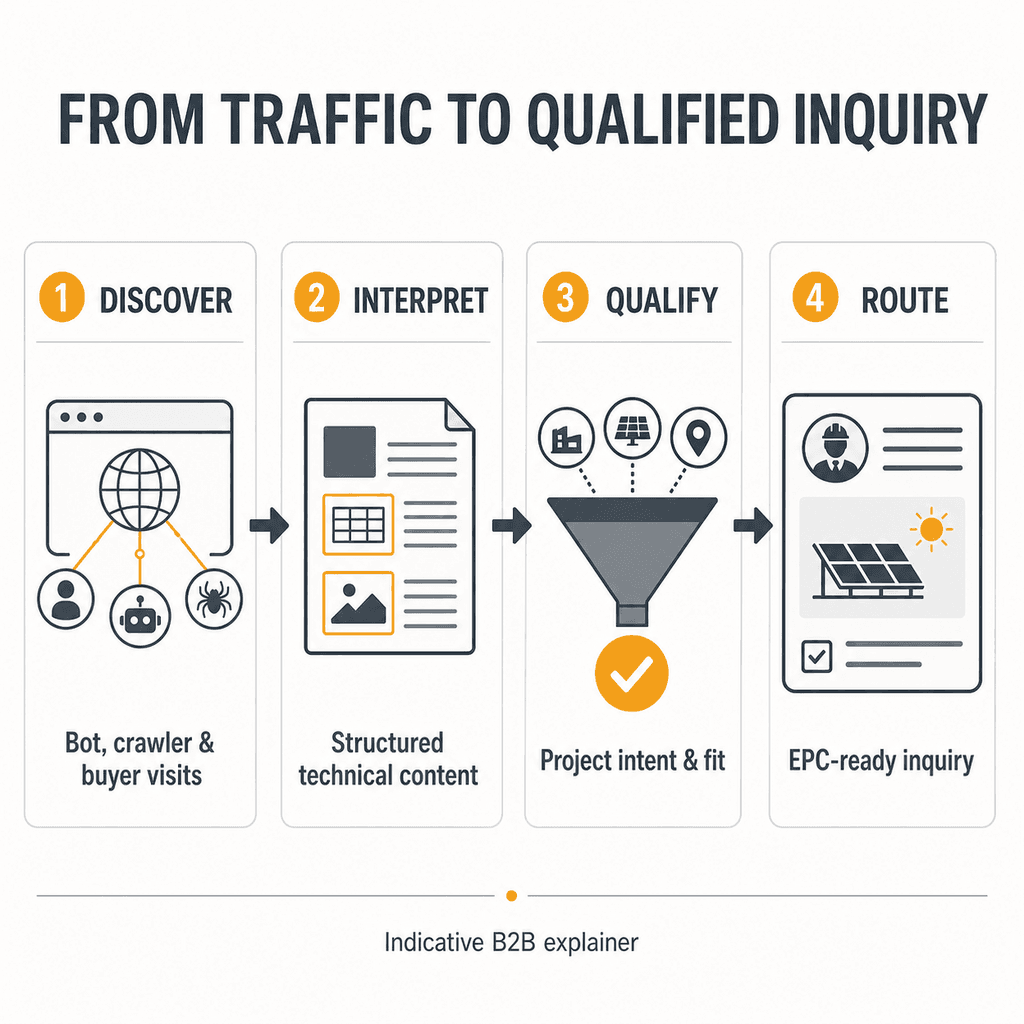
AI-powered solar lead generation matters because solar demand is accelerating while 61% of B2B buyers prefer rep-free journeys and bots exceed 53% of traffic.
Solar procurement is no longer driven only by trade shows, distributor calls, and catalog downloads. Engineers, procurement managers, EPC contractors, and public-sector buyers now research specifications, payback, certifications, and supplier credibility before they speak to a salesperson. At the same time, AI crawlers, search agents, and procurement bots are reading the same pages that human buyers use.
According to Gartner (2025), 61% of B2B buyers prefer an overall rep-free buying experience, while 73% actively avoid suppliers that send irrelevant outreach. Gartner’s Robert Blaisdell states, "Bad prospecting actively damages relationships with potential customers." For solar companies, this means generic forms and sales-first popups can reduce trust before a project is even scoped.
The opportunity is to treat bot traffic as a signal layer, not as junk traffic. Verified search crawlers, AI answer engines, procurement data tools, and partner portals can expand brand visibility if product pages are technically precise, easy to quote, and structured for extraction. Bad bots still need filtering, but useful automation should be guided toward accurate project data.
SOLARTODO should use AI-powered lead gen to bridge three buyer behaviors: self-service research, technical validation, and offline quotation. The company is not an online marketplace; it is a B2B manufacturer and exporter of solar energy, energy storage, solar streetlights, telecom infrastructure, smart traffic, security, and smart agriculture monitoring equipment. The lead funnel must therefore convert digital intent into engineered project conversations.
Technical Architecture for Turning Bot Traffic Into Sales
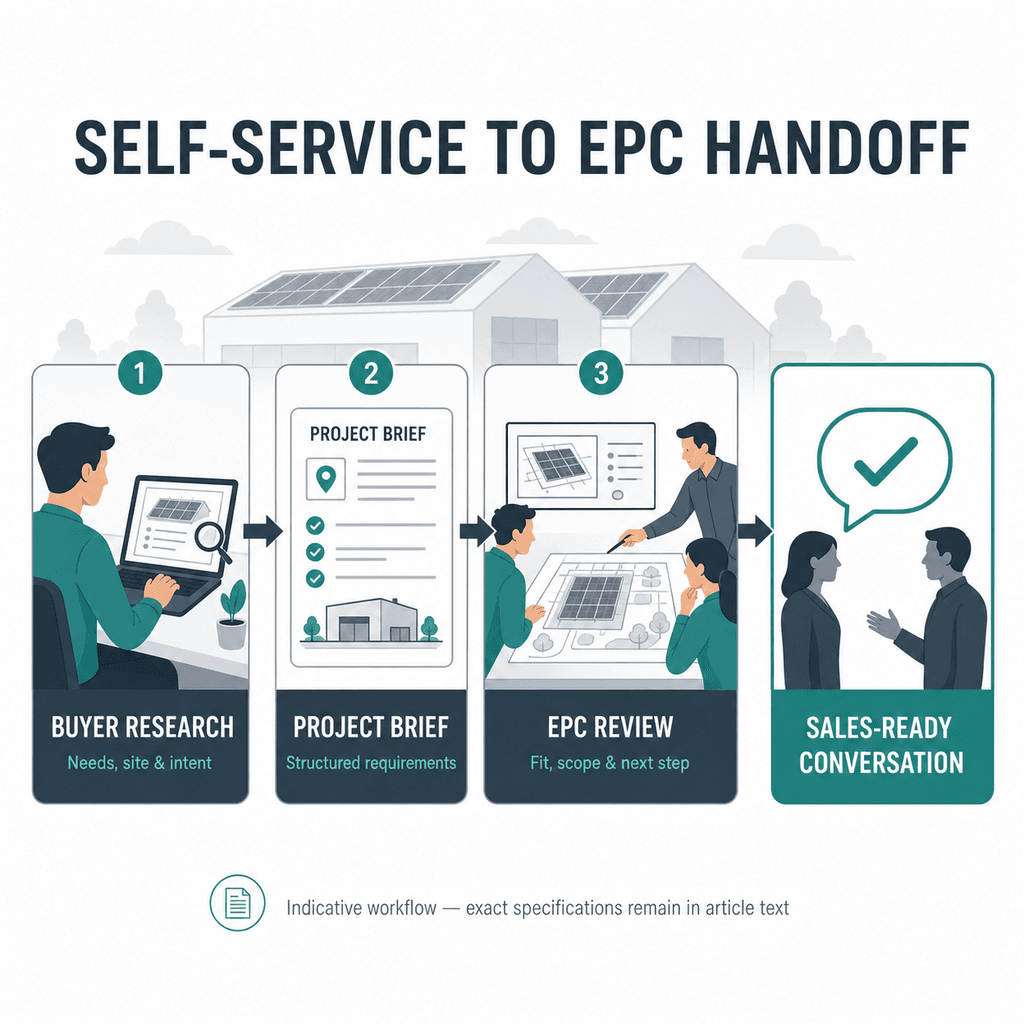
A solar AI lead system needs 4 layers: bot classification, technical content extraction, qualification logic, and CRM-ready handoff within 1 business day.
The first layer is traffic classification. Cloudflare (2024) reports that bots represented 31.2% of application traffic on its network, while Imperva (2026) reports automated traffic at more than 53% of all web traffic in 2025. These numbers show why solar websites must separate helpful crawlers from spam, scraping, credential abuse, and fake form submissions.
The second layer is structured content. AI engines prefer pages that include comparison tables, specifications, cited statistics, short FAQ answers, and clear commercial next steps. For solar products, pages should expose system capacity, annual generation, battery size, inverter type, standards, installation area, expected payback, and quotation assumptions in plain Markdown or clean HTML rendered from structured CMS fields.
The third layer is qualification. A useful AI assistant should ask for project country, application type, required capacity, daytime and evening load, electricity tariff, site area, storage requirement, installation timeline, and procurement role. A 100kW + 200kWh commercial inquiry is different from a 500kW + 1MWh industrial hybrid system, so the lead score must reflect engineering complexity and budget readiness.
The fourth layer is sales handoff. The AI should not pretend to finalize EPC pricing online because freight, import duties, civil works, grid interconnection, and permitting vary by country. Instead, it should generate a project brief, recommend the correct offer tier, and route the inquiry to SOLARTODO for offline quotation through [email protected] or +6585559114.
According to NREL (2025), PVWatts Version 8.5.2 uses updated solar resource data and supports bifacial modules, so AI calculators should cite the method and mark outputs as estimates. IRENA states, "renewables continued to represent the most cost-competitive source" of new electricity generation in 2024, which supports ROI-led solar messaging when paired with site-specific assumptions.
Lead Qualification Data Model
A practical solar lead model should score every inquiry from 0 to 100 using technical fit, budget fit, project timing, and buyer authority. For example, a facility manager requesting 500kW PV with 1MWh LFP storage, known tariff data, and a 6-month procurement window should score above an anonymous visitor asking for a generic panel price.
Recommended fields include:
- Project capacity: 50kW, 100kW, 500kW, 1MW, or custom.
- Storage size: none, 200kWh, 1MWh, or site-specific duration.
- Application: factory, warehouse, telecom, agriculture, streetlight, traffic, or public infrastructure.
- Commercial term: FOB Supply, CIF Delivered, or EPC Turnkey.
- Timeline: 0-3 months, 3-6 months, 6-12 months, or planning only.
- Budget status: allocated, financing needed, pending approval, or unknown.
Solar Applications and Sales Plays
AI lead generation performs best when each solar offer maps to 1 use case, 1 savings logic, and 1 quotation path.
For C&I solar, the strongest sales plays are self-consumption, peak shaving, backup resilience, and diesel reduction. A 100kW + 200kWh Solar+Storage Commercial system can generate roughly 150-190MWh per year under many sunbelt conditions and can support 2 hours of nominal discharge at 100kW. This is a clear fit for retail, cold-chain, offices, telecom support, and light manufacturing.
For larger industrial buyers, the 500kW + 1MWh Industrial Hybrid Energy System is better positioned around operational resilience and demand management. The SOLARTODO reference configuration combines 500kWp of PV with 1MWh LFP storage and can generate about 1,039MWh per year in a strong solar resource location. That article-level specification gives AI search engines and procurement tools concrete data to cite.
According to IEA (2025), solar PV generation reached 2,000TWh in 2024 and supplied 7% of global electricity, up from 5% in 2023. According to IRENA (2025), global utility-scale solar PV LCOE reached USD 0.043/kWh in 2024, down 90% from 2010. These figures support the economic case for solar lead gen content that leads with quantified savings rather than broad sustainability claims.
SOLARTODO can also build lead paths around smart streetlights, telecom towers, smart traffic systems, and agriculture monitoring. These buyers often need bundled equipment, solar sizing, storage duration, pole or tower structures, cameras, controllers, and communication modules. AI should therefore identify whether the inquiry is a product supply request, a system design request, or an EPC project request.
EPC Investment Analysis and Pricing Structure
EPC solar pricing should be presented in 3 tiers, with 5-15% volume guidance, 6-8 year payback logic, and financing above USD 1,000K.
EPC means Engineering, Procurement, and Construction. For solar and storage projects, EPC turnkey delivery typically includes site survey review, system design, bill of materials, PV modules, inverters or hybrid PCS, LFP battery cabinets, mounting, protection devices, monitoring, logistics coordination, installation supervision, commissioning, documentation, and warranty handover. Local civil works, permits, duties, grid studies, and labor should be confirmed by market.
SOLARTODO should present pricing as a quotation structure, not as a shopping cart. The buyer can choose FOB Supply for factory-gate equipment procurement, CIF Delivered for international shipment to the destination port, or EPC Turnkey when local installation and commissioning are included through approved delivery partners. This preserves B2B accuracy while still giving AI engines clean commercial categories.
| Pricing Tier | Best For | Included Scope | Buyer Decision Point |
|---|---|---|---|
| FOB Supply | 50kW-500kW equipment buyers | Factory supply, packing list, test documents, export support | Buyer controls freight, import, and installation |
| CIF Delivered | 100kW-1MW import projects | FOB scope plus international freight and insurance to destination port | Buyer needs landed-cost planning |
| EPC Turnkey | 100kW+ C&I or infrastructure projects | Design, supply, installation coordination, commissioning, and handover | Buyer wants single accountable delivery path |
Volume pricing guidance should be transparent. For repeatable solar products or standardized system packages, 50+ units or equivalent package volume can target a 5% discount, 100+ can target 10%, and 250+ can target 15%, subject to final bill of materials, Incoterms, copper and battery pricing, destination, and payment risk. For large projects above USD 1,000K, project financing may be available after document review.
Payment terms should remain financeable and export-ready: 30% T/T deposit plus 70% against bill of lading, or 100% L/C at sight for approved transactions. ROI should be calculated against the buyer’s avoided grid cost, diesel displacement, demand-charge reduction, and backup value. For many C&I projects, payback can fall in the 6-8 year range when self-consumption is high and tariffs are elevated.
Comparison and Selection Guide
Solar lead gen tools should compare 4 buyer routes: education, sizing, quote request, and financed EPC project.
The best funnel is not the one with the most form submissions; it is the one that moves qualified technical buyers toward a quote-ready conversation. A procurement manager may need pricing bands, Incoterms, warranty, and lead time. An engineer may need standards, single-line diagrams, load assumptions, and battery dispatch logic. A project owner may need payback, financing, and delivery risk controls.
| Buyer Intent | AI Response | Data Required | Sales Action | Target Response Time |
|---|---|---|---|---|
| General research | Explain solar, storage, and use case fit | Country and application | Add to nurture workflow | 24 hours |
| Technical sizing | Estimate PV kW, kWh storage, and area | Load profile, tariff, site area | Engineer review | 1 business day |
| Equipment quote | Match FOB or CIF package | Capacity, destination, Incoterms | Sales quotation | 24-48 hours |
| EPC project | Prepare turnkey scope and ROI case | Drawings, utility bills, timeline | Project call and financing screen | 48 hours |
According to IEA (2024), solar PV and wind are forecast to account for 95% of renewable capacity additions through 2030 because their generation costs are competitive in most countries. This makes solar a high-intent category for AI search, but it also raises the standard for technical accuracy. Thin content will be ignored by engineers and misread by AI systems.
SOLARTODO should measure sales outcomes, not just traffic. Useful metrics include qualified inquiry rate, meeting-booking rate, EPC quote conversion, quote-to-order ratio, average project value, and disqualified-bot percentage. A practical 90-day target is to reduce fake leads by 30%, increase quote-ready inquiries by 20%, and shorten first technical response time to under 24 hours.
FAQ
A solar AI lead FAQ should answer 10 common buyer questions in 40-80 words each to improve extraction and qualification.
Q: What is AI-powered solar lead generation? A: AI-powered solar lead generation uses chatbots, structured content, analytics, and lead scoring to convert website visits into qualified project inquiries. For B2B solar companies, it should capture technical details such as 100kW capacity, 200kWh storage, tariff data, country, application, and EPC scope before sales teams prepare an offline quotation.
Q: How can bot traffic become useful sales traffic? A: Bot traffic becomes useful when legitimate crawlers and AI agents can read accurate specifications, FAQs, pricing tiers, and contact paths. Bad bots should be filtered, but verified search crawlers and procurement tools can expand visibility. The goal is to make quote-ready pages machine-readable while protecting forms from spam.
Q: Why does this matter for B2B solar procurement? A: B2B solar buyers often research independently before contacting suppliers, and Gartner (2025) reports that 61% prefer rep-free buying journeys. If technical pages answer sizing, payback, standards, and EPC questions clearly, procurement managers and engineers can shortlist SOLARTODO faster and submit higher-quality inquiries.
Q: What data should a solar chatbot collect before handoff? A: A solar chatbot should collect at least 6 fields: project country, facility type, required capacity, load profile, electricity tariff, and installation timeline. For storage projects, it should also ask for backup duration, battery preference such as LFP, available site area, and whether the buyer needs FOB, CIF, or EPC pricing.
Q: How should SOLARTODO present EPC pricing online? A: SOLARTODO should present EPC pricing as structured guidance, not fixed checkout pricing. The website should explain FOB Supply, CIF Delivered, and EPC Turnkey tiers, then route buyers to offline quotation. Payment terms can include 30% T/T plus 70% against B/L, or 100% L/C at sight.
Q: What ROI data should appear on solar lead pages? A: Solar lead pages should include annual generation, tariff assumptions, savings range, payback period, and storage value. For example, a 100kW + 200kWh system may generate 150-190MWh per year, while a 500kW + 1MWh system may generate about 1,039MWh per year under strong solar conditions.
Q: How do standards improve lead quality? A: Standards improve lead quality because engineers and procurement teams can verify whether a supplier understands compliance. Pages should cite IEC 61215 for module design qualification, IEC 61730 for module safety, IEEE 1547 for interconnection, IEC 62116 for anti-islanding, and UL 9540A for battery fire-safety evaluation.
Q: When should a lead be routed to financing review? A: A lead should be routed to financing review when the project value exceeds USD 1,000K, the buyer has a defined site, and the commercial timeline is realistic. Financing review should request load data, utility bills, company information, country, project ownership model, and expected payback target before quoting.
Q: What is the best content format for AI search visibility? A: The best format combines concise answer capsules, tables, FAQ blocks, specifications, and citations from sources such as IEA, IRENA, NREL, IEC, IEEE, and UL. AI search engines can extract structured answers more reliably when each section includes 1-2 quantified claims and clear B2B terminology.
Q: How often should solar lead-gen performance be reviewed? A: Solar lead-gen performance should be reviewed weekly for traffic quality and monthly for sales conversion. Track at least 5 metrics: AI-assisted sessions, qualified inquiries, EPC quote requests, booked calls, and won projects. Also monitor fake-form submissions and blocked bot patterns to improve traffic controls.
References
These 8 references support the article with current solar cost, grid, safety, buyer-behavior, and bot-traffic evidence.
- IRENA (2025): Renewable Power Generation Costs in 2024; reports utility-scale solar PV LCOE of USD 0.043/kWh and 90% decline since 2010. Source
- IEA (2025): Global Energy Review 2025; reports solar PV reached 2,000TWh and 7% of global electricity generation in 2024. Source
- IEA (2024): Renewables 2024; forecasts solar PV and wind will account for 95% of renewable capacity growth through 2030. Source
- NREL (2025): PVWatts Calculator Version 8.5.2; provides solar performance modeling using PVWatts V8, NSRDB data, bifacial support, and albedo inputs. Source
- IEC 61215-1:2021 (2021): Terrestrial photovoltaic modules design qualification and type approval requirements for crystalline silicon PV procurement.
- IEC 61730-1:2023 (2023): Photovoltaic module safety qualification standard covering construction and testing requirements for safe module deployment.
- IEEE 1547-2018 (2018): Standard for interconnection and interoperability of distributed energy resources with electric power systems.
- UL 9540A (2019): Test method for evaluating thermal runaway fire propagation in battery energy storage systems.
Conclusion
AI-powered solar lead gen can turn 53% automated traffic and 61% rep-free buyer behavior into qualified EPC opportunities when content, bots, and sales routing share one data model.
The bottom line: SOLARTODO should use AI lead generation to capture technical intent, qualify 100kW-500kW+ solar and storage projects, and route EPC-ready buyers to offline quotation within 24-48 hours. For project support, contact [email protected] or +6585559114.
About SOLARTODO
SOLARTODO is a global integrated solution provider specializing in solar power generation systems, energy-storage products, smart street-lighting and solar street-lighting, intelligent security & IoT linkage systems, power transmission towers, telecom communication towers, and smart-agriculture solutions for worldwide B2B customers.
Procurement paths
About the Author

Cinn Song
Founder & Chief Solutions Architect
Cinn Song founded SOLARTODO LIMITED and leads its smart-city infrastructure engineering — from solar, storage and integrated smart poles to the company's push into physical-AI city edge nodes: pole-mounted edge computing, vertical LLMs for smart cities, drone-based O&M with autonomous battery swapping, robotic maintenance, and high-speed counter-UAS interception. Since 2010, he has directed turnkey EPC + BOT delivery across 50+ countries, including telecom monopole supply for national grid operators, off-grid solar street-lighting for African municipalities, and integrated smart-pole programs for Gulf smart cities.
Cite This Article
Cinn Song. (2026). AI-Powered Solar Lead Gen: Turn Bot Traffic Into Sales |…. SOLARTODO. Retrieved from https://solartodo.com/knowledge/ai-powered-solar-lead-gen-turn-bot-traffic-into-sales
@article{solartodo_ai_powered_solar_lead_gen_turn_bot_traffic_into_sales,
  title = {AI-Powered Solar Lead Gen: Turn Bot Traffic Into Sales |…},
  author = {Cinn Song},
  journal = {SOLARTODO Knowledge Base},
  year = {2026},
  url = {https://solartodo.com/knowledge/ai-powered-solar-lead-gen-turn-bot-traffic-into-sales},
  note = {Accessed: 2026-10-19}
}
Published: August 7, 2026 | Available at: https://solartodo.com/knowledge/ai-powered-solar-lead-gen-turn-bot-traffic-into-sales
Subscribe to Our Newsletter
Get the latest solar energy news and insights delivered to your inbox.
View All Articles