All-in-one Solar Streetlights Waterproofing Guide

SOLAR TODO
Solar Energy & Infrastructure Expert Team
Watch the video
TL;DR
Advanced all-in-one solar streetlights are best for 4m-8m poles and 30W-80W applications where fast installation and fewer exposed interfaces matter. Specify IP65-IP66 protection, 2,000+ cycle LiFePO4 batteries, MPPT control above 98%, and 3-5 rainy-day autonomy for most projects; choose split systems instead for 10m+ poles, extreme heat, or higher serviceability needs.
Advanced all-in-one solar streetlights integrate LED, battery, controller, and PV in one IP65-IP66 housing, typically delivering 30W-120W output, 3-8 rainy-day autonomy, and 15-25% faster installation than split systems in suitable projects.
Summary
Advanced all-in-one solar streetlights combine LED, battery, controller, and PV in one IP65-IP66 housing, typically delivering 30W-120W lighting, 3-8 rainy-day autonomy, and 15-25% faster installation than split systems in suitable low-to-medium complexity projects.
Key Takeaways
- Specify IP65-IP66 waterproofing and sealed cable glands to reduce water-ingress risk in outdoor lighting systems exposed to rain, dust, and humidity for 5-10 years.
- Match 30W-120W all-in-one solar streetlights to 4m-8m poles, because integrated designs perform best where maintenance access and moderate lighting loads are priorities.
- Size battery autonomy at 3-5 rainy days for urban roads and 5-8 days for remote sites to maintain 12-hour nightly operation during poor weather.
- Verify LiFePO4 batteries with 2,000+ deep cycles and MPPT controllers above 98% efficiency to improve lifecycle value and charging performance.
- Compare all-in-one against split systems carefully, since split architecture can improve thermal management and serviceability by 15-25% in harsher industrial applications.
- Calculate EPC economics using FOB, CIF, and turnkey pricing, then target payback in roughly 2-5 years versus trenching-heavy grid-connected street lighting.
- Select corrosion-resistant aluminum housings, tempered optics, and galvanized poles for coastal or tropical projects where salt spray and heat accelerate enclosure failure.
- Request DIALux lighting simulation, IEC-aligned component documentation, and project-specific irradiance review before ordering 50+ units for municipal or industrial deployment.
Advanced All-in-one Solar Streetlights: Waterproofing and Performance Fundamentals
Advanced all-in-one solar streetlights typically integrate 30W-120W LED output, LiFePO4 storage with 2,000+ cycles, and IP65-IP66 enclosure protection to simplify installation while maintaining 3-8 rainy-day autonomy.
For B2B buyers, the main engineering question is not whether all-in-one solar streetlights work, but where they work best compared with split systems. An all-in-one design places the solar module, battery, LED engine, and controller in a compact housing mounted directly on the arm or pole. This reduces cabling, shortens installation time, and lowers the number of exposed interfaces where water ingress can occur.
The performance tradeoff is that integrated architecture concentrates heat-sensitive components in a smaller enclosure. In moderate climates and standard municipal roads, campuses, parks, compounds, and internal roads, this can be a practical advantage. In very hot, dusty, coastal, or high-load industrial settings, thermal stress and service access can favor split-type products instead.
According to IEA (2024), solar PV continues to scale as one of the lowest-cost electricity sources globally, which supports off-grid lighting economics where trenching and grid extension are expensive. The International Energy Agency states, "Solar PV is expected to account for most renewable electricity expansion," reinforcing why standalone lighting is increasingly bankable in distributed infrastructure projects.
SOLAR TODO supplies both integrated and split Solar Street Light solutions, allowing procurement teams to choose architecture based on waterproofing risk, autonomy, pole height, and maintenance strategy rather than a one-size-fits-all approach. For lower-complexity projects with fast deployment targets, advanced all-in-one solar streetlights are often the preferred option.
Waterproofing Design: What Actually Protects an All-in-one Solar Streetlight
Effective waterproofing in all-in-one solar streetlights depends on IP65-IP66 enclosure integrity, sealed connectors, pressure-balanced housing design, and corrosion-resistant materials rather than a single gasket or marketing claim.
Waterproofing performance starts with enclosure design. In outdoor solar lighting, rain is only one threat; condensation, dust, UV exposure, thermal expansion, and salt-laden air can all degrade seals over time. A fixture labeled IP65 or IP66 should resist dust ingress and strong water jets, but field durability also depends on assembly quality, fastener torque, venting, and long-term material stability.
Critical waterproofing elements
- Die-cast aluminum housing with uniform gasket compression
- Silicone or EPDM seals rated for UV and temperature cycling
- Waterproof cable glands and connector interfaces
- Breathable membrane vents to reduce internal condensation
- Tempered glass or high-stability optical lens sealing
- Anti-corrosion coating for coastal, tropical, or industrial environments
According to IEC 60529 (2013), IP ratings classify enclosure protection against solids and liquids, but they do not by themselves guarantee long-term outdoor reliability under every climate condition. That is why B2B buyers should ask for salt-spray testing, thermal cycling data, and housing material specifications in addition to the nominal IP rating.
UL states, "Proper enclosure selection is critical to maintaining electrical safety in wet and harsh environments." That principle directly applies to all-in-one solar streetlights because the battery compartment, controller cavity, and LED chamber are often integrated into one mechanical body. If one seal fails, multiple subsystems may be exposed.
For tropical and coastal deployments, waterproofing should be evaluated together with corrosion protection. A well-sealed luminaire can still fail prematurely if screws, brackets, or housing coatings deteriorate under salt fog. In these projects, SOLAR TODO typically recommends corrosion-resistant hardware, galvanized poles, and project-specific environmental review before final specification.
Performance Analysis: Energy Balance, Thermal Behavior, and Lighting Output
All-in-one solar streetlight performance is determined by four measurable variables: LED wattage, solar input, battery capacity, and nightly operating profile, with real-world autonomy usually ranging from 3 to 8 days.
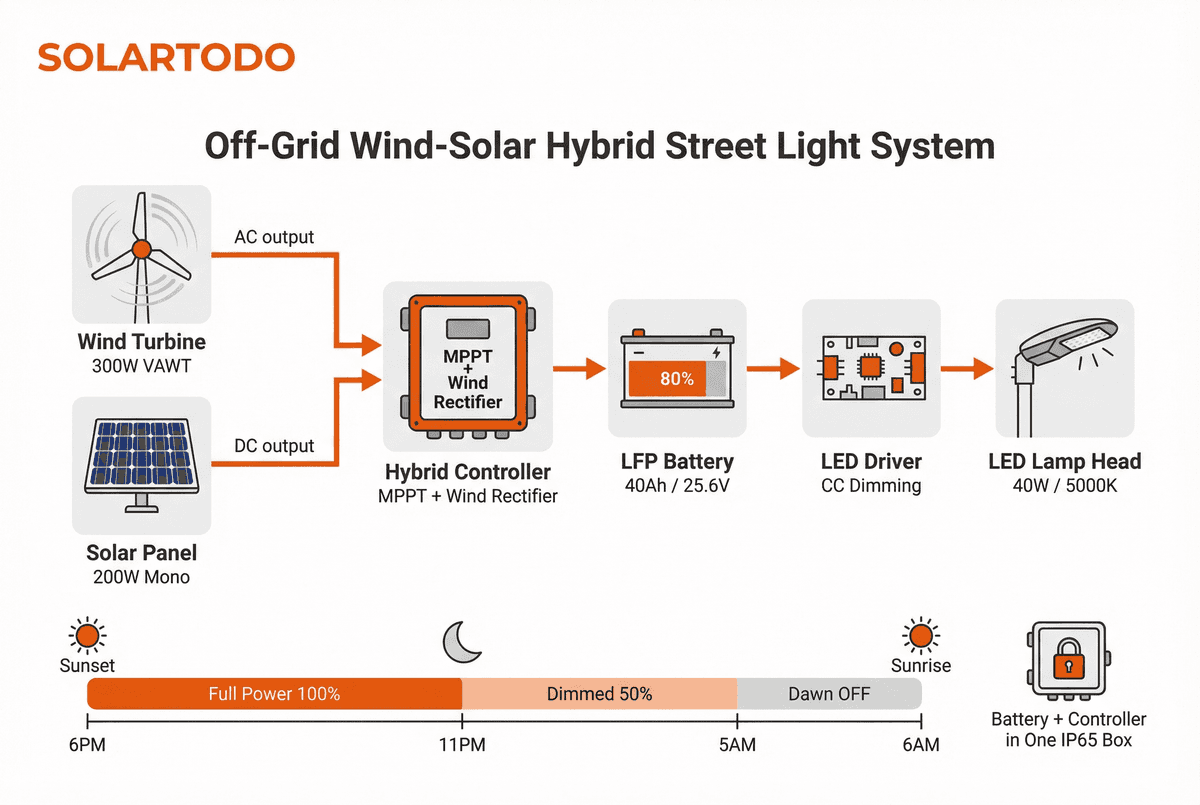
A properly designed system must balance generation, storage, and load. For example, a 30W all-in-one unit running 12 hours nightly consumes about 360Wh per night before controller and system losses. If the design includes dimming, motion sensing, or adaptive output, the effective nightly energy demand can drop significantly, allowing a smaller battery or more rainy-day reserve.
LiFePO4 batteries are now standard in quality systems because they offer better thermal stability and cycle life than older lead-acid or lower-grade lithium chemistries. In practical procurement terms, 2,000+ deep cycles can support multi-year operation with lower replacement frequency, especially when the controller limits depth of discharge intelligently. MPPT charging above 98% efficiency further improves energy harvest during variable irradiance conditions.
According to NREL (2024), solar resource modeling and system loss assumptions are essential for reliable off-grid PV sizing, because nominal module wattage alone does not predict delivered energy. According to IRENA (2024), solar technology cost reductions have continued to improve distributed energy project economics, which supports broader adoption of standalone lighting in emerging infrastructure markets.
Typical performance factors to review
- LED efficacy, often above 170 lm/W in quality systems
- Battery usable capacity rather than nominal capacity only
- Local peak sun hours, such as 4.0-5.5 hours in many target markets
- Dimming schedule, for example 100% for 4 hours then 50% for 8 hours
- Pole height and optics matched to road width and lux target
- Ambient temperature range and enclosure heat dissipation
Thermal behavior is the main technical limitation of all-in-one architecture. Because the battery and controller are close to the LED and solar module, internal temperatures can rise in hot climates. This does not automatically disqualify the design, but it means buyers should request operating temperature data, battery derating information, and evidence of heat-sink design. For very high ambient temperatures or 10m+ high-power installations, split systems often remain the safer engineering choice.
Applications and System Selection by Use Case
Advanced all-in-one solar streetlights are best suited to 4m-8m poles, 30W-80W lighting loads, and projects where faster installation, reduced trenching, and lower maintenance complexity matter more than maximum component separation.
The strongest use cases are municipal secondary roads, parks, pathways, residential compounds, campuses, parking areas, and internal industrial roads with moderate lighting requirements. In these scenarios, integrated systems reduce installation labor because the installer mounts one main assembly instead of routing multiple external cables between panel, battery box, and luminaire.
For very demanding roads or industrial yards, buyers should compare all-in-one and split options carefully. SOLAR TODO's 120W Industrial Dual-Arm Split Solar Street Light, for example, is positioned for 10m poles, 240Wp solar input, 960Wh LiFePO4 storage, and 8 rainy days of autonomy. That type of architecture improves angle optimization and serviceability by 15-25% in many field installations.
By contrast, smaller integrated products are ideal where visual simplicity and speed are priorities. A compact garden or pathway project may not need separate battery cabinets or larger pole-top structures. The right choice depends on road classification, autonomy target, climate severity, maintenance access, and theft or vandalism risk.
Comparison table: all-in-one vs split solar streetlights
| Parameter | All-in-one Solar Streetlight | Split Solar Streetlight |
|---|---|---|
| Typical power range | 30W-120W | 40W-200W+ |
| Typical pole height | 4m-8m | 6m-12m |
| Waterproofing interfaces | Fewer external interfaces | More external cable interfaces |
| Installation speed | Faster by about 15-25% | Slower due to separate assembly |
| Thermal management | More compact, higher heat concentration | Better component separation |
| Maintenance access | Simpler replacement of full unit | Easier subsystem servicing |
| Best use cases | Parks, roads, campuses, compounds | Highways, ports, yards, industrial roads |
| Climate suitability | Moderate to harsh with correct IP design | Better for very hot/high-load sites |
A useful benchmark is to avoid overspecifying all-in-one products for applications better served by split systems. If a project requires 10m poles, wide carriageways, or very high nightly energy demand, a split design often delivers better long-term reliability. If the project needs rapid deployment across 50-200 poles with moderate lux targets, integrated systems can reduce total installed cost meaningfully.
EPC Investment Analysis and Pricing Structure
EPC evaluation for all-in-one solar streetlights should compare FOB supply, CIF delivered, and turnkey installation cost, with project payback commonly falling in the 2-5 year range versus conventional trenching-based lighting.
For B2B procurement, pricing must be reviewed as a delivered system rather than a lamp-only number. Engineering, Procurement, and Construction turnkey delivery usually includes lighting design review, product supply, pole and bracket specification, logistics coordination, site installation guidance or execution, commissioning, and basic documentation. In larger public or industrial tenders, EPC scope may also include foundation design, cable-free layout planning, and after-sales training.
Three-tier pricing structure
- FOB Supply: Product ex-factory pricing covering the light and agreed accessories, excluding ocean freight, insurance, customs, and local installation.
- CIF Delivered: Product plus freight and insurance to destination port, useful for import budgeting where local contractors handle installation.
- EPC Turnkey: Full project delivery including engineering support, logistics coordination, installation scope, testing, and commissioning.
Using known market references from SOLAR TODO's range, small-format solar garden products can fall around USD 50-82 FOB and USD 80-120 EPC depending on quantity and specification. Higher-capacity industrial systems can reach USD 1,200-1,650 turnkey where pole class, autonomy, and dual-arm configuration increase total project value. Advanced all-in-one streetlights generally sit between these ranges depending on wattage, pole height, battery size, and smart control features.
Volume pricing guidance
- 50+ units: about 5% discount
- 100+ units: about 10% discount
- 250+ units: about 15% discount
ROI and savings logic
Compared with conventional AC streetlights, solar systems can avoid trenching, cabling, transformer extension, and recurring electricity bills. In distributed projects, especially remote roads or compounds, installed cost savings versus grid extension can be substantial. Payback often lands between 2 and 5 years when the avoided civil works and energy charges are included, though exact results depend on local labor rates, electricity tariffs, and maintenance assumptions.
Payment and financing terms
- Standard payment: 30% T/T deposit + 70% against B/L
- Alternative payment: 100% L/C at sight
- Financing: available for large projects above USD 1,000K
- Commercial contact: cinn@solartodo.com
For procurement managers, the most important commercial step is to compare lifecycle cost, not just unit price. SOLAR TODO supports inquiry-based project development with offline quotation, technical review, and financing discussion for qualified large-scale infrastructure opportunities.
Procurement Checklist and Risk Control
A reliable all-in-one solar streetlight procurement process should verify IP rating, battery cycle life, controller efficiency, pole compatibility, and lighting simulation before any 50+ unit order is approved.
Many project failures come from under-sizing rather than product category choice. Buyers sometimes select wattage based on marketing labels instead of road width, pole spacing, or local irradiance. Others focus on IP rating alone without reviewing battery thermal limits, lens aging, or corrosion class. A structured technical checklist reduces these risks.
Procurement checklist
- Confirm road class, pole height, spacing, and lux target
- Review solar resource and rainy-day autonomy assumptions
- Verify LiFePO4 battery cycle life of 2,000+ cycles
- Confirm MPPT controller efficiency above 98%
- Request DIALux or equivalent lighting simulation
- Check enclosure rating, housing material, and anti-corrosion treatment
- Review warranty scope for battery, LED, controller, and housing
- Align spare parts strategy with local maintenance capability
According to IEC 62124-1 (2017), stand-alone PV system performance should be assessed using structured methods rather than nominal component values alone. That is especially relevant for solar streetlighting, where real nightly service continuity matters more than brochure wattage. A disciplined specification process is often the difference between a durable 5-year asset and a high-maintenance project.
FAQ
Q: What is an advanced all-in-one solar streetlight? A: An advanced all-in-one solar streetlight is an integrated lighting system that combines the LED lamp, solar panel, LiFePO4 battery, and controller in one housing. Typical systems range from 30W to 120W and are designed for 3-8 rainy days of autonomy, depending on battery size, dimming profile, and local solar resource.
Q: How waterproof are all-in-one solar streetlights in real outdoor use? A: Most quality all-in-one units are specified at IP65 or IP66, which means strong protection against dust and rain exposure. However, real durability depends on gasket quality, cable sealing, vent design, and corrosion resistance, so buyers should request test data rather than relying only on the IP label.
Q: Why does waterproofing matter so much in integrated solar streetlights? A: Waterproofing matters more in integrated systems because the battery, controller, and LED assembly are housed together. If moisture enters one enclosure, it can affect multiple subsystems at once, increasing failure risk and repair cost compared with designs where components are physically separated.
Q: How do all-in-one solar streetlights compare with split solar streetlights? A: All-in-one systems usually install 15-25% faster and have fewer external cable interfaces, which helps on simpler projects. Split systems generally offer better thermal management and easier subsystem servicing, making them more suitable for high-power, 10m+ pole, or very hot industrial environments.
Q: What battery technology is best for this product category? A: LiFePO4 is generally the preferred battery chemistry because it provides better thermal stability, safety, and 2,000+ deep cycles in quality designs. For B2B projects, buyers should also confirm usable capacity, battery management strategy, and operating temperature limits instead of checking nominal watt-hours only.
Q: How many rainy days of backup should I specify? A: For municipal roads and standard urban applications, 3-5 rainy days is often adequate when solar resource is stable and dimming is used. For remote, security-sensitive, or cloudy locations, 5-8 days of autonomy is safer to maintain 12-hour nightly operation during extended poor weather.
Q: What are the main causes of poor performance in all-in-one solar streetlights? A: The most common causes are undersized solar panels, insufficient battery reserve, poor thermal design, and unrealistic operating schedules. Incorrect pole spacing and optics selection can also create the impression of poor performance even when the electrical system itself is functioning normally.
Q: How much can an all-in-one solar streetlight project cost? A: Pricing varies by wattage, pole height, battery size, and delivery scope. Buyers should compare FOB Supply, CIF Delivered, and EPC Turnkey pricing, then include civil works savings; volume orders of 50+, 100+, and 250+ units commonly qualify for about 5%, 10%, and 15% discounts respectively.
Q: What does EPC turnkey delivery include for solar streetlight projects? A: EPC turnkey delivery typically includes engineering review, product procurement, logistics coordination, installation scope, testing, and commissioning. Depending on the project, it may also cover pole and foundation specification, lighting simulation, and after-sales training, which gives buyers a clearer total-cost picture than lamp-only pricing.
Q: What payment terms are common for B2B solar streetlight orders? A: Common international terms are 30% T/T in advance and 70% against B/L, or 100% L/C at sight for qualified transactions. For larger infrastructure projects above USD 1,000K, financing support may also be available subject to project review and commercial approval.
Q: When should I avoid an all-in-one design and choose a split system instead? A: Buyers should favor split systems when projects require 10m-12m poles, very high wattage, extreme heat, or easier access to individual components for maintenance. Split architecture is also preferable where panel orientation flexibility and larger battery reserves are critical to long-term performance.
Q: How should I evaluate suppliers before ordering? A: Review technical drawings, DIALux simulation, battery and controller specifications, warranty terms, and environmental test evidence before placing an order. For multi-site or municipal projects, it is also wise to request a pilot installation and verify after-sales response capability, spare parts planning, and documentation quality.
References
- NREL (2024): PV performance modeling guidance and resource tools used to estimate off-grid solar generation and system losses.
- IEC 60529 (2013): Degrees of protection provided by enclosures, including IP rating definitions for dust and water ingress.
- IEC 60598 (2020): Luminaire safety and construction requirements relevant to outdoor lighting products.
- IEC 62124-1 (2017): Photovoltaic stand-alone system design verification methods relevant to off-grid solar lighting performance.
- IEA (2024): Renewable electricity market outlook and solar PV deployment trends supporting distributed energy economics.
- IRENA (2024): Renewable power cost and market analysis showing the continued competitiveness of solar technologies.
- UL (2023): Guidance on enclosure and electrical safety considerations for equipment used in wet or harsh outdoor environments.
- IEEE (2018): Distributed energy interconnection and system interface principles relevant to broader renewable power engineering practice.
Conclusion
Advanced all-in-one solar streetlights deliver the best value at 30W-80W and 4m-8m pole heights when IP65-IP66 waterproofing, 2,000+ cycle LiFePO4 batteries, and realistic 3-5 day autonomy are correctly specified.
For B2B buyers, the bottom line is simple: choose all-in-one systems for faster deployment and lower installation complexity, but move to split architecture when heat, power level, or serviceability demands exceed the limits of integrated design. SOLAR TODO can support specification, quotation, and EPC evaluation for both approaches.
About SOLARTODO
SOLARTODO is a global integrated solution provider specializing in solar power generation systems, energy-storage products, smart street-lighting and solar street-lighting, intelligent security & IoT linkage systems, power transmission towers, telecom communication towers, and smart-agriculture solutions for worldwide B2B customers.
Further Reading
About the Author

SOLAR TODO
Solar Energy & Infrastructure Expert Team
SOLAR TODO is a professional supplier of solar energy, energy storage, smart lighting, smart agriculture, security systems, communication towers, and power tower equipment.
Our technical team has over 15 years of experience in renewable energy and infrastructure, providing high-quality products and solutions to B2B customers worldwide.
Expertise: PV system design, energy storage optimization, smart lighting integration, smart agriculture monitoring, security system integration, communication and power tower supply.
Cite This Article
SOLAR TODO. (2026). All-in-one Solar Streetlights Waterproofing Guide. SOLAR TODO. Retrieved from https://solartodo.com/knowledge/advanced-all-in-one-solar-streetlights-with-all-in-one-waterproofing-and-performance-analysis
@article{solartodo_advanced_all_in_one_solar_streetlights_with_all_in_one_waterproofing_and_performance_analysis,
  title = {All-in-one Solar Streetlights Waterproofing Guide},
  author = {SOLAR TODO},
  journal = {SOLAR TODO Knowledge Base},
  year = {2026},
  url = {https://solartodo.com/knowledge/advanced-all-in-one-solar-streetlights-with-all-in-one-waterproofing-and-performance-analysis},
  note = {Accessed: 2026-04-21}
}
Published: April 18, 2026 | Available at: https://solartodo.com/knowledge/advanced-all-in-one-solar-streetlights-with-all-in-one-waterproofing-and-performance-analysis
Subscribe to Our Newsletter
Get the latest solar energy news and insights delivered to your inbox.
View All Articles