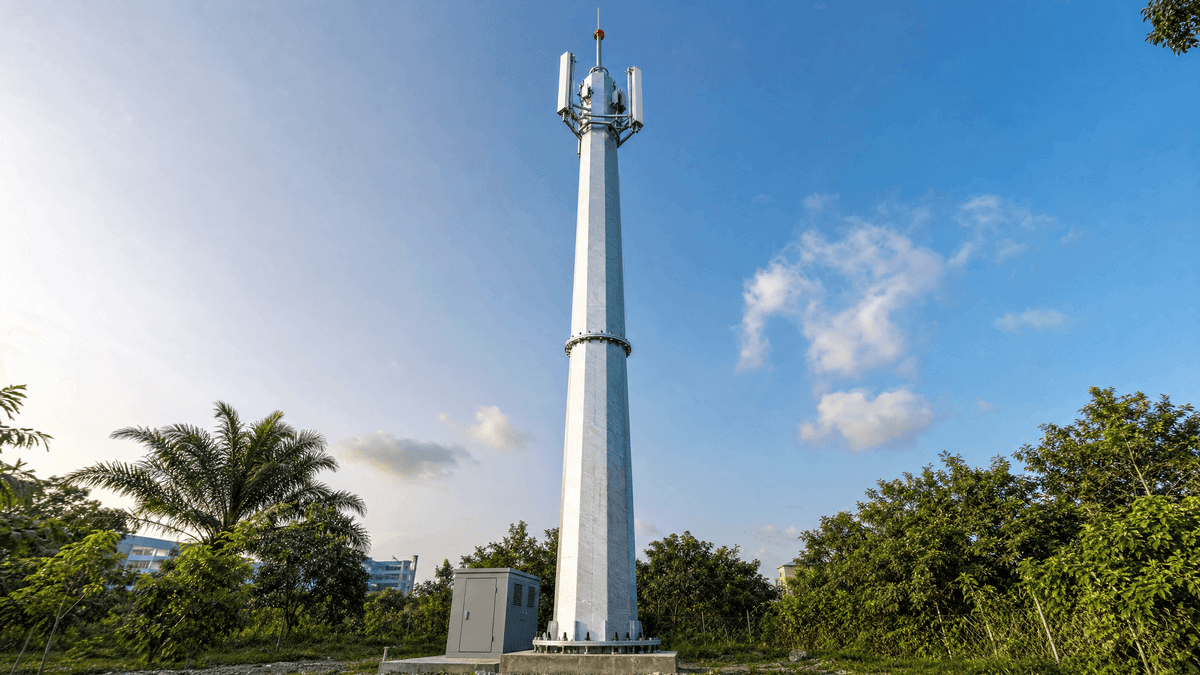
Accra Telecom Tower Market Analysis: 20m Urban Macro Configuration Guide for Ghana
Summary
Accra’s dense urban growth, coastal corrosion exposure, and rising mobile data demand make a 20m urban macro Telecom Tower a practical fit for infill coverage. A typical program of approximately 44 units using Q345 galvanized steel, 40 m/s wind class, and drilled pier foundations aligns with compact city-site constraints and 30-year design-life requirements.
Key Takeaways
- Accra Metropolitan District covers about 20.4 km² with high built density, which favors 20m monopole urban macro sites over larger-footprint lattice structures, according to the Ghana Statistical Service (2021).
- Ghana had roughly 38.3 million mobile cellular subscriptions in 2023, indicating sustained network loading in Greater Accra and continued demand for infill telecom structures, according to the World Bank (2024).
- A typical Accra urban macro rollout at this scale would use approximately 44 units of 20m tapered steel monopoles, each at about 7t total steel weight and 3 antenna platforms.
- For coastal Accra conditions, a recommended material set is hot-dip galvanized Q345 steel with high-corrosion-zone treatment and a 30-year design life under TIA-222-H / GB/T 50233.
- The specified load case of 3× panel antennas + 1× microwave dish + RRU + small cell suits mixed macro coverage and targeted capacity densification in urban districts such as Osu, Adabraka, Kaneshie, and airport corridors.
- With CKD shipping reducing volume by 60-70%, a 44-unit procurement can lower container-space demand and improve delivery planning for constrained urban receiving yards in Accra Port logistics chains.
- A standard fabrication window of 30-45 days and drilled pier foundations typically support phased deployment in 3-4 rollout batches, subject to permitting, geotechnical review, and utility clearance.
- SOLAR TODO positions this Telecom Tower format as a compact monopole option for city telecom operators that need 20m height, 40 m/s wind compliance, and reduced visual footprint compared with heavier multi-leg structures.
Market Context for Accra
Accra combines high subscriber density, limited urban land, and coastal environmental exposure, making compact 20m monopole Telecom Tower designs more suitable than larger-footprint alternatives for many city infill sites. According to the Ghana Statistical Service (2021), the Accra Metropolitan District has a population of 284,124 within about 20.4 km², while the larger Greater Accra Metropolitan Area carries much higher daily mobility and service demand across commercial corridors.
According to the World Bank (2024), Ghana recorded about 38.3 million mobile cellular subscriptions in 2023, a level above the national population because of multi-SIM usage and strong mobile dependence. That matters in Accra because high device density usually translates into pressure on urban radio access networks, especially where 4G coverage, microwave backhaul, and small-cell overlays must coexist on constrained plots. For this reason, a monopole in the urban infill class is often preferred where site acquisition is difficult and aesthetics matter.
Climate also affects tower selection. According to the World Bank Climate Change Knowledge Portal (2021), coastal Ghana faces high humidity, salt-laden air, and seasonal intense rainfall, all of which accelerate steel corrosion if coating systems are underspecified. For Accra, that supports the use of hot-dip galvanized Q345 steel, a high-corrosion-zone specification, and a grounding/lightning package sized for tropical storm conditions rather than a bare minimum inland standard.
The city context also favors shorter structures where aviation constraints, zoning, and visual impact are important. Kotoka International Airport influences parts of Accra’s height environment, while dense neighborhoods often leave only narrow compounds for telecom infrastructure. A 20m Telecom Tower therefore fits the 15-25m rooftop/urban infill engineering class from the product table, even though the loading package is stronger than a basic rural single-tier site.
There is also a logistics reason to choose sectional monopoles. According to UNCTAD (2023), Tema and Ghana’s logistics network remain central to imported project cargo handling, but inland urban delivery can still face congestion and staging limitations. SOLAR TODO’s CKD shipping with 60-70% volume reduction is useful in Accra because fewer cubic meters per tower improve warehouse handling and last-mile delivery into dense commercial districts.
Two authority statements are relevant here. The ITU states, "Infrastructure sharing can reduce deployment costs and accelerate broadband expansion," which is directly relevant to compact monopole designs in dense cities. TIA states that TIA-222-H provides minimum requirements for antenna-supporting structures under wind, ice, and seismic loading, which is the baseline reference for the recommended tower class in this guide.
Recommended Technical Configuration
A typical Accra urban macro deployment would use approximately 44 units of 20m tapered steel monopole Telecom Tower structures with drilled pier foundations, 3 antenna platforms, and a mixed macro-plus-backhaul loading package. This recommendation fits the city’s urban-infill profile, coastal corrosion exposure, and need to balance coverage, microwave transport, and limited site footprints.
Based on the provided project configuration, the recommended structure is a 20m tapered steel monopole tower, not lattice and not FRP. The material is hot-dip galvanized Q345 steel, with each tower weighing about 7t, or 350 kg/m. That weight is internally consistent for a compact telecom monopole and remains below the heavier 500 kg/m rule-of-thumb upper range used for larger telecom or utility tubular structures.
The advised loading package is 3× panel antennas + 1× microwave dish + RRU + small cell. This is a practical hybrid arrangement for Accra because it allows one structure to support wide-area macro service, microwave backhaul resilience, and localized capacity improvement in dense urban pockets. In districts where fiber access is inconsistent or leased backhaul costs are high, the single microwave dish adds network design flexibility without pushing the structure into a much larger suburban backhaul class.
Foundation choice should be concrete pier (drilled pier) foundation. In Accra, drilled piers are often preferred where plots are tight, excavation must be controlled, and adjacent structures limit the use of broad pad foundations. Final depth and reinforcement still depend on geotechnical conditions such as fill layers, groundwater level, and allowable bearing pressure, but for a 20m / 7t monopole class, drilled piers are a technically sound default starting point.
The accessory package should include:
- Climbing ladder
- Cable tray
- Aircraft warning light
- Grounding system
- Lightning rod
- 3 antenna platforms
- Safety cage
For Accra, this package is justified by urban maintenance access requirements, lightning exposure, and the need to separate antenna elevations where macro panels, microwave equipment, and small-cell hardware share one pole. SOLAR TODO can therefore position this Telecom Tower as an urban macro support structure rather than a basic rural coverage pole.
A typical 44-unit deployment of this scale would usually be split into 3 or 4 batches to match permit sequencing, foundation curing, and RF integration windows. That is especially relevant in Accra where municipal approval timing, traffic management plans, and utility conflict checks can vary by district. For technical discussions on site-specific adaptation, buyers can review the product page at /products/telecom-tower or contact us.
Technical Specifications
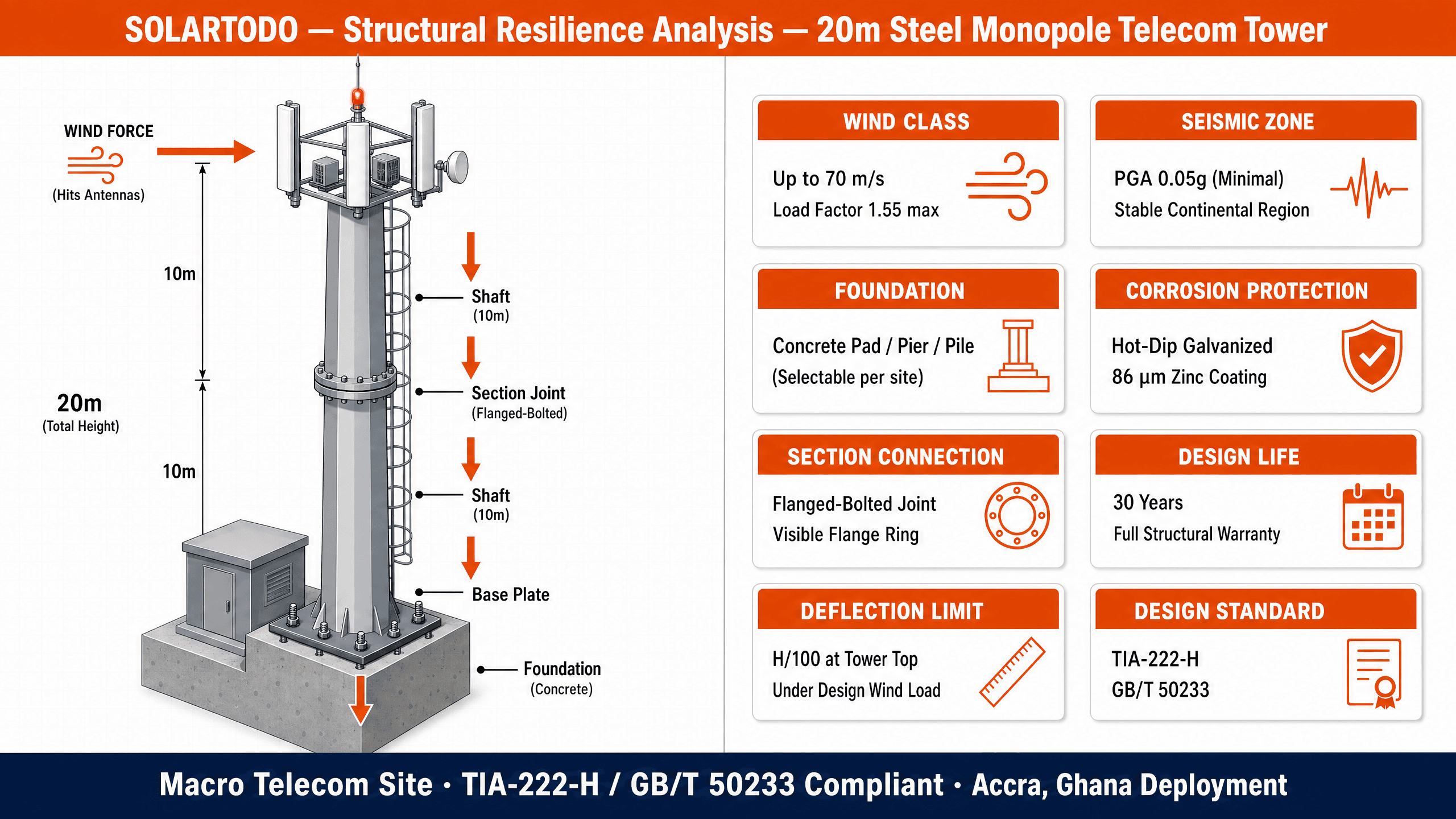
The recommended Accra configuration is a 20m, 7t, wind-class-1 steel monopole with 3 platforms, drilled pier foundation, and high-corrosion protection, intended for urban macro telecom loading under TIA-222-H and GB/T 50233. The specification below follows the provided project configuration and keeps the tower in the correct 15-25m urban infill class.
- Product type: Steel monopole Telecom Tower
- Application class: Urban macro site in dense city districts
- Height: 20m
- Quantity reference: Approximately 44 units for a city-scale infill package of this profile
- Pole form: Tapered steel monopole
- Material: Q345 steel
- Surface treatment: Hot-dip galvanized for high-corrosion-zone service
- Design life: 30 years
- Wind class: Class 1 = 40 m/s, factor 1.0, per TIA-222-H load basis
- Tower weight: ~7t per tower or ~350 kg/m
- Antenna load: 3× panel antennas + 1× microwave dish + RRU + small cell
- Platforms: 3 antenna platforms
- Foundation type: Concrete pier (drilled pier) foundation
- Access and safety: Climbing ladder + safety cage
- Cable management: Integrated cable tray
- Protection package: Aircraft warning light + grounding system + lightning rod
- Section/shipping mode: CKD shipping, reducing transport volume by 60-70%
- Production lead time: 30-45 days under standard factory scheduling
- Standards: TIA-222-H / GB/T 50233
From the engineering size table, a 20m tower belongs to the 15-25m rooftop/urban infill class. That class typically supports 1 platform and 3-6 panel antennas at 8-15t per tower, but the provided Accra configuration remains credible because the total tower weight is only ~7t, the loading is moderate, and the structure is specifically defined as a compact urban macro monopole. The recommendation therefore stays within the intended short-height monopole use case while using a customized accessory count of 3 platforms for mixed equipment separation.
Implementation Approach
A 44-unit Accra rollout would typically move through geotechnical review, fabrication, CKD shipment, drilled pier construction, tower erection, and RF commissioning over a phased 30-45 day production plus local installation schedule. The main implementation variable is not tower fabrication alone; it is site access, permit timing, and utility conflict resolution across dense urban parcels.
The first phase is site screening. For a 20m monopole, the engineering team would normally confirm plot dimensions, underground utility conflicts, setback requirements, and any airport-related height restrictions. In Accra, this review should also check corrosion exposure bands, because coastal air in districts nearer the shoreline can justify stricter coating inspection and grounding detail verification.
The second phase is structural and foundation design. A drilled pier foundation is suitable where site compounds are narrow and adjacent walls or pavements limit excavation width. Final pier diameter, reinforcement cage, and embedment depth should be based on geotechnical data, because a 40 m/s wind-class design under TIA-222-H still requires local soil parameters rather than a generic drawing.
The third phase is manufacturing and logistics. SOLAR TODO’s CKD format reduces shipping volume by 60-70%, which helps when multiple towers must be consolidated into containerized lots for Ghana-bound freight. Sectional delivery also simplifies urban unloading because shorter flanged or sectional members are easier to move through city roads than one-piece poles.
The fourth phase is erection and accessory installation. A typical sequence is pier curing, anchor setting or base preparation, lower-section lift, upper-section assembly, platform mounting, cable tray installation, grounding, and aviation light fit-out. Because the structure is only 20m, crane demand and road-closure time are usually lower than for 35-45m suburban or peri-urban towers.
The fifth phase is telecom integration and acceptance. This includes antenna mounting, microwave alignment, RRU installation, small-cell attachment, grounding resistance testing, plumb verification, and final load-path inspection. According to TIA, structural modifications and appurtenance additions should always be checked against the original design basis, which is important if operators later add heavier radios or a second dish.
Expected Performance & ROI
A 20m Accra urban macro Telecom Tower can improve localized coverage and backhaul flexibility within a compact footprint, with lifecycle value driven more by lease efficiency and faster densification than by raw tower height. In dense districts, ROI usually depends on tenant loading, avoided rooftop lease complexity, and lower urban land use compared with larger multi-leg structures.
According to the ITU (2020), infrastructure sharing lowers network deployment cost and can accelerate broadband expansion in urban markets. For Accra, that means a 20m monopole with 3 platforms can be commercially stronger when it is configured for at least 1 primary tenant with room for selective co-location or equipment upgrades. The exact payback period varies by lease model, but towers in dense city zones commonly outperform isolated rural sites because traffic demand and tenant probability are both higher.
Maintenance economics are also relevant. A galvanized steel monopole with a 30-year design life and moderate 40 m/s wind class generally has lower routine maintenance complexity than larger lattice structures with many more bolted members and exposed surfaces. According to NREL (2023), lifecycle cost analysis for infrastructure assets should include inspection intervals, corrosion management, replacement cycles, and downtime risk rather than capex alone; that principle applies directly to telecom support structures.
Expected performance benefits in Accra would include:
- Better infill coverage in built-up districts where rooftop options are limited
- Support for macro + microwave + small-cell loading on one pole
- Lower transport volume through 60-70% CKD reduction
- Faster urban erection than taller 35-45m classes in many cases
- Lower visual impact than lattice alternatives on comparable plots
For buyers assessing commercial return, the strongest metric is usually not a generic national ROI number but cost per served urban sector, cost per additional tenant option, and time-to-service after permit release. SOLAR TODO therefore should be evaluated on structural fit, logistics efficiency, and standards compliance rather than on a single headline payback claim.
Results and Impact
For Accra, the practical impact of this 20m Telecom Tower configuration would be improved urban infill coverage, better equipment consolidation, and lower logistics burden through 60-70% CKD volume reduction. The strongest use case is not long-range rural reach; it is compact city deployment where 3 panels, 1 microwave dish, an RRU set, and a small cell must fit on one corrosion-protected monopole.
Compared with taller 35-45m highway or peri-urban towers, a 20m / 7t monopole is easier to place on constrained urban plots and usually simpler to permit visually. Compared with rooftop-only solutions, it gives operators more control over structural loading, grounding, climb safety, and future equipment changes. For Accra’s mixed commercial and residential districts, that combination is often the deciding factor.
Comparison Table
The table below compares the recommended 20m Accra Telecom Tower against other common telecom support options used for urban and peri-urban network expansion.
| Option | Height | Typical footprint | Typical loading | Weight range | Best fit in Accra | Notes |
|---|---|---|---|---|---|---|
| Recommended monopole (SOLAR TODO) | 20m | Small | 3 panels + 1 dish + RRU + small cell | ~7t | Urban macro / infill | High-corrosion galvanizing, drilled pier, 3 platforms |
| Standard urban infill monopole | 15-25m | Small | 3-6 panels | 8-15t class reference | Dense city sites | Often fewer platforms, less mixed loading |
| Suburban backhaul monopole | 30-35m | Medium | 6 panels + 1-2 dishes | 15-22t | Outer Accra / residential edge | Better reach, larger footprint |
| Peri-urban highway monopole | 35-45m | Medium-large | 6-9 panels + microwave | 22-30t | Ring roads / transport corridors | Higher crane and foundation demand |
| Lattice tower | 25-45m | Large | High multi-tenant loads | Varies widely | Limited urban use | Lower steel efficiency on small plots; stronger visual impact |
Pricing & Quotation
SOLAR TODO offers three pricing tiers for this product line: FOB Supply (equipment ex-works China), CIF Delivered (including ocean freight and insurance), and EPC Turnkey (fully installed, commissioned, with 1-year warranty). Volume discounts are available for large-scale deployments. Configure your system online for an instant estimate, or request a custom quotation from our engineering team at [email protected].
Frequently Asked Questions
This FAQ answers 10 common buyer questions about 20m Telecom Tower selection in Accra, including structure, timeline, maintenance, EPC scope, warranty, and commercial evaluation. The answers use the specified 44-unit, 20m urban macro configuration and keep to TIA-222-H / GB/T 50233 compliance logic.
Q1: Why is a 20m Telecom Tower recommended for Accra instead of a 35m or 40m tower?
A 20m tower fits Accra’s dense urban-infill profile better than a 35-40m class in many districts. It needs a smaller footprint, lower crane capacity, and simpler visual approval while still carrying 3 panels, 1 microwave dish, an RRU set, and a small cell. Taller towers are more suitable for peri-urban reach than city-center densification.
Q2: What exact tower specification is recommended for this Accra profile?
The recommended configuration is approximately 44 units of 20m tapered steel monopole Telecom Tower structures in hot-dip galvanized Q345 steel. Each tower is about 7t, rated to wind class 1 at 40 m/s, uses a drilled pier foundation, and includes 3 antenna platforms, ladder, safety cage, cable tray, grounding, lightning rod, and aircraft warning light.
Q3: Is a monopole better than a lattice tower for Accra urban sites?
For many Accra city parcels, yes. A monopole usually occupies less land, has lower visual impact, and is easier to place inside compact compounds. Lattice towers remain useful where loading is much heavier or multiple tenants require larger separation distances, but for a 20m urban macro site, a monopole is often the more practical option.
Q4: How long would procurement and deployment typically take?
Production is typically 30-45 days under standard factory scheduling. Local deployment time then depends on permit approval, geotechnical checks, foundation curing, and telecom integration. A 44-unit package is commonly split into 3-4 batches so that fabrication, shipment, civil works, and commissioning can overlap instead of waiting for all sites to be released at once.
Q5: Why use a drilled pier foundation in Accra?
A drilled pier foundation suits tight urban plots where excavation width is restricted and nearby walls, drains, or pavements must be protected. It also helps control the foundation footprint for a 20m monopole. Final depth and reinforcement still require site-specific soil data, groundwater review, and wind-load verification under TIA-222-H.
Q6: What maintenance should buyers expect over a 30-year design life?
Typical maintenance includes annual visual inspection, bolt and platform checks, grounding resistance testing, coating inspection, and periodic aviation-light servicing. In coastal Accra, corrosion inspection matters more because salt-laden air can attack damaged galvanized surfaces. A planned maintenance cycle usually costs less than corrective repair after coating failure or unauthorized loading changes.
Q7: What is the expected ROI or payback period for this type of tower?
There is no single universal payback number because returns depend on tenancy, lease rates, traffic demand, and backhaul strategy. In Accra, ROI is usually driven by faster urban coverage improvement, lower site-acquisition friction than rooftop alternatives, and the option to support both macro and microwave equipment on one structure. Buyers should model revenue per tenant and time-to-service.
Q8: Does SOLAR TODO provide EPC pricing or only supply?
SOLAR TODO supports multiple commercial scopes, including supply-only and turnkey formats. Buyers can request FOB supply, CIF delivered, or EPC turnkey scope depending on whether civil works, erection, and commissioning will be handled by local contractors or a single integrated package. Final quotations depend on quantity, accessories, logistics, and site-specific foundation requirements.
Q9: What warranty terms are typical for this product line?
Commercial proposals typically distinguish between supply warranty and EPC warranty scope. The pricing section in this guide specifies a 1-year warranty for EPC turnkey packages. Buyers should also confirm coating specification, fabrication tolerances, excluded misuse conditions, and whether later tenant additions require a new structural check to preserve warranty validity.
Q10: Can this 20m tower support future network upgrades?
Yes, within the original structural reserve and approved appurtenance limits. The current load case already includes 3 panel antennas, 1 microwave dish, an RRU set, and a small cell, which gives useful flexibility for urban macro service. Any future addition should be checked against TIA-222-H calculations so that wind area, torsion, and foundation demand remain compliant.
References
This guide is based on public telecom, climate, and structural-standard sources, including at least 5 authoritative references relevant to Accra, Ghana, and telecom support structures. Buyers should still validate final design inputs against local permits, geotechnical reports, and operator loading schedules.
- Ghana Statistical Service (2021): 2021 Population and Housing Census district profile data for Accra Metropolitan; population and district-area context used for urban density assessment.
- World Bank (2024): World Development Indicators, mobile cellular subscriptions for Ghana; used to show national telecom access intensity and subscriber pressure.
- World Bank Climate Change Knowledge Portal (2021): Ghana climate risk and coastal weather profile; used for humidity, rainfall, and corrosion-exposure context.
- TIA (2022): TIA-222-H, Structural Standard for Antenna Supporting Structures, Antennas and Small Wind Turbine Support Structures; basis for wind class and loading compliance.
- GB/T 50233 (2014): Code for construction and acceptance of communication line engineering; cited for fabrication and installation acceptance reference.
- ITU (2020): Broadband infrastructure and sharing policy guidance; cited for the cost-reduction and rollout benefits of infrastructure sharing.
- UNCTAD (2023): Review of Maritime Transport and West Africa logistics context; used to support CKD shipping and port-linked delivery planning considerations.
- NREL (2023): Lifecycle cost analysis guidance for infrastructure assets; referenced for maintenance and lifecycle-value framing relevant to telecom structures.
Equipment Deployed
- 20m tapered steel monopole Telecom Tower, urban macro class
- Hot-dip galvanized Q345 steel structure, high-corrosion-zone finish
- Wind class 1 design: 40 m/s, factor 1.0, per TIA-222-H
- Approx. 7t tower weight per unit
- Antenna package: 3× panel antennas + 1× microwave dish + RRU + small cell
- 3 antenna platforms
- Concrete pier (drilled pier) foundation
- Climbing ladder
- Safety cage
- Cable tray
- Aircraft warning light
- Grounding system
- Lightning rod
- CKD sectional shipping with 60-70% volume reduction