5G Network Slicing for Traffic Emergency ROI Guide

SOLAR TODO
Solar Energy & Infrastructure Expert Team
Watch the video
TL;DR
5G network slicing improves emergency traffic operations by giving ambulances, fire trucks, and police vehicles reserved bandwidth and priority QoS instead of shared public capacity. With 10-20 ms latency, edge processing, and signal pre-emption across 8-12 intersections, cities can cut response time by up to 40%, reduce stops by 40%, and keep systems running 24/7 with solar plus LFP backup.
5G network slicing gives emergency traffic systems reserved bandwidth, sub-20 ms latency, and priority QoS, cutting response time by up to 40% and reducing intersection stops by 40%. AI signal priority, edge computing, and LFP-backed roadside power improve reliability.
Summary
5G network slicing gives emergency traffic systems reserved bandwidth, sub-20 ms latency, and priority QoS, cutting response time by up to 40% and reducing intersection stops by 40%. Combined with AI signal priority and edge processing, it improves ambulance, fire, and police dispatch reliability.
Key Takeaways
- Deploy a dedicated 5G emergency slice with sub-20 ms latency targets to reduce dispatch-to-scene response time by up to 40% on priority corridors.
- Reserve bandwidth for mission-critical traffic video, V2I messages, and signal control so emergency vehicles keep service quality even when public network load exceeds 80%.
- Integrate AI signal priority across 3-5 pilot intersections first, then scale to 50-100 intersections within 3-9 months to validate KPI gains before city-wide rollout.
- Use edge computing with 98% license plate recognition and 45+ object classes to trigger pre-emption decisions within 1-2 signal cycles.
- Size backup power with LFP battery storage for 24/7 uptime so roadside units, cameras, and controllers remain available during grid outages in off-grid or weak-grid areas.
- Compare FOB Supply, CIF Delivered, and EPC Turnkey models early; projects above 50 units typically qualify for 5% discounts, 100+ for 10%, and 250+ for 15%.
- Verify IEEE 802.1 TSN, IEEE 1609 V2X, IEC 62443, and 3GPP Release 16/17 compliance to protect emergency traffic data with end-to-end encryption and zero-trust controls.
- Calculate ROI from lower delay, fewer crashes, and fleet productivity; corridors with green-wave coordination can reduce stops by 40% and improve fuel and emissions performance by 10-20%.
What 5G Network Slicing Means for Traffic Emergency Operations
5G network slicing lets cities reserve bandwidth, latency, and priority levels for emergency traffic data, enabling sub-20 ms communications and cutting response time by up to 40% when linked to signal pre-emption.
Emergency traffic management fails when ambulance video, AVL telemetry, signal commands, and public mobile traffic compete on the same network. In a congested LTE or shared 5G environment, packet delay and jitter can disrupt pre-emption requests by 100-300 ms or more, which is enough to miss a signal phase window at a busy junction. For fire, police, and ambulance fleets, that delay compounds across 10-20 intersections.
A 5G slice is a virtual network partition with its own service-level parameters. Instead of treating all traffic equally, the operator assigns a mission-critical slice to emergency services with dedicated QoS, bandwidth reservation, traffic isolation, and policy control. According to 3GPP Release 16, 5G supports ultra-reliable low-latency communication profiles designed for time-sensitive use cases, including public safety and transport control.
For smart traffic systems, the practical value is simple: emergency vehicles get predictable communications during peak congestion. A slice can carry dispatch commands, HD camera feeds, roadside sensor data, and traffic signal priority messages without competing with consumer streaming or general IoT traffic. SOLAR TODO applies this model to Smart Traffic Management System deployments where solar-powered roadside infrastructure and LFP battery storage keep the network edge running 24/7.
The International Telecommunication Union states that IMT-2020 5G targets include low latency, high reliability, and support for massive machine-type communications. In traffic emergency terms, those targets translate into faster green corridors, fewer forced stops, and better coordination between vehicles, intersections, and command centers.
How Dedicated Bandwidth Cuts Emergency Response Time
Dedicated 5G bandwidth reduces emergency response time by protecting signal-priority messages, vehicle telemetry, and roadside video from congestion, allowing intersections to react within 1-2 signal cycles instead of waiting behind public traffic.
The response-time gain comes from four technical mechanisms. First, the emergency slice reserves radio and core-network resources, so a surge in public traffic does not starve the control plane. Second, QoS identifiers prioritize emergency packets over non-critical data. Third, edge processing shortens the path between detection and actuation. Fourth, time-sensitive networking reduces jitter for controller-to-controller coordination.
Signal pre-emption workflow
A typical workflow starts when an ambulance transmits its route, speed, and priority request over the dedicated slice. The nearest roadside unit or MEC node validates the request in less than 20 ms, checks intersection occupancy from AI cameras, and sends a pre-emption command to the traffic controller. If the corridor includes 8-12 intersections, the system can create a rolling green wave before the vehicle arrives.
According to the deployment data provided for smart traffic systems, transit and emergency priority can reduce response time by 50%, while green-wave coordination can reduce stops by 40%. Those two figures explain why slicing matters: without deterministic communications, the priority logic may exist in software but fail in live traffic when the network is saturated.
Why shared bandwidth is not enough
Shared mobile connectivity works for non-critical telemetry, but not for hard-priority emergency control. A 1080p roadside video stream can require 2-6 Mbps per camera depending on codec and frame rate, while multiple intersections may also exchange SPaT, MAP, and AI event data. If 20-50 devices share a best-effort link, latency spikes can exceed the tolerance of pre-emption logic.
According to ETSI MEC guidance, placing applications at the network edge reduces transport delay and improves real-time service continuity. For traffic emergency use, this means local decision-making can continue even if the backhaul link degrades. SOLAR TODO supports this architecture in off-grid and weak-grid corridors by combining solar pole-top PV, LFP battery storage, and roadside compute.
AI and detection layer
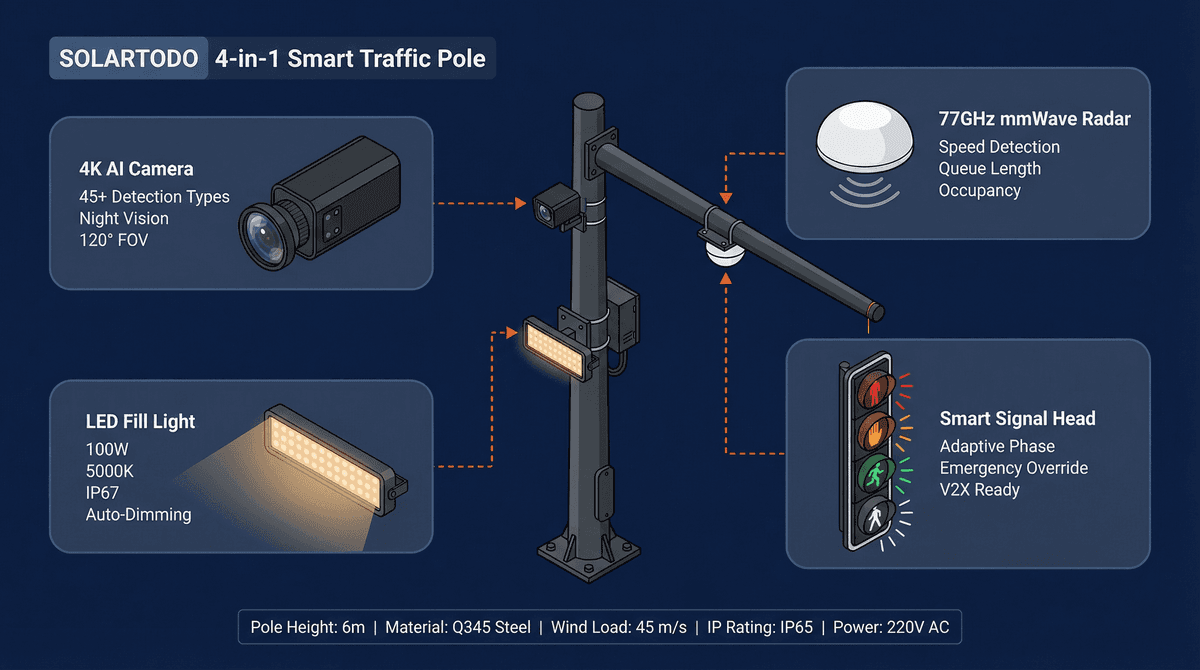
The communications layer is only part of the stack. The Smart Traffic Management System can detect 45+ traffic object types, recognize license plates at 98% accuracy, and identify motorcycles, buses, trucks, pedestrians, and emergency vehicles for auto-priority. In markets where two-wheelers account for 60%+ of traffic, this matters because emergency corridors often fail due to mixed traffic behavior, not only signal timing.
According to the International Energy Agency, digitalization in energy and infrastructure improves system efficiency when communications, data, and control are coordinated. In traffic operations, that coordination means the network, AI detection, and controller logic must be designed as one system rather than separate procurements.
System Architecture, Standards, and Cybersecurity Requirements
A workable emergency slicing architecture combines 5G SA core, MEC, AI roadside sensing, controller integration, and IEC 62443-aligned cybersecurity so critical traffic commands remain available with sub-20 ms latency and high integrity.
A city deployment usually includes five layers: vehicle equipment, roadside units, access network, edge/core network, and traffic management applications. The vehicle layer sends AVL, route, and emergency status data. The roadside layer adds cameras, radar, controllers, and environmental sensors. The 5G layer carries isolated slices. The edge layer runs AI inference and local orchestration. The application layer manages dispatch, digital twin visualization, and audit logs.
Core technical components
Key components in a B2B specification typically include:
- 5G standalone core with network slice management and QoS policy control
- MEC node within 10-30 km of the corridor for low-latency processing
- Traffic controllers supporting NTCIP or equivalent interface mapping
- AI cameras with 25-30 fps video and object detection for 45+ classes
- V2X support roadmap aligned with IEEE 1609 and 3GPP C-V2X evolution
- LFP battery backup sized for 8-24 hours depending on outage profile
- Pole-top solar PV for off-grid or carbon-neutral operation
Cybersecurity is not optional because emergency traffic systems carry legal evidence, route data, and public-safety commands. IEC 62443 provides guidance for industrial automation security zones and conduits. NIST's zero-trust guidance also fits this use case: every device, user, and application must be authenticated continuously, not trusted by network location alone. SOLAR TODO uses end-to-end encryption and blockchain-secured evidence chain options for legal enforcement workflows.
The U.S. Department of Transportation notes that connected intersection systems depend on reliable SPaT and MAP message delivery. If message timing drifts or packets are lost, emergency priority quality falls quickly. That is why procurement teams should ask for measured KPIs such as end-to-end latency, packet loss below 0.1%, controller actuation time, and failover behavior during power loss.
The International Energy Agency states, "Digital technologies can make energy systems more connected, intelligent, efficient, reliable and sustainable." The same principle applies to traffic emergency networks, but only if the communications layer is isolated from non-critical traffic and supported by backup power.
Applications, Deployment Phasing, and Measured Benefits
Cities gain the most from emergency 5G slicing on hospital corridors, airport access roads, tunnels, industrial zones, and rural highways where 8-20 intersections or long weak-grid segments create repeated delay points.
The best first use case is a corridor with measurable emergency demand: for example, routes between hospitals, trauma centers, fire stations, and high-crash junctions. A pilot should include 3-5 intersections in Phase 1 over 1-3 months, then 50-100 intersections in Phase 2 over 3-9 months, followed by city-wide deployment in 9-18 months. This phased model matches the smart traffic implementation path already used in broader ITS programs.
According to the provided deployment results, Pittsburgh achieved a 25% reduction in travel time and a 20% reduction in emissions with AI signal control, while London reported 10-30% travel-time reductions. These figures are not the same as emergency slicing results, but they show that corridor-level traffic optimization already delivers measurable gains. When emergency priority is added on top of deterministic communications, the response-time benefit becomes more consistent.
Sample deployment scenario (illustrative)
A city equips 12 intersections on a 7 km hospital corridor with 5G roadside units, AI cameras, and controller integration. Ambulances send priority requests 300-500 m before arrival. MEC software evaluates occupancy, pedestrian calls, and queue length in less than 20 ms, then adjusts phase timing. If each junction saves 5-8 seconds, the corridor saves 60-96 seconds on a single run.
For rural highways and developing regions, the power model is often the limiting factor rather than software. SOLAR TODO has a practical advantage here because pole-top solar panels and LFP batteries can keep cameras, radios, and controllers operating without stable grid electricity. That makes 5G-enabled emergency traffic systems feasible in off-grid corridors where diesel backup is expensive and maintenance-heavy.
The environmental case also matters. According to smart traffic deployment data, green-wave coordination can reduce stops by 40%, and Pittsburgh reported 20% lower emissions. Less idling means lower fuel use for emergency fleets and general traffic, which improves total corridor economics beyond the public-safety KPI.
Comparison and Selection Guide
The right 5G emergency traffic design combines dedicated slicing, edge processing, and resilient power; projects that omit any one of these three elements usually lose 20-40% of the expected operational benefit.
Procurement teams should compare architectures by latency, resilience, integration depth, and operating model rather than by hardware price alone. A low-cost shared-bandwidth design may look acceptable in a tender spreadsheet, but it often underperforms during public events, storms, or commuter peaks when emergency priority is needed most.
| Option | Network Model | Typical Latency | Congestion Resilience | Power Resilience | Best Use Case |
|---|---|---|---|---|---|
| Shared LTE/5G public traffic | Best effort | 50-150 ms | Low | Grid-dependent | Non-critical telemetry |
| Private APN without slicing | Prioritized but limited isolation | 30-80 ms | Medium | Grid + UPS | Small corridor pilots |
| 5G slice + MEC | Dedicated QoS and isolated policies | 10-20 ms | High | Grid + battery | Urban emergency corridors |
| 5G slice + MEC + solar/LFP | Dedicated QoS + resilient edge power | 10-20 ms | High | 8-24 h backup or off-grid | Rural highways, weak-grid regions |
Selection checklist for B2B buyers
- Specify end-to-end latency target of less than 20 ms for priority control messages
- Require packet loss below 0.1% on the emergency slice under peak load tests
- Confirm controller compatibility with existing cabinets and signal firmware
- Define backup autonomy of 8-24 hours using LFP storage based on outage history
- Include 98% LPR and 45+ object detection if enforcement and situational awareness are part of scope
- Ask for GDPR compliance, evidence-chain controls, and IEC 62443 security design
- Plan V2X readiness for 2026-2028 if connected vehicles are on the roadmap
EPC Investment Analysis and Pricing Structure
For emergency traffic corridors, EPC delivery bundles design, procurement, installation, integration, testing, and commissioning into one contract, reducing interface risk and shortening deployment by roughly 15-25% compared with split-package delivery.
A turnkey EPC scope usually includes site survey, pole and cabinet design, solar and battery sizing, 5G equipment supply, controller integration, AI camera commissioning, network configuration, FAT/SAT testing, training, and KPI acceptance. For projects with 12-100 intersections, this structure helps procurement teams assign one accountable party for latency, uptime, and response-time outcomes.
Three-tier commercial model
| Commercial Model | What It Includes | Typical Buyer Profile |
|---|---|---|
| FOB Supply | Hardware only: cameras, controllers, RSUs, solar/LFP subsystems, documentation | Buyers with local installers and telecom partners |
| CIF Delivered | Hardware plus freight and destination delivery | Importers managing local civil and electrical works |
| EPC Turnkey | Design, supply, installation, integration, testing, training, commissioning | Municipalities, EPCs, and PPP projects needing one interface |
Volume pricing guidance for planning is straightforward:
- 50+ units: 5% discount
- 100+ units: 10% discount
- 250+ units: 15% discount
Payment terms typically follow one of two structures:
- 30% T/T deposit + 70% against B/L
- 100% L/C at sight
Financing is available for large projects above $1,000K, subject to project review, jurisdiction, and risk assessment. For budgetary pricing, EPC scope clarification, and financing discussion, contact [email protected] or call +6585559114.
ROI logic versus conventional emergency priority
Conventional radio-based pre-emption can work at a few junctions, but it scales poorly when cities need video verification, AI detection, and corridor-wide coordination. A 12-intersection corridor that saves 60-96 seconds per emergency run, reduces stops by 40%, and lowers delay for general traffic can justify the upgrade through lower fleet operating cost, fewer crash exposures, and better service-level compliance.
Payback depends on corridor volume, incident frequency, and whether the project also supports enforcement, adaptive signals, and solar generation. In mixed-use deployments, buyers often evaluate ROI across 3-6 years by combining emergency response gains, reduced congestion cost, lower diesel backup use, and avoided outage losses. SOLAR TODO supports this broader ROI model because the same smart pole can host traffic sensing, communications, and solar power assets.
FAQ
Emergency traffic 5G slicing works best when answers are specific: buyers should expect 10-20 ms latency targets, 8-24 hour backup options, and phased deployment from 3-5 intersections to 100+ sites.
Q: What is 5G network slicing in a traffic emergency system? A: 5G network slicing is a way to reserve part of a 5G network for emergency traffic operations with its own bandwidth, latency, and security policies. In practice, it gives ambulance, fire, and police data priority over public traffic, helping intersections react within 10-20 ms instead of waiting on best-effort connectivity.
Q: How does dedicated bandwidth reduce emergency response time by 40%? A: Dedicated bandwidth protects pre-emption messages, vehicle telemetry, and roadside video from congestion during peak network load. When those packets arrive on time at each of 8-12 intersections, the system can maintain a rolling green corridor, which is why emergency and transit priority programs report response-time reductions up to 50% and stop reductions around 40%.
Q: What data traffic should be placed on the emergency slice? A: The emergency slice should carry priority request messages, AVL/GPS telemetry, SPaT/MAP data, controller commands, selected HD video, and incident alerts. Non-critical public Wi-Fi, infotainment, and bulk uploads should stay on separate slices so mission-critical traffic keeps stable latency below 20 ms.
Q: How is 5G slicing different from standard signal pre-emption radios? A: Standard radios usually support point-to-point priority requests at single intersections, but they do not always provide corridor-wide visibility, AI video support, or flexible QoS control. A 5G slice adds network isolation, edge computing, and easier scaling across 50-100 intersections, which is important for modern traffic management centers.
Q: What latency and reliability targets should procurement teams specify? A: A practical tender should ask for less than 20 ms end-to-end latency for priority messages, packet loss below 0.1%, and defined failover behavior during power or backhaul loss. Buyers should also require measured controller actuation time, not just telecom latency, because both values affect real intersection performance.
Q: Can this system work in off-grid or weak-grid road corridors? A: Yes, if roadside equipment includes solar generation and LFP battery backup sized for the local outage profile, typically 8-24 hours. This is a strong fit for rural highways, border roads, and developing regions where grid instability would otherwise interrupt cameras, radios, and controller communications.
Q: What cybersecurity controls are required for emergency traffic slicing? A: The minimum baseline should include end-to-end encryption, device authentication, role-based access control, network segmentation, and IEC 62443-aligned security architecture. For legal enforcement workflows, buyers should also ask for tamper-evident evidence handling, audit logs, and regular patch management across cameras, RSUs, and edge servers.
Q: How long does deployment usually take? A: A pilot with 3-5 intersections usually takes 1-3 months including survey, installation, and KPI testing. Expansion to 50-100 intersections often takes another 3-9 months, while city-wide deployment with digital twin functions can extend to 9-18 months depending on civil works and telecom coordination.
Q: What is included in an EPC turnkey package for this type of project? A: EPC turnkey delivery usually includes design, hardware supply, installation, 5G and controller integration, solar/LFP sizing, testing, training, and commissioning. This model reduces interface disputes between telecom, traffic, and electrical contractors and gives the buyer one accountable party for uptime, latency, and acceptance KPIs.
Q: How are pricing and payment terms typically structured? A: Projects are commonly quoted as FOB Supply, CIF Delivered, or EPC Turnkey depending on scope and local capability. Standard payment terms are 30% T/T plus 70% against B/L, or 100% L/C at sight, with financing options available for projects above $1,000K and volume discounts of 5%, 10%, or 15% at 50+, 100+, and 250+ units.
Q: What maintenance does a 5G emergency traffic system require? A: Maintenance usually includes quarterly inspection of cameras, radios, cabinets, and battery health, plus software updates and KPI review every 3-6 months. LFP systems reduce routine service compared with diesel backup, but buyers should still specify spare parts, remote diagnostics, and annual cybersecurity review in the O&M contract.
Q: Why consider SOLAR TODO for this application? A: SOLAR TODO combines smart traffic equipment with solar power, LFP storage, and off-grid roadside deployment experience, which is useful where telecom and traffic systems must keep operating during grid outages. That combination supports 24/7 availability, especially on rural highways and in developing markets with weak utility infrastructure.
References
Authoritative standards and agency reports support emergency traffic slicing decisions by defining 5G performance, V2X messaging, cybersecurity, and distributed power requirements.
- 3GPP (2022): Release 17 specifications for 5G system enhancement, including support for ultra-reliable low-latency communications and network slicing management.
- ITU-R (2021): IMT-2020 framework and performance requirements for 5G, including latency, reliability, and massive connectivity targets.
- ETSI (2023): Multi-access Edge Computing guidance for low-latency applications and distributed service continuity at the network edge.
- IEEE 1609 (2023): Wireless Access in Vehicular Environments standards for V2X communications and message exchange relevant to connected intersections.
- IEC 62443 (2024): Industrial communication networks and system security standards for secure zones, conduits, and lifecycle cybersecurity management.
- NIST (2020): SP 800-207 Zero Trust Architecture guidance applicable to public-safety and traffic control networks.
- U.S. Department of Transportation FHWA (2023): Connected intersections and signal phase and timing guidance for real-time traffic operations.
- IEA (2023): Digitalization and infrastructure integration findings on how connected systems improve efficiency, reliability, and sustainability.
Conclusion
5G network slicing improves traffic emergency operations by reserving bandwidth, holding latency near 10-20 ms, and enabling corridor-wide signal priority that can cut response time by up to 40%.
For municipalities, EPCs, and transport agencies, the bottom line is clear: combine a dedicated 5G slice, MEC, AI detection, and resilient solar-plus-LFP roadside power to get measurable response gains, better uptime, and stronger ROI than shared-bandwidth designs. SOLAR TODO is a practical supplier option when the project also needs off-grid capability, integrated smart traffic hardware, and EPC support.
About SOLARTODO
SOLARTODO is a global integrated solution provider specializing in solar power generation systems, energy-storage products, smart street-lighting and solar street-lighting, intelligent security & IoT linkage systems, power transmission towers, telecom communication towers, and smart-agriculture solutions for worldwide B2B customers.
About the Author

SOLAR TODO
Solar Energy & Infrastructure Expert Team
SOLAR TODO is a professional supplier of solar energy, energy storage, smart lighting, smart agriculture, security systems, communication towers, and power tower equipment.
Our technical team has over 15 years of experience in renewable energy and infrastructure, providing high-quality products and solutions to B2B customers worldwide.
Expertise: PV system design, energy storage optimization, smart lighting integration, smart agriculture monitoring, security system integration, communication and power tower supply.
Cite This Article
SOLAR TODO. (2026). 5G Network Slicing for Traffic Emergency ROI Guide. SOLAR TODO. Retrieved from https://solartodo.com/knowledge/5g-network-slicing-for-traffic-emergency-how-dedicated-bandwidth-cuts-response-time-by-40
@article{solartodo_5g_network_slicing_for_traffic_emergency_how_dedicated_bandwidth_cuts_response_time_by_40,
  title = {5G Network Slicing for Traffic Emergency ROI Guide},
  author = {SOLAR TODO},
  journal = {SOLAR TODO Knowledge Base},
  year = {2026},
  url = {https://solartodo.com/knowledge/5g-network-slicing-for-traffic-emergency-how-dedicated-bandwidth-cuts-response-time-by-40},
  note = {Accessed: 2026-05-06}
}
Published: May 6, 2026 | Available at: https://solartodo.com/knowledge/5g-network-slicing-for-traffic-emergency-how-dedicated-bandwidth-cuts-response-time-by-40
Subscribe to Our Newsletter
Get the latest solar energy news and insights delivered to your inbox.
View All Articles