5G base station EV Charging Integration Best Practices

Cinn Song
Founder & Chief Solutions Architect
Watch the video
TL;DR
5G base station EV charging works best when telecom loads are treated as critical and EV charging is managed as flexible demand. Plan 150-750kW site capacity, reserve 4-8 hours of backup for radios, use OCPP 2.x controls, and add 300kWh-1.5MWh BESS where grid capacity is 25-50% short.
Integrating 5G base stations with EV charging can share 3 assets: power, backhaul, and pole real estate, but sites need 150-750kW capacity planning, OCPP 2.x controls, and 4-hour backup separation to protect telecom uptime.
Summary
Integrating 5G base stations with EV charging can share 3 assets: power, backhaul, and pole real estate, but sites need 150-750kW capacity planning, OCPP 2.x controls, and 4-hour backup separation to protect telecom uptime.
Key Takeaways
Use a 150-750kW electrical design envelope to combine 5G radios, smart streetlight loads, and EV chargers without overloading feeders.
- Map 24-hour telecom loads before adding 2-10 EV chargers, because 5G backup power must remain protected during grid outages.
- Separate critical and flexible loads with at least 4 hours of reserved battery autonomy for base station equipment.
- Specify OCPP 2.0.1 or OCPP 2.1 for smart charging, device management, and ISO 15118 support across 10+ charger networks.
- Size BESS buffers from 300kWh to 1.5MWh when peak charger demand exceeds available grid import by 25-50%.
- Use IEEE 1547-2018 and IEC 61851-1:2017 as baseline references for grid interconnection and EV supply equipment safety.
- Design pole, cabinet, and transformer layouts with 2 physically separated service zones for telecom and public charging maintenance.
- Model ROI using demand-charge savings of 15-40%, charger utilization, and solar PV LCOE benchmarks near USD 0.043/kWh.
- Require 30% T/T plus 70% against B/L or 100% L/C at sight, with financing review for projects above USD 1,000K.
Why 5G Base Station and EV Charging Integration Matters
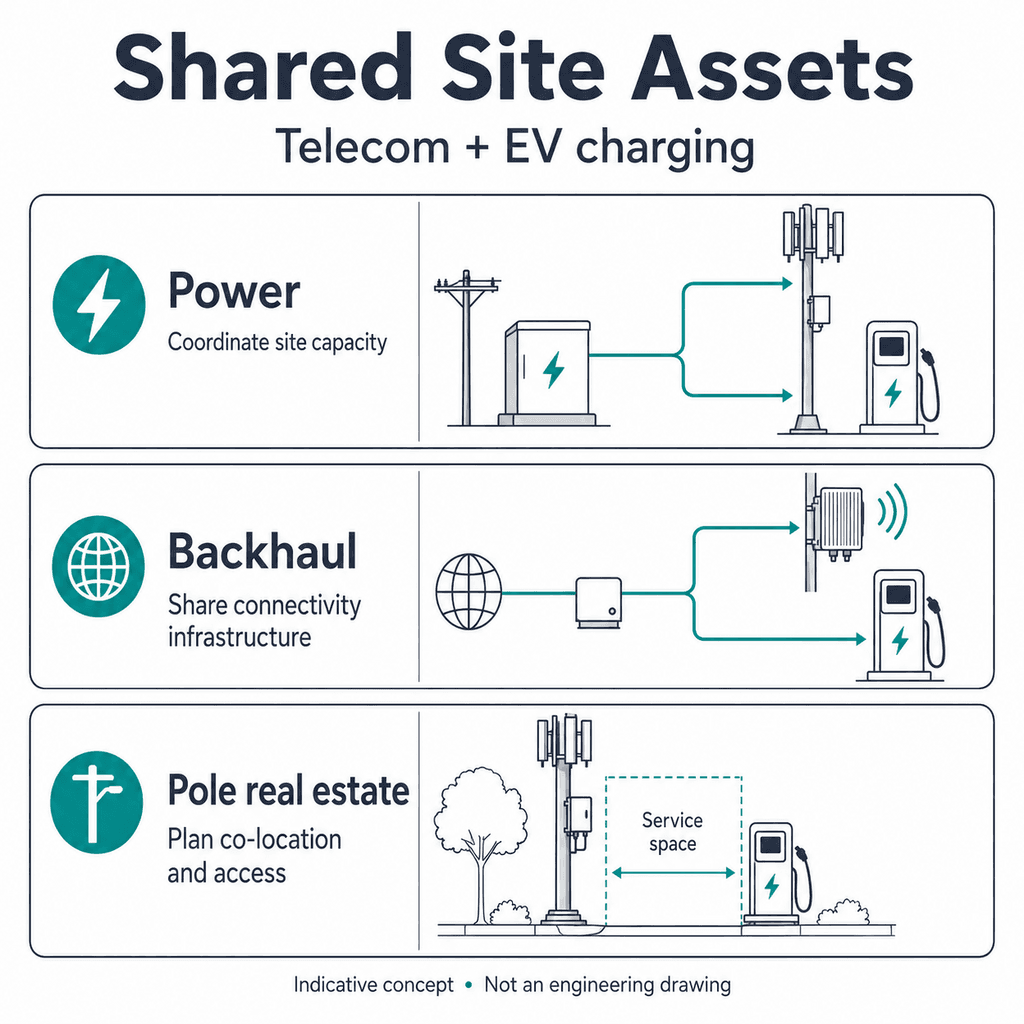
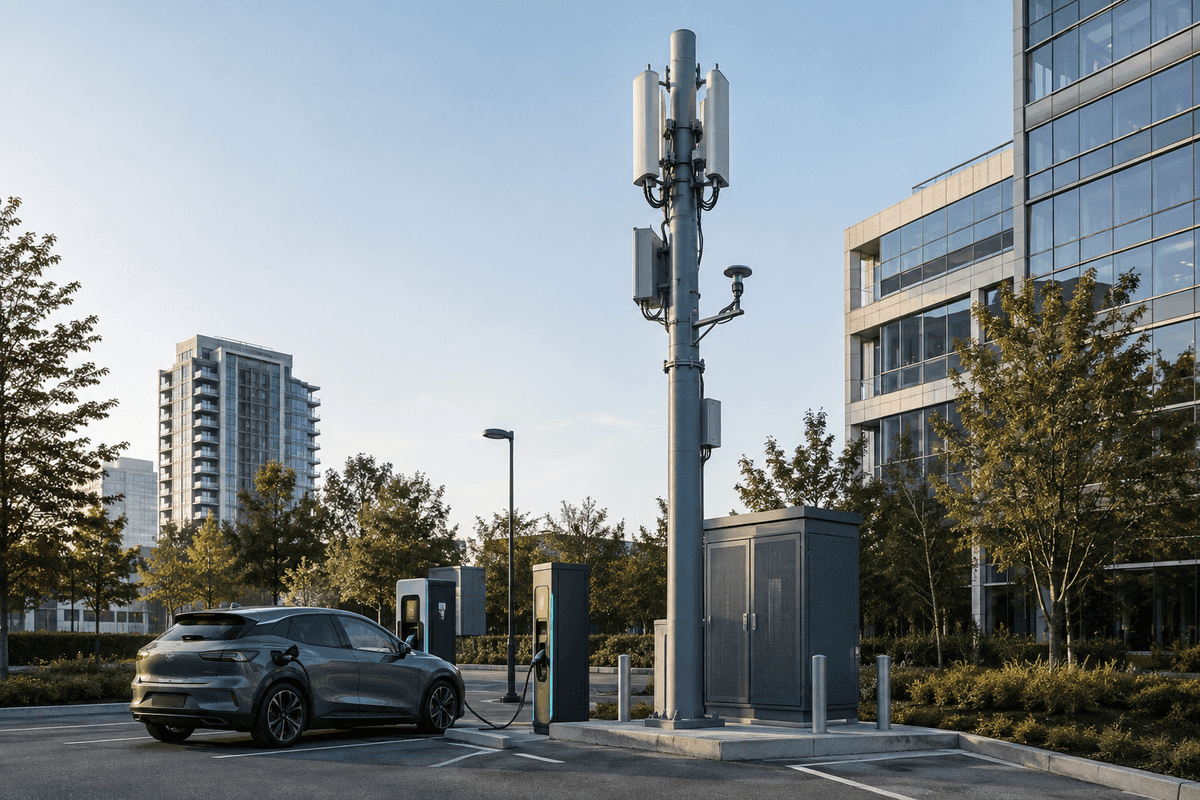
A shared 5G and EV charging site can reduce duplicated civil works by 20-35% when power cabinets, backhaul, lighting, and real estate are engineered together.
For cities, highway operators, malls, and telecom tower companies, the opportunity is not simply to mount a charger near a mast. The best projects treat the site as a distributed energy node: telecom radios require high availability, EV chargers create intermittent peaks, smart streetlights add control points, and optional solar-plus-storage reduces feeder stress. According to IEA (2025), public chargers exceeded 5 million globally in 2024 after more than 1.3 million additions in one year, so the pressure on urban distribution networks is accelerating.
The main risk is load conflict. A 5G base station may draw only several kilowatts continuously, but its uptime value is much higher than a flexible charging session. A site with 4 DC fast chargers at 150kW each can create 600kW of short-duration demand, while the telecom layer still needs uninterrupted DC power, cooling, monitoring, and backhaul. Best practice is to classify base station equipment as critical load and EV charging as controllable load.
SOLARTODO positions this integration as a B2B infrastructure package for smart streetlight corridors, telecom-adjacent commercial sites, transport depots, and municipal charging programs. SOLARTODO is a manufacturer and exporter, not an online marketplace, so final equipment selection should move from inquiry to offline engineering quotation, grid review, and optional project financing.
Technical Architecture and Load Priority
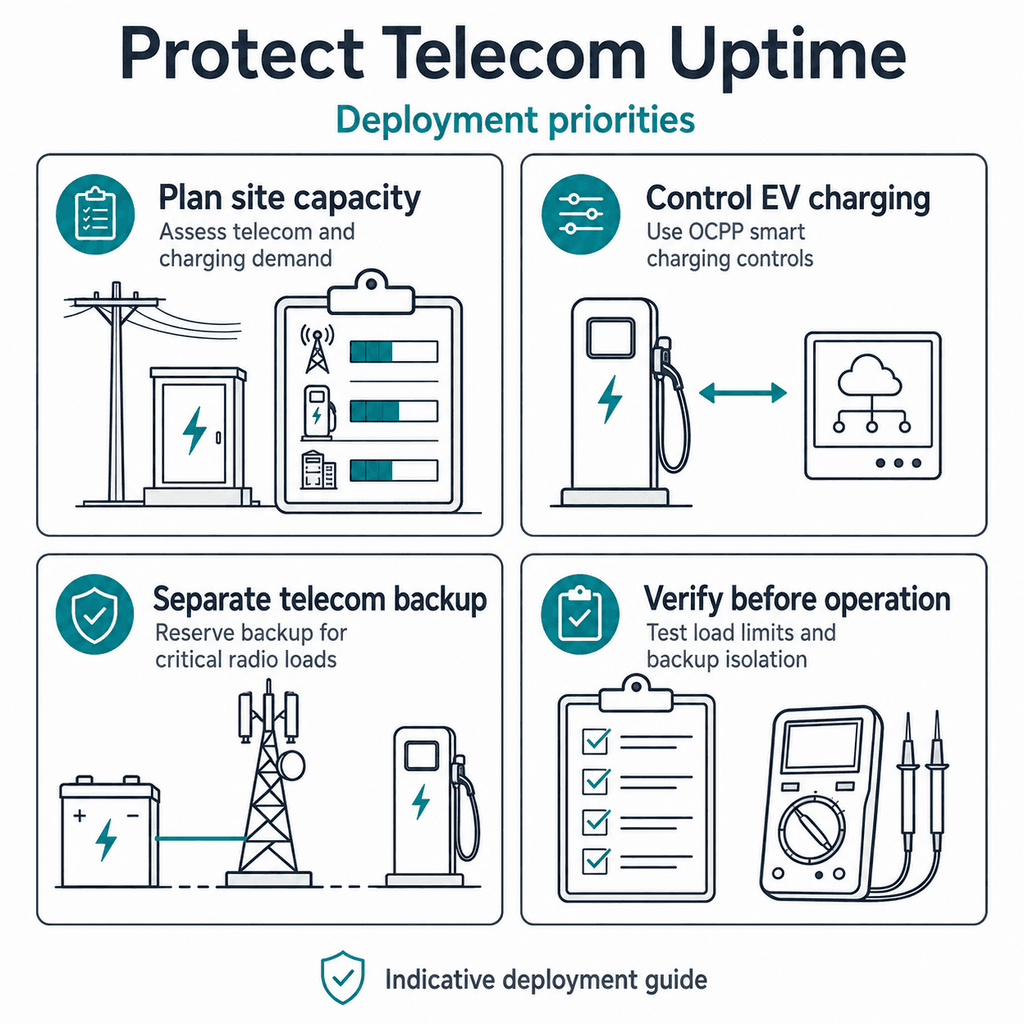
The preferred architecture uses 3 power layers: critical telecom DC, managed EV charging AC/DC, and optional PV-BESS buffering sized from 300kWh to 1.5MWh.
A robust design begins with a single-line diagram that separates telecom survivability from charger monetization. The 5G base station should have rectifiers, DC distribution, surge protection, and battery backup on a protected circuit. EV chargers should sit behind a controllable feeder with metering, residual-current protection, emergency stop, and load-management controls. When storage is included, the EMS must reserve a minimum state of charge for telecom backup before allowing charger peak shaving.
According to ITU-T L.1390 (2022), mobile networks consumed about 90TWh in 2015 and may reach about 130TWh in 2030, with most consumption in radio access network sites. That statistic explains why telecom operators care about every auxiliary load added to a base station location. EV charging revenue is attractive, but it must not increase outage exposure, cooling failure risk, or truck-roll frequency.
The Open Charge Alliance states, "OCPP is the global open communication protocol between charging stations and charging management systems." For integrated 5G sites, OCPP 2.0.1 or OCPP 2.1 is preferable because it supports device management, security, smart charging, and ISO 15118 features. OCPP 1.6 can work for simpler AC charging, but it usually requires stronger compensating controls for cybersecurity and diagnostics.
Recommended Electrical Segmentation
Use separate protection and metering for telecom, lighting, EV charging, and BESS. A practical layout includes one telecom DC cabinet, one EV distribution cabinet, one EMS gateway, one revenue-grade meter, and one optional battery container or outdoor cabinet. For urban smart streetlight corridors, AC chargers in the 7-22kW class are easier to distribute across poles, while highway and fleet sites often require 60-150kW DC charging bays.
Communications and Cybersecurity
The 5G base station can provide low-latency backhaul for charger telemetry, CCTV, payment terminals, parking sensors, and smart streetlight controllers. However, charger traffic should be logically segmented from telecom operations using VLANs, firewall rules, certificate-based authentication, and separate remote access policies. OCA (2026) identifies secure connection setup, security event logging, and secure firmware update as important OCPP security improvements.
Best Practices for Deployment and Operations
Successful integrated sites apply 6 controls: load hierarchy, smart charging, backup reserve, thermal separation, standards compliance, and remote fault response.
Start with a load study covering 15-minute demand intervals, peak charger concurrency, base station backup duration, streetlight operating hours, and seasonal cooling. For a small municipal node, the EV layer may be only 2 AC chargers at 22kW each. For a transport corridor or service station, the EV layer may require 4-10 chargers and a 300kWh to 1.5MWh BESS to avoid a transformer upgrade.
According to IEA (2024), public charging points grew 40% in 2023, and public charging needs to increase sixfold by 2035 under announced policy assumptions. The IEA states, "Public charging needs to increase sixfold by 2035." This supports early planning for shared feeder capacity, especially where 5G densification and EV adoption are happening in the same districts.
For the storage layer, LFP chemistry is generally preferred because it supports long cycle life, thermal stability, and daily peak shaving. A 750kW / 1.5MWh buffer battery can support charging hubs with up to 20 chargers where the utility connection is constrained. In smaller smart streetlight applications, modular 50-200kWh cabinets may be more practical than a containerized BESS.
| Integration Area | Best Practice | Target Specification | Procurement Check |
|---|---|---|---|
| Telecom backup | Reserve battery SOC for base station loads | 4-8 hours autonomy | Separate critical-load circuit |
| EV charging | Use managed charging profiles | 7-22kW AC or 60-150kW DC | OCPP 2.0.1 or 2.1 support |
| Grid interface | Control export/import behavior | IEEE 1547-2018 alignment | Utility interconnection approval |
| Energy storage | Use LFP BESS for peak shaving | 300kWh-1.5MWh | UL 9540 and UL 9540A evidence |
| Smart lighting | Integrate dimming and monitoring | 0-10V or DALI control | CMS compatibility |
| Cybersecurity | Segment charger and telecom networks | TLS and certificate controls | Firmware update policy |
EPC Investment Analysis and Pricing Structure
An EPC package should define 3 commercial scopes: FOB supply, CIF delivered equipment, and turnkey construction with ROI modeled over 5-8 years.
FOB Supply is suitable when the buyer has a local EPC contractor and wants SOLARTODO to provide chargers, poles, cabinets, PV, BESS, and smart controllers from the factory. CIF Delivered adds international freight, insurance, export documentation, and destination port delivery. EPC Turnkey includes engineering, procurement, installation supervision or full construction, testing, commissioning, as-built documentation, and operator training, subject to local licensing rules.
Volume pricing should be evaluated at the program level. For repeat deployments, use 50+ integrated poles or charger nodes as a 5% discount planning threshold, 100+ units as a 10% threshold, and 250+ units as a 15% threshold. These are commercial guidance points for budgeting, not a binding quotation, because steel structure, transformer size, civil works, battery capacity, and local compliance can shift final cost materially.
ROI depends on avoided civil duplication, energy savings, demand-charge reduction, and charger revenue. According to IRENA (2025), utility-scale solar PV reached a global weighted-average LCOE of USD 0.043/kWh in 2024, while battery storage costs declined 93% from 2010 to 2024 to USD 192/kWh. IRENA states, "renewables remained the most cost-competitive option for new electricity generation in 2024." For integrated sites, practical payback is often 5-8 years where charger utilization is healthy and demand charges are reduced by 15-40%.
SOLARTODO payment terms are typically 30% T/T plus 70% against B/L, or 100% L/C at sight for qualified buyers. Project financing is available for large projects above USD 1,000K, subject to credit review, country risk, project documents, and offtake assumptions. For quotations, procurement teams should contact [email protected] with site load data, charger count, grid capacity, backup-hour requirement, and destination country.
Selection Guide for Smart Streetlight and Telecom Sites
Choose AC charging for dwell times above 60 minutes, DC charging for turnover below 45 minutes, and BESS buffering when grid capacity is 25% undersized.
A smart streetlight corridor is usually different from a highway charging hub. Streetlight poles are distributed, space-constrained, and highly visible, so AC charging, camera integration, environmental sensing, and lighting control often matter more than ultra-fast charging. Telecom tower compounds and service stations have more room for transformers, switchgear, and BESS, so they can support higher-power DC charging while preserving base station uptime.
Procurement teams should evaluate 5 criteria before selecting equipment. First, confirm available grid import capacity and transformer headroom. Second, define the guaranteed telecom backup period, usually 4-8 hours depending on service criticality. Third, select charger power based on dwell time, not only headline charging speed. Fourth, require standards documentation for EVSE, BESS, interconnection, and fire safety. Fifth, require remote monitoring that covers alarms, charger status, battery SOC, lighting faults, and energy settlement.
| Site Type | Typical Charger Mix | Storage Need | Best Fit |
|---|---|---|---|
| Urban smart streetlight row | 2-20 AC chargers at 7-22kW | Optional 50-200kWh | Parking streets, municipal lots |
| 5G tower compound | 2-6 DC chargers at 60-150kW | 300-750kWh | Fleet depots, roadside retail |
| Mall or transport hub | 10 AC/DC chargers | 300kWh-1.5MWh | Retail parking, mixed-use sites |
| Highway service area | 4-20 DC fast chargers | 750kWh-1.5MWh | High turnover, constrained feeders |
SOLARTODO can package smart streetlights, 5G-ready poles, EV charging, solar PV, BESS, monitoring, and security systems into one exportable infrastructure scope. The best result comes from early engineering coordination among the telecom operator, utility, municipality, landowner, and charger operator.
FAQ
A 5G and EV charging integration project is viable when 4-hour telecom backup, smart charging controls, and grid capacity are designed before procurement.
Q: What is 5G base station EV charging integration? A: It is the co-location of 5G telecom equipment, EV chargers, smart streetlights, power cabinets, and sometimes solar-plus-storage at one infrastructure site. The goal is to share power, real estate, backhaul, and monitoring while keeping base station uptime protected. Designs usually range from 2 AC chargers to 20 mixed AC/DC chargers.
Q: Why integrate EV charging with a 5G base station or smart streetlight pole? A: Integration reduces duplicated civil works, improves use of pole or tower real estate, and gives EV chargers reliable communications. A shared site can cut trenching, metering, cabinet, and monitoring duplication by roughly 20-35% when planned early. The business case is strongest in parking corridors, malls, depots, and highway service areas.
Q: How much power capacity is needed for an integrated site? A: Small smart streetlight sites may need only 50-100kW, while 4 DC fast chargers can require 240-600kW before diversity factors. A larger hub with 10-20 chargers may need 750kW or more plus BESS buffering. Always reserve critical power separately for the base station, cooling, and communications equipment.
Q: Should telecom backup batteries be shared with EV chargers? A: Telecom backup should not be freely shared with EV charging loads because base station uptime is the critical service. A better design uses an EMS rule that reserves 4-8 hours of backup SOC for telecom circuits. EV chargers can use surplus BESS capacity only after the critical reserve is protected.
Q: Which communication protocol is best for charger management? A: OCPP 2.0.1 or OCPP 2.1 is the preferred protocol for new multi-site deployments because it supports smart charging, device management, improved security, and ISO 15118 features. OCPP 1.6 remains common, but buyers should require security extensions, remote diagnostics, and a migration path for 10+ charger networks.
Q: When is a BESS buffer necessary? A: A BESS buffer is necessary when charger peak demand exceeds available grid import, transformer capacity, or demand-charge limits. For example, a 300kWh to 1.5MWh LFP system can reduce peak import by 25-50% depending on charger utilization. It is most valuable for DC fast charging, weak feeders, and high-tariff sites.
Q: What standards should procurement teams request? A: Request IEC 61851-1:2017 for EV supply equipment safety, IEEE 1547-2018 for DER interconnection, UL 9540 and UL 9540A for BESS safety evidence, and OCPP certification where applicable. For PV additions, include IEC 61215 and IEC 61730 module documentation. Local utility and fire-code requirements still govern final approval.
Q: How does EPC pricing usually work for these projects? A: Pricing is normally structured as FOB Supply, CIF Delivered, or EPC Turnkey. FOB covers factory supply, CIF adds freight and insurance, and EPC Turnkey adds engineering, installation, commissioning, and documentation. SOLARTODO also uses volume guidance of 5% discount for 50+ units, 10% for 100+, and 15% for 250+.
Q: What payment terms and financing options are available? A: Standard payment terms are 30% T/T plus 70% against B/L, or 100% L/C at sight for qualified buyers. Financing may be available for large projects above USD 1,000K after review of buyer credit, country risk, project economics, and supporting documents. Contact [email protected] for quotation screening.
Q: What maintenance issues are unique to combined 5G and EV sites? A: Maintenance must protect two service models: telecom uptime and public charger availability. Separate access zones reduce the risk that charger maintenance affects radio equipment. Operators should inspect switchgear, connectors, cooling, firmware, metering, security cameras, and battery SOC policies at least every 6-12 months.
Conclusion
The best 5G base station EV charging sites protect 4-8 hours of telecom backup while using smart charging and BESS to manage 150-750kW peaks.
The bottom line: 5G base station EV charging integration is most bankable when critical telecom loads are electrically separated, chargers are controlled through OCPP 2.x, and storage is sized to avoid 25-50% grid-capacity shortfalls. For B2B programs, SOLARTODO should be specified through an engineering quotation covering power, poles, chargers, BESS, monitoring, standards, logistics, and EPC scope.
References
- IEA Global EV Outlook (2025): Reports more than 5 million public charging points in 2024 and over 1.3 million additions during the year. — https://www.iea.org/reports/world-energy-outlook-2024
- IEA Global EV Outlook (2024): Reports 40% public charging growth in 2023 and a sixfold public charging requirement by 2035. — https://www.iea.org/reports/world-energy-outlook-2024
- IRENA Renewable Power Generation Costs in 2024 (2025): Reports solar PV LCOE of USD 0.043/kWh and battery storage cost decline to USD 192/kWh. — https://www.irena.org/Data/View-data-by-topic/Capacity-and-Generation
- IEEE 1547-2018 (2018): Standard for interconnection and interoperability of distributed energy resources with electric power systems interfaces. — https://standards.ieee.org/ieee/1547/7382/
- IEC 61851-1:2017 (2017): Electric vehicle conductive charging system standard covering EVSE operating conditions, connection requirements, and electrical safety. — https://webstore.iec.ch/
- UL 9540 (2023): Energy Storage Systems and Equipment standard covering ESS safety, protection functions, controls, and grid interaction. — https://www.ul.com/ Authoritative standards and market references confirm that EV charging, DER interconnection, telecom energy efficiency, and BESS safety require at least 5 coordinated compliance checks.
- IEA (2025): Global EV Outlook 2025 reports more than 5 million public charging points in 2024 and over 1.3 million additions during the year.
- IEA (2024): Global EV Outlook 2024 reports 40% public charging growth in 2023 and a sixfold public charging requirement by 2035.
- IRENA (2025): Renewable Power Generation Costs in 2024 reports solar PV LCOE of USD 0.043/kWh and battery storage cost decline to USD 192/kWh.
- IEEE 1547-2018 (2018): Standard for interconnection and interoperability of distributed energy resources with electric power systems interfaces.
- IEC 61851-1:2017 (2017): Electric vehicle conductive charging system standard covering EVSE operating conditions, connection requirements, and electrical safety.
- UL 9540 (2023): Energy Storage Systems and Equipment standard covering ESS safety, protection functions, controls, and grid interaction.
- Open Charge Alliance (2025): OCPP 2.0.1 and OCPP 2.1 protocol guidance covering smart charging, security, ISO 15118, and DER-related functions.
- ITU-T L.1390 (2022): Energy-saving technologies and best practices for 5G RAN equipment, including mobile network energy consumption context.
About SOLARTODO
SOLARTODO is a global integrated solution provider specializing in solar power generation systems, energy-storage products, smart street-lighting and solar street-lighting, intelligent security & IoT linkage systems, power transmission towers, telecom communication towers, and smart-agriculture solutions for worldwide B2B customers.
About the Author

Cinn Song
Founder & Chief Solutions Architect
Cinn Song founded SOLARTODO LIMITED and leads its smart-city infrastructure engineering — from solar, storage and integrated smart poles to the company's push into physical-AI city edge nodes: pole-mounted edge computing, vertical LLMs for smart cities, drone-based O&M with autonomous battery swapping, robotic maintenance, and high-speed counter-UAS interception. Since 2010, he has directed turnkey EPC + BOT delivery across 50+ countries, including telecom monopole supply for national grid operators, off-grid solar street-lighting for African municipalities, and integrated smart-pole programs for Gulf smart cities.
Cite This Article
Cinn Song. (2026). 5G base station EV Charging Integration Best Practices. SOLARTODO. Retrieved from https://solartodo.com/knowledge/5g-base-station-ev-charging-integration-best-practices
@article{solartodo_5g_base_station_ev_charging_integration_best_practices,
  title = {5G base station EV Charging Integration Best Practices},
  author = {Cinn Song},
  journal = {SOLARTODO Knowledge Base},
  year = {2026},
  url = {https://solartodo.com/knowledge/5g-base-station-ev-charging-integration-best-practices},
  note = {Accessed: 2026-09-07}
}
Published: September 7, 2026 | Available at: https://solartodo.com/knowledge/5g-base-station-ev-charging-integration-best-practices
Subscribe to Our Newsletter
Get the latest solar energy news and insights delivered to your inbox.
View All Articles