45+ Traffic Violation Types by Single AI Camera 2026

SOLARTODO Editorial Team
Solar Energy & Infrastructure Expert Team
Watch the video
TL;DR
A 2026 single AI traffic camera can detect 45+ traffic and violation types from one device, including 98% license plate recognition, 320 km/h speed capture, and >95% wrong-way detection. For B2B buyers, the main advantage is replacing 3-6 legacy roadside devices with one solar-ready, encrypted, EPC-deployable platform that improves enforcement ROI and lowers installation complexity.
A single AI traffic camera can classify 45+ traffic and violation events in real time, including 98% license plate recognition, 320 km/h speed capture, and >95% wrong-way detection, helping cities replace 3-6 legacy roadside devices with one platform.
Summary
A single AI traffic camera can classify 45+ vehicle, pedestrian, and violation events in real time, including 98% license plate recognition, 320 km/h speed capture, and >95% accuracy for wrong-way riding in 2026 deployments.
Key Takeaways
- Deploy one AI camera to detect 45+ object and violation classes, reducing hardware count by 30-50% versus single-function roadside devices.
- Prioritize models with 98% license plate recognition and 320 km/h speed capture when enforcement must support highways, arterials, and legal evidence workflows.
- Select systems with >95% accuracy for wrong-way riding and >93% for restricted-zone entry to improve enforcement reliability in dense urban corridors.
- Use motorcycle-focused analytics where two-wheelers exceed 60% of traffic, including 97.7% mAP helmet detection and >94% triple-riding recognition.
- Integrate edge AI and event filtering to cut backhaul bandwidth by 40-70% compared with continuous raw-video transmission architectures.
- Plan phased rollout from 3-5 intersections in 1-3 months, then expand to 50-100 intersections within 3-9 months after KPI validation.
- Compare FOB Supply, CIF Delivered, and EPC Turnkey pricing, and apply volume discounts of 5% at 50+, 10% at 100+, and 15% at 250+ units.
- Specify blockchain-secured evidence, end-to-end encryption, and GDPR-aligned data handling to protect chain of custody and reduce compliance risk.
What a Single AI Traffic Camera Can Detect in 2026
A single 2026-grade AI traffic camera can identify 45+ traffic classes and violations, deliver 98% license plate recognition, and capture speed events up to 320 km/h from one edge-enabled device.
For B2B buyers, the key shift is from single-purpose enforcement hardware to multi-class computer vision running on one camera, one pole, and one communications link. Instead of deploying separate devices for ANPR, speed, red-light, helmet, pedestrian, and lane analytics, municipalities and EPC contractors can consolidate functions into a unified roadside node. This reduces civil works, simplifies maintenance, and improves data consistency across enforcement and traffic operations.
The practical value is strongest in mixed-traffic environments where cars, buses, trucks, motorcycles, e-bikes, bicycles, and pedestrians share constrained road space. According to the product data used in this guide, modern systems detect 45+ object and violation types, including helmet non-compliance with 97.7% mAP and 92.7% F1, triple riding above 94%, overloading 4+ above 91%, wrong-way riding above 95%, and restricted-zone entry above 93%. These metrics matter because procurement teams increasingly require measurable detection performance, not generic AI claims.
SOLAR TODO positions this capability inside a broader Smart Traffic Management System that can also integrate solar power, LFP battery storage, and off-grid deployment. That is especially relevant in developing markets, rural highways, border roads, and temporary enforcement zones where utility power is unstable or unavailable. For project managers, this means the camera is no longer just a sensor; it becomes a self-powered, networked enforcement and traffic intelligence asset.
According to the International Energy Agency, "Digitalization is becoming a key enabler of more efficient, resilient and sustainable energy and infrastructure systems." That statement applies directly to smart traffic, where AI vision converts unmanaged video into operational decisions, enforceable evidence, and planning data. In 2026, the winning specification is not simply image resolution, but how many validated traffic decisions one camera can support.
Classification Framework: 45+ Violation and Traffic Event Types
A practical 45+ classification framework groups detections into 5 operational layers: road users, vehicle attributes, behavioral violations, lane-space misuse, and enforcement evidence, enabling one camera to serve both safety and revenue objectives.
Procurement teams should evaluate AI camera capability by classification logic rather than by marketing labels. A useful framework separates what the camera sees, what it infers, and what it can legally document. This distinction helps engineers match camera outputs to enforcement rules, signal control inputs, and reporting dashboards.
1. Road user and vehicle class detection
The first layer identifies who or what is on the road. Typical classes include sedan, SUV, MPV, sports car, motorcycle, electric motorcycle, 3-wheel motorcycle, e-bike, bicycle, bus, school bus, light truck, heavy truck, tanker, pedestrian, child pedestrian, wheelchair user, and emergency vehicle. In developing markets, motorcycle and e-bike intelligence is critical because two-wheelers can represent 60%+ of traffic volume.
This base classification supports counting, lane occupancy analysis, queue estimation, and violation context. For example, the same stop-line event has different enforcement meaning for a bus, tanker, or motorcycle. SOLAR TODO emphasizes this mixed-traffic capability because many standard Western ITS datasets underperform in regions with high motorcycle density and non-homogeneous traffic behavior.
2. Identity, attributes, and evidence extraction
The second layer extracts forensic details such as license plate number, plate region, vehicle color, type, and trajectory. Product data indicates 98% license plate recognition, which is a critical threshold for automated enforcement workflows. Evidence quality also depends on timestamping, lane mapping, image clarity, and secure event packaging.
At this layer, one camera can support watchlists, stolen vehicle alerts, access control, and post-incident search. It also enables integration with police databases, tolling systems, and municipal command centers. For legal defensibility, buyers should ask whether metadata is signed, hashed, and retained under auditable chain-of-custody rules.
3. High-frequency rider and occupant violations
The third layer captures violations common in dense urban and peri-urban roads. These include helmet non-compliance, triple riding, overloading 4+, and unsafe passenger carriage on motorcycles or e-bikes. According to the product data, helmet non-compliance reaches 97.7% mAP with 92.7% F1, while triple riding exceeds 94% detection accuracy.
These functions are commercially important because they address under-enforced risks in Asia, Africa, Latin America, and the Middle East. They also produce fast ticket volumes in corridors where conventional red-light-only systems miss the majority of unsafe behavior. For public agencies, this expands the ROI case beyond congestion management into road safety and public health.
4. Directional, lane, and zone violations
The fourth layer covers wrong-way riding, motor lane intrusion, restricted-zone entry, bus-lane misuse, stop-line crossing, illegal turn, illegal U-turn, lane weaving, and shoulder misuse. Product data reports >95% for wrong-way riding, >93% for motor lane intrusion, and >93% for restricted-zone entry. These are the core detections for urban corridor discipline and protected-lane enforcement.
Such events are especially useful when linked to adaptive signals or dynamic message signs. A wrong-way or restricted-entry event can trigger immediate alerts, while aggregated patterns can justify geometric redesign, bollards, or revised lane markings. This is where one camera shifts from enforcement tool to traffic engineering sensor.
5. Speed, incident, and priority events
The fifth layer includes speed detection, congestion anomalies, stopped vehicle alerts, pedestrian conflict zones, emergency vehicle recognition, and incident escalation. Current product capability supports speed detection up to 320 km/h and automatic emergency vehicle priority. This allows one roadside node to serve both highway enforcement and urban operations.
According to IEEE, interoperability and trusted data exchange are essential for distributed intelligent infrastructure. In practice, that means the camera should output standardized events into signal controllers, VMS systems, and central software rather than trapping data in a proprietary silo. SOLAR TODO addresses this through integrated smart traffic architecture rather than isolated camera sales.
Technical Architecture and Performance Requirements
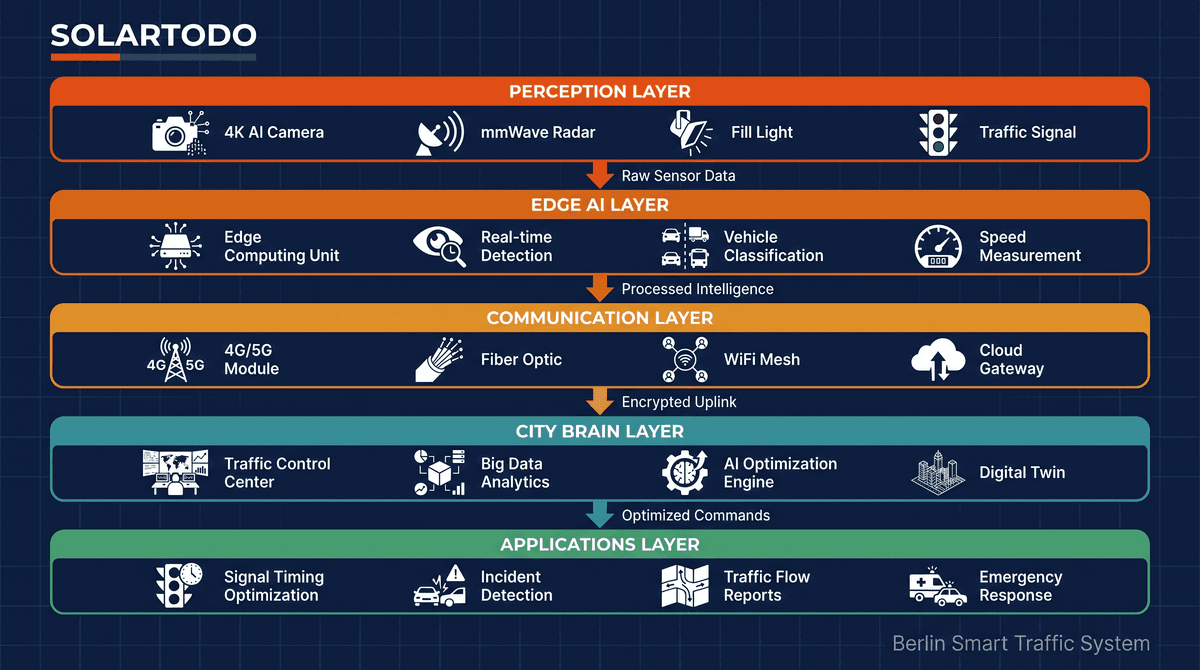
A 2026 single-camera enforcement system should combine edge AI, 4G/5G or fiber backhaul, encrypted evidence storage, and sub-second event processing to replace 3-6 legacy roadside devices with one managed node.
The technical question is not whether AI can detect violations, but whether the camera can do so consistently under heat, rain, glare, night conditions, and mixed-speed traffic. B2B buyers should therefore assess optics, processing, cybersecurity, and power architecture together. A strong spec sheet without deployment resilience usually leads to false positives, missed evidence, and maintenance escalation.
A typical architecture includes a high-resolution image sensor, onboard AI processor, IR or low-light support, radar or video speed estimation logic, GNSS time sync, encrypted local storage, and uplink to a central platform. Event filtering at the edge is increasingly important because transmitting only clips and metadata can reduce bandwidth by 40-70% compared with continuous raw video. That matters for rural, solar-powered, or cellular deployments where every watt and megabyte affects operating cost.
SOLAR TODO adds a differentiator by integrating solar panels on pole tops with LFP battery storage for 24/7 operation without grid electricity. For off-grid corridors, this avoids trenching, utility approvals, and diesel dependence. It also supports temporary deployments, rural highways, and border enforcement where civil works often delay projects longer than the technology itself.
According to NREL (2024), distributed solar and storage improve resilience and reduce infrastructure dependence in remote applications. In smart traffic, that resilience translates into higher uptime for enforcement and safety systems. When a city loses grid power, a solar-plus-storage camera can continue capturing evidence and monitoring incidents.
The International Energy Agency states, "Digital technologies can improve the efficiency, sustainability and resilience of energy systems." The same logic applies to transport infrastructure when cameras, power systems, and analytics are designed as one platform. For 2026 projects, buyers should specify zero-trust security, end-to-end encryption, and GDPR-aligned data handling as baseline requirements rather than optional features.
Deployment Scenarios, ROI, and Measured Outcomes
Single AI cameras generate value through enforcement revenue, congestion reduction, and lower infrastructure cost, with pilot deployments typically starting at 3-5 intersections in 1-3 months before scaling to 50-100 intersections.
The ROI case is strongest when one device supports multiple departments at once: traffic police, transport authority, smart city office, and public works. Instead of just issuing citations, the same camera can count traffic, detect queue buildup, prioritize emergency vehicles, monitor lane compliance, and provide planning data. This multi-department utility improves budget approval because capex serves more than one KPI.
Real-world smart traffic outcomes support the business case. According to the deployment results provided, Pittsburgh's SURTRAC AI signal program reduced travel time by 25% and emissions by 20%, while London reported travel-time improvements of 10-30%. Singapore's digital twin traffic approach reduced commute time by 15%, and green-wave coordination can reduce stops by 40%. These examples show that detection infrastructure creates more value when connected to broader traffic management workflows.
Enforcement-focused deployments also show high activity levels. In Greece, 8 cameras detected 29,000 violations within weeks, illustrating how quickly automated systems can surface previously unobserved non-compliance. In Rwanda, full automation deployment was associated with fewer accidents, while transit and emergency priority applications can cut response time by 50% according to the product data.
For EPCs and project developers, the commercial model should compare AI camera deployment against conventional multi-device roadside systems. Savings come from fewer poles, less trenching, fewer cabinets, and reduced maintenance visits. In off-grid sites, solar integration can remove utility connection costs entirely, which is often decisive in rural and peri-urban tenders.
Comparison Guide: Single AI Camera vs Conventional Multi-Device Enforcement
A single AI camera can replace 3-6 conventional roadside devices, improving data consistency and lowering installation complexity by consolidating detection, evidence, and communications into one platform.
The comparison below helps procurement managers evaluate whether consolidation is technically and financially justified.
| Criteria | Single AI Camera System | Conventional Multi-Device Setup |
|---|---|---|
| Detection scope | 45+ traffic and violation classes | 1-3 functions per device |
| License plate recognition | Up to 98% | Often separate ANPR unit required |
| Speed capture | Up to 320 km/h | Usually separate radar/camera pair |
| Motorcycle analytics | Helmet, triple riding, overloading 4+ | Often unsupported or limited |
| Lane/zone violations | Wrong-way, intrusion, restricted entry | Usually requires multiple sensors |
| Edge processing | Yes, event filtering at source | Often central-server dependent |
| Power options | Grid or solar + LFP battery | Mainly grid-dependent |
| Installation complexity | Low to medium | Medium to high |
| Civil works | Reduced pole/cabinet count | Higher trenching and cabinet needs |
| Best use case | Mixed-traffic smart corridors | Legacy point enforcement |
Selection should also consider climate rating, legal evidence requirements, and integration with existing ITS software. A camera that detects 45+ classes but cannot export validated events into your command platform will underperform operationally. SOLAR TODO typically fits projects where buyers want enforcement, traffic analytics, and renewable-powered resilience in one package.
EPC Investment Analysis and Pricing Structure
A bankable 2026 smart traffic project should compare FOB, CIF, and EPC Turnkey delivery, target payback within 24-48 months in active corridors, and use volume discounts up to 15% for 250+ units.
For B2B buyers, EPC means Engineering, Procurement, and Construction delivered as one turnkey scope. In a smart traffic camera project, this typically includes site survey, pole and foundation design, power design, camera and network hardware supply, software integration, commissioning, training, and handover documentation. Where required, it may also include solar pole-top generation, LFP battery storage, and central platform deployment.
A practical pricing structure is usually divided into three tiers:
- FOB Supply: Factory supply only, suitable for distributors or experienced local integrators handling freight, customs, civil works, and installation.
- CIF Delivered: Product plus freight and insurance to destination port, suitable when the buyer wants import cost visibility but retains local installation control.
- EPC Turnkey: Full delivery including engineering, installation, integration, testing, and training, suitable for municipalities, highway operators, and donor-funded projects.
Indicative commercial guidance for volume procurement should follow these discount bands:
- 50+ units: 5% discount
- 100+ units: 10% discount
- 250+ units: 15% discount
Payment terms commonly used are 30% T/T deposit and 70% against B/L, or 100% L/C at sight for qualified transactions. Financing is available for large projects above $1,000K, which is relevant for city-wide deployments, corridor modernization, and national road safety programs. For quotations, EPC discussions, and financing inquiries, buyers can contact [email protected].
ROI depends on enforcement intensity, avoided civil works, and whether the project also improves flow. In active corridors, payback can often fall within 24-48 months when citation revenue, reduced field labor, and lower infrastructure cost are combined. Compared with conventional multi-device systems, a single AI camera architecture can reduce installation and maintenance burden enough to improve lifecycle economics even before enforcement revenue is counted.
FAQ
A strong FAQ for AI traffic cameras should answer 10 core buyer questions on accuracy, legality, deployment, pricing, maintenance, and integration in 40-80 words each for fast decision support.
Q: What does “45+ traffic violation types” actually include? A: It means one AI camera can classify more than 45 road-user, vehicle, and violation events from a single video stream. Typical categories include vehicle classes, license plate recognition, speeding, wrong-way riding, helmet non-compliance, triple riding, lane intrusion, restricted-zone entry, illegal turns, and pedestrian-related conflicts.
Q: How accurate is a single AI traffic camera in real deployments? A: Accuracy depends on the violation type, camera placement, and lighting conditions. Based on the available product data, license plate recognition reaches 98%, helmet non-compliance reaches 97.7% mAP with 92.7% F1, wrong-way riding exceeds 95%, and restricted-zone entry exceeds 93% under trained deployment conditions.
Q: Can one camera replace multiple traditional enforcement devices? A: Yes, in many corridors one AI camera can replace 3-6 legacy devices by combining ANPR, speed, lane, rider, and zone analytics. The main benefit is lower installation complexity, fewer cabinets and poles, and more consistent evidence and reporting across departments.
Q: Which markets benefit most from motorcycle-focused AI detection? A: Regions where motorcycles and e-bikes make up 60% or more of traffic benefit the most. This includes many cities in Southeast Asia, Africa, Latin America, and parts of the Middle East, where helmet use, triple riding, and lane discipline are major safety and enforcement priorities.
Q: How does solar integration help smart traffic camera projects? A: Solar integration allows 24/7 operation without grid electricity when combined with LFP battery storage. This reduces trenching, utility approvals, and outage risk, making it ideal for rural highways, temporary enforcement zones, border roads, and developing regions with unstable power supply.
Q: What is included in an EPC turnkey smart traffic project? A: EPC turnkey delivery usually includes engineering design, procurement, civil works coordination, installation, software integration, testing, commissioning, and training. In SOLAR TODO projects, it can also include solar pole-top power systems, LFP batteries, communications, and central platform integration for a complete operational handover.
Q: What pricing model should B2B buyers request? A: Buyers should request quotations in three formats: FOB Supply, CIF Delivered, and EPC Turnkey. This makes it easier to compare factory cost, landed cost, and full installed cost, while also applying volume discounts of 5% for 50+, 10% for 100+, and 15% for 250+ units.
Q: What are the usual payment terms and financing options? A: Standard terms are typically 30% T/T in advance and 70% against B/L, or 100% L/C at sight. For large projects above $1,000K, financing may be available, which is useful for municipalities, donor-backed programs, and corridor-scale smart traffic upgrades.
Q: How long does deployment usually take? A: A pilot of 3-5 intersections can usually be deployed in 1-3 months, depending on permits and communications readiness. Expansion to 50-100 intersections often takes 3-9 months, while city-wide deployment with digital twin integration may require 9-18 months.
Q: What cybersecurity and compliance features should be mandatory? A: Buyers should require end-to-end encryption, zero-trust access control, signed evidence files, audit logs, and GDPR-aligned data handling. For legal enforcement, blockchain-secured evidence chain or equivalent tamper-evident storage is valuable because it strengthens chain of custody and reduces disputes.
Q: How much maintenance does a single AI traffic camera require? A: Maintenance is usually lower than multi-device systems because there are fewer field components. Most projects need periodic lens cleaning, alignment checks, battery and solar inspection for off-grid sites, firmware updates, and annual validation of detection accuracy against local traffic conditions.
Q: Why choose SOLAR TODO for this category? A: SOLAR TODO is relevant when the project needs smart traffic analytics plus renewable-powered roadside infrastructure. Its advantage is combining AI enforcement, solar pole-top integration, LFP battery storage, and export-oriented B2B delivery for municipalities, EPCs, and infrastructure developers in emerging and mixed-traffic markets.
References
A bankable procurement decision should rely on at least 5 authoritative standards and industry sources covering AI infrastructure, power resilience, interoperability, and photovoltaic support systems.
- NREL (2024): Distributed energy and solar resource methodologies relevant to resilient off-grid and hybrid roadside infrastructure design.
- IEEE (2018): IEEE 1547-2018, interoperability principles for distributed energy resources and connected infrastructure interfaces.
- IEA (2024): Analysis of digitalization and infrastructure efficiency, supporting the role of smart connected systems in transport and energy operations.
- IRENA (2024): Renewable power deployment and cost trends supporting solar-plus-storage economics for distributed infrastructure.
- IEC (2021): IEC 61215-1:2021, photovoltaic module design qualification and type approval requirements.
- IEC (2023): IEC 61730-1:2023, photovoltaic module safety qualification requirements for construction and testing.
- UL (2023): UL standards framework for electrical safety and equipment compliance relevant to integrated roadside power systems.
- IEEE (2023): Intelligent transportation and connected infrastructure publications supporting secure, interoperable smart traffic deployments.
Conclusion
A single 2026 AI traffic camera can detect 45+ classes, reach 98% plate recognition, and support highway speeds up to 320 km/h, making it a practical replacement for multiple legacy enforcement devices.
For municipalities, EPCs, and corridor operators, the bottom line is clear: choose a multi-class, solar-ready, secure platform such as SOLAR TODO when you need faster deployment, lower infrastructure complexity, and measurable enforcement ROI within 24-48 months.
About SOLARTODO
SOLARTODO is a global integrated solution provider specializing in solar power generation systems, energy-storage products, smart street-lighting and solar street-lighting, intelligent security & IoT linkage systems, power transmission towers, telecom communication towers, and smart-agriculture solutions for worldwide B2B customers.
Further Reading
About the Author

SOLARTODO Editorial Team
Solar Energy & Infrastructure Expert Team
SOLAR TODO is a professional supplier of solar energy, energy storage, smart lighting, smart agriculture, security systems, communication towers, and power tower equipment.
Our technical team has over 15 years of experience in renewable energy and infrastructure, providing high-quality products and solutions to B2B customers worldwide.
Expertise: PV system design, energy storage optimization, smart lighting integration, smart agriculture monitoring, security system integration, communication and power tower supply.
Cite This Article
SOLARTODO Editorial Team. (2026). 45+ Traffic Violation Types by Single AI Camera 2026. SOLARTODO. Retrieved from https://solartodo.com/knowledge/45-traffic-violation-types-detected-by-single-ai-camera-complete-classification-guide-2026
@article{solartodo_45_traffic_violation_types_detected_by_single_ai_camera_complete_classification_guide_2026,
  title = {45+ Traffic Violation Types by Single AI Camera 2026},
  author = {SOLARTODO Editorial Team},
  journal = {SOLARTODO Knowledge Base},
  year = {2026},
  url = {https://solartodo.com/knowledge/45-traffic-violation-types-detected-by-single-ai-camera-complete-classification-guide-2026},
  note = {Accessed: 2026-10-19}
}
Published: July 12, 2026 | Available at: https://solartodo.com/knowledge/45-traffic-violation-types-detected-by-single-ai-camera-complete-classification-guide-2026
Subscribe to Our Newsletter
Get the latest solar energy news and insights delivered to your inbox.
View All Articles