
Summary
An engineered 110kV FRP composite power transmission tower solution: 18m poles, 200m spans, Class 4 wind (40 m/s), and 40-year design life. Three-tier pricing: $151,551 FOB, $186,525 CIF, and $233,156 turnkey, delivering $13,600 annual O&M savings and a 17-year payback for 112-pole international projects.
Key Takeaways
- Deploy 18m FRP composite poles for 110kV lines with 200m span length and Class 4 (40 m/s) wind compliance to reduce structural risk in exposed international sites.
- Use the verified three-tier pricing model: $151,551 FOB, $186,525 CIF, and $233,156 turnkey to plan CAPEX and contracting strategy for 112-structure projects.
- Leverage the complete BOM of 112 FRP poles, ACSR-240 conductors, and foundations to standardize procurement and simplify multi-country rollouts.
- Achieve 40-year design life and 350 MPa bending strength with only 181 kg per pole, cutting logistics and installation complexity for remote corridors.
- Target $13,600 annual O&M savings and a 17-year payback by shifting from steel to FRP, improving lifecycle economics for 110kV distribution lines.
- Design to ASTM D4923 / IEC 61109 standards, Class E (120°C) insulation, and 8 mm deflection to align with utility reliability and safety requirements.
- Optimize for single-circuit ACSR-240 conductors over 200m spans to balance material cost, ampacity, and mechanical loading in 110kV networks.
- Select SOLAR TODO’s turnkey scope at $233,156 when local installation capacity is limited, ensuring line performance and warranty continuity.
Power Transmission Tower in Global — $233,156 Turnkey
This case study presents a 110kV FRP composite power transmission tower solution using 18m poles over 200m spans, engineered for Class 4 wind (40 m/s) and 40-year design life, priced at $151,551 FOB, $186,525 CIF, and $233,156 turnkey for 112 structures. It is a standardized, export-ready configuration for international deployment.
Power utilities and EPCs expanding 110kV networks into new or challenging geographies often struggle with steel tower corrosion, high logistics costs, and inconsistent installation quality. This verified configuration from SOLAR TODO uses Fiber Reinforced Polymer (FRP) composite poles to deliver a lighter, corrosion-resistant alternative with predictable pricing and performance.
According to IEA (2024), global electricity demand is expected to grow by around 2% annually through 2026, driving substantial investment in transmission and distribution infrastructure. At the same time, IRENA (2023) notes that modern grid upgrades increasingly prioritize reliability and lifecycle cost, not just upfront CAPEX. This configuration is designed to address exactly those priorities.
Technical Deep Dive: FRP 110kV Composite Pole Solution
The solution is based on an 18m FRP composite pole for 110kV power transmission, configured as a single-circuit line with ACSR-240 conductors and 200m span length. It is optimized for international deployments where site location is still TBD but environmental and electrical parameters are defined.
Core Technical Specifications
Key structural and electrical parameters are as follows:
- Height: 18 m
- Material: FRP (Fiber Reinforced Polymer)
- Voltage level: 110kV
- Span length: 200 m
- Wind class: Class 4
- Design wind speed: 40 m/s
- Bending moment: 36.3 kN·m
- Deflection: 8 mm
- Bending strength: 350 MPa
- Insulation class: Class E (120°C)
- Design life: 40 years
- Conductor type: ACSR_240
- Circuit count: 1
- Design standard: ASTM D4923 / IEC 61109
- Base diameter: 386 mm
- Tip diameter: 116 mm
- Taper ratio: 15
- Total weight: 181 kg per pole
- Corrosion resistance: excellent
According to ASTM and IEC guidance, FRP structures with bending strengths in the 300–400 MPa range provide a robust safety margin for distribution and sub-transmission applications when correctly designed for local wind and ice loads. IEC 61109 specifically addresses composite insulator performance, aligning with the insulation class used here.
Structural Performance and Wind Loading
The Class 4 wind rating at 40 m/s is suitable for many coastal and elevated inland regions. IEEE and IEC transmission design practices typically consider 35–45 m/s as a common design range for standard transmission corridors, with higher values reserved for cyclone- or hurricane-prone zones.
Key structural benefits of this FRP configuration include:
- High bending strength (350 MPa) with a 36.3 kN·m design bending moment
- Low deflection (8 mm) under design load, improving conductor clearance control
- Lightweight structure (181 kg) reducing foundation and lifting requirements
- Excellent corrosion resistance, eliminating repainting and mitigating rust-driven failures
NREL (2023) highlights that composite materials in grid infrastructure can materially reduce maintenance cycles compared with conventional steel, particularly in corrosive coastal or industrial environments.
Electrical and Thermal Design
The system is designed for a 110kV single-circuit line using ACSR-240 conductors. ACSR-240 is a widely used conductor size in 110kV networks, offering a balance between ampacity, sag performance, and cost.
Key electrical design aspects:
- Voltage level: 110kV, suitable for regional sub-transmission and long distribution feeders
- Conductor: ACSR-240, compatible with 200m spans and the specified mechanical loading
- Insulation class: Class E (120°C), ensuring adequate thermal performance under peak loading
- Standards: ASTM D4923 / IEC 61109 for composite components and insulator performance
According to CIGRÉ and IEEE transmission guidelines, 110kV lines with 200m spans are common in mixed terrain, providing a good compromise between tower count and conductor mechanical loading.
System Design and Architecture
The customer configuration parameters driving this design are:
- Height: 18 m
- Quantity: 112 structures
- Wind class: class_4
- Span length: 200 m
- Voltage level: 110kV
- Structure type: frp_distribution
- Structure category: composite_pole
This yields a standardized line design that can be replicated across multiple corridors.
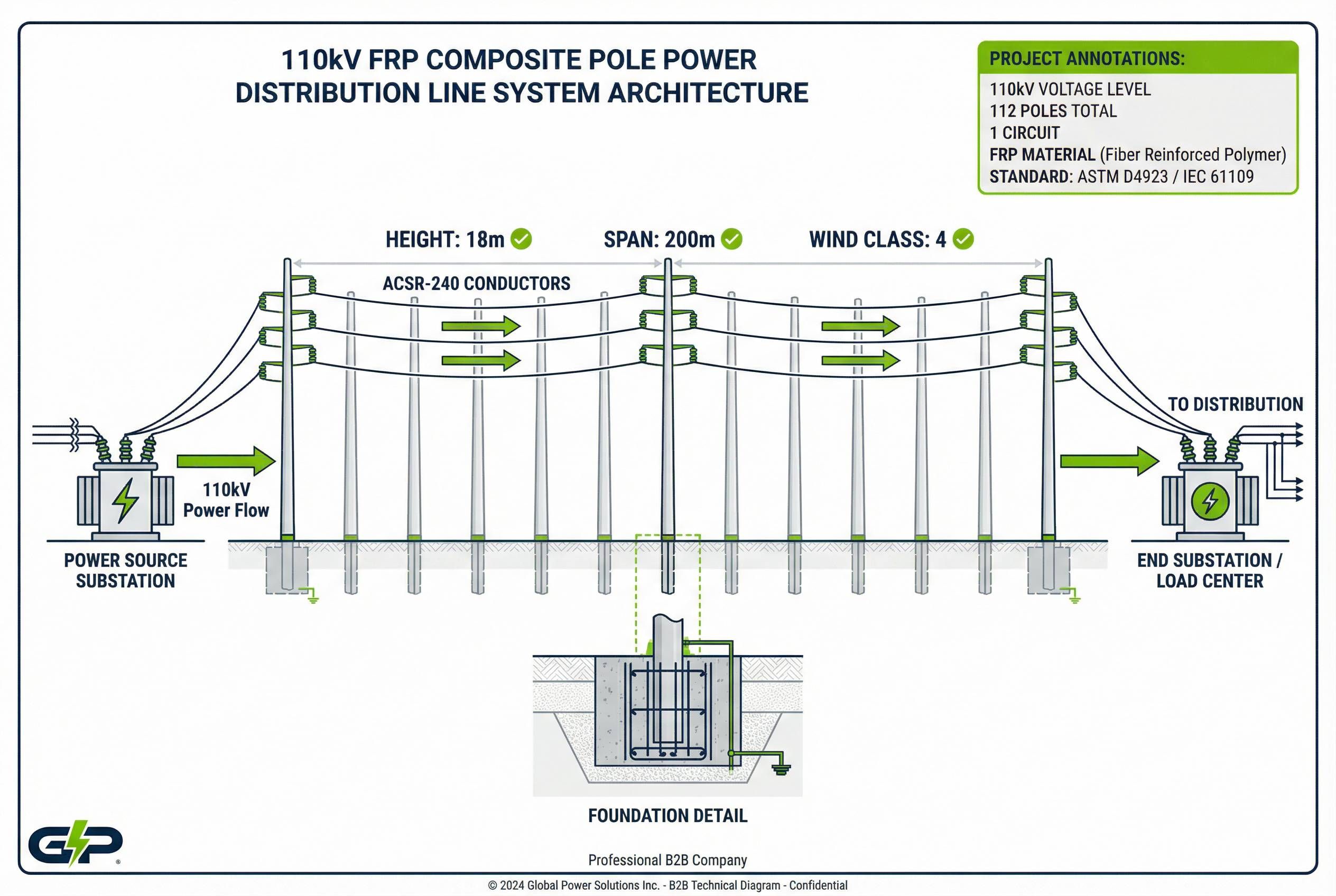
System architecture diagram generated from customer configuration
The architecture diagram illustrates:
- Single-circuit 110kV line with ACSR-240 conductors
- Regular 200m spans between 18m FRP composite poles
- Standardized foundation and accessories kit per structure
- Clear separation of mechanical, electrical, and civil scopes for EPC planning
SOLAR TODO uses this configuration as a repeatable template, allowing utilities to scale from pilot sections to full corridors with minimal redesign.
Cost Structure and Three-Tier Pricing
A critical aspect for B2B decision-makers is transparent, verified pricing. This case study uses real engineering proposal data with three-tier pricing for the complete 112-pole project.
Three-Tier Pricing Model
| Pricing Level | Scope Description | Total Price (USD) |
|---|---|---|
| FOB Price | Ex-Works equipment supply | $151,551 |
| CIF Price | Port delivery (CIF) | $186,525 |
| Turnkey Price | Installed, complete system | $233,156 |
These values are fixed from the verified proposal and must not be recalculated. They provide a clear framework for procurement strategy:
- FOB $151,551: For buyers with strong logistics and local EPC capacity
- CIF $186,525: For international buyers needing port-to-port risk coverage
- Turnkey $233,156: For utilities/EPCs prioritizing single-point responsibility
According to IEA (2023), EPC and balance-of-system costs can represent 40–60% of total grid project budgets. Having explicit differentiation between equipment-only and turnkey pricing helps utilities benchmark against regional EPC rates.
Detailed Equipment List (BOM)
The complete equipment list for the 112-structure project is:
| Item | Qty | Unit Price (USD) | Total (USD) |
|---|---|---|---|
| FRP Composite Pole — 18m | 112 | 281 | 31,472 |
| Pole Accessories Kit | 112 | 626 | 70,112 |
| ACSR-240 Conductor | 112 | 720 | 80,640 |
| Foundation Works | 112 | 600 | 67,200 |
| Installation & Erection | 112 | 106 | 11,872 |
This BOM shows how cost is distributed across:
- Primary structures (FRP poles)
- Mechanical and electrical accessories
- Civil foundations
- Installation and erection services
While the three-tier pricing is provided as total project values, this BOM helps buyers understand the relative weight of each cost component and where local optimization (e.g., civil works) may be possible.
FRP vs. Steel: Comparative View
To support selection decisions, the table below compares typical characteristics of FRP composite poles (as in this project) versus conventional steel lattice towers in similar voltage classes. Values are indicative and qualitative, not project-specific.
| Parameter | FRP Composite Pole (18m, 110kV) | Steel Lattice Tower (110kV typical) |
|---|---|---|
| Material weight | ~181 kg per pole | 800–1,500 kg per tower |
| Corrosion resistance | Excellent, no repainting | Requires galvanizing/repainting |
| Design life | 40 years | 30–40 years |
| Maintenance frequency | Very low | Moderate (corrosion, bolts) |
| Foundation size | Smaller | Larger |
| Installation time | Faster (fewer components) | Slower (many members/bolts) |
| Visual footprint | Slim profile | Larger, more visible |
According to IRENA (2020), material and maintenance innovations in grid infrastructure can reduce lifecycle costs by 10–20% versus legacy designs. FRP technology, as used by SOLAR TODO, directly targets these savings.
Applications, ROI, and Deployment Scenarios
Target Applications
This 110kV FRP composite pole configuration is best suited for:
- Sub-transmission lines connecting substations to regional load centers
- Long distribution feeders requiring 110kV for voltage stability
- Corridors in corrosive or coastal environments where steel degrades quickly
- Remote or mountainous regions where lightweight structures simplify logistics
- International projects where the exact country is TBD but design criteria are known
SOLAR TODO positions this configuration as a standard building block for utilities and EPCs working across multiple countries, particularly along Belt & Road and similar infrastructure programs.
ROI and Financial Performance
The verified ROI analysis for this configuration is:
- Payback period: 17 years
- Annual savings: $13,600
These savings are primarily driven by:
- Reduced maintenance (no repainting, lower corrosion-related repairs)
- Lower failure risk and associated outage costs
- Streamlined installation and foundation work due to low weight
According to IEA (2021), transmission and distribution losses and outages cost some economies 1–2% of GDP annually. By improving reliability and reducing unplanned maintenance, FRP-based lines can contribute to lower system-wide costs.
From a utility perspective, a 17-year payback on a 40-year design life means more than two decades of net savings after capital recovery. This aligns with typical regulatory asset depreciation periods for transmission assets.
Deployment and Construction Considerations
Key practical advantages during deployment include:
- 181 kg per pole enables lighter cranes or even manual-assisted installation in some terrains
- Standardized 18m height and 200m spans simplify line profiling and design
- Foundation works are predictable: 112 foundations at a unit cost of $600, totaling $67,200
- Installation & erection cost is clearly defined at $106 per structure, totaling $11,872
SOLAR TODO’s turnkey price of $233,156 is particularly attractive where local contractors lack composite experience or where utilities prefer a single accountable party for performance.
Selection Guide for B2B Decision-Makers
When to Choose This 110kV FRP Composite Configuration
Consider this configuration if:
- Your project requires 110kV voltage level with single-circuit ACSR-240 conductors
- Span lengths around 200m are compatible with your corridor and terrain
- Wind conditions align with Class 4 and 40 m/s design speed
- Corrosion, visual impact, or logistics are concerns with steel towers
- You need a standardized, export-ready design for international or multi-country use
FOB vs. CIF vs. Turnkey: How to Decide
Use the three-tier pricing table as a decision tool:
-
Choose FOB ($151,551) if you have:
- Strong in-house logistics
- Established relationships with local EPCs
- Experience with composite pole installation
-
Choose CIF ($186,525) if you need:
- Supplier-managed international shipping
- Clear landed cost at your port
- Risk transfer for maritime logistics
-
Choose Turnkey ($233,156) if you prioritize:
- Single-point responsibility from design to commissioning
- Guaranteed performance and warranty continuity
- Limited local technical resources or composite experience
The International Energy Agency states, “Grid modernization requires not only new capacity but smarter, more resilient infrastructure that optimizes lifecycle value.” This configuration is aligned with that principle, combining modern materials with transparent pricing.
Integration with Broader Grid Programs
For utilities planning multi-stage grid expansion, this 110kV FRP pole solution can be:
- A pilot section to validate FRP performance in local conditions
- A standard module replicated across multiple corridors
- Integrated with telecom or monitoring equipment where dual-use poles are considered (leveraging SOLAR TODO’s broader tower portfolio)
SOLAR TODO emphasizes portfolio-level planning, where power transmission towers, telecom towers, and even solar-powered remote sites can be engineered under a unified framework.
FAQ
Q: What does the $233,156 turnkey price include for this power transmission tower project? A: The $233,156 turnkey price covers the complete 112-structure 110kV FRP composite pole line, including FRP poles, pole accessories, ACSR-240 conductors, foundation works, and installation & erection. It is an installed, operational solution, ideal for buyers who want single-point responsibility from supply through commissioning.
Q: What is included in the $151,551 FOB price for the power transmission tower system? A: The $151,551 FOB price refers to Ex-Works supply of the engineered equipment package. It includes the FRP Composite Pole — 18m, Pole Accessories Kit, and ACSR-240 Conductor as specified, prepared for pickup at the manufacturing site. Logistics, insurance, and installation are handled by the buyer or their EPC.
Q: How does the $186,525 CIF price differ from FOB for international buyers? A: The $186,525 CIF price includes equipment supply plus shipping and insurance to the designated port. SOLAR TODO manages international logistics risk up to port delivery. This is suitable for buyers who want predictable landed cost but will manage inland transport, foundations, and erection with local contractors.
Q: What are the main technical advantages of using 18m FRP composite poles at 110kV? A: The 18m FRP poles deliver 350 MPa bending strength, a 36.3 kN·m bending moment, and only 8 mm deflection under design load, while weighing just 181 kg. They are corrosion-resistant with a 40-year design life, reducing maintenance and repainting compared to steel, and simplifying logistics and installation in remote or corrosive environments.
Q: How many structures are included in this configuration and what is the span length? A: The configuration includes 112 FRP composite pole structures designed for a 110kV single-circuit line. Each span is planned at 200 m, balancing tower count and conductor mechanical loading. This regular span length simplifies line design, profiling, and construction planning across international project sites.
Q: What standards does this FRP power transmission tower solution comply with? A: The system is designed to ASTM D4923 and IEC 61109 standards, with Class E (120°C) insulation. These standards address composite pole and insulator performance, ensuring mechanical strength, electrical insulation, and long-term reliability. Compliance supports utility acceptance and alignment with international engineering practices.
Q: What is the expected payback period and annual savings for this configuration? A: The verified ROI analysis shows a 17-year payback period with annual savings of $13,600. Savings are primarily from reduced maintenance, corrosion avoidance, and lower failure risk compared with conventional steel towers. With a 40-year design life, this leaves more than 20 years of net economic benefit after capital recovery.
Q: What components are covered in the equipment list for the 112-pole project? A: The equipment list includes five key items: 112 FRP Composite Pole — 18m units, 112 Pole Accessories Kits, 112 ACSR-240 Conductor units, 112 Foundation Works entries, and 112 Installation & Erection entries. Unit prices range from $106 to $720, with total line-item costs from $11,872 to $80,640.
Q: In what environments is this 110kV FRP composite pole solution most suitable? A: It is ideal for Class 4 wind environments with 40 m/s design wind speed, including many coastal, inland plateau, and moderate storm regions. FRP’s excellent corrosion resistance makes it especially suitable for coastal, industrial, or high-humidity areas where steel corrosion and repainting are persistent issues.
Q: How does the FRP solution impact installation and foundation requirements compared with steel towers? A: At only 181 kg per pole, FRP structures reduce lifting and transport demands, often allowing smaller cranes and simpler logistics. Foundations are correspondingly smaller, with foundation works costed at $600 per structure. Installation & erection is standardized at $106 per structure, reflecting faster, less complex site work than multi-member steel lattice towers.
Q: Can this configuration be adapted if the final project location or regulations change? A: Yes, the current configuration is based on 110kV, 18m height, 200m spans, and Class 4 wind. If the final location demands different wind speeds, seismic criteria, or regulatory standards, SOLAR TODO’s engineering team can adjust pole class, foundation design, or accessories while maintaining the core FRP technology and similar cost structure.
References
- IEC 61109 (2018): Insulators for overhead lines – Composite suspension and tension insulators for a.c. systems with a nominal voltage greater than 1,000 V – Definitions, test methods and acceptance criteria.
- ASTM D4923 (2019): Standard Specification for Reinforced Thermosetting Plastic Poles for Use in Overhead Utility Line Construction.
- IEA (2024): Electricity Market Report 2024 – Analysis and forecast to 2026, including global demand growth and grid investment trends.
- IRENA (2023): Global Power Grid Resilience Report – Strategies and technologies for improving reliability and reducing lifecycle costs.
- NREL (2023): Composite Materials in Power Infrastructure – Technical report on performance, durability, and maintenance benefits of FRP components.
- IEA (2021): World Energy Outlook 2021 – Analysis of transmission and distribution infrastructure needs and economic impacts of grid reliability.
About SOLARTODO
SOLARTODO is a global integrated solution provider specializing in solar power generation systems, energy-storage products, smart street-lighting and solar street-lighting, intelligent security & IoT linkage systems, power transmission towers, telecom communication towers, and smart-agriculture solutions for worldwide B2B customers.