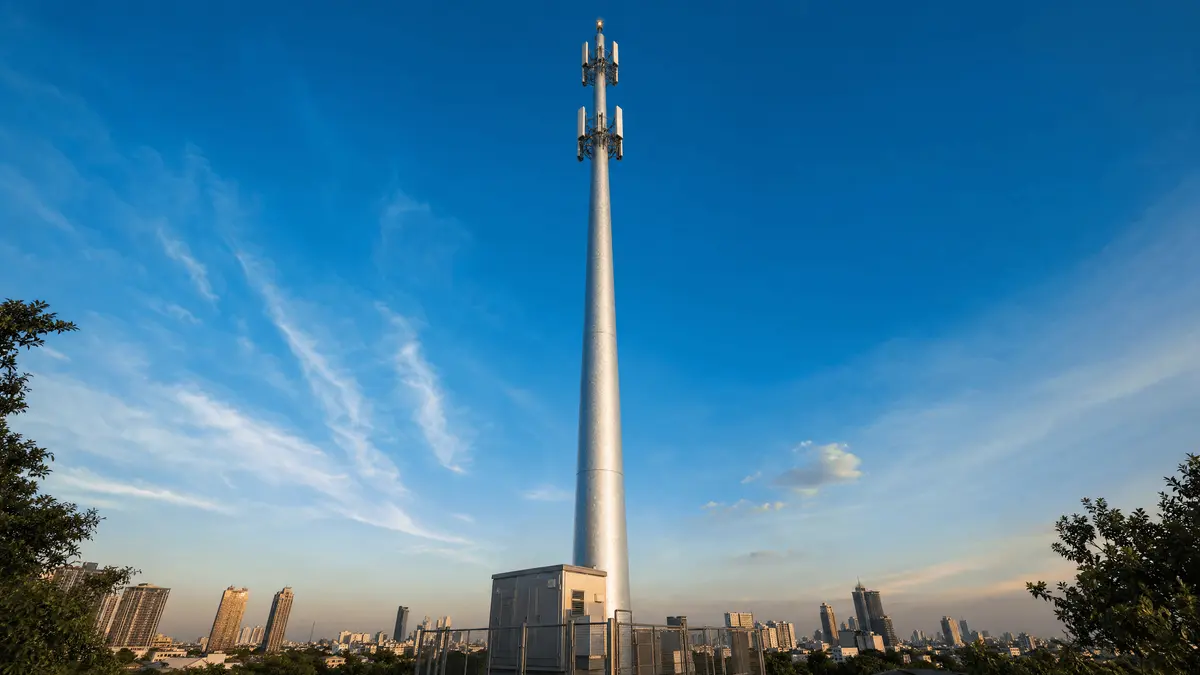
Bangkok Telecom Tower Market Analysis: 35m Steel Monopole Configuration Guide for Coastal Urban Macro Coverage
Summary
Bangkok’s dense urban form, coastal corrosion exposure, and high mobile data demand make 35m steel monopole Telecom Tower configurations a practical macro-site option. For a typical 29-unit network expansion, a 35m Q345 hot-dip galvanized monopole at about 18t per tower with 40 m/s wind rating fits urban-suburban coverage and backhaul needs.
Key Takeaways
- A typical Bangkok macro-cell rollout of this profile would use approximately 29 units of 35m tapered steel monopole Telecom Tower structures, each weighing about 18t based on the 500kg/m engineering rule.
- Bangkok’s coastal-air environment supports a high-corrosion specification, so hot-dip galvanized Q345 steel and a 30-year design life are recommended for lower lifecycle maintenance.
- The specified antenna load of 6× panel antennas, 1× 50kg microwave dish, and 3× 30kg RRUs aligns with a standard 4G/5G urban macro site rather than a rural single-tier site.
- Under TIA-222-H, the recommended wind class is Class 1 at 40 m/s with factor 1.0, which fits Bangkok’s non-typhoon but storm-exposed metropolitan conditions.
- A drilled concrete pier foundation is the preferred foundation type for 35m monopoles in constrained urban plots where pile work may be excessive and pad foundations may require larger footprints.
- CKD shipment can reduce transport volume by about 60-70%, which is useful for port-to-city logistics through Bangkok-area industrial and construction corridors.
- A practical delivery window for this 29-unit supply profile is typically 30-45 days for production, followed by phased foundation, erection, antenna mounting, and commissioning.
- SOLAR TODO positions this Telecom Tower class within the 25-35m suburban/residential size band, but Bangkok’s macro coverage profile supports the upper end at 35m with 3 platforms and urban loading verified to TIA-222-H and GB/T 50233.
Market Context for Bangkok
Bangkok combines a population of more than 5.4 million within the Bangkok Metropolitan Administration area and a far larger daily metropolitan catchment, creating sustained pressure on macro-cell density, rooftop alternatives, and transport-corridor coverage. According to the Bangkok Metropolitan Administration (2023), Bangkok covers about 1,568.7 km2, which means tower siting must work within dense land use, road setbacks, and mixed commercial-residential blocks. According to the National Statistical Office of Thailand (2023), Bangkok remains the country’s largest urban economy and communications hub, which supports continued demand for high-capacity 4G and 5G radio layers.
Bangkok’s climate also matters for tower specification. According to the Thai Meteorological Department (2023), Bangkok has high annual humidity, long wet-season exposure, and regular convective storm events, all of which increase corrosion risk and make galvanization quality more important than in dry inland sites. For a Telecom Tower near sea-influenced air masses at coordinates 13.76, 100.5, a high-corrosion classification is a practical recommendation even when the site is not directly on the shoreline.
Mobile demand is structurally strong. According to the NBTC Thailand (2023), Thailand continues nationwide 4G and 5G expansion across low-band and mid-band spectrum, with Bangkok as a priority service area for capacity and enterprise-grade connectivity. According to the ITU (2023), urban mobile broadband growth is driven by video traffic, fixed wireless access, and enterprise applications, which increases the need for macro sites that can carry 6-panel antenna arrays plus microwave backhaul.
Tower form factor is a local planning issue as much as a radio issue. Bangkok has many districts where a lattice tower footprint is difficult to permit or visually undesirable, especially near arterial roads, mixed-use corridors, and infill plots under 400 m2. A tapered steel monopole Telecom Tower in the 35m class reduces footprint, simplifies transport, and supports sectional erection with flanged connections. This is one reason SOLAR TODO would typically recommend monopoles over lattice structures for Bangkok urban and peri-urban macro infill.
Two authority statements help frame the design logic. ITU states, "Mobile broadband networks require continuous densification and modernization to meet traffic growth and quality expectations." TIA states, "Structural standards shall account for wind, ice, seismic and appurtenance loading in determining antenna supporting structure adequacy." Those two points directly support a Bangkok recommendation centered on verified structural loading rather than generic tower height selection.
Recommended Technical Configuration
For Bangkok’s dense urban and suburban macro-cell profile, a typical 29-unit deployment would use 35m steel monopole Telecom Tower structures with urban antenna loading, drilled pier foundations, and high-corrosion galvanizing protection. This configuration balances land-use constraints, 4G/5G sector loading, and microwave backhaul needs within the 25-35m telecom size class.
The correct size class from the engineering table is 25-35m, defined for suburban and residential applications with 2 platforms, 6-9 panels, and 15-22t per tower. Bangkok sits at the upper edge of that class because many sites need more than rooftop infill but less than a 40-45m highway tower. At 35m and approximately 18t, the specified pole remains fully consistent with the telecom engineering rule of about 500kg per meter of height.
A recommended Bangkok configuration for this profile is:
- Approximately 29 units of 35m tapered steel monopole Telecom Tower
- Hot-dip galvanized Q345 steel construction
- Wind Class 1, 40 m/s, factor 1.0 under TIA-222-H
- Antenna load: 6× panel antennas + 1× microwave dish at 50kg + 3× RRUs at 30kg each
- Concrete pier foundation using drilled-pier construction
- Flanged bolt-on sectional design for transport and erection
- High-corrosion zone treatment for humid, sea-influenced conditions
- Accessories: climbing ladder, cable tray, aircraft warning light, grounding system, lightning rod, 3 antenna platforms, and safety cage
- Design life: 30 years
- Pole class: regional macro / high-coverage tower
- CKD shipping with 60-70% volume reduction
- Production lead time: 30-45 days
Why 35m instead of 25m or 30m? In Bangkok, many macro sites must clear roadside trees, low-rise rooflines, sign structures, and uneven building heights while still keeping a moderate planning profile. A 35m monopole gives better Fresnel clearance for a single microwave dish than a 25m class structure and usually improves urban sector propagation over 800 MHz, 1800 MHz, 2100 MHz, and 3500 MHz layers. According to GSMA (2023), mid-band 5G performance depends strongly on site grid quality and antenna elevation in dense urban conditions.
Why a drilled pier foundation? Bangkok soils often include soft clay layers and variable groundwater conditions, especially in low-lying districts. According to the Department of Public Works and Town & Country Planning Thailand (2021), geotechnical verification is essential for deep foundation design in Bangkok’s soft-ground environment. For a 35m monopole at about 18t with urban appurtenance loading, a drilled concrete pier commonly offers a better footprint-to-capacity balance than a broad pad foundation.
SOLAR TODO would generally position this configuration for operators, tower companies, and EPC contractors seeking macro coverage expansion, capacity overlays, or microwave-supported edge sites. Buyers needing a product overview can review the Telecom Tower product page or contact us for site-specific loading checks.
Technical Specifications
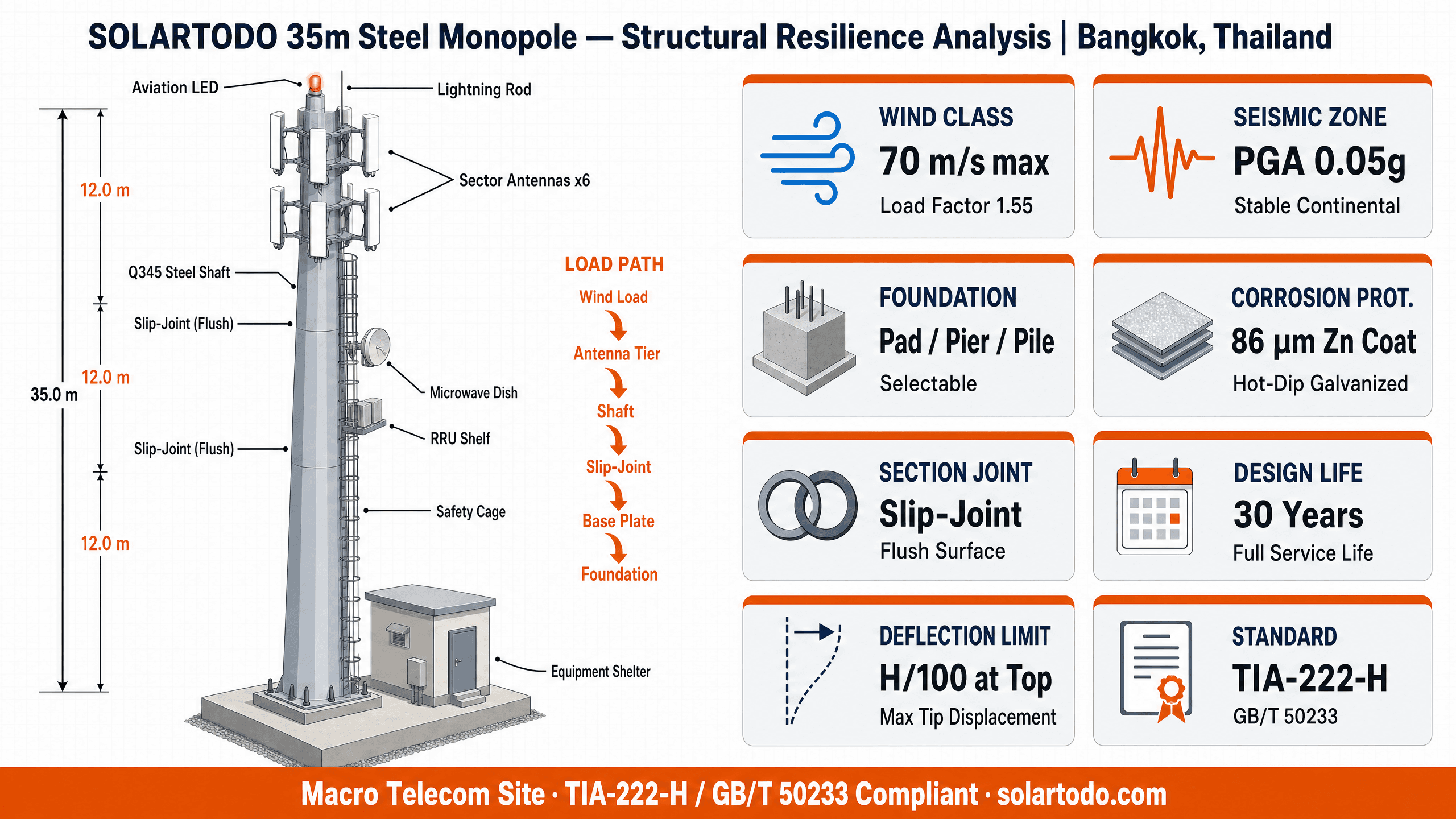
The Bangkok-recommended Telecom Tower specification is a 35m, approximately 18t, hot-dip galvanized Q345 steel monopole with 6 panel antennas, 1 microwave dish, 3 RRUs, and drilled pier foundation designed to TIA-222-H and GB/T 50233.
- Product type: Steel monopole Telecom Tower
- Tower form: Tapered steel tube, monopole only; not lattice, not FRP, not joint-use
- Height: 35m
- Size class match: 25-35m suburban/residential class
- Application profile: Urban-suburban macro coverage with microwave backhaul
- Steel grade: Q345
- Surface treatment: Hot-dip galvanizing for high-corrosion zone
- Tower weight: Approximately 18t per tower
- Weight rule check: 35m × 500kg/m = 17,500kg, rounded to about 18t
- Wind class: Class 1
- Basic wind speed: 40 m/s
- Wind factor: 1.0
- Antenna load: 6× panel antennas, 1× microwave dish at 50kg, 3× RRUs at 30kg each
- Platform arrangement: 3 antenna platforms
- Foundation type: Concrete pier foundation, drilled pier
- Section connection: Flanged bolt-on sectional design
- Accessories included: Climbing ladder, cable tray, aircraft warning light, grounding system, lightning rod, safety cage
- Design life: 30 years
- Pole class: Regional macro / high-coverage tower
- Shipping mode: CKD, with 60-70% transport volume reduction
- Production window: 30-45 days
- Structural standards: TIA-222-H, GB/T 50233
The 35m and 18t combination is technically coherent for telecom monopoles. It stays inside the 15-22t envelope of the 25-35m class while supporting a 6-panel macro configuration. By contrast, a 40m or 45m structure would shift the project into the 35-45m or 45-55m class with higher steel tonnage, larger foundations, and a different cost basis.
Implementation Approach
A 29-unit Bangkok Telecom Tower program would typically proceed in 4 phases over roughly 4-8 months, starting with geotechnical checks and ending with RF and grounding acceptance. The main execution variables are permitting, soft-soil foundation curing, and site access in dense districts.
1. Site validation and structural inputs
The first step is candidate-site screening. This usually includes topographic survey, borehole or soil data review, antenna loading confirmation, and local authority checks for aviation lighting and right-of-way constraints. For Bangkok, geotechnical review is critical because soft clay can change pier depth, rebar quantity, and uplift design. A 35m monopole should not move into fabrication until appurtenance loads and foundation reactions are locked.
2. Fabrication and CKD logistics
After design approval, production would typically take 30-45 days. The flanged sectional design supports CKD packing, which can reduce shipping volume by about 60-70% compared with fully assembled transport. For Bangkok buyers, this helps container utilization and inland delivery through port and metro logistics corridors. SOLAR TODO commonly uses this supply logic for projects where site access and crane windows are constrained.
3. Civil works and erection
Civil work generally starts with drilled pier excavation, cage placement, anchor setting, and concrete curing. Once the foundation reaches target strength, the monopole sections are lifted and bolted in sequence. A 35m tower with 3 platforms, ladder, cable tray, and safety cage usually requires a controlled crane plan and short-duration traffic management if installed near roads. Grounding and lightning protection should be completed before antenna integration.
4. Antenna installation and commissioning
The final stage includes mounting 6 panel antennas, 1 microwave dish, and 3 RRUs, followed by feeder or hybrid cable routing, grounding continuity checks, and tilt alignment. Commissioning normally covers plumb verification, bolt torque inspection, earthing resistance testing, and as-built documentation. According to TIA-222-H, appurtenance loads are part of the structural verification, so any field change in antenna count or dish size should trigger re-checking.
Expected Performance & ROI
A 35m Bangkok macro Telecom Tower can improve urban-suburban coverage radius, support 6-sector-equivalent antenna loading patterns, and reduce rooftop dependency, with ROI usually driven by tenancy, coverage obligations, and avoided lease complexity rather than tower steel alone. In many Southeast Asian urban markets, payback commonly depends on 1-2 anchor tenants and a 10-30 year asset life.
From a network perspective, a 35m monopole with 6 panels and 1 microwave dish is suitable for macro LTE and 5G overlays where rooftop rights are limited or fragmented. According to GSMA (2023), mobile operators continue shifting capital toward capacity densification and modernization in high-traffic urban areas. A ground-based monopole can reduce rooftop structural uncertainty and landlord renegotiation risk over a 30-year design life.
From an asset perspective, hot-dip galvanized steel is important in Bangkok’s humid and sea-influenced environment. According to NREL (2022), corrosion protection and preventive maintenance strongly affect lifecycle cost in outdoor infrastructure. A high-corrosion galvanized finish, periodic bolt inspection, and grounding maintenance can materially reduce unplanned repair events over 10-15 years.
For ROI, tower companies often model returns through co-location potential and reduced network churn. A 29-unit macro rollout could be justified where operators need coverage continuity along transport corridors, district edges, or suburban growth zones. According to the World Bank (2023), digital infrastructure investment supports urban productivity and service-sector growth, which is why macro tower assets in capital cities often remain financeable even when site-level payback varies.
A practical commercial expectation is that payback is usually faster when a site supports at least 2 revenue streams, such as primary mobile tenancy plus microwave backhaul or later co-location. Maintenance budgets should include annual visual inspection, bolt torque checks, galvanization touch-up where required, and grounding tests. SOLAR TODO generally recommends buyers compare 10-year lifecycle cost, not only initial supply scope.
Results and Impact
For Bangkok, a 29-unit 35m monopole tower program would typically improve macro-layer continuity, reduce dependence on difficult rooftop leases, and create a 30-year steel asset base suitable for 4G/5G expansion with microwave support. The main impact comes from better siting control, lower transport volume through CKD supply, and corrosion-aware specification for humid coastal exposure.
In planning terms, this tower class fits districts where operators need moderate height, limited footprint, and enough structural reserve for standard urban appurtenance loads. Compared with taller 40-45m highway-class structures, the 35m option limits steel tonnage and foundation scale while still supporting 6 panels, 3 RRUs, and 1 dish. For Bangkok’s mixed-density urban form, that is often the most balanced macro solution.
Comparison Table
A 35m monopole with 6 panels, 1 microwave dish, and 3 RRUs is the most balanced Bangkok option because it stays near 18t, fits the 25-35m class, and avoids the heavier foundation burden of 40-45m highway towers.
| Configuration option | Height | Typical application | Antenna load | Approx. tower weight | Foundation tendency | Bangkok fit |
|---|---|---|---|---|---|---|
| Urban infill monopole | 25m | Rooftop replacement / infill | 3-6 panels | 12.5t | Pad or small pier | Good for dense infill, limited backhaul clearance |
| Recommended macro monopole | 35m | Urban-suburban macro | 6 panels + 1×50kg dish + 3 RRUs | 18t | Drilled concrete pier | Best balance for Bangkok macro coverage |
| Taller peri-urban monopole | 40m | Highway / district edge | 6-9 panels + 1-2 dishes | 20t | Larger pier or pile | Useful where clutter is high but permitting is harder |
| Rural wide-coverage monopole | 45m | Rural / broad-area | 9-12 panels | 22.5t | Pier or pile | Usually excessive for central Bangkok plots |
Pricing & Quotation
SOLAR TODO offers three pricing tiers for this product line: FOB Supply (equipment ex-works China), CIF Delivered (including ocean freight and insurance), and EPC Turnkey (fully installed, commissioned, with 1-year warranty). Volume discounts are available for large-scale deployments. Configure your system online for an instant estimate, or request a custom quotation from our engineering team at [email protected].
Frequently Asked Questions
A Bangkok 35m Telecom Tower specification typically centers on 18t steel weight, 40 m/s wind class, drilled pier foundation, and 30-year design life, with most buyer questions focusing on loading, timeline, maintenance, and quotation scope.
Q1: Why is 35m the recommended height for Bangkok instead of 25m or 45m? A 35m monopole sits at the top of the 25-35m class and fits Bangkok’s mixed urban-suburban morphology. It clears more clutter than 25m, supports a 50kg microwave dish more comfortably, and avoids the larger foundation and permitting burden that often comes with 40-45m highway-class structures.
Q2: Is an 18t weight realistic for a 35m telecom monopole? Yes. Using the stated engineering rule of about 500kg per meter, a 35m monopole calculates to 17,500kg, or about 18t. That is consistent with a steel monopole carrying 6 panel antennas, 1 microwave dish, 3 RRUs, and accessory steel under TIA-222-H loading checks.
Q3: Why use Q345 steel instead of a lighter material? Q345 is a common structural steel grade for monopoles because it balances strength, fabrication availability, and cost control. In Bangkok’s humid environment, the more important factor is usually galvanization quality and coating thickness, not switching to non-standard lightweight materials that may complicate fabrication or maintenance.
Q4: What foundation is usually best for Bangkok soil conditions? For a 35m monopole in Bangkok, a drilled concrete pier is often the practical starting point because many sites face soft clay, groundwater, and limited plot area. Final foundation geometry still depends on geotechnical data, uplift loads, and local bearing conditions, so borehole review remains necessary before issue-for-construction drawings.
Q5: How long would a 29-unit supply program usually take? Production for this specification is typically 30-45 days after approved drawings. Full program duration is longer because foundation work, curing, logistics, crane scheduling, and antenna installation add time. In Bangkok, a phased 29-site program often lands in a 4-8 month window depending on permits and civil access.
Q6: What maintenance does this Telecom Tower require over 30 years? Routine maintenance is straightforward but should be scheduled. Typical tasks include annual visual checks, bolt torque verification, grounding resistance testing, galvanization inspection, ladder and safety-cage checks, and aircraft light testing. In high-corrosion zones, coating inspection intervals may need to be stricter after the first 5-7 years.
Q7: How does a monopole compare with a lattice tower in Bangkok? A monopole usually needs less ground area and presents a cleaner planning profile than a lattice tower, which helps in dense districts. The tradeoff is that monopoles can become less economical at taller heights or heavier appurtenance loads. For 35m urban macro use, monopoles are often the more practical choice.
Q8: What affects ROI or payback for a Bangkok tower project? Payback depends more on tenancy and lease strategy than on steel tonnage alone. A site with 1 anchor tenant and future co-location potential generally performs better than a single-use site. Microwave backhaul utility, avoided rooftop lease disputes, and 30-year asset life also influence the return model.
Q9: Does SOLAR TODO offer EPC or only equipment supply? SOLAR TODO offers multiple quotation structures, including FOB supply, CIF delivered, and EPC turnkey. The right scope depends on whether the buyer already has a local civil contractor, rigging team, and RF integrator. For Bangkok, many buyers request split quotations to compare supply-only and full-installation economics.
Q10: What warranty terms are typically available? The required pricing section specifies EPC turnkey with a 1-year warranty. For equipment supply packages, warranty scope usually covers fabrication quality, galvanization compliance, and missing-item claims subject to contract terms. Buyers should confirm exclusions for civil work, third-party antenna equipment, and local installation damage.
Q11: Can this tower be shipped efficiently into Thailand? Yes. The flanged sectional CKD format is specifically useful for international transport because it can reduce shipping volume by about 60-70%. That improves container loading and inland handling compared with oversized assembled sections, especially when final delivery must pass through urban roads with crane and unloading constraints.
Q12: What documents should buyers request before ordering? A serious procurement package should include structural calculations to TIA-222-H, GA drawings, foundation reactions, steel grade certificates, galvanization records, bolt specifications, packing list, and inspection plan. For Bangkok, buyers should also request corrosion assumptions, wind class confirmation, and accessory details for grounding and aviation lighting.
References
- Bangkok Metropolitan Administration (2023): Bangkok administrative area and urban planning statistics for approximately 1,568.7 km2.
- National Statistical Office of Thailand (2023): Bangkok demographic and economic significance within Thailand’s urban system.
- Thai Meteorological Department (2023): Bangkok climate data, including humidity, rainfall seasonality, and storm exposure relevant to corrosion and wind planning.
- NBTC Thailand (2023): National telecom and 4G/5G spectrum and network development framework for Thailand.
- ITU (2023): Mobile broadband traffic growth and network densification requirements in urban markets.
- TIA (2017): TIA-222-H structural standard for antenna supporting structures and antennas.
- Department of Public Works and Town & Country Planning Thailand (2021): Geotechnical and construction control guidance relevant to Bangkok soil and foundation design.
- GSMA (2023): Mobile network modernization and mid-band 5G deployment considerations in dense urban environments.
- NREL (2022): Corrosion, maintenance, and lifecycle cost considerations for outdoor infrastructure assets.
- World Bank (2023): Digital infrastructure investment and urban economic productivity links in developing metropolitan regions.
Equipment Deployed
- 35m tapered steel monopole Telecom Tower, approximately 18t per tower
- Hot-dip galvanized Q345 steel pole sections, flanged bolt-on design
- Wind Class 1 structural design, 40 m/s, factor 1.0, per TIA-222-H
- Antenna loading: 6× panel antennas
- 1× microwave dish, 50kg
- 3× RRUs, 30kg each
- Concrete pier foundation, drilled-pier type
- 3 antenna platforms
- Climbing ladder
- Cable tray
- Aircraft warning light
- Grounding system
- Lightning rod
- Safety cage
- CKD shipment format with 60-70% volume reduction