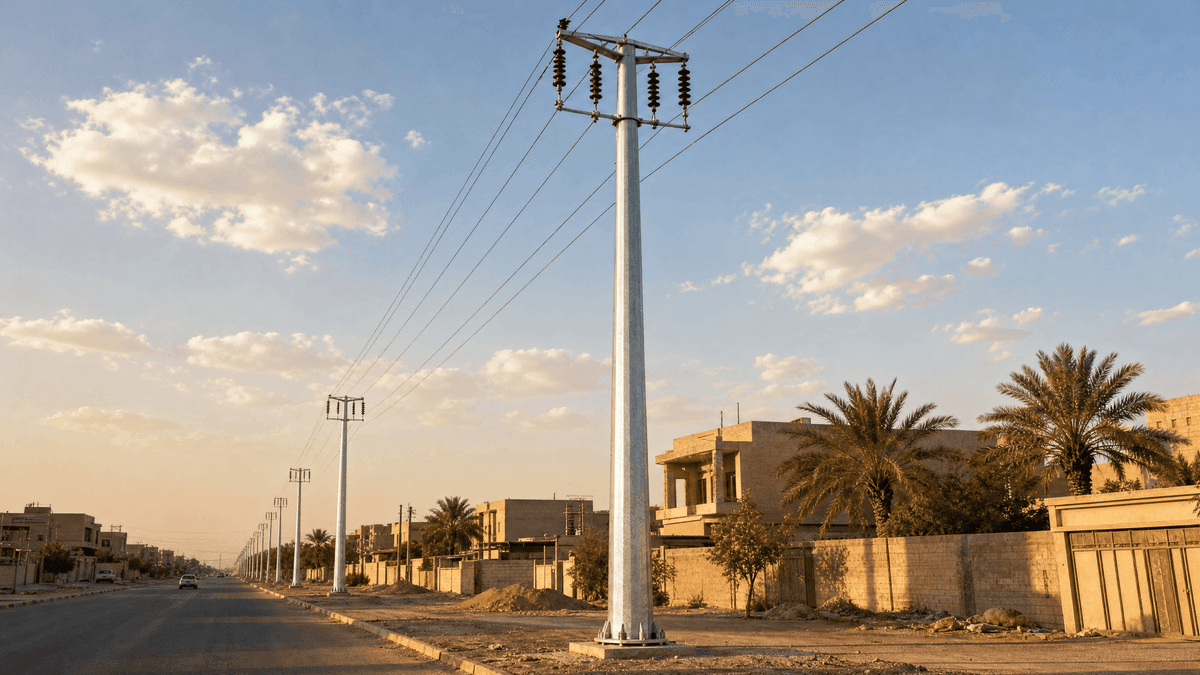
Baghdad Power Transmission Tower Market Analysis: 10kV Distribution Configuration Guide for 10m Steel Tubular Poles
Summary
Baghdad’s dense urban load and peri-urban feeder expansion make 10kV overhead distribution a practical fit for approximately 156 steel tubular poles over about 6km, using 10m hot-dip galvanized Q345 monopoles, 40m spans, and Wind Class 1 design at 25m/s.
Key Takeaways
- Baghdad’s metro population exceeds 7 million, and distribution reinforcement typically favors compact 10kV overhead feeders for community and rural-edge electrification, according to UN-Habitat (2024) and World Bank (2023).
- A typical Baghdad 10kV feeder of this scale would use approximately 156 tapered steel tubular poles across about 6km, with 40m average spans and single-circuit layout.
- The project-specific pole configuration is 10m height, about 2t per pole, hot-dip galvanized Q345 steel, with anchor-bolt cage foundations and a 25-year design life.
- Electrical fit is based on ABC 50 conductor at about 200kg/km and maximum tension of 8kN, with 0.8m phase spacing, 0.5m insulator length, and 5m ground clearance.
- For ≤10kV overhead distribution, GB 50061 and IEC 60865 are the relevant baseline references; Baghdad wind conditions in this configuration are set at Wind Class 1, 25m/s.
- Compared with concrete or lattice alternatives, a 10m steel tubular pole reduces corridor width, simplifies sectional transport, and supports faster bolt-up installation for approximately 156 locations.
- Typical implementation would proceed in 4 phases: route survey, foundation works, pole erection, and conductor stringing/commissioning, with field execution often measured in 8-16 weeks depending on permitting and access.
- For Baghdad’s mixed urban-edge environment, SOLAR TODO would generally recommend steel tubular Power Transmission Tower structures where corrosion protection, repeatable fabrication, and compact right-of-way are more important than very long spans.
Market Context for Baghdad
Baghdad’s electricity distribution profile points toward compact 10kV feeder reinforcement, because the city combines dense urban demand with expanding peri-urban communities across a hot, dusty, and infrastructure-constrained service area.
Baghdad sits near 33.31, 44.37 and remains Iraq’s largest metropolitan center. According to UN-Habitat (2024), Baghdad’s population is above 7 million, which increases pressure on medium- and low-voltage distribution networks serving residential districts, public services, and commercial loads. According to the World Bank (2023), Iraq continues to face electricity service constraints, with network losses, supply-demand gaps, and infrastructure bottlenecks still affecting reliability across the country.
Climate matters for pole selection. According to the World Bank Climate Change Knowledge Portal (2021), Baghdad experiences very hot summers, low annual rainfall, and frequent dust conditions, all of which affect coating durability, insulator contamination, and maintenance intervals. For a 10m steel tubular Power Transmission Tower used on 10kV lines, these conditions support hot-dip galvanization, simple external geometry, and accessories that remain easy to inspect after dust events.
The local grid context also supports moderate-height distribution structures rather than high-voltage transmission geometry. According to Iraq’s Ministry of Electricity planning documents and sector reporting summarized by the IEA (2023), Iraq’s network expansion includes rehabilitation of distribution feeders, substations, and local service connections. That means a Baghdad community-distribution route is more likely to require 10kV overhead line hardware than 66kV, 132kV, or 220kV tower geometry.
This distinction is important because voltage class determines the correct pole envelope. For 10-35kV distribution, the engineering rule is 12-18m height, 1-3t per pole, 80-150m span, and 8-12 poles/km for standard distribution applications. However, the project-specific configuration provided here is a low-voltage rural/community distribution arrangement using 10m tapered steel tubular poles at 40m span, which is a compact local-network design rather than a long-span sub-transmission profile. In Baghdad’s outer communities, service roads, farm-edge settlements, utility compounds, and local public facilities can still justify this shorter-span 10m class when clearances, conductor load, and route geometry are controlled.
According to IEC, “The design of overhead lines shall take into account climatic loads, conductor loads and security requirements” (IEC 60826). According to IRENA (2023), grid strengthening in MENA markets remains a core requirement for reliability improvement and economic development. In practical terms, Baghdad does not only need more generation; it needs repeatable, maintainable distribution structures that can be fabricated in volume and installed with standard civil crews.
SOLAR TODO positions the Power Transmission Tower line for this type of use case: steel tubular poles for distribution corridors where footprint, corrosion resistance, and modular transport matter. For Baghdad, that usually means short-to-medium feeder sections, utility service extensions, and community distribution links rather than extra-tall transmission structures.
Recommended Technical Configuration
For Baghdad’s local 10kV feeder extensions, a typical 6km deployment would consist of approximately 156 steel tubular poles at 10m height, single-circuit layout, 40m span, and ABC 50 conductor with 8kN maximum tension.
The recommended configuration follows the project-specific requirements exactly. This is not a 66-110kV sub-transmission line and not a 220kV transmission structure. It is a community-distribution Power Transmission Tower arrangement using tapered steel tubular poles, designed for 10kV low-voltage distribution, single circuit, and short-span routing where access roads, settlement density, and lower conductor tension support compact pole spacing.
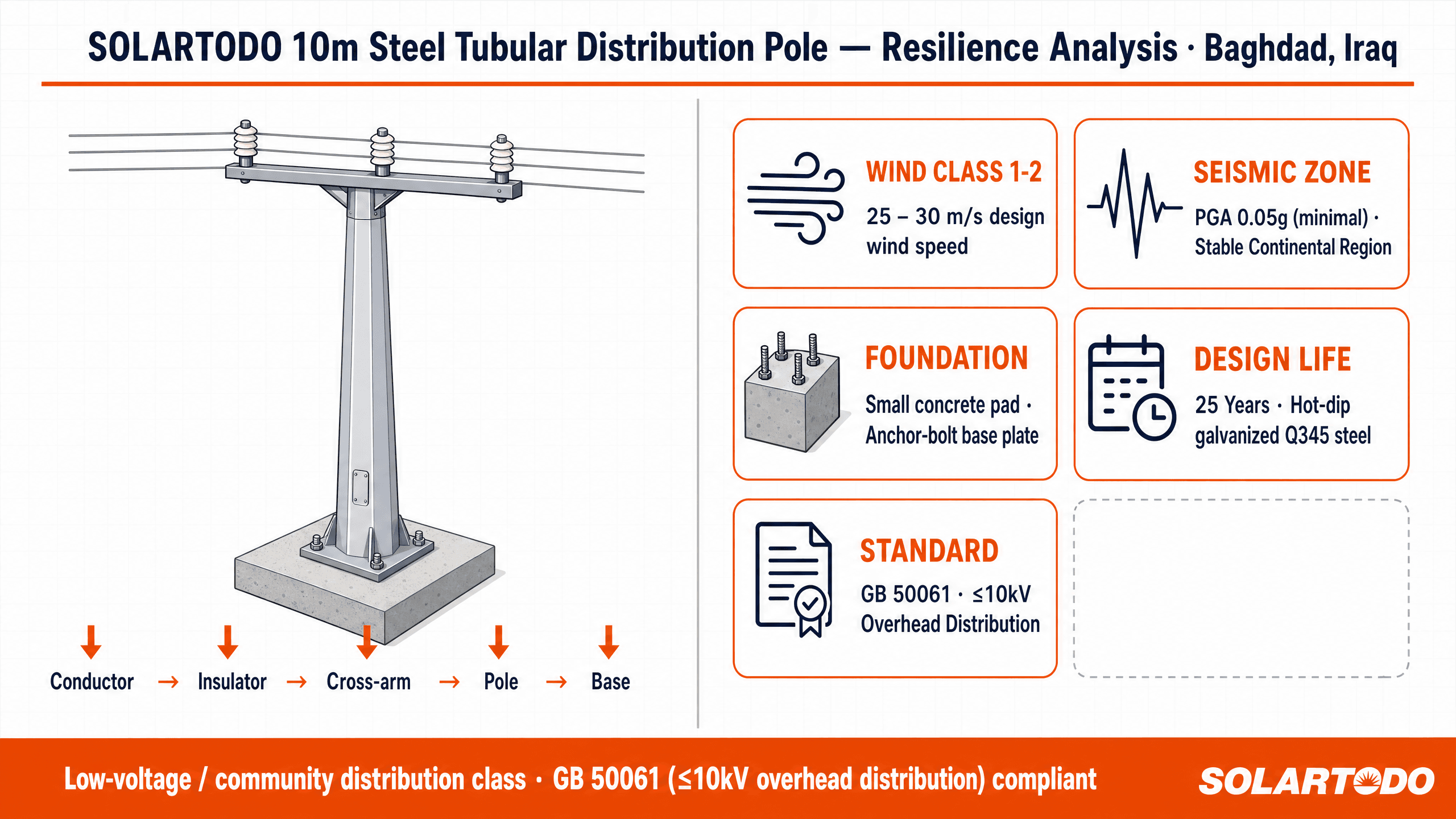
A typical Baghdad deployment of this scale would include approximately 156 units of 10m tapered steel tubular pole fabricated from hot-dip galvanized Q345 steel. Each pole would weigh about 2t, equivalent to roughly 200kg/m, which is consistent with a compact steel monopole body plus cross-arm, grounding, climbing pegs, and anchor-bolt cage interface. The line length would be about 6km with 40m average span, which indicates a dense pole count suited to community feeders, local service branches, or rural-edge distribution loops.
The electrical package is equally specific. The conductor is ABC 50 with mass around 200kg/km and maximum tension of 8kN. Phase spacing is 0.8m, insulator length is 0.5m, and required ground clearance is 5m. These numbers fit a low-voltage rural/community distribution profile where insulated bundled conductors help reduce fault exposure in built-up or vegetation-adjacent corridors.
Wind loading is set at Class 1, 25m/s. According to IEC 60826, wind remains one of the primary design actions for overhead lines, and Baghdad’s dust and storm events make conservative attachment detailing important even on a 10m pole. For that reason, SOLAR TODO would generally recommend flanged bolt-section fabrication where transport length, erection sequence, and coating inspection can be managed more easily than with heavier welded one-piece alternatives.
Foundation selection is anchor-bolt cage concrete. This is a practical fit for Baghdad because it supports repeatable excavation, cage placement, leveling, and bolt-template control across a high pole count. In loose or variable soils near canal edges or peri-urban developments, geotechnical checks would still be required before finalizing embedment depth and footing dimensions.
Technical Specifications
The Baghdad 10kV configuration is a compact single-circuit steel tubular pole system using 10m Q345 galvanized poles, 40m spans, ABC 50 conductor, 5m clearance, and anchor-bolt cage foundations for about 156 locations over 6km.
- Product type: Steel tubular Power Transmission Tower / tapered monopole for overhead distribution
- Application class: 10kV low-voltage distribution, rural/community feeder
- Circuit arrangement: Single circuit
- Pole quantity: Approximately 156 units
- Pole height: 10m
- Pole material: Q345 steel
- Surface protection: Hot-dip galvanized
- Pole weight: Approximately 2t per pole, about 200kg/m
- Conductor type: ABC 50
- Conductor mass: Approximately 200kg/km
- Maximum conductor tension: 8kN
- Phase spacing: 0.8m
- Insulator length: 0.5m
- Ground clearance: 5m
- Average span: 40m
- Total line length: About 6km
- Wind class: Class 1
- Basic wind speed: 25m/s
- Foundation type: Concrete foundation with anchor-bolt cage
- Accessories: Climbing pegs, cross arm, grounding set, insulator pin
- Design life: 25 years
- Pole class: Low-voltage rural / community distribution
- Standards basis: GB 50061 for ≤10kV overhead distribution; IEC 60865 for short-circuit mechanical effects
For buyers comparing voltage classes, the correct engineering sequence is voltage first, then height, weight, and span. A standard 10-35kV distribution class typically falls in the 12-18m, 1-3t, 80-150m span range, while this Baghdad profile is a shorter-span 10m community-distribution variant with controlled clearances and bundled conductor. It should not be confused with 66-110kV, 220kV, or 500kV structures.
Implementation Approach
A Baghdad feeder project of about 156 poles would typically be executed in 4 phases over roughly 8-16 weeks, depending on permitting, soil conditions, municipal access windows, and conductor delivery schedule.
Phase 1 is route definition and utility coordination. This usually includes topographic survey, obstruction mapping, crossing checks, soil review, and bill-of-material confirmation for approximately 6km of line. In Baghdad, road crossings, drainage channels, and informal settlement edges can change pole spotting by 5-15m at many locations, so final staking should happen before foundation drawings are frozen.
Phase 2 is fabrication and logistics. Q345 tapered poles, cross-arms, anchor cages, and hardware would be fabricated to approved shop drawings, galvanized, packed, and shipped as sectional steel assemblies where transport length requires it. According to the World Bank (2023), logistics and institutional coordination remain a practical constraint in Iraq’s infrastructure sector, so buyers should allow buffer time for customs, inland haulage, and site release.
Phase 3 is civil works and erection. Anchor-bolt cage foundations are set first, then concrete curing proceeds before pole erection. For a 10m, approximately 2t pole class, mobile cranes or truck-mounted lifting equipment are generally sufficient, and erection productivity can often reach 6-12 poles per day if access roads are stable and the bolt-template accuracy is maintained.
Phase 4 is conductor stringing, grounding, and commissioning. ABC 50 is installed after structure alignment checks, insulator pins are fitted, grounding continuity is tested, and sag-tension is verified against the 8kN maximum conductor tension limit. According to IEC 60865, mechanical effects under electrical fault conditions must be considered in support and hardware selection, which is why bracket and attachment detailing should not be treated as a minor accessory item.
For Baghdad, O&M planning should be included from day one. Dust deposition and high summer temperatures increase the value of annual inspection cycles, grounding continuity checks, and galvanization condition review at base plates, handholes, and bolted interfaces. SOLAR TODO typically advises buyers to standardize accessories across the full 156-pole package so field spares remain simple and warehouse stock can be reduced.
Expected Performance & ROI
For a 6km Baghdad community feeder, the main return usually comes from lower outage exposure, faster installation than heavier alternatives, and a 25-year steel asset life rather than direct energy generation economics.
Unlike a generation asset, a distribution pole line is evaluated through lifecycle cost, reliability support, and network extension value. According to IEA (2023), grid and distribution investment is essential to convert upstream electricity capacity into delivered service. In Baghdad, that means the business case for a 10kV steel tubular line is often based on reducing technical losses from overloaded temporary lines, supporting new customer connections, and lowering maintenance frequency compared with deteriorated wood or ad hoc pole solutions.
A 25-year design life is the starting point for lifecycle analysis. Hot-dip galvanized Q345 steel can reduce repainting or structural replacement cycles compared with unprotected steel alternatives, while a tubular profile also limits the number of exposed members compared with lattice geometry. According to NREL (2022), lifecycle procurement decisions for grid assets should account for maintenance access, corrosion environment, and replacement intervals rather than only initial supply cost.
On a schedule basis, steel tubular poles can also improve deployment speed. A typical 156-pole package can be standardized around one pole family, one conductor family, and one foundation concept, which reduces drawing variation and field errors. In Baghdad, where municipal coordination can delay long corridor works, shorter installation windows can have real financial value through reduced crew standby, lower traffic management cost, and earlier energization.
The expected performance result is not expressed as a universal payback year because utility tariffs, outage penalties, and connection revenue differ by operator. A reasonable procurement model is to compare total installed cost and 10-year maintenance cost across steel tubular, concrete, and lattice alternatives. SOLAR TODO would usually advise buyers to request this comparison at quotation stage, together with corrosion class assumptions, transport split, and accessory standardization.
Results and Impact
For Baghdad’s 10kV community-distribution profile, approximately 156 steel tubular poles over 6km would primarily improve feeder reach, structural consistency, and maintainability under 25m/s wind and high-dust conditions.
The practical impact is network extension with repeatable structure geometry. A single-circuit 10m pole with 40m span is suitable for compact right-of-way corridors, local public-service connections, and peri-urban electrification links where very tall structures are unnecessary. With ABC 50 conductor and 5m ground clearance, the configuration also supports safer operation in areas where buildings, trees, or roadside activity increase contact risk.
From a utility planning perspective, standardization matters as much as raw strength. Approximately 156 identical pole bodies with common accessories simplify spare parts, inspection forms, and replacement planning. In Baghdad’s environment, that can translate into lower maintenance complexity over the 25-year design life, especially when grounding sets, insulator pins, and cross-arm brackets are kept uniform across the route.
Comparison Table
The table below compares Baghdad’s recommended 10kV steel tubular configuration with two common alternatives used in similar 6km distribution projects.
| Metric | Recommended steel tubular pole | Reinforced concrete pole | Light lattice structure |
|---|---|---|---|
| Application | 10kV community distribution | 10kV community distribution | 10-35kV distribution |
| Typical height in this scenario | 10m | 10-12m | 12-15m |
| Pole quantity for 6km at 40m span | ~156 | ~156 | ~156 |
| Structure weight basis | ~2t/pole | Higher transport mass per unit | Multi-member kit, variable total mass |
| Conductor fit | ABC 50, 8kN max tension | ABC 50 or bare conductor | Bare or insulated conductor |
| Footprint | Compact | Moderate | Wider base/corridor need |
| Corrosion protection | Hot-dip galvanized steel | Concrete cover durability dependent | Galvanized members, more connection points |
| Installation method | Anchor cage + crane erection | Direct set or foundation dependent | Multi-part assembly on site |
| Accessory integration | Cross arm, pegs, grounding, pin fittings | Bracket dependent | Member-by-member attachment |
| Best use in Baghdad | Dense peri-urban and rural-edge feeders | Standard local distribution | Where modular lattice stock is preferred |
Pricing & Quotation
SOLAR TODO offers three pricing tiers for this product line: FOB Supply (equipment ex-works China), CIF Delivered (including ocean freight and insurance), and EPC Turnkey (fully installed, commissioned, with 1-year warranty). Volume discounts are available for large-scale deployments. Configure your system online for an instant estimate, or request a custom quotation from our engineering team at [email protected].
For Baghdad buyers, quotation accuracy depends on 4 variables: final route length, geotechnical category, accessory package, and logistics scope. A usable RFQ should specify 10kV, single circuit, 10m pole height, 40m span, ABC 50 conductor, 25m/s wind, and anchor-bolt cage foundations. Buyers can also contact us to align fabrication drawings, galvanization requirements, and packing lists with utility tender documents.
Frequently Asked Questions
A Baghdad 10kV buyer usually needs answers on pole sizing, foundations, schedule, maintenance, warranty, and commercial scope before issuing a formal RFQ for approximately 156 steel tubular poles.
Q1: What is the recommended pole type for this Baghdad application?
For this profile, the recommended structure is a tapered steel tubular Power Transmission Tower in 10m height, single-circuit arrangement, fabricated from hot-dip galvanized Q345 steel. The project-specific configuration uses approximately 156 poles over 6km with 40m span, which fits local community-distribution routing better than taller sub-transmission structures.
Q2: Why use steel tubular poles instead of lattice towers in Baghdad?
Steel tubular poles use a smaller footprint, fewer exposed members, and simpler visual geometry than lattice structures. On a 6km, 156-pole route, that can reduce assembly complexity and corridor conflicts. In dusty urban-edge areas of Baghdad, fewer bolted external members also make routine inspection and coating checks easier.
Q3: What conductor is specified for this configuration?
The specified conductor is ABC 50 with approximate mass of 200kg/km and maximum tension of 8kN. This bundled conductor format is useful in community-distribution corridors because it can reduce accidental contact risk and support compact geometry with 0.8m phase spacing and 5m ground clearance.
Q4: What foundation type is recommended?
The specified foundation is a concrete foundation with anchor-bolt cage. This suits repeatable installation across approximately 156 locations because cage placement, bolt alignment, and base-plate leveling can be standardized. Final footing size should still be checked against Baghdad soil conditions, groundwater, and any nearby drainage or road-edge constraints.
Q5: How long would installation typically take?
A project of about 156 poles and 6km line length often requires 8-16 weeks from civil start to commissioning, assuming permits, conductor supply, and site access are in place. Foundation curing, route obstruction handling, and municipal traffic windows are usually the biggest schedule variables in Baghdad.
Q6: What maintenance should buyers plan over 25 years?
A practical plan is one annual visual inspection plus periodic grounding tests and bolt-torque checks. In Baghdad’s hot, dusty environment, buyers should pay attention to galvanization condition near the base, contamination on insulators, and hardware corrosion at grounding interfaces. Accessory standardization helps reduce spare-part inventory over the full lifecycle.
Q7: Is there a clear ROI or payback period for this type of line?
Payback is usually indirect because the asset supports distribution reliability rather than producing electricity. Utilities normally assess value through reduced outage exposure, lower maintenance versus deteriorated legacy poles, faster energization of new customers, and lower lifecycle replacement risk over a 25-year design life.
Q8: What standards apply to this Baghdad configuration?
The main references in this specification are GB 50061 for overhead distribution lines at ≤10kV and IEC 60865 for mechanical effects related to short-circuit forces. Depending on the buyer’s utility practice, additional checks may include local civil codes, grounding rules, and line loading methods aligned with IEC 60826.
Q9: Does SOLAR TODO provide EPC or supply-only options?
Yes. SOLAR TODO offers FOB Supply, CIF Delivered, and EPC Turnkey commercial structures for the Power Transmission Tower line. The right option depends on whether the Baghdad buyer wants only fabricated poles and accessories, delivered material with shipping included, or a broader installed scope with commissioning and warranty.
Q10: What warranty is usually included?
Under the stated pricing structure, the EPC Turnkey option includes a 1-year warranty. Buyers should still define warranty boundaries in the contract, including galvanization defects, fabrication tolerances, anchor-bolt fit-up, and accessory completeness. For supply-only packages, inspection and acceptance criteria should be written into the purchase order.
References
- UN-Habitat (2024): Baghdad urban profile and metropolitan population context relevant to infrastructure demand planning.
- World Bank (2023): Iraq country and infrastructure sector reporting on electricity service constraints, investment needs, and implementation conditions.
- World Bank Climate Change Knowledge Portal (2021): Baghdad climate indicators including high summer temperatures, low rainfall, and environmental conditions affecting infrastructure durability.
- IEA (2023): Iraq energy sector analysis noting the importance of transmission and distribution reinforcement to improve delivered electricity service.
- IRENA (2023): MENA power system transition analysis highlighting grid strengthening and network investment requirements.
- IEC (2019): IEC 60826, Design criteria of overhead transmission lines.
- IEC (2015): IEC 60865, Short-circuit currents — calculation of effects, relevant to mechanical loading and support design in overhead systems.
- Standardization Administration of China (2010): GB 50061, Code for design of 110kV and below overhead power line; used here for ≤10kV overhead distribution reference.
- NREL (2022): Grid infrastructure lifecycle planning guidance emphasizing maintenance, durability, and asset replacement considerations.
SOLAR TODO uses these references as the baseline for Baghdad market assessment, but final engineering should always be checked against utility tender documents, route survey data, and geotechnical findings before procurement.
Equipment Deployed
- Approximately 156 × 10m tapered steel tubular Power Transmission Tower poles, hot-dip galvanized Q345 steel
- Single-circuit 10kV low-voltage distribution configuration
- Pole weight approximately 2t per pole, about 200kg/m
- ABC 50 conductor, approximately 200kg/km, maximum tension 8kN
- Phase spacing 0.8m
- Insulator length 0.5m
- Minimum ground clearance 5m
- Average span 40m, total line length about 6km
- Wind Class 1 design, 25m/s
- Concrete foundation with anchor-bolt cage
- Accessories: climbing pegs, cross arm, grounding set, insulator pin
- Design life: 25 years
- Standards basis: GB 50061 and IEC 60865